TenderKosh for EPC teams
Turn tender reading into faster bidding decisions.
Discover relevant tenders, monitor corrigenda, compare opportunities, and move from document reading to structured action.
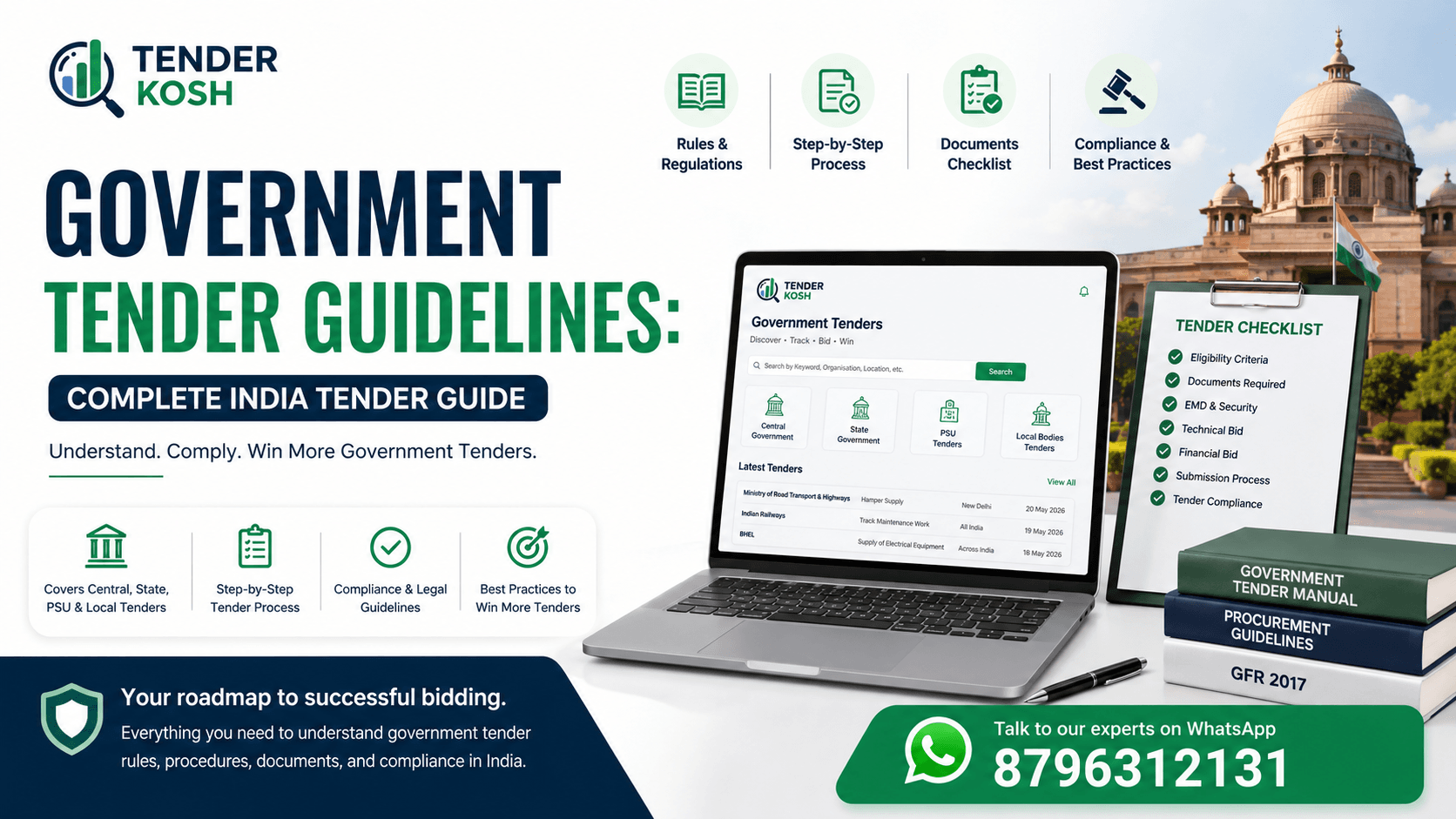
Government tenders in India offer massive business opportunities for contractors, manufacturers, suppliers, consultants, startups, MSMEs, EPC companies, and service providers. Every year, thousands of tenders are published by organizations like SECI, NTPC, Railways, CPWD, ONGC, IOCL, State DISCOMs, Municipal Corporations, and Central Government departments.
However, many businesses lose contracts not because of pricing, but because they fail to follow proper government tender guidelines. Missing documents, incorrect EMD submission, technical bid mistakes, eligibility mismatches, and misunderstanding corrigendums can instantly disqualify a bidder.
If you want to improve your tender participation success rate, this detailed guide explains everything about government tender rules, bid preparation, eligibility criteria, documentation, technical evaluation, financial bidding, and compliance requirements.
Looking for live government tenders daily?
Track SECI, GeM, Railway, CPWD, Solar, Biofuel, Electrical, Civil, and EPC tenders instantly on
TenderKosh.com.
Government tender guidelines are the official rules and procedures issued by government departments and public sector organizations for procurement of goods, services, works, and infrastructure projects.
These guidelines define:
Understanding these guidelines is critical for winning public procurement contracts in India.
Ignoring tender guidelines can lead to immediate rejection even before your financial bid is opened. Government departments strictly evaluate bids based on tender conditions.
Following proper guidelines helps businesses:
Businesses actively monitoring tender updates through TenderKosh often gain an advantage because they receive timely notifications about corrigendums, bid extensions, and eligibility modifications.
Government tenders are categorized based on project type, procurement process, and industry sector.
Any eligible bidder can participate in open tenders. These are the most common public procurement opportunities in India.
Only selected or invited vendors can participate in limited tenders.
Electronic tenders are submitted through online procurement portals like CPPP, GeM, state e-procurement portals, and departmental systems.
EPC tenders involve Engineering, Procurement, and Construction contracts for infrastructure and industrial projects.
The contractor handles the entire project from design to commissioning.
Tracking all these portals manually can be difficult. Platforms like TenderKosh help businesses discover relevant tenders across sectors from one dashboard.
The Notice Inviting Tender (NIT), Request for Proposal (RFP), and bid documents contain all official instructions. Never assume conditions based on previous tenders.
Focus on:
Most government tenders include mandatory eligibility requirements such as:
Submitting a bid without meeting eligibility conditions usually results in rejection during technical evaluation.
EMD (Earnest Money Deposit) is one of the most critical compliance areas in government tendering.
Bidders must verify:
Incorrect EMD submission can immediately disqualify the bid.
The technical bid is evaluated before the financial bid. If technical requirements are not satisfied, the price bid is never opened.
Common technical bid documents include:
Understanding Government Tender Guidelines is one of the most important parts of successful tender participation in India. Many companies lose contracts because they fail to follow mandatory tender instructions issued by government departments and procurement agencies.
Proper knowledge of Government Tender Guidelines helps businesses submit technically compliant bids, upload correct documentation, follow EMD rules, and avoid rejection during technical evaluation.
Whether you are bidding for solar EPC projects, railway tenders, civil contracts, electrical procurement, or GeM tenders, following updated Government Tender Guidelines improves bid quality and increases winning probability.
Modern e-procurement systems have made Government Tender Guidelines more structured and compliance-focused. Most departments now require online bid submission through portals like CPPP, GeM, SECI, and state e-tender portals.
Under current Government Tender Guidelines, bidders must use valid DSC certificates, submit properly signed PDF documents, comply with BOQ formats, and monitor corrigendums regularly before final submission.
Companies using platforms like TenderKosh can track tender updates and changing Government Tender Guidelines more efficiently across multiple sectors.
Government organizations frequently issue corrigendums modifying:
Missing a corrigendum can ruin bid preparation. Many companies use TenderKosh tender alerts to stay updated automatically.
Most e-tendering portals require bidders to use a valid Class 3 Digital Signature Certificate for online submission.
The DSC is used for:
During technical evaluation, departments verify whether the bidder satisfies all mandatory tender conditions.
Evaluation typically includes:
Only technically qualified bidders move to financial evaluation.
Government tenders use different evaluation methods.
The lowest eligible bidder wins the contract.
Quality and Cost Based Selection evaluates both technical quality and financial pricing.
Technical and financial bids are submitted separately.
Discover live tenders across Solar, Railways, Biofuel, Civil, Electrical, EPC, GeM, CPWD, and more.
Explore TenderKoshFind Live TendersTenderKosh helps businesses simplify government tender tracking by providing:
Instead of checking multiple procurement portals manually every day, businesses can monitor opportunities from a centralized platform.
Understanding government tender guidelines is essential for successful bidding in India’s public procurement ecosystem. Whether you are participating in solar tenders, railway tenders, EPC contracts, civil works, biofuel projects, or GeM procurement, compliance with tender conditions directly impacts your chances of winning.
Businesses that carefully review eligibility criteria, monitor corrigendums, prepare accurate technical documentation, and submit compliant bids consistently perform better in tender evaluations.
To stay ahead in competitive bidding, platforms like TenderKosh.com help businesses track live government tenders, corrigendums, and procurement opportunities across India efficiently.
There is no legal cap. Large SECI and NGEL tenders frequently receive 5 to 10 corrigendums during a bid window. Smaller state DISCOM tenders usually see 1 to 3.
Yes. Once published on the official portal, the corrigendum becomes part of the tender document. Bidders are expected to track and comply, regardless of whether they received an email alert.
You can raise objections during the pre-bid clarification window or through formal representation to the issuing agency. In rare cases, bidders approach the High Court or CERC if a corrigendum violates published bidding guidelines.
A corrigendum corrects or modifies existing tender terms. An addendum adds new information without changing what was already published. In practice, Indian agencies often use the terms interchangeably.
Sometimes. If the deadline is extended, the EMD validity must usually be extended too. Always re-read the EMD clause after every corrigendum and reissue the bank guarantee if needed.
The SECI tenders portal at seci.co.in/tenders is the primary source. CPPP and GeM mirror the same documents within a few hours. For RESCO and rooftop programs, GeM is often the fastest channel.
Register on the state e-procurement portal, the DISCOM website, and CPPP. Better still, use a tender aggregator like TenderKosh that monitors all three simultaneously and sends real-time alerts.
This article is general information, not advice. It has been compiled from publicly available sources — government releases and notifications, official portals, published tender documents and trade reporting — and reflects our understanding at the time of writing. It is not legal, financial, tax or professional advice, and it does not create any advisory relationship.
Public procurement changes constantly. Tender terms, eligibility criteria, thresholds, fees, deadlines, scheme conditions and government policy are revised frequently, often through corrigenda issued mid-window and sometimes without wide notice. Figures and rules that were accurate when published may already have changed by the time you read this.
Always verify against the primary source before you act or bid. The tender document, the issuing authority's official portal and the relevant government notification are the authoritative sources. Where anything in this article differs from them, the official source prevails. Do not rely on this page — or on any third-party summary — as the basis for a bid, an investment or a compliance decision.
TenderKosh is a private tender-intelligence platform. We are not a government body, and we are not affiliated with, endorsed by or acting on behalf of any government department, ministry, PSU or procurement portal. Names, marks and portals referenced belong to their respective owners and are used for identification only. External links are provided for convenience; we do not control and are not responsible for third-party content.
While we take reasonable care, we make no warranty as to the accuracy, completeness or currency of this content, and accept no liability for any loss or damage arising from reliance on it.Spotted something wrong or out of date? Please tell us at support@tenderkosh.com — we correct errors promptly.See our full Disclaimer.
Discover relevant tenders, monitor corrigenda, compare opportunities, and move from document reading to structured action.