TenderKosh for EPC teams
Turn tender reading into faster bidding decisions.
Discover relevant tenders, monitor corrigenda, compare opportunities, and move from document reading to structured action.
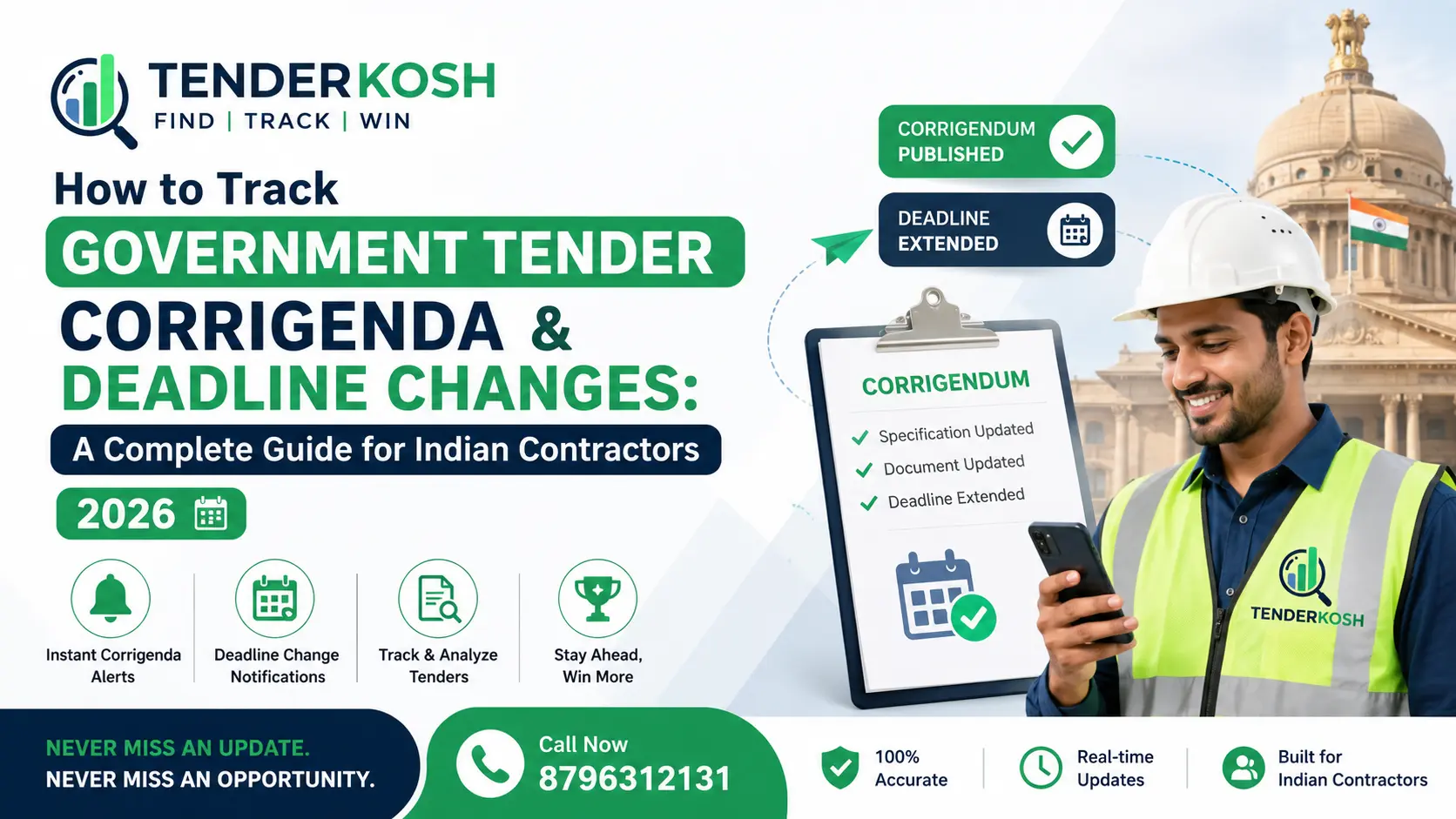
A Lucknow-based highway contractor spent 18 working days preparing a ₹14-crore bid for a Public Works Department package. On submission day, the portal rejected the file. Three days earlier, the department had issued Corrigendum-3 changing the financial bid format from the standard BOQ to a custom Excel template. The notification landed in a generic procurement inbox no one was actively monitoring. EMD locked. Contract lost. Eighteen days, gone.
Government tender corrigenda can completely change bid eligibility, BOQ formats, technical specifications, and submission deadlines — making tender corrigendum tracking essential for every Indian contractor participating in public procurement.
This story plays out hundreds of times every week across India’s procurement ecosystem. With thousands of tenders floated daily on CPPP, GeM, IREPS, and 1,000+ state and PSU portals, government tender corrigenda and deadline changes are the single biggest source of avoidable bid failures for MSMEs, EPC firms, and PSU vendors.
This guide is the operational playbook for fixing that. By the end, you’ll know exactly where corrigenda are published, why manual tracking fails, and how to build a system that surfaces every amendment, every deadline shift, and every BOQ change — before they cost you a contract.
A government tender corrigendum is an official amendment issued after a tender is published. Procuring authorities use corrigenda to announce tender deadline changes, BOQ revisions, technical specification updates, eligibility modifications, and bid submission clarifications.
For a deeper explanation, read our guide on What Is a Corrigendum in Tenders?.
Missing a government tender corrigendum can instantly disqualify an otherwise competitive bid. Effective tender corrigendum tracking protects contractors from compliance failures and costly administrative mistakes.
Many contractors also lose bids because they ignore common government tender mistakes during bid preparation.
The most common type of government tender amendment is a submission deadline extension. Procuring entities often revise dates after pre-bid meetings or low bidder participation.
BOQ revisions modify quantities, item descriptions, formats, or pricing schedules. Missing these tender amendment notifications usually leads to technical rejection.
Technical corrigenda alter material specifications, standards, scope of work, or approved makes and models.
Authorities may revise turnover requirements, experience conditions, MSME exemptions, or consortium rules through government tender corrigenda.
Pre-bid clarifications answer bidder queries and often reshape technical interpretation of the tender.
Tracking government tender corrigenda is difficult because India’s procurement ecosystem is fragmented across central, state, railway, PSU, and defence portals.
If you work in railway procurement, read our guide to railway tender types in India.
Power sector vendors should also review our NTPC tender process guide.
Effective government tender corrigenda tracking requires real-time monitoring of BOQ revisions, deadline extensions, bid format changes, and technical amendments across CPPP, GeM, IREPS, NTPC, and state procurement portals.
Strong bid teams combine automated corrigendum alerts, centralized bid tracking, and structured approval workflows to prevent submission errors.
Manual tender corrigendum tracking becomes unreliable once a contractor manages dozens of active bids across multiple procurement portals.
Contractors also struggle during the technical bid preparation process when corrigenda arrive late in the submission cycle.
Understanding the L1 vs L2 bidder evaluation process also helps contractors prepare more competitive bids after corrigendum updates.
TenderKosh helps contractors automate government tender corrigenda tracking across 1,000+ procurement portals in India.
A government tender corrigendum is an official amendment issued after publication of a tender notice. It may include deadline changes, BOQ revisions, technical updates, or eligibility modifications.
Platforms like TenderKosh provide automatic tender corrigendum alerts through email, WhatsApp, and dashboard notifications. These alerts help contractors track government tender amendments, BOQ revisions, and deadline changes in real time.
Missing a corrigendum can result in bid rejection, incorrect BOQ submission, EMD forfeiture, or technical disqualification.
Yes. Large infrastructure and EPC tenders frequently receive multiple deadline extensions through corrigenda.
Successfully tracking government tender corrigenda is now one of the most important operational disciplines for Indian contractors bidding on public procurement projects.
The contractors who consistently win bids are the ones who never miss BOQ revisions, technical amendments, or tender deadline changes.
TenderKosh helps contractors automate corrigendum monitoring, improve compliance, and reduce bid preparation risks across India’s procurement ecosystem.
This article is general information, not advice. It has been compiled from publicly available sources — government releases and notifications, official portals, published tender documents and trade reporting — and reflects our understanding at the time of writing. It is not legal, financial, tax or professional advice, and it does not create any advisory relationship.
Public procurement changes constantly. Tender terms, eligibility criteria, thresholds, fees, deadlines, scheme conditions and government policy are revised frequently, often through corrigenda issued mid-window and sometimes without wide notice. Figures and rules that were accurate when published may already have changed by the time you read this.
Always verify against the primary source before you act or bid. The tender document, the issuing authority's official portal and the relevant government notification are the authoritative sources. Where anything in this article differs from them, the official source prevails. Do not rely on this page — or on any third-party summary — as the basis for a bid, an investment or a compliance decision.
TenderKosh is a private tender-intelligence platform. We are not a government body, and we are not affiliated with, endorsed by or acting on behalf of any government department, ministry, PSU or procurement portal. Names, marks and portals referenced belong to their respective owners and are used for identification only. External links are provided for convenience; we do not control and are not responsible for third-party content.
While we take reasonable care, we make no warranty as to the accuracy, completeness or currency of this content, and accept no liability for any loss or damage arising from reliance on it.Spotted something wrong or out of date? Please tell us at support@tenderkosh.com — we correct errors promptly.See our full Disclaimer.
Discover relevant tenders, monitor corrigenda, compare opportunities, and move from document reading to structured action.