TenderKosh for EPC teams
Turn tender reading into faster bidding decisions.
Discover relevant tenders, monitor corrigenda, compare opportunities, and move from document reading to structured action.
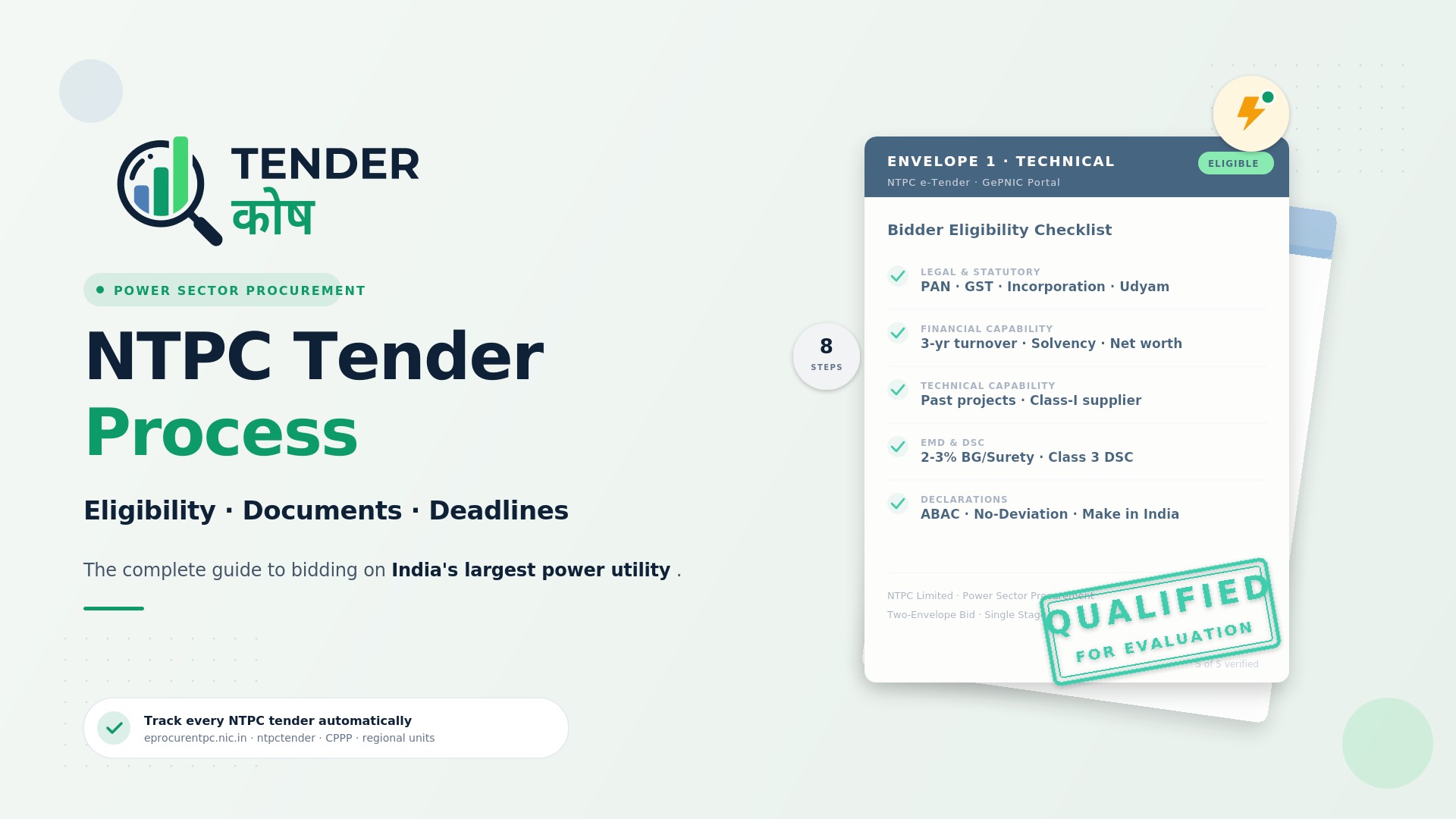
If you supply to India’s power sector, NTPC is unavoidable. With over 62,000 MW of installed capacity across coal, gas, hydro, solar, and wind plants, NTPC Limited is one of the country’s largest single buyers — issuing thousands of tenders every year worth tens of thousands of crores.
It’s also one of the most procedurally rigorous procurement environments in India. Get one document wrong, miss one signature, misunderstand one Class-I local supplier clause — and your bid is out before it’s even read.
This guide walks through the full NTPC tender process: where tenders are published, who’s eligible, what documents you need, how bidding actually works, and the common mistakes that disqualify perfectly capable bidders.
NTPC tenders live across two primary portals, and you need to know both:
| Portal | URL | What It’s For |
|---|---|---|
| NTPC e-Tender Portal | eprocurentpc.nic.in | Main e-procurement platform for active bid submission, hosted on GePNIC |
| NTPC Tender Information Site | ntpctender.ntpc.co.in | NIT and pre-qualification publishing, document downloads |
Many tenders also get republished on CPPP (eprocure.gov.in) for visibility. For BESS, biomass, and select renewables tenders, NTPC sometimes publishes on third-party platforms like BiofuelCircle.
Practical tip: Don’t rely on a single portal. NTPC’s regional units (Vindhyachal, Talcher, Kayamkulam, Korba, etc.) sometimes publish locally before the central portal updates.
NTPC issues tenders across a wide spectrum:
Each category has different eligibility logic, so understanding which bucket your business falls into is step one.
NTPC eligibility criteria vary tender by tender, but most bids check for some combination of:
If you can’t meet all the criteria for a specific tender, do not bid. NTPC’s evaluation is mechanical — partial qualification = disqualification.
Here’s the typical document checklist for an NTPC bid. Build this folder once, keep it updated, and you’ll save hours on every bid:
Company documents:
Financial documents:
Experience documents:
Tender-specific:
Pro tip: NTPC routinely rejects bids for document mismatches — different addresses on PAN vs GST, name variations, expired certificates. Cross-check every document for consistency before submission.
EMD is a near-universal requirement for NTPC tenders, with some variation:
EMD typically ranges from 2-3% of estimated tender value, capped per NTPC policy.
Critical: EMD validity must extend beyond bid validity (usually 45 days beyond). Submitting an EMD with the wrong validity period is a top-3 disqualification reason.
Before you can bid, register on the e-tender portal at eprocurentpc.nic.in:
DSC (Class 3) is mandatory — bids without a valid DSC at submission are not accepted. Vendor registration is a one-time step that enables you to bid across all NTPC tenders.
Search for relevant tenders on:
Tender documents on the NTPC portal are generally free to download. Read every section:
Most NTPC tenders have a clarifications window (often 10-15 days from publication). Submit queries through the “Seek Clarifications” tab on the portal. NTPC’s responses are published as corrigenda — and these corrigenda are binding.
Pre-bid meetings (physical or virtual) are common for large packages. Attend if eligible — clarifications issued there can change technical specs.
NTPC bids are typically single-stage two-envelope:
Common mistake: Including any pricing inside the techno-commercial bid (even on a stray supporting document) leads to immediate rejection.
Bids submitted without complete envelope structure or DSC are not accepted by the system.
The L1 bidder receives a Letter of Award (LoA). Within the timeline specified, the awardee must submit Performance Bank Guarantee (PBG) — typically 5-10% of contract value — to formalize the contract.
Failing to accept the LoA or submit PBG often triggers EMD forfeiture, debarment from re-tendering, and possible blacklisting.
After hundreds of NTPC bid post-mortems, the same patterns repeat:
Each of these is preventable with discipline — and a system that catches issues before submission.
If your business depends on NTPC contracts, you need three things:
Doing this manually means a dedicated employee checking 3-5 portals daily, reading every corrigendum, and updating an internal tracker that someone forgets about during peak weeks.
TenderKosh is built specifically for this:
You stop scrambling to keep up. You start bidding strategically.
No. NTPC has its own e-procurement system (GePNIC-based at eprocurentpc.nic.in). You’ll need a separate enrolment, even if you’re already registered on GeM or CPPP. DSC is mandatory.
In many goods tenders, yes — MSEs registered under Udyam can claim EMD exemption under PPP 2012. However, this exemption is not available for works contracts and not for traders/dealers. Always check the specific tender’s MSE clauses.
Under the Public Procurement (Preference to Make in India) Order 2017, a Class-I local supplier is one with local content of 50% or more. NTPC restricts certain tenders exclusively to Class-I suppliers. A Chartered Accountant or statutory auditor’s certificate is required to declare local content.
Techno-commercial evaluation typically takes 2-6 weeks depending on complexity. Price bid opening follows, and final award can take an additional 4-12 weeks. Total time from bid submission to LoA can range from 2 to 6 months.
EMD is usually around 2-3% of estimated tender value, sometimes capped at a maximum amount specified in the tender. Always refer to the specific tender’s EMD clause — not all are calculated the same way.
NTPC tenders are high-volume, high-value, and high-discipline. The bidders who win consistently aren’t the ones who scramble harder — they’re the ones with the systems to catch every NIT, every corrigendum, every document requirement, every deadline.
If you’re bidding on NTPC tenders, the cost of a missed alert is enormous. The cost of automating that alerting is trivial.
Bidding for a specific NTPC package and have questions? Drop them in the comments — we answer them all.
This article is general information, not advice. It has been compiled from publicly available sources — government releases and notifications, official portals, published tender documents and trade reporting — and reflects our understanding at the time of writing. It is not legal, financial, tax or professional advice, and it does not create any advisory relationship.
Public procurement changes constantly. Tender terms, eligibility criteria, thresholds, fees, deadlines, scheme conditions and government policy are revised frequently, often through corrigenda issued mid-window and sometimes without wide notice. Figures and rules that were accurate when published may already have changed by the time you read this.
Always verify against the primary source before you act or bid. The tender document, the issuing authority's official portal and the relevant government notification are the authoritative sources. Where anything in this article differs from them, the official source prevails. Do not rely on this page — or on any third-party summary — as the basis for a bid, an investment or a compliance decision.
TenderKosh is a private tender-intelligence platform. We are not a government body, and we are not affiliated with, endorsed by or acting on behalf of any government department, ministry, PSU or procurement portal. Names, marks and portals referenced belong to their respective owners and are used for identification only. External links are provided for convenience; we do not control and are not responsible for third-party content.
While we take reasonable care, we make no warranty as to the accuracy, completeness or currency of this content, and accept no liability for any loss or damage arising from reliance on it.Spotted something wrong or out of date? Please tell us at support@tenderkosh.com — we correct errors promptly.See our full Disclaimer.
Discover relevant tenders, monitor corrigenda, compare opportunities, and move from document reading to structured action.