TenderKosh for EPC teams
Turn tender reading into faster bidding decisions.
Discover relevant tenders, monitor corrigenda, compare opportunities, and move from document reading to structured action.
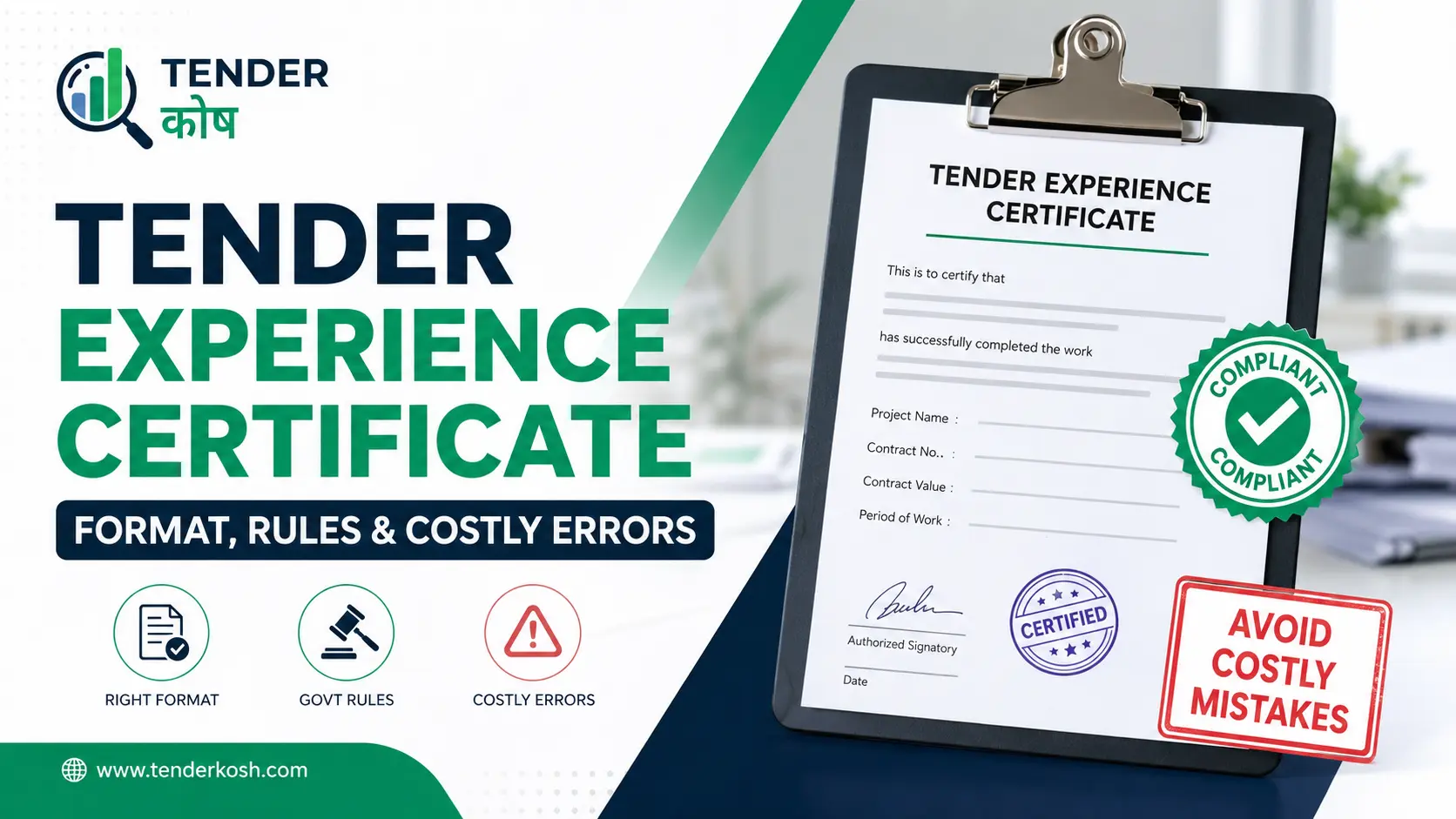
A tender experience certificate is your client’s written confirmation that you completed a specific work — naming the scope, the value, the dates, and that performance was satisfactory. It is the only thing that makes your track record exist on paper.
Evaluators do not accept verbal references or your own project records. A tender experience certificate is the only accepted proof. If the certificate omits the contract value or describes the scope in language that does not match the tender’s “similar work” definition, your bid can fail pre-qualification regardless of how capable you are.
There is a particular kind of loss that stings more than being outbid: being disqualified before anyone reads your price. You had the capability, you had done the work, and the bid was rejected because a piece of paper from a client three years ago did not say the right things in the right way.
The tender experience certificate is the document that decides this. It is treated as hard evidence of capacity by every tender authority in India, and it is routinely the weakest link in an otherwise strong bid — because contractors collect it casually at project closeout, when nobody is thinking about a tender they will bid on two years later.
This guide covers what the certificate must contain, how the “similar work” definition traps people, who is allowed to issue one, what happens when the work was for a private client, and the mistakes that get bids thrown out at technical evaluation.
Key Takeaways
A tender experience certificate is a client-issued document confirming that your firm completed a defined work satisfactorily. It is not the same as an employment experience letter, and it is not quite the same as a completion certificate either — though in Indian practice the terms overlap heavily and many departments use them interchangeably.
| Document | What It Proves | Used For |
|---|---|---|
| Experience / completion certificate | Your firm completed a specific work of stated scope and value, satisfactorily | Pre-qualification in tenders |
| Work order / LOA | The work was awarded to you and on what terms | Supporting document, usually required alongside |
| TDS certificate / Form 26AS | Payment was actually received, and how much | Corroborating value, especially for private clients |
| Performance certificate | Quality, timeliness and conduct during execution | Often a required section within the certificate itself |
| Employment experience letter | An individual worked somewhere | Personnel credentials, not firm credentials |
The distinction that costs people bids: a tender experience certificate proves what your firm did. An employment letter proves what a person did. If a tender asks for key-personnel experience, that is a separate requirement with separate documents — do not try to satisfy one with the other.
There is no single statutory format for a tender experience certificate, but there is a well-established set of fields that evaluators expect — and departments increasingly publish their own proforma you must follow exactly. Where a tender attaches a prescribed format, use it; a certificate in your own layout can be rejected even when the content is complete.
Two fields do most of the damage when missing. A certificate that omits the completed contract value or the nature of the work is practically useless for pre-qualification, because those are exactly the two things the evaluator is checking against the tender’s threshold and its similar-work definition. Get both onto the page even if the client’s draft leaves them out.
Note the last field. Several tender documents require the tender experience certificate to carry the issuing authority’s complete address and official email id — not a personal address — precisely so the evaluating department can write and verify. A certificate with a gmail address in the signatory block invites doubt.
This is where capable firms lose bids they should win, and it turns on how your tender experience certificate is worded. Every tender defines “similar work” in its own words, and the definitions range from extremely narrow to extremely broad.
One tender may define similar work as a specific system type — a named category of installation, on a named delivery model. Another may define it as broadly as “works of Civil Works”. A third may define it as “Operation & Maintenance works and round the clock security”, bundling two activities that most firms would consider unrelated. There is no consistency across departments, and the evaluator applies the tender’s own definition rather than the ordinary meaning of the phrase.
How to work with this rather than against it:
Most wasted bid effort goes into tenders the firm was never eligible for. Track live tenders across GeM, CPPP, IREPS, SECI, NTPC and state portals filtered by value, category and eligibility — with corrigendum alerts, so a mid-window change to the qualification criteria never catches you out.
The qualification threshold usually combines three variables: how many works, how large each one, and how far back they may go. A very common pattern in works tenders offers three alternative routes to qualify.
| Route | Typical Requirement | Who It Suits |
|---|---|---|
| Three works | Each costing not less than around 40% of the estimated cost | Firms with a steady run of mid-sized projects |
| Two works | Each at a higher percentage of the estimated cost | Firms with fewer, larger projects |
| One work | A single project at a substantially higher percentage | Firms with one large marquee project |
The lookback window is commonly seven years ending on the original last date of bid submission, though five years appears frequently and some tenders count a fixed set of financial years plus the current year to date. The exact percentages and window are set per tender — the pattern above is orientation, not a rule.
The indexation clause almost nobody uses. Many tenders allow the value of executed works to be brought to current costing level, commonly by enhancing it at a simple rate of around 7% per annum from the date of completion to the last date of receipt of tenders. Over five or six years that is a material uplift — enough to carry a project that looks below threshold on its face value over the line. If your best credential is a few percent short, check for this clause before you conclude you cannot bid.
Some tenders also allow the value of executed works to include the value of materials and services supplied free of cost by the client — cement, steel, scaffolding, batching plant and similar. Others explicitly exclude free-issue material from the completion cost. Both provisions exist; read which one applies.
Departments increasingly specify not just who issues a tender experience certificate but at what rank. One railway proforma, for instance, notes that the certificate must be issued by an officer of Junior Administrative Grade or above in a Government of India department, or Superintending Engineer or above in a state government, or the equivalent elsewhere. A certificate signed by a junior site officer can be set aside on that basis alone.
The direction of travel is toward tighter verification. NHAI issued a standard operating procedure in 2025 governing how experience certificates for similar completed works are to be submitted and verified — centralising issuance for its own projects and requiring the technical division receiving a bid to verify details with the concerned project director. The stated purpose was to reduce ambiguity and curb fraudulent claims.
What that means for you. Assume the certificate will be checked with the issuing office, not merely read. Keep the signatory’s designation and official contact details current in your records, and make sure the project reference numbers on the certificate match what the client’s own records will show when someone calls to verify.
This is the single most variable area, and assuming the wrong rule is expensive. Three distinct approaches appear across Indian tender documents.
Private-client certificates are accepted provided they are supported by TDS certificates or a Form 26AS certified by a chartered accountant, sometimes with a UDIN issued by ICAI. In several tenders the value of the work is taken as equal to the TDS-certified amount rather than the value stated on the certificate.
Implication: if TDS was under-deducted or the paperwork is incomplete, your creditable value shrinks accordingly.
Certificates from government, semi-government, autonomous bodies, municipal bodies and public limited companies listed on a recognised stock exchange are accepted directly, while those from unlisted private firms require the additional financial proof described above.
Implication: work for a listed company may qualify more easily than identical work for a private one. Know which category each of your clients falls into.
Some tenders state plainly that credentials for works executed for private organisations shall not be considered, restricting qualification to government and PSU work.
Implication: a firm with an excellent private-sector record can be ineligible on its first public tender. Building an initial public-sector credential is the only route through.
These tender experience certificate failures recur across departments and sectors. Almost all of them are fixable months in advance and impossible to fix in the week of submission.
That last point deserves weight. Tender declarations routinely state that if information is found to be wrong, incomplete, or if relevant information has been suppressed, the bid is liable to rejection at any stage — and any agreement subsequently entered into is liable to be terminated. The downside is not a lost bid; it is a lost bid plus a contract cancellation plus a debarment that follows you across departments.
The best time to obtain a tender experience certificate is at project closeout, while the officers who supervised your work are still in post. Two years later they have transferred, the file is archived, and a routine request becomes a campaign.
And if your credentials genuinely fall short of a tender you want, the legitimate route is partnering rather than paperwork. Our guide to joint venture bidding covers how consortiums pool experience to clear thresholds no member could meet alone — and the rules that govern it.
A tender experience certificate is a document issued by a client confirming that your firm successfully completed a specific work — naming the scope, the contract value, the start and completion dates, and confirming satisfactory performance. It is the evidence used at pre-qualification to prove you meet a tender’s similar-work requirement. Without it, your track record does not exist on paper, however many projects you have actually delivered.
At minimum: the issuing organisation’s letterhead, a reference number and date, your firm’s full legal name, the work order or LOA reference, a clear description of the scope, the completed contract value, actual start and completion dates, a statement that the work was completed satisfactorily, and the signature, name, designation and seal of an authorised officer with contact details. Many departments also require a performance assessment section. Omitting the contract value or the nature of work makes the certificate practically useless for pre-qualification.
It depends entirely on the tender. Some accept them only when supported by TDS certificates or Form 26AS certified by a chartered accountant, with the work value taken as equal to the TDS amount. Others accept certificates from government, semi-government, autonomous bodies, municipal bodies and listed public limited companies, but treat private-firm certificates as requiring extra proof. Some tenders exclude private-sector credentials entirely. Read the clause before relying on private work.
Similar work is defined inside each individual tender, and the definitions vary enormously — one tender may define it narrowly as a specific system type, another broadly as civil works. Evaluators apply the tender’s own definition, not the ordinary meaning of the words. If your certificate describes the scope in different terminology from the tender’s definition, it can be rejected even when the work was genuinely comparable.
A seven-year lookback ending on the original last date of bid submission is very common in works tenders, though some use five years and others count a set number of financial years plus the current year. A frequent qualification pattern is three similar works each costing at least 40% of the estimated cost, or two works each at a higher percentage, or one work at a substantially higher percentage — but the exact figures are set per tender and must be read from the document.
Many tenders allow it. A common provision brings the value of executed works to current costing level by enhancing it at a simple rate of around 7% per annum from the date of completion to the last date of bid receipt. This matters because an older project that looks below the threshold on its face value may qualify once indexed. Check whether your tender contains such a clause before concluding that you fall short.
Escalate politely in writing to a senior officer, attaching a completed draft on the department’s preferred format for signature. If the certificate still does not come, the work order, contract agreement, final bill and TDS certificates or Form 26AS together evidence the work — but you must check whether the specific tender you are bidding accepts that combination in place of a certificate, because many do not.
A tender experience certificate is not paperwork you collect after the fact; it is an asset you build during delivery. The scope wording, the value shown, the signatory’s rank and the supporting documents all determine how many future tenders that project will qualify you for — and every one of those is easy to influence at handover and impossible to change later.
Read the similar-work definition before the threshold, check for the indexation clause before you conclude you fall short, know whether your private-sector work counts in the tender at hand, and keep an indexed archive so assembling credentials takes an hour rather than a week. Get that right and you stop losing bids to a document instead of to a competitor.
Note: Qualification criteria, accepted issuing authorities, similar-work definitions, lookback periods, indexation provisions and treatment of private-sector credentials are set individually by each tender and vary widely between departments. The patterns described above are drawn from commonly used provisions in Indian tender documents and departmental circulars current at the time of writing; they are orientation, not universal rules. Always follow the conditions and any prescribed proforma in the specific tender document, and take professional advice where a certificate’s acceptability is in doubt.
This article is general information, not advice. It has been compiled from publicly available sources — government releases and notifications, official portals, published tender documents and trade reporting — and reflects our understanding at the time of writing. It is not legal, financial, tax or professional advice, and it does not create any advisory relationship.
Public procurement changes constantly. Tender terms, eligibility criteria, thresholds, fees, deadlines, scheme conditions and government policy are revised frequently, often through corrigenda issued mid-window and sometimes without wide notice. Figures and rules that were accurate when published may already have changed by the time you read this.
Always verify against the primary source before you act or bid. The tender document, the issuing authority's official portal and the relevant government notification are the authoritative sources. Where anything in this article differs from them, the official source prevails. Do not rely on this page — or on any third-party summary — as the basis for a bid, an investment or a compliance decision.
TenderKosh is a private tender-intelligence platform. We are not a government body, and we are not affiliated with, endorsed by or acting on behalf of any government department, ministry, PSU or procurement portal. Names, marks and portals referenced belong to their respective owners and are used for identification only. External links are provided for convenience; we do not control and are not responsible for third-party content.
While we take reasonable care, we make no warranty as to the accuracy, completeness or currency of this content, and accept no liability for any loss or damage arising from reliance on it.Spotted something wrong or out of date? Please tell us at support@tenderkosh.com — we correct errors promptly.See our full Disclaimer.
Discover relevant tenders, monitor corrigenda, compare opportunities, and move from document reading to structured action.