TenderKosh for EPC teams
Turn tender reading into faster bidding decisions.
Discover relevant tenders, monitor corrigenda, compare opportunities, and move from document reading to structured action.
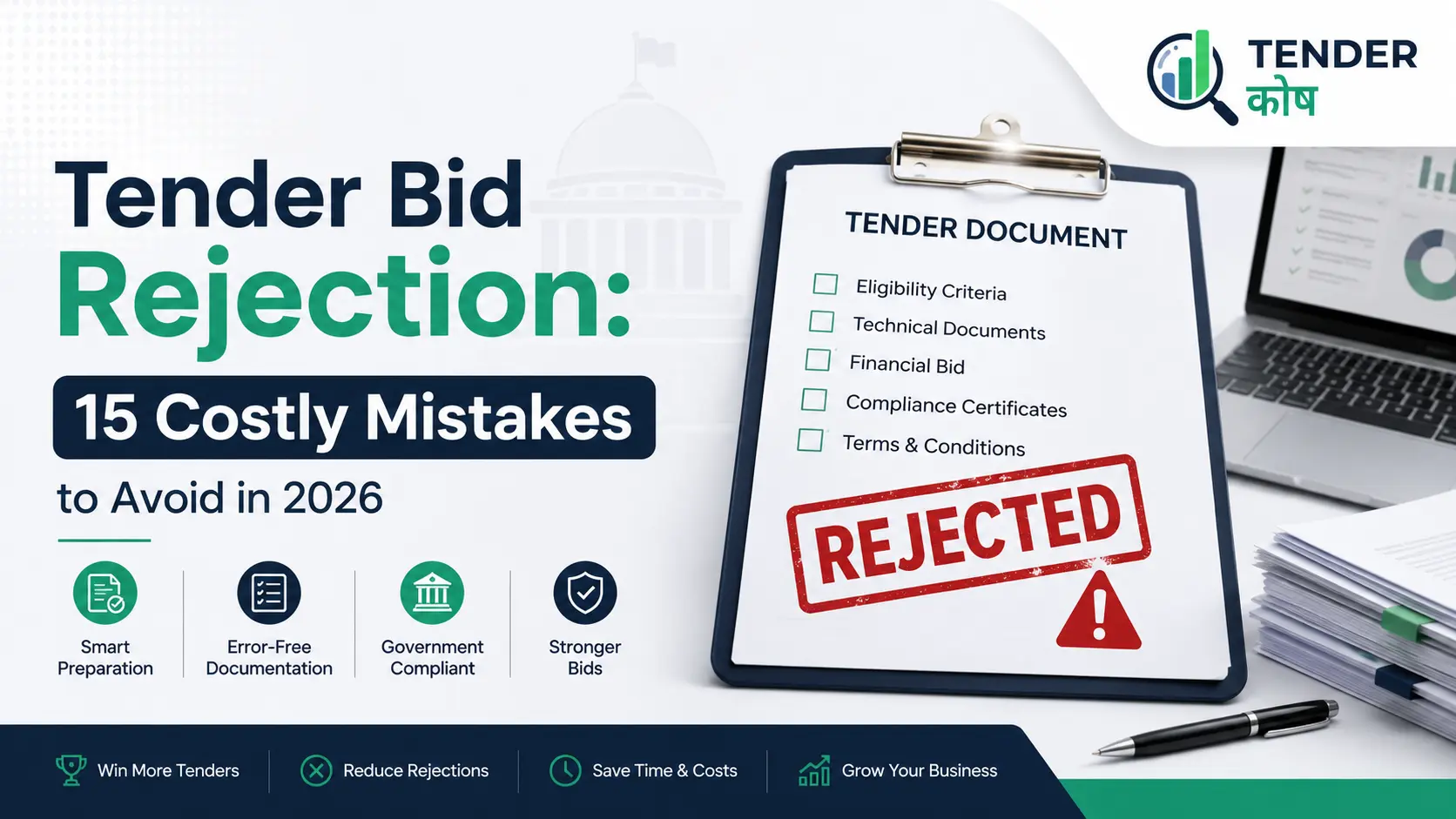
Most tender bid rejection happens before anyone looks at your price — and almost none of it is about capability.
The dominant cause is documentation: a missing annexure, an expired certificate, a name mismatch across registrations, an unsigned page. Most of the fifteen problems below can be significantly reduced with a disciplined bid-preparation process, and several are best addressed months before the tender is even published.
Tender bid rejection carries a specific frustration that has nothing to do with losing on price. You spend three weeks and real money assembling a bid, submit it, and find out your financial envelope was never opened. Somewhere in a two-hundred-page technical submission, one thing was wrong.
The uncomfortable part is that tender bid rejection is rarely a judgement on your firm. Evaluators work through a compliance checklist, and a bid that fails one line is declared non-responsive regardless of what the rest of it shows. That is a problem of process, which means it is fixable with process.
Below are the fifteen causes that account for the great majority of tender bid rejection, what each one actually looks like, and how to prevent it. At the end, something most guides skip: the circumstances in which a rejection may not be lawful, and what you are entitled to ask for when it happens.
Key Takeaways
Three terms get used interchangeably in tender correspondence, and they do not mean quite the same thing. Knowing which one applies to you tells you whether the problem was your eligibility or your paperwork.
| Term | What It Means | Where It Goes Wrong |
|---|---|---|
| Bid rejection | The broad, general term for a bid being rejected at any stage and for any reason | Anywhere in the process |
| Disqualification | The bidder fails an eligibility or qualification requirement — turnover, experience, registration, personnel | Who you are, or what you have done |
| Non-responsive bid | The submission does not comply with mandatory tender requirements — a missing document, an unsigned page, a conditional quote | How you submitted, not who you are |
The practical difference matters. A disqualification means you should not have bid at all, or need to build credentials before you do. A non-responsive finding means you were eligible and lost on process — which is the more painful outcome and the more fixable one.
Knowing the stage at which bids die tells you where to concentrate effort. Tender bid rejection is not a single event; it happens at four distinct points, and the earlier ones account for most of the damage.
| Stage | What Gets You Out | How Common? |
|---|---|---|
| Preliminary scrutiny | Missing documents, EMD defects, unsigned pages, late submission | Very common |
| Technical evaluation | Eligibility shortfalls, specification deviation, credential defects | Common |
| Financial evaluation | Conditional bids, BOQ errors, tax format errors, abnormally low pricing | Less common, more painful |
| Post-L1 verification | Original documents not matching uploads; misrepresentation discovered | Rare, most damaging |
The last row deserves attention. Being knocked out after emerging as L1 is worse than being knocked out on day one, because you have by then invested everything and may have declined other work. It is also the stage at which a discrepancy stops looking like carelessness and starts looking like misrepresentation.
This cluster causes more tender bid rejection than every other category combined. None of it requires expertise to fix — only method.
Tenders routinely list dozens of required documents across technical and financial bids, scattered through annexures. The ones that get missed are never the obvious ones — it is the solvency certificate in Annexure VII, the no-blacklisting affidavit, the integrity pact, the authorised signatory proof, the cancelled cheque.
Prevention: build a document checklist directly from the tender on day one, annexure by annexure, and tick against the uploaded file list rather than against memory.
Your business name or address reads slightly differently on PAN, GST, Udyam, bank records and the incorporation certificate. “Pvt Ltd” here, “Private Limited” there. Inconsistencies can trigger verification issues or raise questions during evaluation.
Prevention: fix the mismatch at source, not per bid. One afternoon reconciling registrations protects every future submission.
Expired ISO or BIS certificates, licences where applicable, or a digital signature certificate that is no longer valid can create compliance problems. An invalid DSC can also become a last-minute issue when you are trying to authenticate or submit the bid.
Prevention: maintain an expiry register for certificates and licences, with renewal reminders at least 90 days in advance. Also check your DSC validity before starting time-sensitive submissions.
Many tenders require every page to be signed and stamped by the authorised signatory. Where the tender imposes that requirement, missing a required signature can make the bid non-responsive — and in a 200-page set, one page is easy to miss.
Prevention: a two-person check — one signs, another counts pages against the index before scanning.
Tenders commonly require uploads to be readable, printable and legible, and specify file formats, sizes and naming conventions. Blurry scans, cropped pages, unsupported formats or files exceeding portal limits can make an upload unacceptable or prevent proper evaluation.
Prevention: open every file after upload and read it at 100% zoom. If you cannot read it comfortably, neither can the evaluator.
Wrong amount, wrong instrument, insufficient validity, or the original physical instrument arriving after the deadline. A particularly common variant: claiming an available MSME bid-security exemption without submitting the required Udyam documentation or declaration. Note that the availability of any exemption depends on the applicable procurement rules and the specific tender — it is not automatic.
Prevention: read the EMD clause twice and check the exemption paperwork requirement separately. Our EMD guide covers instruments and exemptions in detail.
Not just falling below the threshold, but computing it the wrong way. Some tenders count only turnover relevant to the tendered category rather than total revenue, and some require statutory auditor or CA certification in a prescribed format with a UDIN.
Prevention: read how turnover is defined before assuming you clear it — and get the certificate in the tender’s own format, not a generic one.
Tenders frequently require named personnel with specified qualifications and minimum years, or demonstrated access to particular equipment. CVs missing the required qualification detail, or an equipment list that does not evidence access, fail this test.
Prevention: map each named requirement to a specific person or asset and the document that proves it, before you start writing.
Certificates missing the contract value, scope wording that does not match the tender’s “similar work” definition, part-completion submitted as completed work, or private-client certificates without the required TDS or Form 26AS backing.
Prevention: covered fully in our guide to the tender experience certificate — format, similar-work traps and issuing authority.
One eligibility rule that catches experienced firms: participating both individually and as a consortium member in the same tender, or appearing in two consortiums that share a member. Tender conditions commonly reject all bids involving that firm — including the one you actually cared about. See our guide to joint venture bidding before committing your credentials to someone else’s bid.
Two of the fifteen causes below are pure information problems — a missed corrigendum and a deadline you saw too late. Track tenders across GeM, CPPP, IREPS, SECI, NTPC and state portals in one dashboard, filtered by category and value, with alerts the moment anything changes.
An amendment changed the specification, BOQ, eligibility or deadline, and you bid against the original document. Once an amendment or corrigendum is officially issued, bidders generally need to comply with the tender as amended — and the burden of checking sits with the bidder.
Prevention: check the tender page one final time immediately before upload, every time. See what a corrigendum is for how amendments work.
Offering a product or configuration that does not match the specification line for line, or substituting an alternative on the assumption that “equivalent” is acceptable. Unless the tender expressly permits equivalents, it usually is not.
Prevention: compare your datasheet against the specification item by item. Where you need a deviation, raise it as a pre-bid query, not as a surprise in your submission.
Blank line items, broken formulas in an Excel BOQ, a total that does not match the sum of items, quantities altered, or the price quoted in the wrong unit. Unbalanced pricing across line items also draws scrutiny.
Prevention: our guide on BOQ in tenders covers format, pricing method and the errors that recur.
Adding conditions the tender does not permit — “subject to price escalation”, “delivery subject to material availability” — makes a bid non-responsive. So does quoting inclusive of GST when exclusive was asked, or applying the wrong rate.
Prevention: quote exactly what was asked, in the format asked. If a condition is commercially essential, raise it pre-bid or decline the tender.
Uploading a priced BOQ into the technical section, or leaving rates visible in a supporting document. The two-envelope system exists precisely to keep price hidden until technical qualification is settled, and breaching it voids the bid.
Prevention: strip rates from every technical attachment and have a second person open each file before upload. See technical bid vs financial bid for how the split is evaluated.
E-procurement portals close automatically at the deadline. Once the submission deadline has passed, a late bid may not be accepted — and slow internet, peak-time congestion, a DSC that will not authenticate or a browser failure are unlikely to be treated as valid explanations. Do not rely on a last-minute upload attempt being accepted.
Prevention: submit at least 24 hours early. Treat the deadline as the day before the deadline, and save progress frequently.
Not every tender bid rejection is valid, and this is the part most bidders never learn. Courts have consistently held that a tendering authority must apply the terms it published — and only those terms.
Temper this with realism. Courts have repeatedly said they will not sit as an appellate authority over tender decisions absent clear arbitrariness, and commercial judgement by the procuring entity is generally respected. Litigation is slow, expensive, and can affect a working relationship with a department you will bid to again. Treat the legal route as a remedy for genuine arbitrariness, not for a rejection you privately suspect was fair.
If your bid is rejected and the reason is unclear, ask the tendering authority for the specific ground of disqualification. In JBMD Enterprises v. Sr. Dy. CGDA (Delhi High Court, 1 June 2024), the court directed the tendering authority and GeM to communicate the reasons for the bidder’s “Not Evaluated” status, holding that a clear and justified reason for disqualification is fundamental to transparency in the tender process — partly so deficiencies can be corrected in future tenders.
Almost every tender bid rejection above is defeated by three habits.
And one strategic habit that prevents more tender bid rejection than any checklist: screen honestly before you bid. A meaningful share of wasted bid effort goes into tenders the firm was never eligible for. A feasibility check against the eligibility clause on day one costs an hour and saves weeks.
Incomplete or improper documentation is consistently the single most common reason capable bidders are eliminated before financial opening. A tender may list dozens of mandatory documents across the technical and financial bids, and omitting one — even something minor like a solvency certificate buried in an annexure — is enough for the bid to be declared non-responsive.
There is no single official nationwide statistic for technical bid rejection across Indian government procurement. Industry and procurement sources commonly cite estimates in the 20% to 30% range, but the figure varies by portal, authority, tender type and eligibility criteria. Treat it as an indication of scale, not a measured rate.
Generally not. In Maha Mineral Mining & Benefication Pvt. Ltd. v. Madhya Pradesh Power Generating Co. Ltd. (9 September 2025), the Supreme Court held that a bidder could not be disqualified for non-submission of a joint venture agreement where the NIT clause did not expressly require it. Tender authorities should evaluate bidders against the conditions actually stated in the NIT rather than introducing an unstated mandatory requirement at evaluation stage. The decision turned on the specific clause in issue, so it is not a blanket rule.
Yes, and you should. In JBMD Enterprises v. Sr. Dy. CGDA (Delhi High Court, 1 June 2024), the court directed the tendering authority and GeM to communicate the reasons for a bidder’s “Not Evaluated” status, holding that a clear and justified reason for disqualification is fundamental to transparency. Ask the tendering authority in writing for the specific ground, referencing the tender number and your bid.
Yes, and it is one of the most avoidable causes. If an amendment changes specifications, BOQ line items, eligibility or the deadline and you prepare your bid against the original document, your submission no longer complies with the tender as it stands. The amendment is binding from publication, whether or not you received an alert.
Generally not. Some authorities seek clarification or allow deficiencies to be cured, but there is no right to it, and doing so selectively for one bidder and not another raises its own legal problems. Assume submission is final. The practical protection is a document checklist built from the tender on day one and a submission well before the deadline.
Tender bid rejection is overwhelmingly a process failure, not a capability failure — which is the good news, because process is the one thing entirely within your control. The firms that win consistently are rarely the most technically gifted; they are the ones with a checklist, an expiry register, a second pair of eyes on every upload, and a habit of submitting a day early.
Fix the recurring five or six tender bid rejection defects in your own process and your qualification rate improves within two or three bidding cycles. And when a rejection does look arbitrary, ask for the reason in writing — you are entitled to it, and knowing it is worth more than the bid you lost.
Note: Rejection grounds, document requirements and evaluation practice are set individually by each tender and vary between authorities; the patterns above are drawn from commonly used provisions in Indian tender documents and from public reporting of procurement practice current at the time of writing. Rejection-rate figures are industry estimates, not official statistics. Case references are summarised for general understanding and are not a substitute for legal advice — consult a qualified lawyer before challenging any procurement decision, and always follow the conditions in the specific tender document.
This article is general information, not advice. It has been compiled from publicly available sources — government releases and notifications, official portals, published tender documents and trade reporting — and reflects our understanding at the time of writing. It is not legal, financial, tax or professional advice, and it does not create any advisory relationship.
Public procurement changes constantly. Tender terms, eligibility criteria, thresholds, fees, deadlines, scheme conditions and government policy are revised frequently, often through corrigenda issued mid-window and sometimes without wide notice. Figures and rules that were accurate when published may already have changed by the time you read this.
Always verify against the primary source before you act or bid. The tender document, the issuing authority's official portal and the relevant government notification are the authoritative sources. Where anything in this article differs from them, the official source prevails. Do not rely on this page — or on any third-party summary — as the basis for a bid, an investment or a compliance decision.
TenderKosh is a private tender-intelligence platform. We are not a government body, and we are not affiliated with, endorsed by or acting on behalf of any government department, ministry, PSU or procurement portal. Names, marks and portals referenced belong to their respective owners and are used for identification only. External links are provided for convenience; we do not control and are not responsible for third-party content.
While we take reasonable care, we make no warranty as to the accuracy, completeness or currency of this content, and accept no liability for any loss or damage arising from reliance on it.Spotted something wrong or out of date? Please tell us at support@tenderkosh.com — we correct errors promptly.See our full Disclaimer.
Discover relevant tenders, monitor corrigenda, compare opportunities, and move from document reading to structured action.