
TenderKosh for EPC teams
Turn tender reading into faster bidding decisions.
Discover relevant tenders, monitor corrigenda, compare opportunities, and move from document reading to structured action.
You spent two weeks preparing a bid. EMD ready, technical documents compiled, BoQ filled in, DSC tested. The submission deadline is Friday at 3 PM. On Thursday evening, you log in to upload and you find out the eligibility clause changed eleven days ago. The minimum turnover requirement was revised. You no longer qualify.
Welcome to the world of corrigenda.
If you’ve ever lost a bid you should have won, or wasted weeks preparing for one you weren’t eligible for, there’s a good chance a corrigendum was involved. Here’s what they actually are, why they get missed, and how to make sure you never miss one again.
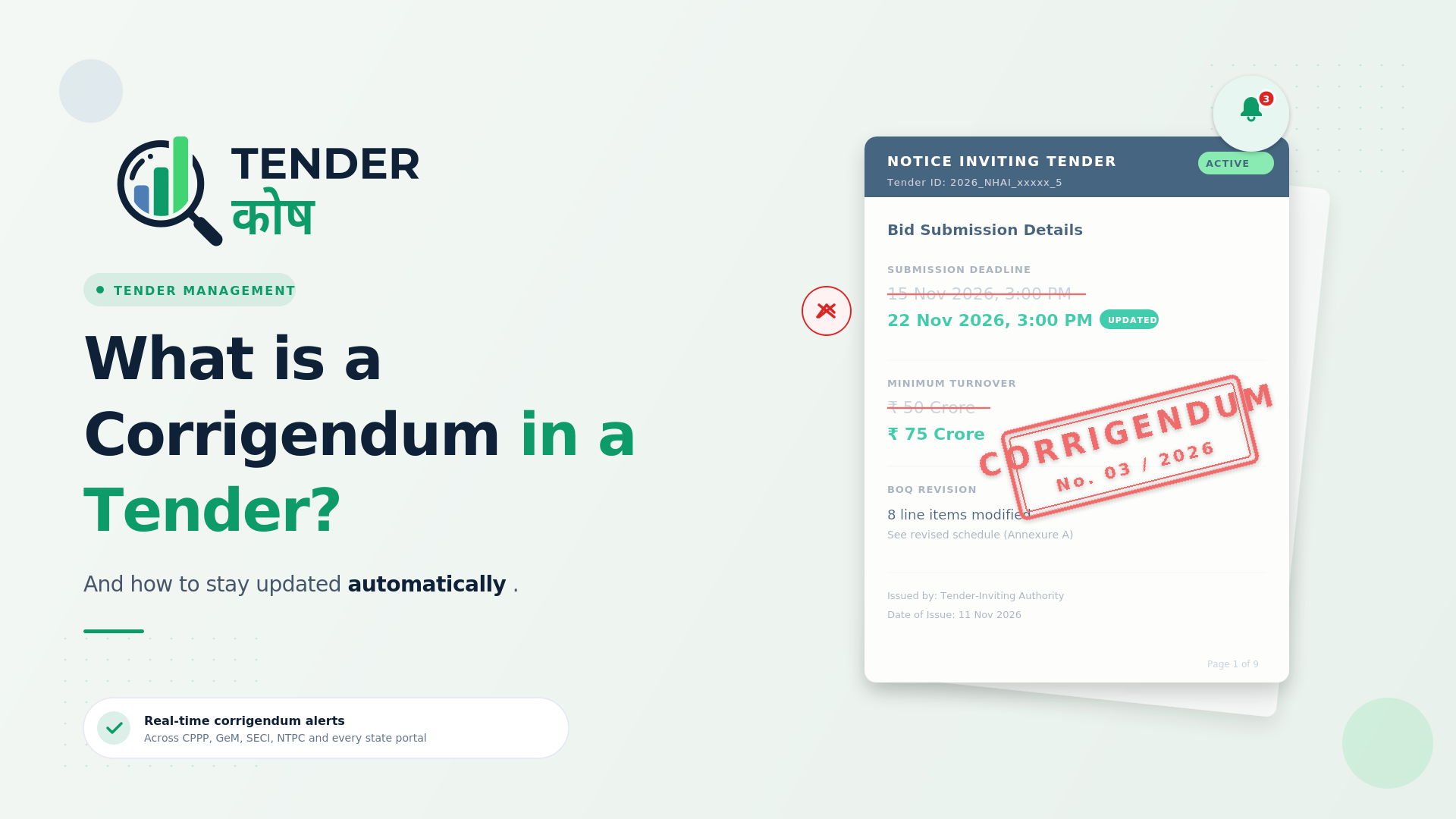
A corrigendum is an official amendment issued by the tender-inviting authority that modifies one or more terms of a previously published tender. It can change deadlines, eligibility, scope, BoQ, EMD requirements, technical specifications, or any other clause of the original Notice Inviting Tender (NIT).
In simpler terms: it’s the government’s way of saying “we changed our minds and your bid has to follow the new rules, not the old ones.”
The word comes from the Latin corrigere (to correct), and that’s basically what it does corrects, amends, or extends something the original tender got wrong, missed, or wants to change.
In Indian government tendering, these three words are often used interchangeably and that’s mostly fine because the practical effect is identical. But there are subtle differences:
| Term | What It Typically Means |
|---|---|
| Corrigendum | A correction or modification to the existing tender most common usage |
| Addendum | An addition of new content to the tender (a new clause, new annexure, a clarification document) |
| Amendment | A formal change to a specific clause, often used when contract terms are revised |
For practical bidding, treat all three the same way: read it carefully, factor it into your bid, and check whether the deadline has changed.
Every corrigendum modifies at least one of these:
A single tender can and often does have multiple corrigenda issued over its lifetime. It’s not unusual to see Corrigendum 1, 2, 3, 4, 5 stacked on a single bid.
Here’s the operational reality of why so many bidders miss them:
1. Portals don’t push notifications by default. Most state e-procurement portals and many central platforms simply publish the corrigendum on the same tender page. There is no email, no SMS, no proactive alert. If you don’t refresh the page, you don’t know.
2. They get buried in long documents. Many corrigenda are PDFs that say “replace clause 3.4.2 of Section II with the following…” Unless you read the whole document carefully, the actual change can hide on page 4 of a 9-page revision.
3. They land at inconvenient times. Corrigenda are frequently issued in the last 7-10 days before bid submission exactly when bidders are heads-down preparing their financial bids and least likely to refresh portal pages.
4. They use cryptic numbering. Tender ID 2026_NHAI_xxxxx_5 (Corr 3) doesn’t scream “important update” it looks like routine portal noise.
5. There’s no central feed. A contractor tracking 12 portals daily can’t reasonably keep up with corrigenda across all of them especially when 2-3 portals issue updates on the same day.
This is why missed corrigenda are quietly the most expensive failure mode in Indian government bidding.
A few patterns we see repeatedly:
The deadline trap: A bidder prepared a complex EPC bid for the original deadline. A corrigendum quietly brought the deadline forward by three days (yes, this happens). The bid was submitted “on time” against the original date and rejected as late.
The eligibility shift: A medium-sized civil contractor qualified at the original turnover threshold of ₹50 crore. Corrigendum 2 raised it to ₹75 crore citing scope additions. The contractor submitted anyway, was disqualified at technical evaluation, and lost the EMD-equivalent processing time.
The BoQ shuffle: A vendor priced their bid against the original BoQ. The corrigendum revised line item quantities for 8 items. The price they submitted no longer matched the new structure, and their L1 position turned into L4.
The pre-bid no-show: A first-time bidder relied on the original NIT and skipped the pre-bid meeting because the corrigendum changing the venue arrived three days before they never saw it. Then a clarification issued at the rescheduled pre-bid meeting changed a critical specification, and their technical bid failed.
None of these bidders were careless. They simply lost a race against a system that publishes critical updates with no proactive notification.
If you want to do this manually, here’s the discipline required:
1. Visit every portal where you’ve shown interest in tenders, every working day. Not “checked once” actually scroll through the latest corrigendum lists.
2. Open every active tender you’re tracking and check the “corrigendum” tab. Don’t trust portal home pages, check inside each tender record.
3. Read the corrigendum document fully. Don’t skim. The change you care about can be one bullet on page 6.
4. Update your internal tracker. Note the new deadline, new eligibility, new scope. Update your bid timeline accordingly.
5. Alert your team. Make sure the technical lead, finance team, and authorised signatory know about the change.
6. Repeat every single working day, until the bid closes.
For one or two tenders, this is doable. For a serious bidding pipeline of 15-30 active tenders across 10+ portals, it’s a full-time job that nobody does perfectly.
Here’s what automated corrigendum tracking should look like and what TenderKosh is built around:
Real-time corrigendum alerts. The moment a corrigendum is published on any tracked portal, an alert hits your inbox or dashboard within minutes, not days.
Diff highlighting. Don’t just get the new document. Get a clear summary of what actually changed, old deadline vs new deadline, old eligibility vs new eligibility, so you don’t have to read 12 pages to find one number.
Linked notifications across the bid lifecycle. Pre-bid meeting changes, eligibility revisions, BoQ amendments, deadline extensions, all linked to the parent tender so your team has full context.
Cross-portal coverage. A solar EPC contractor watching SECI, NTPC, GeM, CPPP, and three state portals shouldn’t need five different alert systems. One platform, one inbox, every relevant corrigendum.
Team alerts. Corrigendum land while your bid manager is on leave? Route alerts to a backup. Multiple people on a bid team? Everyone gets the update simultaneously.
This is exactly the workflow TenderKosh was built for — because the difference between winning and losing isn’t bid quality. It’s whether you saw the update in time.
There is no formal limit. A complex tender can easily have 5-10 corrigenda over its bidding period, especially for large infrastructure or EPC projects with extended timelines and pre-bid clarifications.
You don’t need to “accept” it like a contract amendment. But your bid is automatically governed by the latest corrigendum-amended terms, whether you read it or not. Submitting a bid that ignores a corrigendum almost always leads to disqualification.
Yes. Tender-inviting authorities frequently issue corrigenda cancelling, withdrawing, or rebidding tenders — sometimes after partial bid submission. The reasons vary: insufficient bidders, scope changes, audit objections, or policy shifts.
Most procurement guidelines suggest corrigenda affecting bid preparation should be issued at least 7-15 days before the bid submission deadline, with a corresponding deadline extension if substantial. In practice, this is widely violated, especially for minor corrections.
Your bid will likely be evaluated against the latest corrigendum-amended terms. If your bid is now non-compliant — wrong eligibility, wrong BoQ structure, wrong technical specs — it will be rejected at evaluation. You may forfeit the EMD depending on the cause.
A corrigendum is the single most under-watched document in Indian government tendering. It’s the difference between a bid you win and a bid you lose — and the system, by design, does not make it easy to keep up with.
You can either build a manual tracking discipline that demands hours every day across every portal you watch — or you can let software do it.
That’s the choice TenderKosh makes for you. Every corrigendum, every portal, surfaced in real time, with the change clearly highlighted. You stop missing updates. You start submitting bids that actually qualify.
Have a corrigendum horror story? We’d love to hear it — drop a comment below.
Discover relevant tenders, monitor corrigenda, compare opportunities, and move from document reading to structured action.