
TenderKosh for EPC teams
Turn tender reading into faster bidding decisions.
Discover relevant tenders, monitor corrigenda, compare opportunities, and move from document reading to structured action.
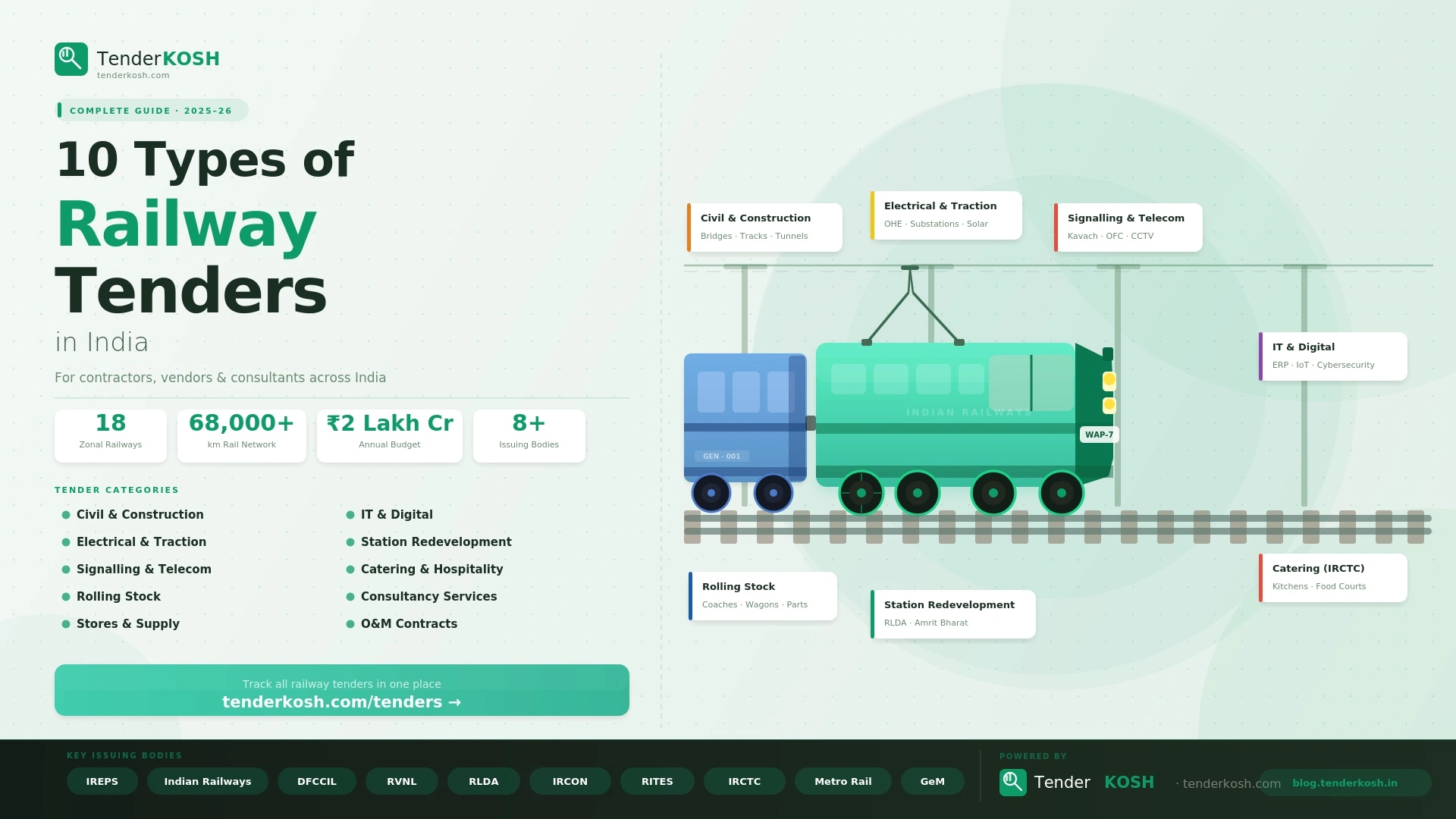
Indian Railways is one of the world’s largest employers and infrastructure networks. It operates over 68,000 kilometres of track. It moves more than 13 million passengers every single day.
To keep that machine running — and to expand it — Indian Railways spends lakhs of crores every year through government tenders. These tenders cover everything from building bridges to supplying biscuits in pantry cars.
If you are a contractor, vendor, or consultant in India, railway tenders represent some of the most consistent and high-value procurement opportunities available. But the category is vast. You need to understand what types of tenders exist before you can target the right ones.
This guide breaks it all down for you.
Railway tenders in India do not come from a single body. Multiple organisations issue them. Here are the key ones you must know.
Now, let us look at the types of tenders each of these bodies — and the broader railway ecosystem — issues.
These are the biggest tenders by value. They cover the physical infrastructure that makes the railway system work.
Common works under civil tenders include:
Civil tenders are issued by Zonal Railways, RVNL, IRCON, and DFCCIL. They typically require strong financial capacity, prior experience in similar works, and a valid EMD in the range of 2–3% of the estimated cost.
Indian Railways runs on electricity. Thousands of kilometres of Overhead Equipment (OHE) lines power electric locomotives. This entire system needs to be built and maintained.
Electrical tenders cover:
With India’s railway electrification mission reaching near-completion, electrical tenders have surged in volume. Solar energy tenders from railways are a fast-growing sub-category worth watching in 2025–26.
Safety depends on signalling. Indian Railways operates one of the most extensive signalling networks in the world. This requires constant upgrades and maintenance.
Signalling and telecom tenders include:
Kavach, India’s homegrown collision-prevention system, has driven a major spike in signalling tenders. If you work in the electronics or railway signalling space, this is one of the most active tender categories right now.
Locomotives, wagons, coaches, and EMUs — the rolling stock that runs on the tracks — need to be manufactured, maintained, and upgraded. This generates an entirely separate category of tenders.
Rolling stock and mechanical tenders include:
Production Units like ICF (Chennai), RCF (Kapurthala), MCF (Raebareli), and CLW (Chittaranjan) issue their own procurement tenders. Many of these go to MSME vendors under railway vendor registration schemes.
Railways needs massive quantities of raw materials, consumables, and components. These come through stores tenders. This category is ideal for manufacturers, traders, and small suppliers.
Common items under stores tenders:
Stores tenders are typically lower in individual value but extremely high in frequency. If you have a registered MSME or manufacturing unit, this is an excellent entry point into railway procurement.
Indian Railways is going digital. Passenger reservation, freight tracking, asset management, safety monitoring — all of it now relies on software and IT infrastructure. That means significant IT tenders.
IT tenders in railways include:
These tenders mostly flow from the Centre for Railway Information Systems (CRIS), IRCTC, and individual zonal railways. Tech firms and system integrators are the primary participants.
India is redeveloping hundreds of railway stations under the Amrit Bharat Station Scheme and world-class station projects. This is a high-profile and growing category.
Station redevelopment tenders cover:
RLDA handles the commercial concession side. RVNL and Zonal Railways handle the civil and building works. These projects can run into hundreds of crores for major stations like New Delhi, CST, or Surat.
IRCTC manages food and hospitality across the rail network. It regularly floats tenders for:
These tenders are accessible to food and hospitality businesses of various sizes. They typically require an FSSAI licence, experience in food service, and a reasonable financial turnover.
Not all railway tenders are for physical works. A significant portion is for expert advisory services.
Consultancy tenders in railways include:
RITES, IRCON, and individual Zonal Railways are the main issuers. These tenders go to engineering firms, consulting companies, and research institutions.
Once infrastructure is built, it needs to be maintained. O&M contracts in railways are long-duration and high-value. They have grown significantly with private participation models.
O&M tenders cover:
Many of these are short-tenure contracts renewed annually. They are accessible to mid-sized firms and are excellent for building a track record with Indian Railways.
Railway tenders are scattered across multiple portals. You need to monitor all of them to avoid missing opportunities.
| Portal | What It Covers |
|---|---|
| IREPS (Indian Railways E-Procurement System) | Main portal for Zonal Railway tenders — works, stores, and services |
| GeM (Government e-Marketplace) | Smaller supply and service tenders across all government entities including railways |
| RVNL Portal | Infrastructure project tenders by Rail Vikas Nigam |
| DFCCIL Portal | All tenders for the Dedicated Freight Corridor works |
| RLDA Portal | Station land development and commercial concession tenders |
| IRCON Portal | Tenders for IRCON’s project contracts |
| IRCTC Portal | Catering, hospitality, and tourism-related tenders |
| Metro Rail Portals | Each metro corporation (DMRC, BMRCL, etc.) has its own procurement portal |
Most professionals track IREPS as their primary source. But if you limit yourself to one portal, you will miss tenders from DFCCIL, Metro Rail, and RLDA — which together run thousands of high-value opportunities.
Railway tenders follow standard Government of India procurement rules. However, each tender has its own specific eligibility criteria. Here are the common ones you will encounter.
Always read the eligibility clauses carefully. Railway tenders frequently issue corrigenda that change these terms. If you miss a corrigendum, you may bid on terms that are no longer valid.
Railway procurement is competitive. Here is what experienced contractors and vendors do differently.
Railway tenders in India span a wider range than most people realise. Whether you are a civil contractor, an IT company, a food service operator, or an electrical supplier — there is a category for you.
The key is knowing which tenders match your capacity and staying alert when they open. That requires the right information at the right time.
TenderKosh tracks railway tenders across all major portals — IREPS, DFCCIL, RVNL, RLDA, Metro Rail, IRCTC, and more. Set your filters once, and get notified the moment a relevant opportunity goes live.
Which type of railway tender does your business target? Drop a comment below — we’d love to help you find the right opportunities.
Discover relevant tenders, monitor corrigenda, compare opportunities, and move from document reading to structured action.