NTPC Tender Process Explained: Eligibility, Documents & Deadlines (2026 Guide)
By TenderKosh Editorial Team/May 1, 2026/Updated May 2, 2026
If you supply to India’s power sector, NTPC is unavoidable. With over 62,000 MW of installed capacity across coal, gas, hydro, solar, and wind plants, NTPC Limited is one of the country’s largest single buyers — issuing thousands of tenders every year worth tens of thousands of crores.
It’s also one of the most procedurally rigorous procurement environments in India. Get one document wrong, miss one signature, misunderstand one Class-I local supplier clause — and your bid is out before it’s even read.
This guide walks through the full NTPC tender process: where tenders are published, who’s eligible, what documents you need, how bidding actually works, and the common mistakes that disqualify perfectly capable bidders.
Where NTPC Tenders Are Published
NTPC tenders live across two primary portals, and you need to know both:
Portal
URL
What It’s For
NTPC e-Tender Portal
eprocurentpc.nic.in
Main e-procurement platform for active bid submission, hosted on GePNIC
NTPC Tender Information Site
ntpctender.ntpc.co.in
NIT and pre-qualification publishing, document downloads
Many tenders also get republished on CPPP (eprocure.gov.in) for visibility. For BESS, biomass, and select renewables tenders, NTPC sometimes publishes on third-party platforms like BiofuelCircle.
Practical tip: Don’t rely on a single portal. NTPC’s regional units (Vindhyachal, Talcher, Kayamkulam, Korba, etc.) sometimes publish locally before the central portal updates.
Types of NTPC Tenders
NTPC issues tenders across a wide spectrum:
Equipment supply — turbines, generators, isolators, transformers, valves, control systems
No active blacklisting from NTPC, any of its projects, or any other PSU
2. Financial Capability
Minimum annual turnover — typically averaged over the last 3 financial years; the threshold scales with tender value (often 100-200% of estimated value)
Net worth — positive net worth is a hard requirement
Solvency certificate — from a scheduled commercial bank, often required for large bids
Working capital — ability to demonstrate liquidity for project cash flow
3. Technical Capability
Past experience — execution of similar contracts of comparable value, often “X projects of minimum Y crore” or “Z projects of minimum W crore” frameworks
Manufacturing capability — for equipment, manufacturer’s authorisation or ownership of facilities
Make in India / Class-I status — many NTPC tenders are restricted to Class-I local suppliers under PPP-MII Order 2017
ISO and quality certifications — varies by category
4. Tender-Specific
Bid security / EMD capability (more on this below)
Acceptance of NTPC’s General Technical Evaluation (GTE) conditions on GePNIC
Adherence to NTPC’s Anti-Bribery and Anti-Corruption (ABAC) policy
Acceptance of “No Deviation” clauses where applicable
If you can’t meet all the criteria for a specific tender, do not bid. NTPC’s evaluation is mechanical — partial qualification = disqualification.
Documents You’ll Need to Bid
Here’s the typical document checklist for an NTPC bid. Build this folder once, keep it updated, and you’ll save hours on every bid:
Company documents:
Certificate of Incorporation / Partnership deed / Proprietorship registration
PAN card
GST registration certificate
Udyam / MSME certificate (if applicable)
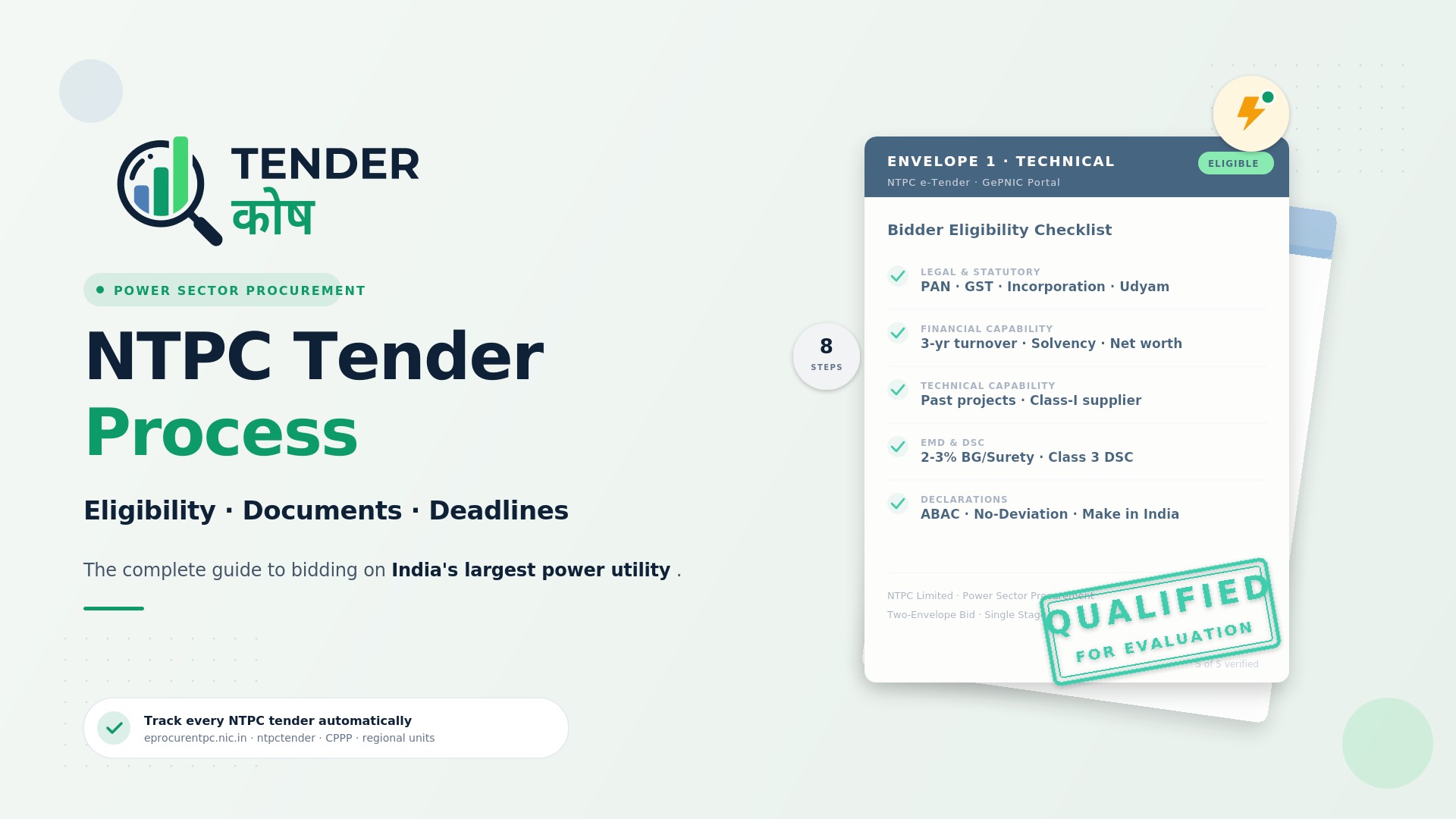
DSC (Digital Signature Certificate) — Class 3, registered in the name of the authorised signatory
Financial documents:
Audited balance sheets and P&L for last 3 years
Auditor’s certificate confirming turnover (Annexure formats specified by NTPC)
Solvency certificate from a scheduled bank (often Rs. ___ crore)
Bank statements (sometimes required)
Experience documents:
Work order copies for cited reference projects
Completion certificates from clients (often must be issued by an officer not below Executive Engineer rank for PSU work)
Make in India self-declaration with local content percentage
Bidder’s Letter, Bid Form, Price Schedules
Pro tip: NTPC routinely rejects bids for document mismatches — different addresses on PAN vs GST, name variations, expired certificates. Cross-check every document for consistency before submission.
EMD (Earnest Money Deposit) — How NTPC Handles It
EMD is a near-universal requirement for NTPC tenders, with some variation:
For amounts up to ₹1 lakh: Pay online through GePNIC
Above ₹1 lakh: Submit a Bank Guarantee, FDR, or Insurance Surety Bond (most common)
MSE exemptions: Available in many goods tenders under PPP 2012, but NOT applicable to “works contracts” (read tender carefully)
Physical submission: When BG/Insurance Surety is used, a physical original is typically required at the NTPC office within 7-10 days of bid opening
EMD typically ranges from 2-3% of estimated tender value, capped per NTPC policy.
Critical: EMD validity must extend beyond bid validity (usually 45 days beyond). Submitting an EMD with the wrong validity period is a top-3 disqualification reason.
The NTPC Bidding Process — Step by Step
Step 1: Vendor Registration on GePNIC
Before you can bid, register on the e-tender portal at eprocurentpc.nic.in:
Click “Online Bidder Enrollment”
Create a user account (email + mobile)
Fill business details (organization name, type, address)
Upload documents
Select vendor categories (goods/services you supply)
Complete DSC enrollment
DSC (Class 3) is mandatory — bids without a valid DSC at submission are not accepted. Vendor registration is a one-time step that enables you to bid across all NTPC tenders.
Step 2: Tender Discovery
Search for relevant tenders on:
ntpctender.ntpc.co.in (NIT publishing)
eprocurentpc.nic.in (active e-tenders)
CPPP for cross-checks
Or — track them automatically via TenderKosh
Step 3: Tender Document Download
Tender documents on the NTPC portal are generally free to download. Read every section:
Section I — Notice Inviting Tender (NIT)
Section II — Instructions to Bidders (ITB)
Section III — General Conditions of Contract (GCC) and Special Conditions (SCC)
Section IV — Forms & Procedures
Section V — Technical Specifications
Section VI — Scope of Work
Section VII — Price Schedule / BoQ
Step 4: Pre-Bid Clarifications
Most NTPC tenders have a clarifications window (often 10-15 days from publication). Submit queries through the “Seek Clarifications” tab on the portal. NTPC’s responses are published as corrigenda — and these corrigenda are binding.
Pre-bid meetings (physical or virtual) are common for large packages. Attend if eligible — clarifications issued there can change technical specs.
Step 5: Bid Preparation
NTPC bids are typically single-stage two-envelope:
Envelope 2: Price Bid — only the financial proposal, separately encrypted
Common mistake: Including any pricing inside the techno-commercial bid (even on a stray supporting document) leads to immediate rejection.
Step 6: Bid Submission
Upload techno-commercial documents to Envelope 1 on GePNIC
Upload price bid to Envelope 2
Submit Fee Cover (tender fee + EMD proof) where applicable
Submit physical EMD instrument (if BG/Insurance) within 10 days of bid opening
Final submission requires DSC signing
Bids submitted without complete envelope structure or DSC are not accepted by the system.
Step 7: Bid Opening & Evaluation
Techno-commercial bid opening — typically a day after submission deadline
Technical evaluation — eligibility, document verification, compliance with specs
Price bid opening — only for technically qualified bidders, on a separately notified date
Reverse Auction (where applicable) — NTPC frequently uses RA for goods and select services. The L1 from the price bid sets the floor; bidders compete to undercut
Step 8: Award & PBG
The L1 bidder receives a Letter of Award (LoA). Within the timeline specified, the awardee must submit Performance Bank Guarantee (PBG) — typically 5-10% of contract value — to formalize the contract.
Failing to accept the LoA or submit PBG often triggers EMD forfeiture, debarment from re-tendering, and possible blacklisting.
Common Mistakes That Disqualify Bidders
After hundreds of NTPC bid post-mortems, the same patterns repeat:
Document mismatches — name/address inconsistencies across PAN, GST, certificates
Wrong EMD validity — instrument expires before bid validity ends
Missing DSC or DSC mismatch — signing authority on PoA differs from DSC holder
Price content in technical bid — even an unintended figure gets you rejected
Missing Class-I local supplier declaration — for tenders restricted to Class-I, no declaration = no bid
Ignoring corrigenda — bid prepared on superseded specs/eligibility
No-deviation violations — submitting bid with conditions when “No Deviation” is specified
Late physical EMD submission — uploaded online but original BG didn’t reach NTPC within deadline
Each of these is preventable with discipline — and a system that catches issues before submission.
How to Stay on Top of Every NTPC Tender
If your business depends on NTPC contracts, you need three things:
Reliable tender discovery across both NTPC portals plus regional/local publishing
Real-time corrigendum alerts — NTPC issues corrigenda frequently, often close to deadline
Document and deadline management — to keep multiple parallel bids on track
Doing this manually means a dedicated employee checking 3-5 portals daily, reading every corrigendum, and updating an internal tracker that someone forgets about during peak weeks.
TenderKosh is built specifically for this:
Aggregated NTPC tender feed across e-tender portal, ntpctender.ntpc.co.in, CPPP, and regional sources
Smart filters by category (BESS, civil, equipment, fuel, services), value, location, and Class-I eligibility
Real-time corrigendum alerts the moment they’re published
Tender history and award data — see who’s winning NTPC contracts in your category and at what value
You stop scrambling to keep up. You start bidding strategically.
Frequently Asked Questions
Is NTPC vendor registration the same as registration on GeM or CPPP?
No. NTPC has its own e-procurement system (GePNIC-based at eprocurentpc.nic.in). You’ll need a separate enrolment, even if you’re already registered on GeM or CPPP. DSC is mandatory.
Can MSEs participate in NTPC tenders without EMD?
In many goods tenders, yes — MSEs registered under Udyam can claim EMD exemption under PPP 2012. However, this exemption is not available for works contracts and not for traders/dealers. Always check the specific tender’s MSE clauses.
What does “Class-I local supplier” mean in NTPC tenders?
Under the Public Procurement (Preference to Make in India) Order 2017, a Class-I local supplier is one with local content of 50% or more. NTPC restricts certain tenders exclusively to Class-I suppliers. A Chartered Accountant or statutory auditor’s certificate is required to declare local content.
How long does NTPC bid evaluation take?
Techno-commercial evaluation typically takes 2-6 weeks depending on complexity. Price bid opening follows, and final award can take an additional 4-12 weeks. Total time from bid submission to LoA can range from 2 to 6 months.
What is the typical EMD percentage for NTPC tenders?
EMD is usually around 2-3% of estimated tender value, sometimes capped at a maximum amount specified in the tender. Always refer to the specific tender’s EMD clause — not all are calculated the same way.
The Bottom Line
NTPC tenders are high-volume, high-value, and high-discipline. The bidders who win consistently aren’t the ones who scramble harder — they’re the ones with the systems to catch every NIT, every corrigendum, every document requirement, every deadline.
If you’re bidding on NTPC tenders, the cost of a missed alert is enormous. The cost of automating that alerting is trivial.