
TenderKosh for EPC teams
Turn tender reading into faster bidding decisions.
Discover relevant tenders, monitor corrigenda, compare opportunities, and move from document reading to structured action.
Most government tenders in India are won or lost at the technical bid stage. The price bid does not decide it.
That sounds counterintuitive. Surely the lowest price wins? Actually, no. By the time the price bid is opened, half the bidders are already out. They failed at technical evaluation.
Wrong document format. Missing certificate. Weak methodology. Unclear scope alignment. Any one of these issues can sink your bid before anyone reads your price.
However, no one hands first-time bidders a guide to this process. So here is one. This is a practical walkthrough of how to write a technical bid that actually qualifies. It is written for contractors, MSMEs, and consultancy firms working on Indian government tenders.
Most Indian government tenders use a two-envelope (or two-cover) system. As a result, you submit two separate bids.
First, the technical bid is opened. Then only the qualifying bidders have their price bids opened. Therefore, if your technical bid fails, your price does not matter. You are out.
The technical bid has one job. It must demonstrate, with documentation, that you meet every eligibility criterion. Also, it must show that you are technically capable of executing the work.
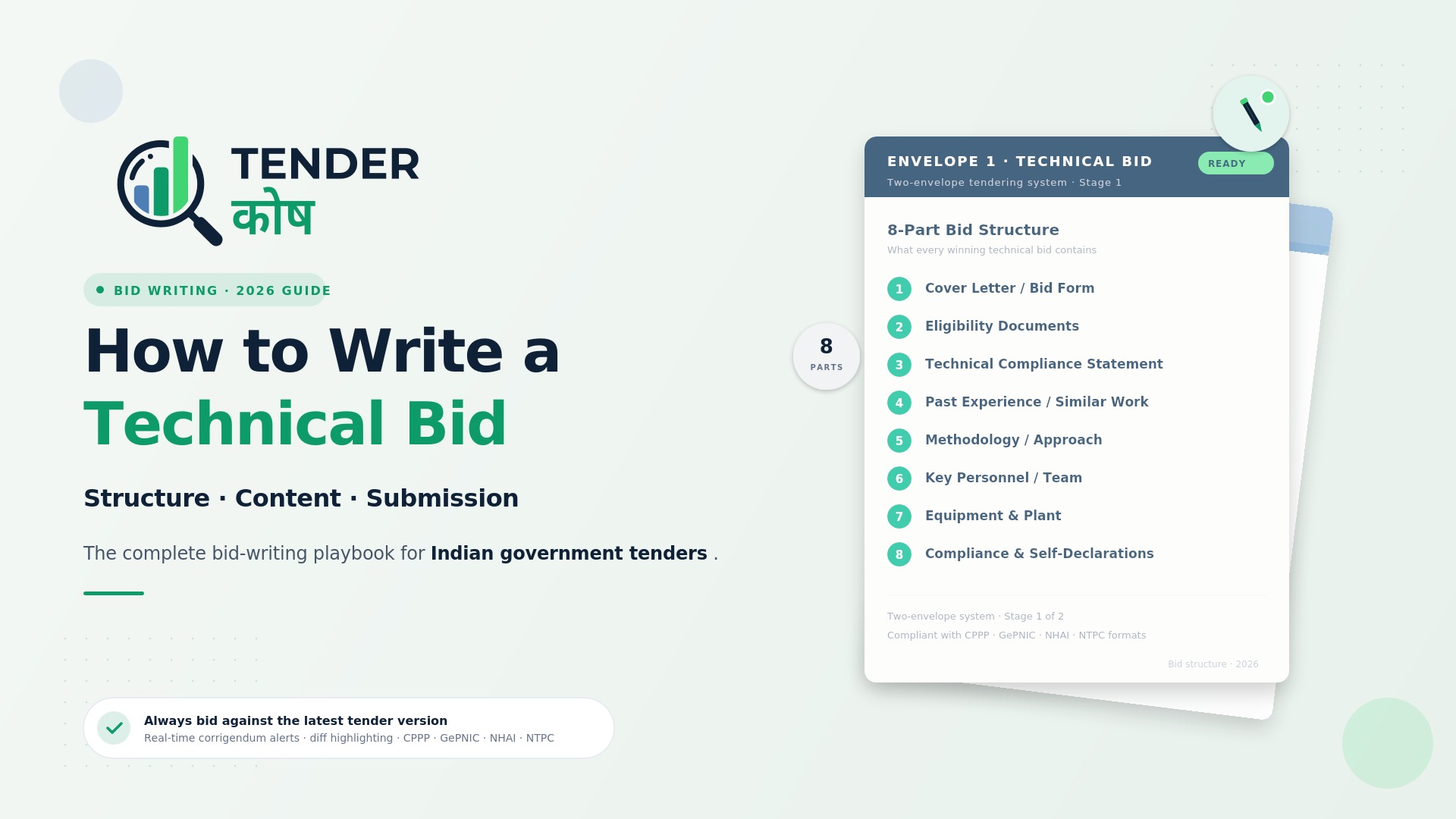
Every technical bid for a government tender should follow these 8 sections. The names vary by tender. However, the substance does not.
The authorised signatory must sign this letter. It states the tender reference and your bid validity acceptance. In addition, it includes EMD or bid security details and overall bid acceptance.
The tender document provides a standard format. Therefore, use it verbatim. Do not rewrite it.
Common mistake: Signing the cover letter without the company seal. Or signing with a name that does not match the DSC holder. Either issue causes rejection.
This is where most bids die. Every eligibility clause in the tender requires a corresponding document. This applies to financial, technical, and statutory clauses alike.
Usually, you also submit an eligibility matrix. The matrix maps each tender clause to the specific document and page number. As a result, evaluators can verify compliance quickly.
What to include:
Pro tip: Almost every tender provides a checklist annexure. Therefore, fill it in completely. Cross-reference each item to your document pack. Evaluators do not hunt. They tick boxes.
Most tenders specify technical requirements as a list of clauses, often in tables. Therefore, your job is to respond to each clause. The standard responses are “Complied” or “Not Complied”. For clauses that need explanation, add a brief technical justification.
The format usually looks like this:
| Clause | Specification | Compliance | Reference / Remark |
|---|---|---|---|
| 4.1.1 | XYZ specification | Complied | See product datasheet, page 12 |
| 4.1.2 | Material grade ABC | Complied | See material certificate Annexure 7 |
Critical: Never write “Better than specified” or “Equivalent” without a technical justification. Also, always attach a supporting datasheet. Many tenders specify “No Deviation”. As a result, any deviation can lead to rejection. This is true even when the deviation is an improvement.
This is where you prove you have done this before. For each cited reference project, provide the following.
Critical: Tenders interpret “similar work” strictly. Therefore, do not cite a project that is tangentially related. For example, NHAI counts highway projects, not unrelated civil works. Similarly, NTPC counts power sector experience. Likewise, SECI counts solar, wind, and storage work. Citing weak references actually hurts your bid more than it helps.
The methodology section matters most for consultancy, EPC, and complex services tenders. This is where you actually win. The methodology section explains how you will execute the work. It is not just confirmation that you can.
Strong methodology sections include the following elements:
This is where most generic templates fail. Therefore, avoid copy-paste methodology. Evaluators read dozens of these. As a result, formulaic content stands out, badly. So tailor every section to the specific tender’s scope, geography, and requirements.
Most major tenders specify named-position requirements. These typically include Project Manager, Resident Engineer, Quality Engineer, Safety Officer, and Specialist roles. Each position has minimum qualifications and years of experience.
For each named position, include:
Critical mistake: Do not nominate the same person for multiple parallel bids. Government evaluators cross-check. Therefore, double-nomination causes rejection across all bids where the conflict appears.
For works contracts, you must demonstrate ownership or assured availability of specific equipment. Therefore, submit:
For high-value works, NHAI and similar bodies often require physical inspection of equipment before contract award. Therefore, do not list equipment you cannot actually produce.
This is the kitchen sink section. However, every item matters.
Each declaration is typically a separate annexure with a specific format. Therefore, use the formats verbatim. Even a small wording change can cause rejection.
Tired of preparing bids on outdated tender versions? See live tenders with real-time corrigendum alerts.
How you format and submit your bid matters as much as the content. Therefore, pay close attention to the following five rules.
Most e-procurement portals have specific upload structures. This applies to CPPP, GePNIC, NHAI, and NTPC. Each portal uses multiple “covers” or “envelopes”. Each cover accepts specific document types. As a result, mismatched uploads cause summary rejection. For example, putting price content in the technical bid will sink your bid instantly.
Name your files clearly. For example, use Eligibility_Matrix.pdf or Audited_Financials_FY23-24.pdf. Likewise, use Annexure_5_Authorised_Signatory_PoA.pdf. Avoid generic names like Document1.pdf.
Number every page in your bid. Also, include a master index at the front of each file. Then cross-reference all eligibility responses to specific document page numbers.
Final submission requires DSC (Class 3) signing on the e-procurement portal. The DSC must be in the name of the authorised signatory mentioned in the PoA. Mismatched DSCs are a top-5 rejection cause.
Some bids require original instruments. These include BG, Insurance Surety, and original PoA. They must reach the issuing office within the specified deadline. Typically, this is 7-10 days from bid opening. Otherwise, late physical submission can disqualify a bid that was uploaded perfectly.
We have reviewed hundreds of disqualified bids. As a result, the patterns are clear.
Every single one of these mistakes is preventable. Therefore, build a checklist discipline.
Use this checklist before every final submission.
That last point is critical. Last-minute submissions are the leading cause of “submitted but not accepted” failures. For example, captcha errors, network drops, and OTP delays all happen near the deadline. Therefore, submit early.
Here is a common failure mode. A bidder prepares a strong technical bid against the original tender. Then they miss Corrigendum 3, issued 5 days before the deadline. Meanwhile, the corrigendum revises Clause 4.2.1 (similar work definition), Clause 6.3 (key personnel qualifications), and the BoQ.
The bid is submitted. The bid is rejected at technical evaluation. EMD forfeit risk follows. Two weeks of preparation are wasted.
This is why corrigendum tracking is part of bid writing. It is not a separate task. Therefore, every time you sit down to update your bid, check the current corrigendum count first. Also check what has changed since you last looked.
This is exactly what TenderKosh is built for. You get real-time corrigendum alerts on every tracked tender. In addition, diff highlighting shows you what changed. As a result, you do not have to read the whole document twice. Combined with structured tender filtering, you can build a bidding pipeline where your team always prepares bids on the latest version.
There is no fixed length. It depends on tender complexity. For example, a small services bid might run 50-80 pages. A major EPC bid can run 300-500 pages, including all annexures. Therefore, the right length is “everything required, nothing more.”
Yes, for major tenders involving turnover and financial criteria. The auditor or CA certificate must confirm turnover and net worth. Also, for Make in India tenders, it must confirm local content percentage. The format is tender-specified and mandatory.
Avoid it. Government evaluators do not read marketing decks. Therefore, include only documents that respond to specific tender requirements. Otherwise, extras can dilute the perception of relevance.
It depends on the document and the evaluator’s discretion. For statutory documents like PAN, GST, or EMD, missing means rejected. For supporting documents, evaluators may issue a clarification request. However, do not count on it. Therefore, always submit complete bids.
Government tenders are predominantly in English. There are notable exceptions in some state portals. However, always submit in English unless the tender specifically asks for a regional language.
In Indian tendering practice, “technical bid” refers to the eligibility and compliance envelope in a two-envelope tender. Meanwhile, “proposal” is sometimes used for consultancy assignments. In those cases, the technical content is more substantive, covering methodology, team, and approach. However, the structures overlap heavily.
Writing technical bids for Indian government tenders is a craft. It is part documentation, part compliance, and part technical communication. Most importantly, it is 100% discipline.
The bidders who win consistently are not necessarily the cheapest or the largest. Instead, they are the ones whose technical bids never get rejected on technicalities. They have document libraries, response templates, current corrigenda, and bid preparation processes. As a result, no tender ever goes out incomplete or outdated.
That is the system TenderKosh is built to support. You never miss a tender. You never miss a corrigendum. You always bid against the current version, with all the eligibility data you need at hand.
Live tender feed. Real-time corrigendum alerts. Diff highlighting. Document deadline tracking. All in one dashboard.
Have a specific tender you are preparing a bid for? Drop a comment with the package details. We will write a focused breakdown.
Discover relevant tenders, monitor corrigenda, compare opportunities, and move from document reading to structured action.