

TenderKosh for EPC teams
Turn tender reading into faster bidding decisions.
Discover relevant tenders, monitor corrigenda, compare opportunities, and move from document reading to structured action.
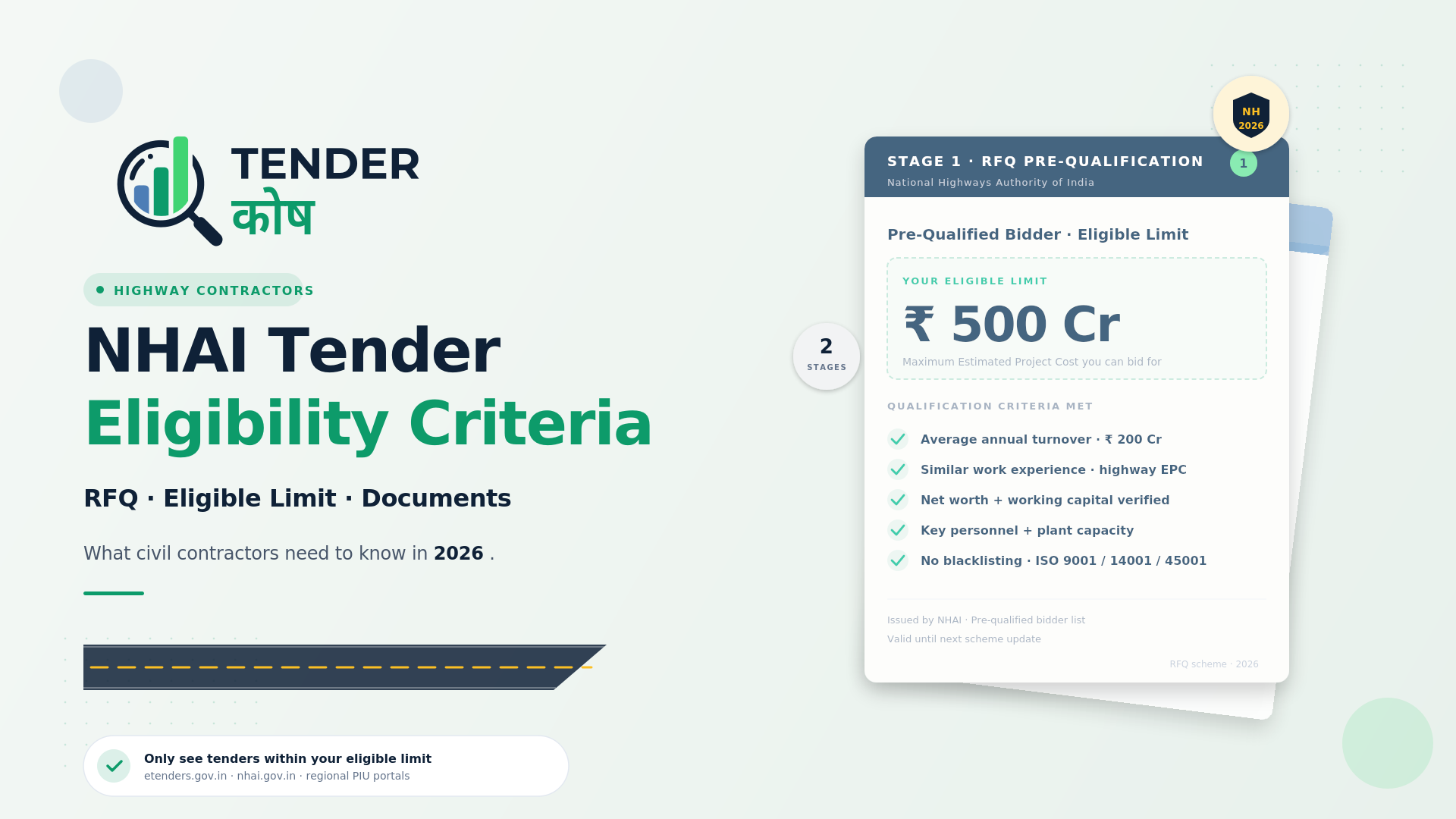
Are you a civil contractor in India? Then NHAI tenders matter to you. They are where the big money flows.
The National Highways Authority of India ranks among India’s largest infrastructure buyers. Every year, NHAI awards contracts worth lakhs of crores. These contracts cover construction, maintenance, tolling, ropeways, and consultancy.
However, NHAI is also one of the toughest tendering environments in India. It does more than check eligibility. First, it pre-qualifies bidders. Then it assigns each one an “eligible limit” in crores. As a result, you know in advance which projects you can and cannot bid for.
So why do some contractors win NHAI work easily while others fail at the RFQ stage? The answer is almost always the same. They understood the eligibility framework. Here is everything you need to know.
Eligibility varies sharply by tender type. In addition, most NHAI work falls into one of five buckets.
| Category | What’s Involved | Typical Bidder |
|---|---|---|
| EPC / HAM / BOT | Greenfield construction, four-laning, six-laning | Large civil EPC firms |
| OPRMC / Maintenance | Output-based maintenance of operational stretches | Medium-large civil contractors with highway experience |
| Toll Operations (OMT) | Toll collection on specific plazas | Toll operators, infra firms |
| Consultancy | DPR preparation, supervision, design, traffic studies | Engineering consultancy firms, JVs with international consultants |
| Support & Amenities | Wayside amenities, ropeways, tourism infrastructure, housekeeping | Specialised contractors and facility operators |
Each category follows its own eligibility logic. For example, EPC and HAM tenders are the most complex. They require RFQ pre-qualification. Similarly, OPRMC tenders use an eligible-limit framework.
For most large NHAI tenders, you do not go straight to bidding. Instead, there are two stages.
The RFQ is the gatekeeper stage. NHAI publishes an RFQ that runs continuously. Usually, there is no last date. First, contractors must apply for pre-qualification under that scheme.
Next, NHAI assesses your financial and technical capacity. Then it assigns you an Eligible Limit in crores. As a result, you know the maximum project value you can bid for.
For example, an RFQ for OPRMC works might assign:
Therefore, you can only bid for projects that fall at or below your eligible limit. Also, the RFQ document itself usually costs around ₹10,000.
NHAI updates its list of pre-qualified bidders periodically. To bid on a specific project, you must be on the list at least 7 days before the bid due date.
Once you are pre-qualified, you can bid on individual project RFPs within your eligible limit. Each RFP requires three things.
Importantly, NHAI forfeits your bid security if you withdraw. The same applies if you fail to sign the contract after award.
However, smaller works follow a different path. For maintenance, plantation, and amenities, NHAI runs single-stage open tenders directly through etenders.gov.in. In these cases, you do not need separate RFQ pre-qualification.
Want to see live NHAI tenders within your eligible limit, without checking 5 portals every morning?
Financial criteria filter out most first-time bidders. NHAI usually checks the following six items.
First, you must show average annual turnover from construction or civil works. NHAI looks at the last 3 to 5 financial years. Moreover, thresholds scale with project size. For example, a ₹500 crore project may require ₹150 to ₹200 crore annual turnover.
Positive net worth is non-negotiable. Also, some tenders specify a minimum net worth. For instance, this is often 25% of estimated project cost.
You will need a banker’s letter confirming working capital availability. Typically, this works out to 10 to 20% of project cost.
You also need a solvency certificate from a scheduled commercial bank. Often, NHAI specifies a minimum amount.
You must disclose all pending litigation. Furthermore, a history of arbitration losses or contract disputes can affect pre-qualification.
Finally, NHAI uses a specific formula to calculate bid capacity. The formula combines past experience, turnover, and pending project commitments. As a result, excessive ongoing commitments reduce your bid capacity. This is true even if your turnover is large.
The technical bar is just as serious. Therefore, you should review each of these five points carefully.
You must have completed similar work within the last 5 to 7 years. Importantly, NHAI defines “similar” tightly. For highway construction, this means actual highway or expressway projects. Unrelated civil works do not count.
Common formats include the following options:
For technical works, NHAI often requires evidence of specific quantities executed. For example, this could include minimum length of bituminous pavement. Likewise, it may include cubic meters of structural concrete or minimum bridge span length.
NHAI looks for a Resident Engineer, Highway Specialist, Bridge Specialist, and Quality Assurance Engineer. Each must meet specified experience and qualification requirements. Also, you must nominate named individuals. In some cases, affidavits are required.
For heavy works, you must own or have assured access to specific equipment. This includes pavers, batching plants, motor graders, and rollers.
Major works typically require ISO 9001, ISO 14001, and OHSAS 18001 or ISO 45001 certifications. In addition, plantation works under the Green Highways Policy need IRC SP:21 compliance.
Build this binder once, and keep it updated. As a result, you will cut bid prep time in half.
Pro tip: NHAI rejects bids on document validity issues more often than on capability gaps. For example, a solvency certificate dated 91 days before submission can sink a bid. Likewise, an expired ISO certificate or an unsigned annexure will disqualify you.
We have analysed hundreds of NHAI bid rejections. As a result, the patterns are predictable.
A contractor with ₹100 crore in factory civil works thinks they qualify for a ₹100 crore highway tender. However, NHAI does not see it that way. Therefore, the bid gets rejected at technical evaluation.
The project was completed. However, the certificate does not say “completed and operational” in NHAI’s prescribed language. Or the issuing officer’s rank is not visible. Either way, the bid is disqualified.
A diversified company shows turnover that comes mostly from manufacturing. But NHAI counts only construction turnover. Therefore, the company is disqualified.
A disclosed pending arbitration case raises red flags during pre-qualification. Some bidders are not pre-qualified outright. Others lose on tiebreakers.
The same Highway Specialist gets nominated across two or three parallel NHAI bids by the same contractor. NHAI catches this. As a result, it disqualifies the bid on personnel availability grounds.
A contractor pre-qualified for ₹100 crore tries to bid on a ₹150 crore project. This is not allowed. Therefore, the system rejects the bid automatically.
Wrong validity, wrong format, wrong issuer, or late physical submission. Bid security errors cause the most common avoidable failures.
Are you serious about scaling on NHAI work? Then follow these five steps.
Do not wait until a specific project surfaces. Instead, stay on the published pre-qualified list. Aim for the highest eligible limit your finances support.
Take on smaller PIU-level NHAI works or sub-contracts first. As a result, you build NHAI-specific track record. Then you can bid for marquee projects.
Solvency certificates, ISO certifications, and completion certificates all expire. Therefore, monitor validity dates closely. Otherwise, something will expire mid-bid.
NHAI adds new contractors regularly. Also, eligible limits get revised. If competitors’ limits move up, yours may need an update too.
NHAI tenders publish on etenders.gov.in under NHAI’s organisation. However, regional PIU-level tenders sometimes appear with delays. As a result, mid-sized maintenance and ropeway tenders are easy to miss without active tracking.
This is exactly where TenderKosh helps. NHAI tenders publish across central and PIU-level portals. Moreover, frequent corrigenda affect eligibility, deadlines, and scope. TenderKosh aggregates NHAI’s full tender feed in one place. You get real-time corrigendum alerts and structured eligibility filters. Therefore, you only see tenders within your eligible limit.
For large EPC and HAM tenders, no. You must be on the pre-qualified list at least 7 days before the bid due date. However, smaller works are different. Single-stage tenders are common for maintenance, plantation, and amenities. These do not require separate RFQ pre-qualification.
NHAI’s RFQ document specifies a methodology. It combines past financial and technical capacity. Therefore, higher turnover, higher net worth, and larger comparable projects move your eligible limit upward.
It depends on the specific tender. Some RFQs disallow JV or consortium applications, especially for OPRMC works. Others allow JVs subject to conditions. These conditions usually cover lead member experience and minimum stake.
Bid security usually appears as a fixed amount in the tender. For example, ₹X crore for a project worth ₹Y crore. Generally, this works out to 1 to 2% of estimated project cost. Also, it must remain valid beyond bid validity, often by 45 days.
NHAI publishes general announcements on nhai.gov.in. For active e-bidding, check etenders.gov.in under NHAI’s organisation page. In some cases, regional PIU-level tenders also appear on state e-procurement portals.
Technical evaluation usually takes 30 to 60 days for competitive RFP bids. Then financial bid opening and award decisions take another 30 to 90 days. Therefore, the total cycle from bid submission to LoA can run 3 to 6 months.
NHAI eligibility is not a one-time checkbox. It is a continuous discipline. You must keep your pre-qualification current. Also, you must track which tenders fall within your eligible limit. Moreover, you must watch corrigenda that affect criteria.
The contractors who win consistently in 2026 do not have a hack. Instead, they have a system. They know about every relevant NHAI tender. They never miss a corrigendum. They never bid for a project they are disqualified to win.
That is the system TenderKosh is built around.
Live NHAI tender feed. Real-time corrigendum alerts. Eligible-limit filters. Document deadline tracking. All in one dashboard.
Have a specific NHAI eligibility question? We would love to answer it. Drop a comment below.
Discover relevant tenders, monitor corrigenda, compare opportunities, and move from document reading to structured action.