
TenderKosh for EPC teams
Turn tender reading into faster bidding decisions.
Discover relevant tenders, monitor corrigenda, compare opportunities, and move from document reading to structured action.
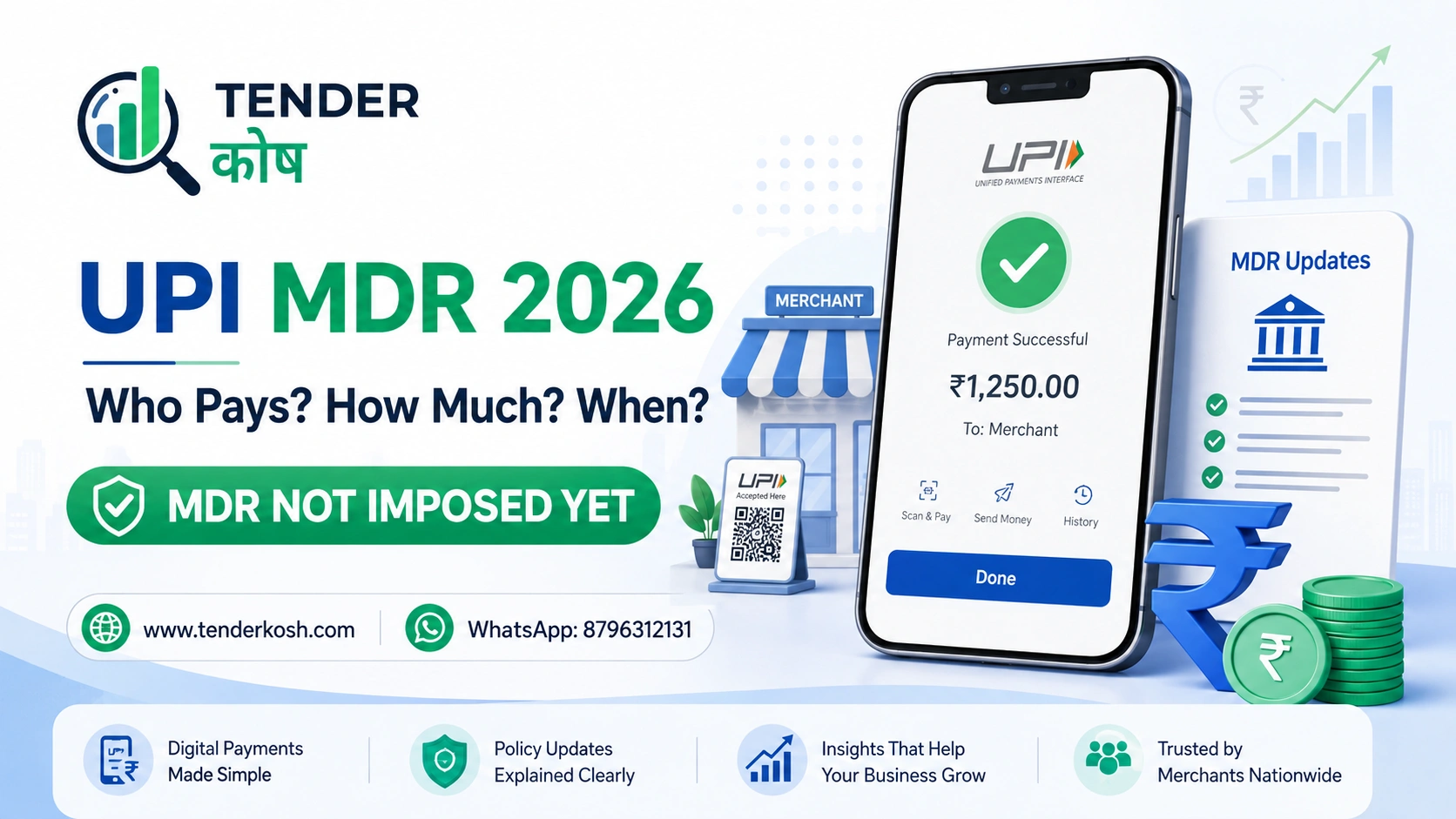
Bottom line: Parliament has created the legal framework for UPI MDR, but no MDR is currently being charged — on any merchant, on any transaction.
Every business owner searching for UPI MDR merchants 2026 wants the same three answers: will I pay, how much, and starting when. Here is the whole position in one table before the detail.
| Is UPI currently free? | Yes |
| Are consumers charged? | No |
| Is merchant MDR active? | No |
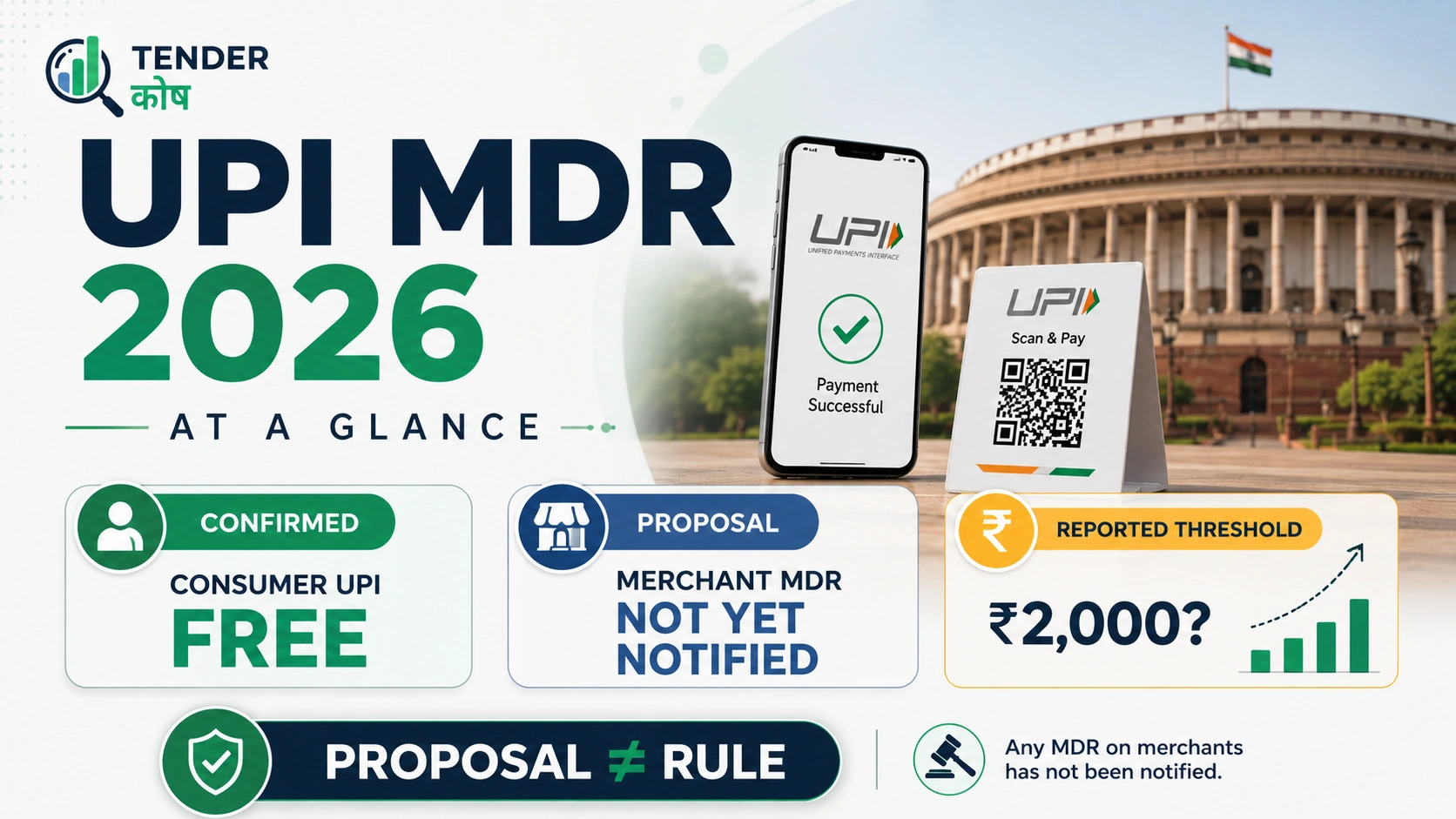
| Proposed transaction threshold | Above ₹2,000 |
| Proposed merchant threshold | Reported ₹1–1.5 crore turnover |
| Final MDR rate | Not announced |
| Start date | Not announced |
What follows explains the detail behind each answer — what Parliament passed on 10 August 2026, which merchants the reported proposals target, and what a sensible business should do while the decision is pending.
This is a developing policy issue, and most confusion comes from treating reported proposals as settled law. Here is the split.
The single most useful distinction is between authority to charge and charging. Parliament granted the first. Nobody has done the second.
Section 10A prohibited MDR on all UPI and RuPay debit transactions, for every merchant, at every value.
Parliament amends Section 10A, replacing the ban with a framework letting the Centre notify which modes stay free.
The legal path exists. No rate set, no notification issued, no merchant paying anything.
The NPCI committee decides the MDR, if any. A government notification would follow before anything applies.
| Before the bill | After the bill |
|---|---|
| Section 10A banned MDR on UPI and RuPay debit card transactions, unconditionally | The Centre may notify which electronic payment modes must remain free, by executive order |
| Zero MDR applied to every merchant, at every transaction size | Specific merchant categories and transaction sizes can be designated for MDR |
| No legal route existed to charge merchants | A legal route exists, but has not been used AS OF 14 AUG 2026 |
Person-to-merchant transactions carry MDR of up to 0.30% of transaction value.
Amendments to the Payment and Settlement Systems Act and Income Tax Act make MDR zero for RuPay debit and BHIM-UPI. Government subsidy replaces transaction revenue.
Four years of incentive payouts covered an estimated 11% of the payment industry’s actual cost, per the Standing Committee on Finance.
The Committee concludes that a viable revenue mechanism is critical to UPI’s financial sustainability without perpetually straining the exchequer.
Finance Minister Nirmala Sitharaman introduces the Taxation and Other Laws (Amendment) Bill, 2026, amending Section 10A.
The Finance Minister confirms UPI stays free for consumers, and that the vast majority of merchant transactions, including low-value payments to roadside vendors, remain free.
The UPI and Services Steering Committee decides on MDR. A government notification would be required before anything takes effect.
Replying in the Rajya Sabha on 10 August 2026, the Finance Minister stated UPI payments remain free for consumers, and all person-to-person transactions continue free of charge.
She added that the vast majority of merchant transactions, including low-value payments to roadside vendors, will continue to remain free.
The Finance Ministry confirmed that once the bill passes, the UPI and Services Steering Committee headed by NPCI will decide on the MDR, if any.
On the rate itself, the Finance Ministry said that if MDR is introduced it would apply to a limited set of merchant transactions above a certain threshold, at a nominal rate significantly lower than debit or credit card MDR. No specific figure was given.
Annual turnover below the reported ₹1–1.5 crore threshold — kirana stores, street vendors, roadside businesses.
Likely unaffectedAny UPI payment at or below ₹2,000, regardless of how large the receiving merchant is.
Proposed to stay freeTurnover above the reported threshold and receiving UPI payments above ₹2,000 — both conditions together.
Potential exposureRead this carefully: the ₹1–1.5 crore turnover figure and the ₹2,000 transaction figure come from reported proposals and government statements about likely design. Neither is notified law. The NPCI-headed committee may set different figures, or none at all.
Based on reported proposals. No MDR applies today.
No rate has been announced. The only firm guidance is that any UPI MDR would sit well below card MDR. Here is the comparison that gives that statement meaning.
| Payment method | MDR | Status |
|---|---|---|
| UPI today | 0% | Zero since January 2020 CONFIRMED |
| UPI before 2020 | Up to 0.30% | Historic P2M rate CONFIRMED |
| Debit card | Up to 0.90% | Per RBI guidelines CONFIRMED |
| Credit card | 1.0–3.0% | Varies by card and category CONFIRMED |
| UPI, if introduced | Not announced | Stated as nominal, well below card MDR PROPOSED |
Model what different rates would mean for your business. Every rate below is illustrative — none has been announced.
Only the share of your UPI sales above ₹2,000 would qualify under reported proposals.
Illustrative only. No MDR rate has been announced. This models hypothetical rates so you can size your exposure — it does not predict a charge. GST at 18% would apply on MDR and is claimable as input tax credit by GST-registered businesses.
| Illustrative rate | Cost on a ₹10,000 transaction |
|---|---|
| 0.1% ILLUSTRATIVE | ₹10 |
| 0.2% ILLUSTRATIVE | ₹20 |
| 0.3% ILLUSTRATIVE | ₹30 |
| 0.5% ILLUSTRATIVE | ₹50 |
| Business type | Typical UPI pattern | Could the threshold matter? |
|---|---|---|
| Kirana store | High volume, mostly ₹50–₹500 per sale | Unlikely — below reported turnover threshold, and almost all receipts under ₹2,000 |
| Restaurant | Mixed; family bills often cross ₹2,000 | Possibly — depends on turnover; only the above-₹2,000 share would qualify |
| Retail chain | High turnover, frequent large-ticket sales | Relevant if notified — worth modelling now |
| E-commerce business | High turnover, order values often above ₹2,000 | Relevant if notified — build into unit economics |
| Service business (clinic, salon, repairs) | Fewer transactions, higher individual value | Depends on turnover; a large share of receipts may sit above ₹2,000 |
| MSME supplier / contractor | Low volume, high value B2B receipts | Turnover often above the reported threshold; most receipts well above ₹2,000 |
If you supply to government or corporate buyers, payment cost sits inside a wider working-capital picture — and that is where a change like this actually bites. It belongs in your cost build-up the same way EMD, performance guarantee and bank charges already do. MSMEs bidding on public contracts should also check how MSME benefits in government tenders interact with their overall cost position before pricing a bid.
An EPC contractor receives ₹20 lakh per month through UPI, and 40% of those receipts are above the reported ₹2,000 threshold. At an illustrative MDR of 0.30%, the potential cost would be roughly ₹2,400 per month, or ₹28,800 a year, before applicable taxes.
This is a scenario, not a prediction of the final MDR. It illustrates how to size exposure — no rate has been announced.
If a payment cost applies to receipts, price it into your cost build-up — exactly as you already price bank charges and guarantee costs into a bid.
Settlement statements would show gross collection, MDR deducted, GST on MDR, and net credit. Your process needs to handle that split from day one.
On milestone-based contracts, payment mode, settlement timing and any deduction all shape cash flow — review alongside your contract terms.
TenderKosh monitors government procurement portals and policy notifications across GeM, CPPP and state portals — so a change that affects your margins never reaches you second-hand.
Businesses that bid for public contracts should apply the same discipline here as they do when reading a tender: separate what is confirmed from what is merely reported. That habit is exactly what protects bidders elsewhere too — see how tender eligibility criteria differ between similar tenders for the same principle applied to procurement documents.
| Task | How to handle it |
|---|---|
| Classification | Book MDR as a payment processing charge under indirect expenses — the same treatment as existing card MDR or bank charges |
| GST | MDR is a financial service; GST at 18% applies and is claimable as input tax credit by GST-registered businesses |
| Revenue recognition | Record gross revenue and MDR as a separate expense — netting MDR against revenue distorts reporting and GST compliance |
| Reconciliation | Reconcile to the settlement statement: gross collection, MDR deducted, GST on MDR, net credit |
No. As of 14 August 2026, no MDR is being charged on any UPI transaction. Parliament passed an enabling framework on 10 August 2026 that gives the government legal authority to notify MDR in future, but no rate has been announced and no notification has been issued.
No. The Finance Minister confirmed in the Rajya Sabha on 10 August 2026 that UPI payments remain free for consumers, and all person-to-person transactions continue to be free. MDR, if introduced, is a merchant-side cost.
Under reported proposals, only larger merchants — those above an annual turnover threshold reported at approximately ₹1 to ₹1.5 crore — and only on individual transactions above ₹2,000. These figures are reported proposals, not notified law. Around 90 percent of UPI-accepting merchants are reported to fall below that threshold.
No final rate has been announced. The Finance Ministry has stated any MDR would be at a nominal rate significantly lower than debit or credit card MDR. Before 2020, UPI person-to-merchant transactions carried MDR of up to 0.30 percent. Debit cards currently carry up to 0.90 percent and credit cards 1 to 3 percent.
Reported proposals suggest MDR would apply only on individual UPI transactions above ₹2,000, even for merchants above the turnover threshold. Transactions of ₹2,000 or below would remain free. This threshold is a reported proposal and has not been formally notified.
Under reported proposals, merchants below the turnover threshold — street vendors, kirana stores, small shops and roadside businesses — would be outside scope entirely. All transactions of ₹2,000 or below would also stay free regardless of merchant size.
No date has been announced. The NPCI-headed UPI and Services Steering Committee must first decide on the MDR, if any, and the government must then issue a formal notification. Until that notification is issued, no MDR applies.
The UPI and Services Steering Committee, headed by the National Payments Corporation of India, will decide on the MDR if any, following the passage of the Taxation and Other Laws (Amendment) Bill, 2026.
For merchants below the reported threshold, there would be no impact. For larger merchants, MDR would function as a payment processing cost on qualifying transactions — booked as an expense, with GST on MDR claimable as input tax credit. The impact depends on what share of receipts comes from UPI transactions above ₹2,000.
Discover relevant tenders, monitor corrigenda, compare opportunities, and move from document reading to structured action.