TenderKosh for EPC teams
Turn tender reading into faster bidding decisions.
Discover relevant tenders, monitor corrigenda, compare opportunities, and move from document reading to structured action.
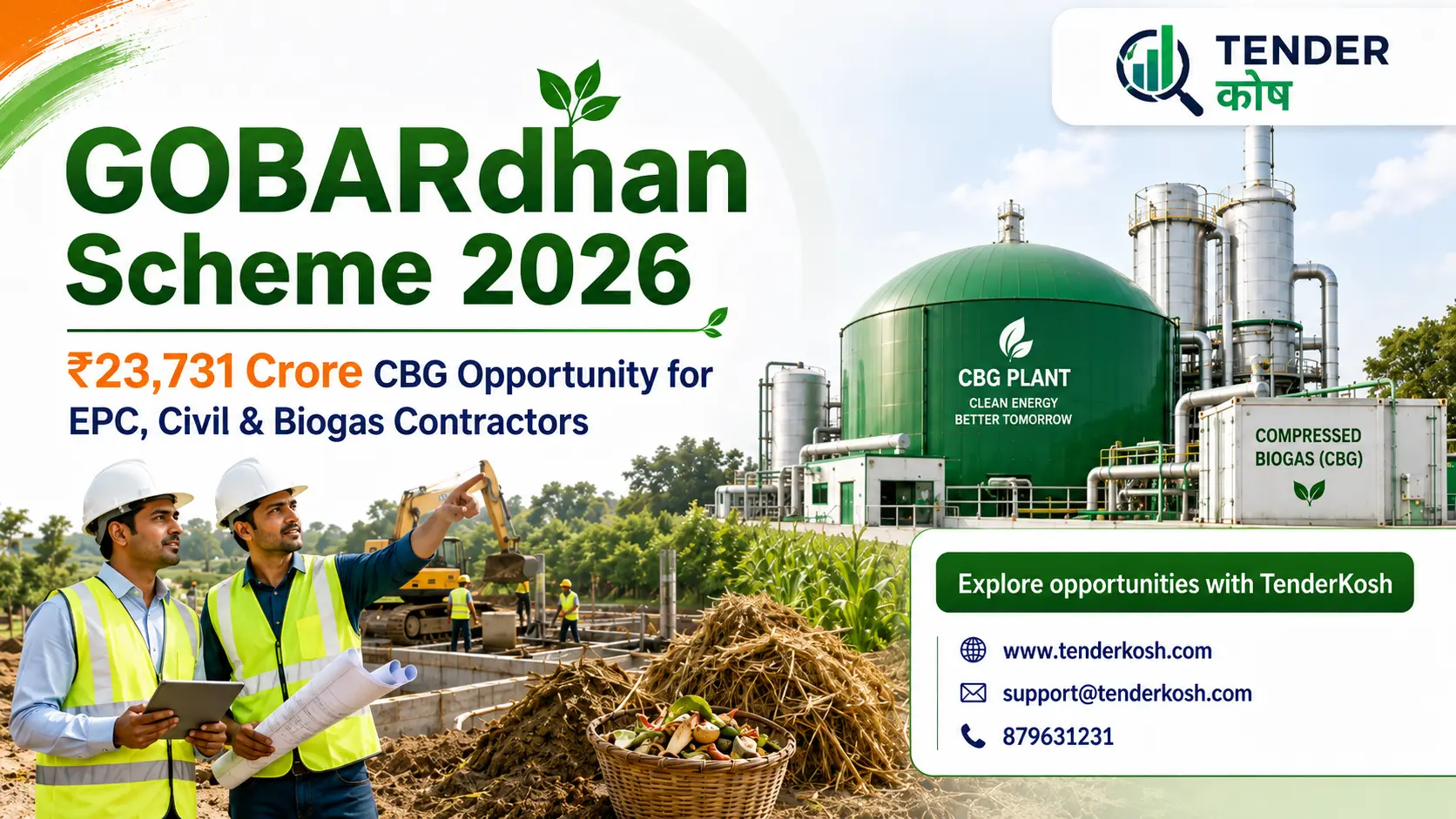
GOBARdhan CBG scheme — the National Circular Bioenergy Scheme — was approved by the Union Cabinet on 6 August 2026 with a total outlay of ₹23,731 crore, running from FY 2026-27 to FY 2035-36.
It is the largest, most integrated government push for compressed biogas India has ever made — covering the entire value chain from feedstock to offtake in one framework, administered by the Ministry of Petroleum and Natural Gas.
For biogas plant developers, EPC contractors, civil and mechanical engineering firms, biomass aggregation equipment suppliers, pipeline contractors, and rural enterprises, this scheme creates one of the clearest and most fundable procurement pipelines in India’s clean energy sector. This guide covers every component of the scheme — what is funded, who can benefit, what the procurement pathway looks like, and how to track tenders as they emerge.
Key Takeaways
On this page
GOBARdhan — Galvanizing Organic Bio-Agro Resources Dhan — was originally launched under the Swachh Bharat Mission (Grameen) in 2018 as a decentralised biogas initiative. The Union Cabinet on 6 August 2026 approved GOBARdhan (National Circular Bioenergy Scheme), a ₹23,731 crore programme aimed at scaling up compressed biogas production through assured offtake, stable pricing, capital support, pipeline connectivity and easier access to finance.
Administered by the Ministry of Petroleum and Natural Gas, the scheme creates one integrated platform across the entire CBG value chain, enabling faster implementation, stronger project economics and greater certainty for investors, lenders and developers. The scheme will be implemented from FY 2026-27 to FY 2035-36 and aims to make Compressed Biogas a major pillar of India’s future energy mix.
Compressed biogas is biogas — primarily methane — produced from the anaerobic digestion of organic matter, then purified and compressed to a pressure and quality similar to Compressed Natural Gas (CNG). It can fuel vehicles, heat homes through city gas networks, and power industrial processes.
| Property | Compressed Biogas (CBG) | CNG (for comparison) |
|---|---|---|
| Primary feedstock | Agricultural residue, cattle dung, municipal organic waste, press mud | Natural gas extracted from wells |
| Primary constituent | Methane (~90–95% after purification) | Methane (~90–95%) |
| Key advantage | Domestic, renewable, waste-converting, carbon negative on a lifecycle basis | Established infrastructure, consistent supply |
| By-product | Organic manure (FOM) — additional revenue stream for plant operators | None |
| Uses | CNG transport, domestic PNG, industrial fuel | CNG transport, domestic PNG, industrial fuel |
The strategic importance is straightforward: India spends hundreds of thousands of crores importing LNG and natural gas every year. Every cubic metre of CBG produced domestically reduces that import bill, strengthens rural livelihoods through feedstock collection, and converts organic waste that would otherwise pollute land and water.
What makes GOBARdhan structurally different from previous CBG interventions is that it addresses the entire value chain simultaneously. Earlier programmes like SATAT addressed demand but not financing. Others addressed financing but not pricing certainty. GOBARdhan covers all six constraints at once.
Mandatory blending obligations for City Gas Distribution entities create a legal, long-term demand signal for every tonne of CBG produced.
Government-administered price of ₹2,110 per MMBTU with a minimum 10-year framework — removing price uncertainty that has blocked investment.
Up to ₹2 crore per TPD for greenfield CBG plants, covering core machinery, feedstock aggregation, organic manure processing and value addition assets.
Cluster-based and standalone pipeline support to connect CBG plants with trunk pipelines and City Gas Distribution networks.
Up to 85% credit guarantee coverage on eligible loans for MSME-based CBG projects — addressing the single biggest barrier to project finance.
District-level planning, feedstock assessment, technology adoption, capacity building and stakeholder awareness — building the local ecosystem around each plant.
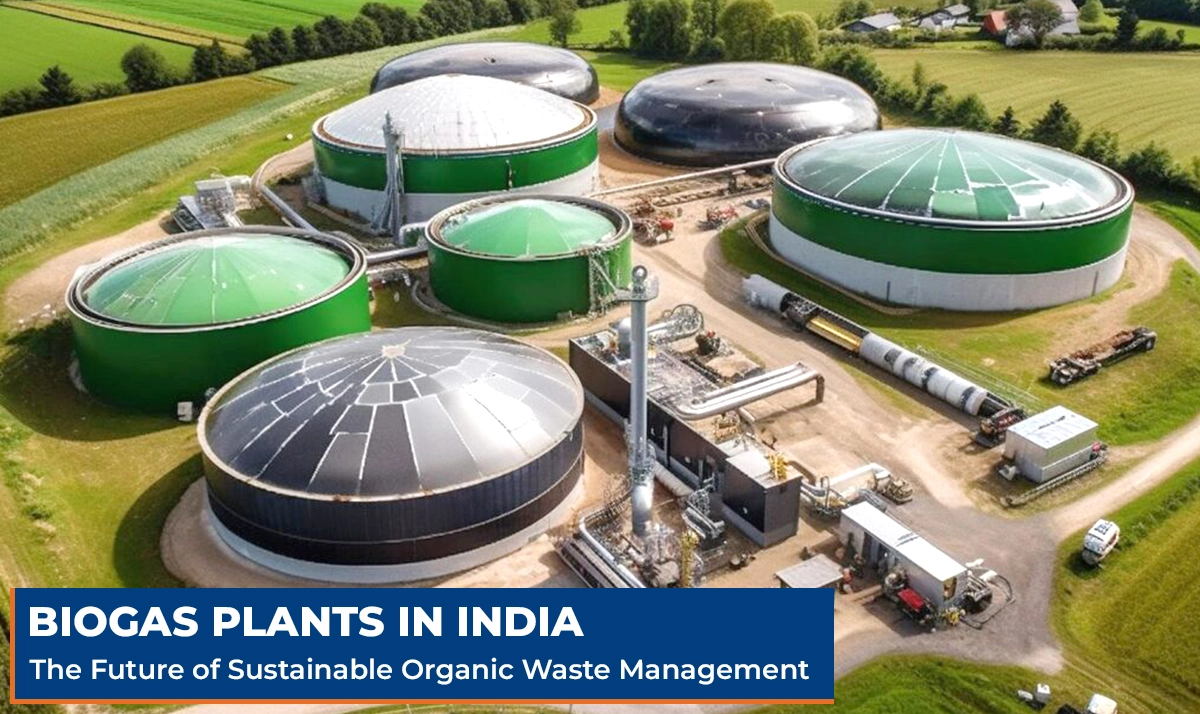
GOBARdhan establishes a dedicated CBG Offtake Assurance framework to provide a reliable and predictable market for producers. Procurement by City Gas Distribution entities will support achievement of the notified CBG Obligation trajectory of 3% in FY 2026-27, 4% in FY 2027-28 and 5% from FY 2028-29 onwards in the CNG transport and PNG domestic segments. The framework converts the blending obligation into a clear, long-term demand signal for the industry.
This is the most important structural element of the scheme for project developers and lenders. A blending obligation converts demand from speculative to mandatory — CGD entities must buy CBG, by law, up to the specified percentages. That changes the risk profile of every CBG project dramatically: revenue is no longer contingent on finding a willing buyer at the right time and price.
| Financial Year | CBG Blending Obligation | Segment |
|---|---|---|
| FY 2026-27 Current | 3% | CNG (Transport) + PNG (Domestic) |
| FY 2027-28 | 4% | CNG (Transport) + PNG (Domestic) |
| FY 2028-29 onwards | 5% | CNG (Transport) + PNG (Domestic) |
What this means for bankability: A project that can demonstrate a mandatory offtake obligation, a government-administered price, and an 85% credit guarantee is a fundamentally different financing proposition from a speculative biogas plant. Lenders and project finance desks can underwrite this — which is precisely the point.
GOBARdhan introduces a government-backed administered CBG price of ₹2,110 per MMBTU with a minimum 10-year pricing framework, providing long-term revenue visibility and durable revenue certainty for producers.
Price certainty is what has been missing from India’s CBG sector. Plant developers who built projects under earlier programmes found themselves negotiating offtake prices with CGD entities with no price floor and no guaranteed term. GOBARdhan fixes that with an administered price — meaning the government sets the price, and CGD entities procure at that rate, with the scheme’s pricing framework specifying how costs are shared between government support and the market.
Eligible greenfield CBG projects will receive capital assistance of up to ₹2 crore per tonne per day of installed CBG capacity. This support extends beyond core plant machinery to critical value-chain assets for feedstock aggregation, organic manure processing and value addition. Brownfield projects expanding their production capacity are also eligible.
Example — a 10 TPD greenfield CBG plant:
One of the most persistent barriers for CBG projects has been the cost of connecting to CGD trunk pipelines. The scheme supports cluster-based pipeline infrastructure and standalone pipeline infrastructure, facilitating connectivity between CBG plants, trunk pipelines and City Gas Distribution networks.
The pipeline infrastructure support creates direct procurement opportunities for civil contractors, pipeline laying firms, mechanical and piping contractors, and pipeline equipment suppliers. As CBG plants are commissioned across agricultural districts, pipeline tenders connecting those plants to the CGD grid will follow.
A dedicated credit guarantee mechanism will facilitate institutional finance for eligible MSME-based CBG projects, with credit guarantee coverage of up to 85% on eligible loans.
This is critical for small and medium enterprises entering the CBG sector. Banks have historically been reluctant to lend to biogas projects because of technology risk, feedstock supply uncertainty, and the absence of proven offtake arrangements. The 85% credit guarantee removes most of that risk from the lender’s balance sheet, making project loans viable for MSME-scale developers who could not previously access institutional finance.
Beyond direct financial support for plants and pipelines, GOBARdhan includes a CBG Ecosystem Challenge Fund for district-level planning, feedstock assessment, infrastructure, technology adoption, capacity building and stakeholder awareness.
This fund will generate procurement for consultancy firms, district-level feasibility study contractors, training and capacity building organisations, technology assessment agencies, and awareness campaign service providers.
| Feedstock Category | Examples | Primary Source |
|---|---|---|
| Agricultural residue | Paddy straw, wheat straw, sugarcane bagasse, crop stubble, maize stalks | Farm fields, post-harvest |
| Cattle dung | Cow dung, buffalo dung, mixed livestock manure | Dairy farms, gaushalas, villages |
| Press mud | Sugarcane press mud from sugar mills | Sugar processing units |
| Municipal organic waste | Segregated wet waste from cities, market waste, food waste | Urban local bodies, MSWM |
| Other biomass | Poultry litter, fish processing waste, food industry organic waste | Industry, agro-processing |
CBG plant construction, pipeline laying, biomass aggregation equipment, feasibility studies, and capacity building tenders will emerge across India as GOBARdhan moves to implementation. TenderKosh monitors MoPNG, CPPP, state energy departments and CGD portals in one place.
| Business Type | Opportunity Under GOBARdhan | Relevant Component |
|---|---|---|
| CBG plant developers Primary | Capital assistance up to ₹2 Cr/TPD for greenfield projects; brownfield expansion also eligible | Capital Assistance |
| EPC contractors Primary | Design, supply, and construction of CBG plants — digester, gas purification, compression, filling, FOM processing | Capital Assistance → Plant Construction |
| Civil contractors | Civil works for CBG plant construction across hundreds of sites nationwide | Plant Construction |
| Pipeline contractors | Pipeline laying connecting CBG plants to trunk pipelines and CGD networks | Pipeline Infrastructure |
| Biomass equipment suppliers | Biomass Aggregation Machinery — grant up to 50% of cost or ₹90 lakh per set | BAM Scheme (supporting) |
| MSMEs MSME | Credit guarantee up to 85% on eligible project loans | Credit Guarantee Mechanism |
| Consultancy firms | District-level feasibility studies, feedstock assessments, technology advisory, DPR preparation | Ecosystem Challenge Fund |
| Rural cooperatives & FPOs | Feedstock aggregation contracts, organic manure supply chain, rural collection networks | Ecosystem & Value Chain |
Construction of greenfield CBG plants — digester, gas purification train, compression unit, filling station, and organic manure processing. Issued by project developers receiving capital assistance.
Cluster-based and standalone pipelines connecting CBG plants to trunk pipelines and CGD networks under MoPNG’s DPI scheme — ₹994.5 crore outlay already allocated for FY 2024-29.
District-level CBG potential assessments, feedstock mapping, infrastructure planning, and Detailed Project Reports under the Ecosystem Challenge Fund.
Supply of biomass collection, transport, and storage machinery under the BAM scheme. Grant up to 50% of cost or ₹90 lakh per set for eligible CBG producers.
R&D and demonstration projects for feedstock pre-treatment, biogas upgrading, digestate processing, and efficiency improvement.
Training programmes for plant operators, district-level stakeholder awareness campaigns, and technical assistance to rural entrepreneurs under the Ecosystem Challenge Fund.
| Portal | What to Watch For |
|---|---|
| MoPNG / petroleum.nic.in | Scheme guidelines, implementing agency notifications, capital assistance application windows |
| CPPP (eprocure.gov.in) | Central government CBG plant tenders, pipeline tenders, feasibility study tenders |
| State energy departments | State-level CBG plant tenders, biomass aggregation tenders, rural enterprise support |
| GeM Portal | Equipment supply tenders, capacity building services, consultancy tenders |
| CGD entity portals | CBG offtake procurement tenders from IGL, MGL, Adani Gas, Torrent Gas and others |
| TenderKosh | All of the above in one place, with alerts the moment new GOBARdhan-related tenders are published |
Implementation timeline to watch: The scheme was approved on 6 August 2026. Detailed implementation guidelines, component-wise allocations, project eligibility criteria, and application procedures are expected to be notified by MoPNG in the coming weeks. Set up alerts now so you are positioned to respond the moment the first tenders drop.
GOBARdhan — the National Circular Bioenergy Scheme — is a ₹23,731 crore programme approved by the Union Cabinet on 6 August 2026, administered by the Ministry of Petroleum and Natural Gas and running from FY 2026-27 to FY 2035-36. It provides assured offtake, stable administered pricing, capital assistance, pipeline infrastructure, credit guarantees and ecosystem development support across India’s compressed biogas value chain.
Eligible greenfield CBG projects can receive capital assistance of up to ₹2 crore per tonne per day (TPD) of installed CBG capacity. Brownfield projects undertaking capacity expansion are also eligible. The assistance covers core plant machinery, feedstock aggregation equipment, organic manure processing assets, and value-addition infrastructure.
GOBARdhan introduces a government-backed administered CBG price of ₹2,110 per Metric Million British Thermal Unit (MMBTU), supported by a minimum 10-year pricing framework providing long-term revenue visibility and pricing certainty for producers.
City Gas Distribution (CGD) entities will procure CBG to meet the notified blending obligation: 3% in FY 2026-27, 4% in FY 2027-28, and 5% from FY 2028-29 onwards in the CNG transport and domestic PNG segments.
The scheme supports CBG production from agricultural residue (paddy straw, wheat straw, sugarcane bagasse, crop stubble), cattle dung, press mud from sugar mills, municipal organic waste, and other biomass. This allows developers to select feedstocks based on regional availability.
GOBARdhan includes a dedicated credit guarantee mechanism for eligible MSME-based CBG projects with coverage of up to 85% on eligible loans — specifically designed to reduce the financing risk that has historically made CBG project lending difficult for banks.
SATAT was a demand-side initiative — it set up offtake agreements but did not address pricing certainty, capital barriers, pipeline access, or project finance. GOBARdhan addresses all six constraints simultaneously in one integrated framework: assured demand, administered price, capital assistance, pipeline connectivity, credit guarantee, and ecosystem development.
Capital assistance is provided to eligible CBG project developers (the plant owner), not directly to EPC contractors. However, EPC contractors benefit as capital assistance flows to plant developers who then issue plant construction contracts. Pipeline infrastructure support under MoPNG’s DPI scheme is procured through government tenders in which pipeline contractors bid directly.
Discover relevant tenders, monitor corrigenda, compare opportunities, and move from document reading to structured action.