TenderKosh for EPC teams
Turn tender reading into faster bidding decisions.
Discover relevant tenders, monitor corrigenda, compare opportunities, and move from document reading to structured action.
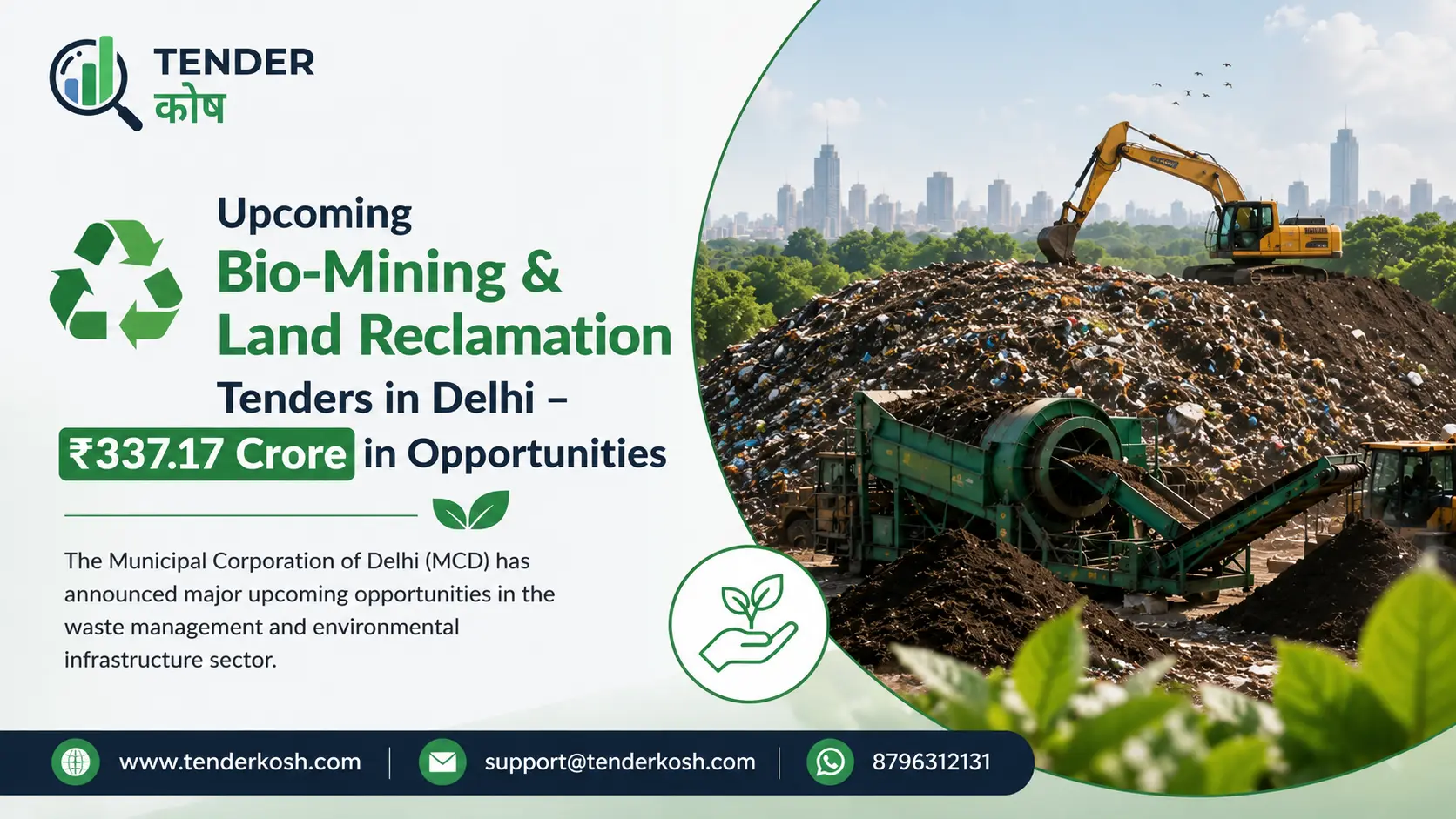
The Municipal Corporation of Delhi (MCD) has announced a major pipeline of bio-mining tenders and land reclamation work — reported at around ₹337 crore — to clear the capital’s decades-old legacy landfills. For contractors, environmental engineering firms, and infrastructure companies, this is one of the most significant urban-environment procurement opportunities in the country right now, combining large contract value with strong policy backing and a clear public mandate.
These tenders are part of a national-priority effort to remediate Delhi’s overloaded dumpsites at Okhla, Bhalswa, and Ghazipur under directions from the National Green Tribunal (NGT). This guide breaks down what these bio-mining tenders involve, why the opportunity is so substantial, who can bid, what the eligibility and EMD requirements typically look like, and exactly how firms can position to win a share of this work.
A note on figures and sourcing: The specific ₹337 crore figure is based on the announcement as reported; individual tender values, EMD amounts, and timelines vary by package and change through corrigenda. The broader context here — Delhi’s legacy landfills, the NGT-directed bio-mining model, and the procurement process — is drawn from public reporting and MCD’s own procurement framework. Always verify the exact scope, value, EMD, and dates of any specific tender against the live NIT/RFP on the Delhi government procurement portal before bidding.
Key Takeaways
Delhi’s three major legacy dumpsites — Okhla, Bhalswa, and Ghazipur — have long surpassed their operational lifespans, accumulating a very large volume of waste over decades and becoming serious environmental and public-health challenges. Under NGT directions, Delhi began large-scale bio-mining using specialised trommel machines, adopting an integrated model in which contractors are held accountable not only for excavation but also for the full disposal and optimal reuse of all bio-mined fractions.
That accountability model is what makes this a serious, execution-heavy programme rather than a simple removal contract — and it is why these bio-mining tenders are aimed at capable environmental and infrastructure firms.
Bio-mining is the process of excavating old, accumulated dumpsite waste and separating it into usable fractions, typically after a period of bio-remediation that stabilises the material. Specialised trommel screening machines sort the excavated waste, and the recovered fractions are then disposed of or reused. The end goal is to shrink the waste mountain, recover material, and reclaim the land underneath.
The legacy waste is treated and stabilised over time so it can be safely excavated and processed — a preparatory step before mechanical separation.
Waste is excavated and passed through trommel machines that separate it into soil-like material, combustible fractions, recyclables, and inert material.
Under the integrated model, contractors must ensure full disposal and reuse of every fraction, leaving reclaimed land ready for productive use.
Beyond the headline value, several features make MCD’s bio-mining tenders especially attractive to the right firms. Few municipal opportunities combine this scale with this little qualified competition, which is what sets these bio-mining tenders apart.
| Feature | Why It Matters to Bidders |
|---|---|
| Large Contract Value | Substantial package sizes support serious mobilisation of machinery and manpower over a multi-quarter execution window |
| Strong Policy Backing | NGT directions and Swachh Bharat priorities mean the programme is a genuine, funded priority rather than a speculative announcement |
| Specialised Barrier to Entry | Bio-mining needs trommel fleets, environmental expertise, and disposal capability — fewer qualified competitors than in generic civil works |
| Follow-On Demand | Reclaimed sites are earmarked for fresh waste processing facilities, creating downstream opportunities in equipment, EPC, and O&M |
| Replicable Model | Delhi’s approach is being positioned as a model for other cities — capability built here can travel to future municipal tenders nationwide |
The bigger picture: Reclaimed landfill land in Delhi is earmarked for new, modern waste-processing facilities. That means winning bio-mining work is not just a one-off contract — it positions a firm within a broader circular-waste ecosystem, with follow-on demand in fresh-waste processing, equipment supply, and long-term operations across multiple sites.
MCD bio-mining tenders are aimed at firms that can prove they can execute large environmental projects reliably. While exact terms across different bio-mining tenders vary by RFP, the typical requirements follow a consistent pattern.
| Requirement | What to Expect |
|---|---|
| Bid Structure | Double-bid system — separate technical and financial bids, evaluated in that order |
| Experience | Strong track record in large-scale environmental / waste-management projects; some RFPs open to registered and unregistered firms with proven capability |
| EMD | Substantial for large packages (earlier bio-mining tenders required EMD running into crores), often part online plus part bank guarantee |
| Tender Fee | Non-refundable processing fee as specified in the RFP |
| Registration & DSC | Vendor registration on the Delhi government procurement portal and a valid Class 3 Digital Signature Certificate |
| Execution Commitments | Daily processing targets and quarterly progress plans to ensure timely completion |
Plan for the EMD. Large bio-mining packages have historically carried significant Earnest Money Deposits — in earlier MCD tenders, running into crores, split between online payment and bank guarantee. Factor this working-capital requirement into your bid decision early. For how to get every compliance detail right before submission, see our tender compliance checklist.
Winning MCD bio-mining tenders takes more than intent — it takes registration, capability, and financial readiness lined up before the RFP closes. Here is how to position your firm.
Register as a vendor on the Delhi government procurement portal (govtprocurement.delhi.gov.in) and obtain a valid Class 3 Digital Signature Certificate — both are prerequisites to bid.
Assemble or partner for trommel fleets, environmental expertise, and disposal/reuse capacity. The technical bar is what keeps competition lower — and margins healthier.
Compile documented proof of similar large-scale environmental or waste-management projects — this is central to clearing the technical bid.
Arrange for the substantial EMD and bank guarantee, plus mobilisation funds. Under-preparing on finance is a common reason capable firms miss large tenders.
High-value tenders often see amendments to scope, EMD, or deadlines. Missing one can disqualify a strong bid — see our guide to finding corrigenda.
If you lack one capability — say trommel capacity or disposal reach — a JV or subcontracting arrangement can help you meet qualification and share execution risk.
MCD’s bio-mining and land reclamation pipeline is just part of a growing wave of municipal environmental tenders across India. TenderKosh tracks tenders and corrigenda across 1,000+ government procurement portals — including MCD and municipal bodies — so you catch high-value bio-mining and waste-management opportunities early and bid against the latest requirements.
Browse Live Tenders View Plans Why TenderKoshMCD’s announced ₹337 crore in bio-mining and land reclamation tenders is more than a big procurement number — it is part of a national-priority mission to reclaim Delhi’s legacy landfills and turn waste mountains into usable land. For firms chasing these bio-mining tenders — contractors, environmental engineering firms, and infrastructure companies — it offers large contract value, strong policy backing, a specialised barrier to entry that limits competition, and follow-on demand as reclaimed sites become fresh waste-processing hubs.
The firms that win will be those that build genuine bio-mining capability, prepare rock-solid experience and financial documentation, and track every tender and corrigendum closely. Get those right, and this programme can be an entry point into one of the fastest-growing segments of India’s municipal procurement market.
MCD’s bio-mining and land reclamation tenders are procurement opportunities floated by the Municipal Corporation of Delhi to clear and reclaim its legacy landfill sites at Okhla, Bhalswa, and Ghazipur. Under the integrated bio-mining and bio-remediation model, contractors excavate decades-old accumulated waste, process it using specialised trommel machines, and are held accountable for the disposal and reuse of all bio-mined fractions so the land underneath can be reclaimed. Recent reporting points to a large pipeline of such tenders, including an announced package worth around ₹337 crore.
Bio-mining of legacy waste is the process of excavating old, accumulated dumpsite waste and separating it into usable fractions — such as soil-like material, combustible refuse-derived fuel, recyclables, and inert material — usually with trommel screening machines after a period of bio-remediation. The goal is to reduce the mountain of legacy waste, recover reusable material, and reclaim the underlying land for productive use. In Delhi, bio-mining is being carried out under directions from the National Green Tribunal to remediate the city’s overloaded legacy dumpsites.
MCD bio-mining tenders are typically open to agencies and firms with a strong track record in large-scale environmental and waste-management projects. Depending on the specific RFP, both registered and unregistered firms with relevant experience may be eligible. Bidders generally need to register on the Delhi government procurement portal, hold a valid Class 3 Digital Signature Certificate, meet turnover and similar-work experience thresholds, and furnish the specified Earnest Money Deposit, which for large bio-mining packages has been substantial.
Delhi’s three major legacy dumpsites being reclaimed through bio-mining are Okhla, Bhalswa, and Ghazipur, which together cover a large area under MCD’s jurisdiction and had accumulated a very large volume of legacy waste over decades. Under the National Green Tribunal’s directions, MCD has been running bio-mining and bio-remediation to clear these sites, with reported targets to reclaim the legacy waste land at sites such as Okhla and Bhalswa within defined timelines and to set up fresh waste processing facilities on the reclaimed land.
Environmental and infrastructure firms can find MCD bio-mining tenders on the Delhi government e-procurement portal (govtprocurement.delhi.gov.in), where MCD publishes its RFPs and NITs. Firms should register as vendors, obtain a Class 3 Digital Signature Certificate, and monitor the waste-management and sanitation category. Because high-value tenders and their corrigenda can be easy to miss on a single portal, many firms also use a tender-tracking platform to receive alerts on relevant bio-mining and land reclamation opportunities across portals.
This article is general information, not advice. It has been compiled from publicly available sources — government releases and notifications, official portals, published tender documents and trade reporting — and reflects our understanding at the time of writing. It is not legal, financial, tax or professional advice, and it does not create any advisory relationship.
Public procurement changes constantly. Tender terms, eligibility criteria, thresholds, fees, deadlines, scheme conditions and government policy are revised frequently, often through corrigenda issued mid-window and sometimes without wide notice. Figures and rules that were accurate when published may already have changed by the time you read this.
Always verify against the primary source before you act or bid. The tender document, the issuing authority's official portal and the relevant government notification are the authoritative sources. Where anything in this article differs from them, the official source prevails. Do not rely on this page — or on any third-party summary — as the basis for a bid, an investment or a compliance decision.
TenderKosh is a private tender-intelligence platform. We are not a government body, and we are not affiliated with, endorsed by or acting on behalf of any government department, ministry, PSU or procurement portal. Names, marks and portals referenced belong to their respective owners and are used for identification only. External links are provided for convenience; we do not control and are not responsible for third-party content.
While we take reasonable care, we make no warranty as to the accuracy, completeness or currency of this content, and accept no liability for any loss or damage arising from reliance on it.Spotted something wrong or out of date? Please tell us at support@tenderkosh.com — we correct errors promptly.See our full Disclaimer.
Discover relevant tenders, monitor corrigenda, compare opportunities, and move from document reading to structured action.