TenderKosh for EPC teams
Turn tender reading into faster bidding decisions.
Discover relevant tenders, monitor corrigenda, compare opportunities, and move from document reading to structured action.
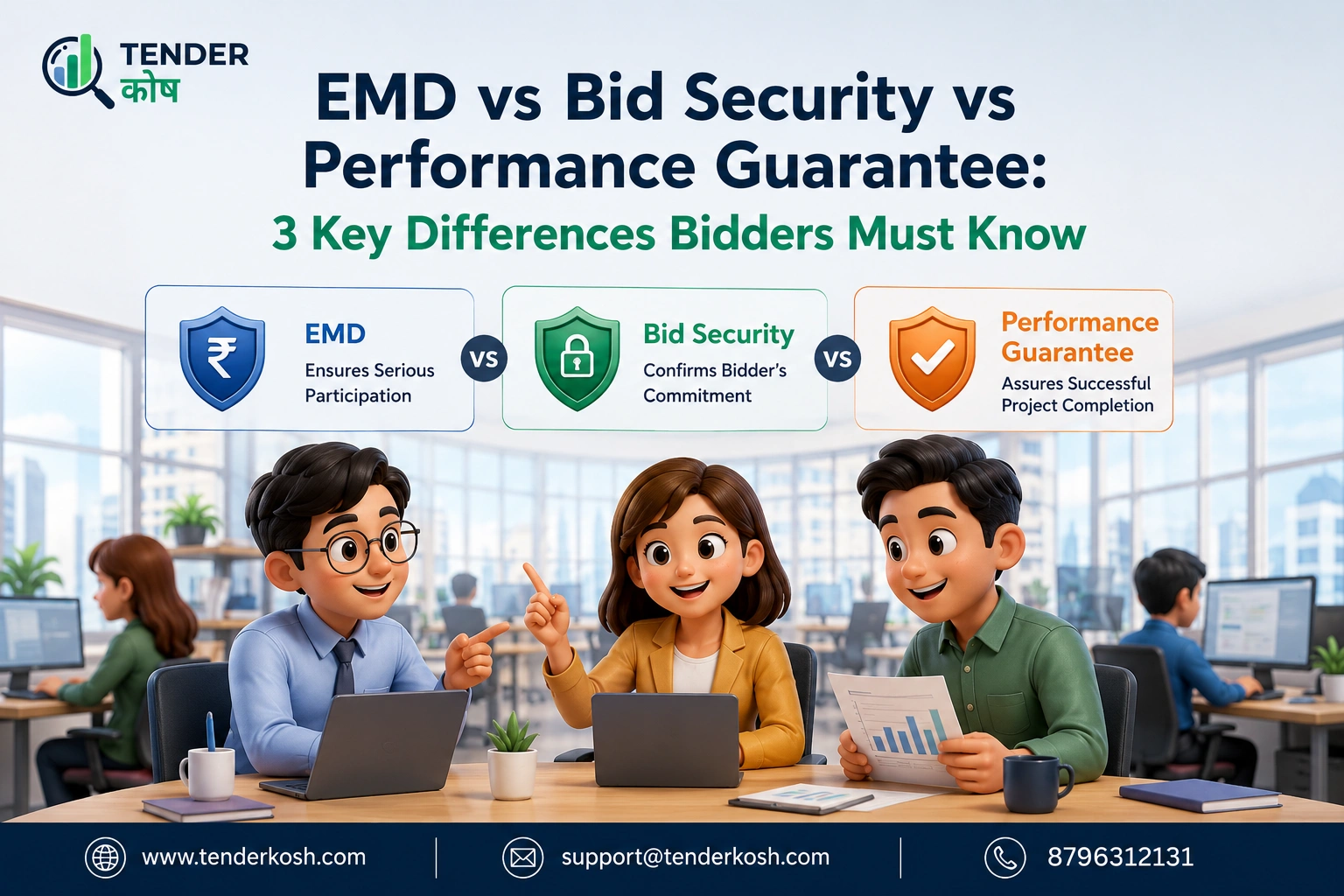
Few things trip up new government bidders more than the money terms in a tender. EMD, bid security, and performance guarantee all involve depositing funds or furnishing a bank guarantee — and they are constantly confused with one another. Getting them wrong is not a minor slip: submit the wrong amount at the wrong stage, and your bid can be rejected or your contract delayed. Understanding EMD vs bid security and how both differ from a performance guarantee is essential for anyone bidding on government work.
This guide explains each term in plain language, shows exactly when each applies, compares the amounts and purposes side by side, and covers the MSME exemptions that can free up your working capital. By the end, you will know precisely what to furnish, when, and how much — so a financial technicality never costs you a tender again.
Key Takeaways
This is the most common confusion, so let’s settle it first: in the vast majority of government tenders, EMD and bid security mean the same thing. Both refer to a refundable amount that a bidder submits along with the bid to demonstrate serious intent and to protect the buyer if the bidder backs out.
The difference is purely terminology and era. Traditional Indian tender documents call it “Earnest Money Deposit” or EMD. Modern procurement frameworks and General Financial Rules increasingly use the term “bid security”. When you see both in the EMD vs bid security debate, treat them as the same requirement unless a specific tender explicitly defines them differently — which is rare.
The simple rule: If a tender asks for “EMD” or “bid security”, it wants the same thing — a refundable deposit or bank guarantee submitted with your bid. Do not submit it twice, and do not treat them as two separate requirements. Read the tender’s definitions once, and you’ll see they point to the same clause.
The performance guarantee (also called performance security or PBG — Performance Bank Guarantee) is a genuinely separate instrument, and confusing it with EMD is what causes real problems. The distinction is about timing and purpose.
Submitted with the bid, before award. It protects the buyer during the bidding stage — ensuring you don’t withdraw your bid or refuse the contract if you win.
Furnished after you win, before the contract starts. It protects the buyer during execution — ensuring you actually complete the work as agreed.
When you win, you submit the performance guarantee and sign the contract — and your EMD is then refunded. One protection replaces the other.
Here is the complete comparison in one view. This is the table to save.
| Parameter | EMD / Bid Security | Performance Guarantee |
|---|---|---|
| When submitted | With the bid, before award | After winning, before contract starts |
| Purpose | Shows serious intent; protects buyer during bidding | Guarantees completion; protects buyer during execution |
| Typical amount | Around 2–3% of estimated tender value | Larger — commonly around 3–10% of contract value |
| Who submits it | Every bidder (unless exempt) | Only the winning bidder |
| Form | Online payment, demand draft, or bank guarantee as specified | Usually a bank guarantee (PBG) or specified instrument |
| When returned | After tender decided / on furnishing performance guarantee | After successful completion and defect-liability period |
| MSME relief | Commonly fully exempt with Udyam registration | Often reduced for MSMEs (relief varies) |
Because EMD sits at the bid stage, it is where most financial rejections happen. Understanding how it works protects both your bid and your money.
EMD is typically a small percentage of the estimated tender value — often around 2% to 3%, though the exact figure and accepted forms are always specified in the tender. It may be payable online, by demand draft, or via a bank guarantee in a prescribed format and validity. The tender’s instructions are binding: an incorrect amount, format, or validity can make the bid non-responsive.
| EMD Is Refunded When | EMD Is Forfeited When |
|---|---|
| You are an unsuccessful bidder and the tender is decided | You withdraw or modify your bid during its validity period |
| You win and furnish the performance guarantee and sign the contract | You win but fail to accept the award or sign the contract |
| The tender is cancelled before award (as per terms) | You win but fail to furnish the required performance guarantee |
EMD mistakes are a leading cause of bid rejection. Wrong amount, invalid bank guarantee format, insufficient validity, an unapproved payment method, or submission after the deadline — any one can make your bid non-responsive before your price is even seen. Always match the EMD clause exactly, and re-check it against the latest corrigendum. See our deeper look at tender rejection over EMD and documentation errors.
The performance guarantee only becomes relevant once you win — but planning for it early matters, because it is a larger commitment than EMD and ties up more working capital or bank-guarantee limits.
Commonly a bigger percentage of contract value than EMD — often in the 3–10% range depending on the authority and contract type.
Typically furnished as a Performance Bank Guarantee (PBG) in a prescribed format, valid through the contract and any defect-liability period.
Returned after successful completion and the defect-liability period — later than EMD, so plan your bank-guarantee limits accordingly.
This is where MSMEs gain a real edge. Under government procurement policy, registered Micro and Small Enterprises are commonly exempt from EMD / bid security altogether — a significant advantage, since it frees working capital that would otherwise be locked for the whole bidding cycle. Performance security requirements are also frequently reduced for MSMEs, though a smaller performance guarantee may still apply after award.
Claim it correctly, or lose it. MSME relief on EMD and performance security only applies if claimed properly, with valid Udyam registration and details that match your bid. Do not assume the exemption is automatic — attach the right documents and check each tender’s specific terms. For the full set of provisions, see our guide on MSME benefits in government tenders.
EMD amounts, bid-security formats, and performance-guarantee terms change from tender to tender — and through corrigenda. TenderKosh tracks tenders and their amendments across 1,000+ government procurement portals, alerting you to changes in EMD, security, and deadlines, so you always furnish the right amount, in the right form, at the right stage.
Browse Live Tenders View Plans Why TenderKoshThe confusion around these three terms is easily resolved once you fix the timeline in your mind. EMD and bid security are the same thing — a refundable deposit submitted with your bid to show you’re serious. The performance guarantee is a separate, larger instrument furnished only after you win, to guarantee you complete the work. One protects the buyer while choosing a contractor; the other protects the buyer while the contractor delivers.
Get the EMD vs bid security distinction right (they’re identical), keep the performance guarantee mentally separate (different stage, bigger amount), claim your MSME exemptions correctly, and match every figure exactly to the tender. Do that, and these financial requirements become a routine step rather than a hidden trap that costs you the work.
EMD (Earnest Money Deposit) and bid security are effectively the same thing, and the terms are used interchangeably in most government tenders. Both refer to a refundable amount a bidder submits along with the bid to demonstrate serious intent. It is forfeited if the bidder withdraws during the bid validity period or, after winning, fails to accept the contract or furnish the performance guarantee. Modern procurement documents increasingly use the term “bid security”, while “EMD” remains the traditional and still very common name for the same requirement.
Bid security (EMD) is submitted with the bid, before award, to show the bidder is serious and will honour the bid. A performance guarantee (also called a performance security or PBG) is submitted only after winning the tender, before the contract begins, to guarantee that the awarded work will be completed as agreed. In short, bid security protects the buyer during the bidding stage, while the performance guarantee protects the buyer during the execution stage. They apply at different points and are usually different amounts.
EMD or bid security is typically a small percentage of the estimated tender value, often around 2% to 3%, though the exact figure is specified in each tender. The performance guarantee is usually a larger percentage of the contract value — commonly in the range of 3% to 10% depending on the procuring authority and contract type. Both figures are set out in the tender document, and bidders must match them exactly, since an incorrect amount can lead to rejection at the bid stage or delay at the contract stage.
Under government procurement policy, registered Micro and Small Enterprises are commonly exempt from paying EMD or bid security, which frees up working capital during bidding. Performance security requirements have also been reduced for MSMEs in many cases, though a reduced performance guarantee may still apply after award. Exemptions must be claimed correctly with valid Udyam registration and supporting documents, and the exact relief available is stated in the tender, so bidders should always confirm the terms of each specific tender.
EMD or bid security is refunded to unsuccessful bidders after the tender is decided, and to the successful bidder once they furnish the performance guarantee and sign the contract. It is forfeited if a bidder withdraws or modifies their bid during the validity period, or if the winning bidder fails to accept the award or provide the required performance security. Because forfeiture is tied to specific breaches, understanding exactly when EMD is at risk helps bidders avoid losing it unnecessarily.

This article is general information, not advice. It has been compiled from publicly available sources — government releases and notifications, official portals, published tender documents and trade reporting — and reflects our understanding at the time of writing. It is not legal, financial, tax or professional advice, and it does not create any advisory relationship.
Public procurement changes constantly. Tender terms, eligibility criteria, thresholds, fees, deadlines, scheme conditions and government policy are revised frequently, often through corrigenda issued mid-window and sometimes without wide notice. Figures and rules that were accurate when published may already have changed by the time you read this.
Always verify against the primary source before you act or bid. The tender document, the issuing authority's official portal and the relevant government notification are the authoritative sources. Where anything in this article differs from them, the official source prevails. Do not rely on this page — or on any third-party summary — as the basis for a bid, an investment or a compliance decision.
TenderKosh is a private tender-intelligence platform. We are not a government body, and we are not affiliated with, endorsed by or acting on behalf of any government department, ministry, PSU or procurement portal. Names, marks and portals referenced belong to their respective owners and are used for identification only. External links are provided for convenience; we do not control and are not responsible for third-party content.
While we take reasonable care, we make no warranty as to the accuracy, completeness or currency of this content, and accept no liability for any loss or damage arising from reliance on it.Spotted something wrong or out of date? Please tell us at support@tenderkosh.com — we correct errors promptly.See our full Disclaimer.
Discover relevant tenders, monitor corrigenda, compare opportunities, and move from document reading to structured action.