TenderKosh for EPC teams
Turn tender reading into faster bidding decisions.
Discover relevant tenders, monitor corrigenda, compare opportunities, and move from document reading to structured action.
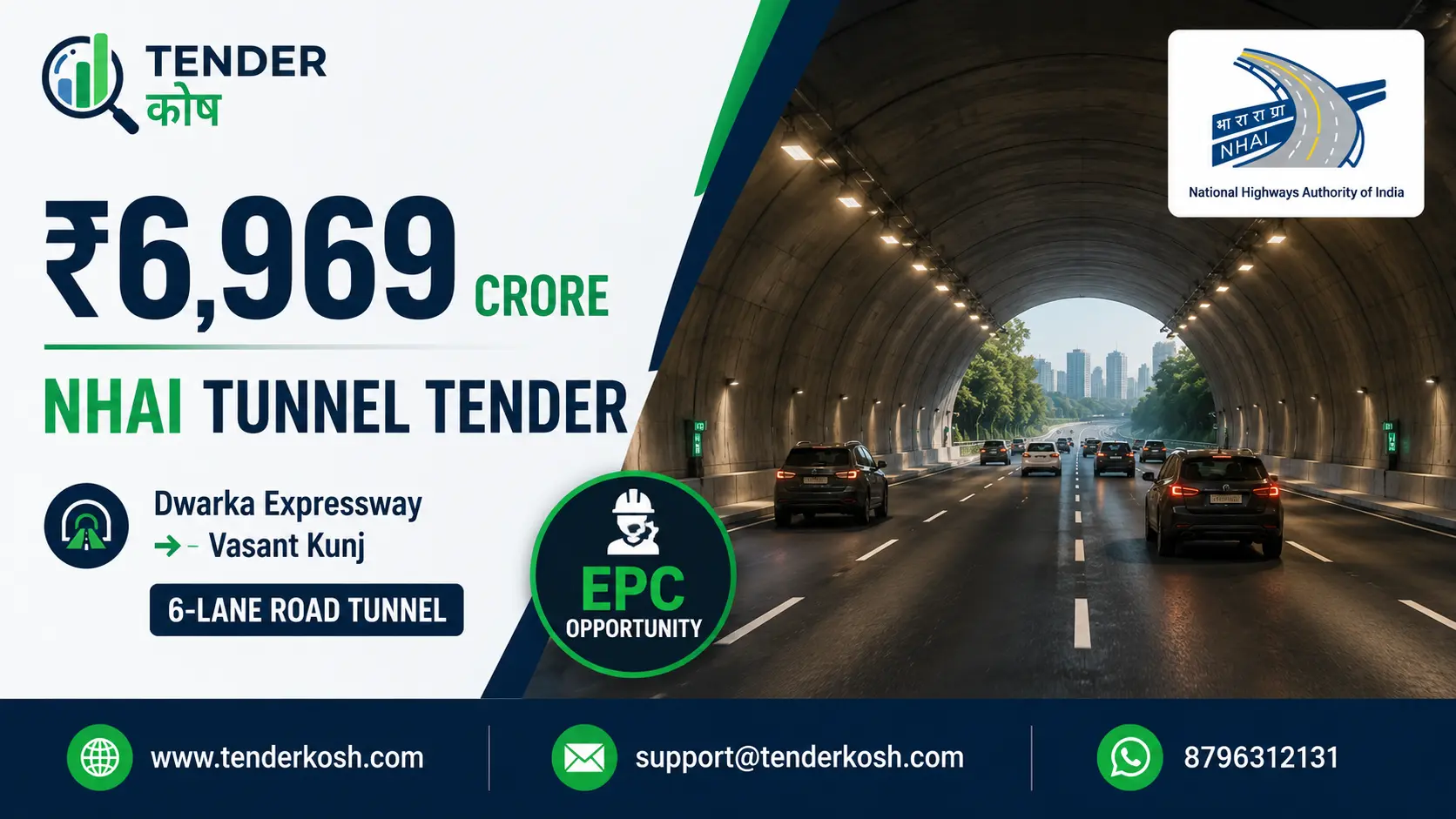
On July 1, 2026, the Cabinet Committee on Economic Affairs (CCEA) approved one of Delhi’s most significant road-infrastructure projects in years: an 8.1 km, six-lane road tunnel connecting the Dwarka Expressway with Nelson Mandela Marg in Vasant Kunj, at an estimated cost of about ₹6,969 crore under the Hybrid Annuity Mode (HAM). For large infrastructure and EPC contractors, this signals a high-value NHAI tunnel tender on the horizon — and the firms that prepare now will be best placed to compete when the formal Request for Proposal is floated.
This guide breaks down exactly what has been approved, why the project matters, what the HAM model means for bidders, and how contractors and suppliers can position themselves for the upcoming NHAI tunnel tender. Whether you are a lead EPC bidder, a specialist tunnelling firm, or a sub-contractor, this is the Delhi-NCR opportunity to have on your radar.
Important — status of this project: As of early July 2026, this is a CCEA cabinet approval, not yet a floated construction tender. The ₹6,969 crore figure is the sanctioned project cost reported by multiple outlets (Business Standard, News9, Fiinews) following the July 1, 2026 approval. The formal NHAI tunnel tender — with contractor eligibility, EMD, packaging, and timelines — is expected to follow. Always verify the exact scope and terms against NHAI’s official Request for Proposal once published. Figures here are drawn from public reporting of the cabinet approval.
Key Takeaways
| Parameter | Detail |
|---|---|
| Approving Authority | Cabinet Committee on Economic Affairs (CCEA) |
| Approval Date | July 1, 2026 |
| Implementing Agency | National Highways Authority of India (NHAI) |
| Corridor | Dwarka Expressway (NH-248BB) to Nelson Mandela Marg, Vasant Kunj |
| Start Point | Shiv Murti Interchange on Dwarka Expressway |
| Total Length | 8.1 km (incl. ~3.14 km tunnel, approach ramps, elevated & at-grade sections) |
| Estimated Cost | ~₹6,969 crore |
| Delivery Model | Hybrid Annuity Mode (HAM), NH (O) scheme |
The approved project is more than a simple tunnel — it is an integrated 8.1 km corridor. According to reporting of the cabinet approval, the alignment starts at the Shiv Murti Interchange on the Dwarka Expressway and ends before the intersection of Nelson Mandela Marg and the Mahipalpur-Chhatarpur Road. The length is made up of a main carriageway, a tunnel section of around 3.14 km, tunnel approach ramps, an elevated stretch, and an at-grade road, with additional structures such as a flyover and an elevated U-turn planned along the corridor.
This mix of tunnelling, elevated, and at-grade work is exactly why the eventual NHAI tunnel tender will demand serious engineering credentials — it is not a straightforward road contract, but a complex urban-infrastructure package.
The tunnel is designed to relieve some of Delhi-NCR’s most congested corridors and strengthen airport connectivity. Understanding its strategic value helps explain why it is a national priority — and why the tender pipeline behind it is worth tracking.
It provides faster connectivity between West and South Delhi, easing pressure on already congested surface roads through Mahipalpur and Vasant Kunj.
Traffic from Gurugram, Dwarka, and IGI Airport toward South Delhi benefits directly — valuable for airport users, cargo, and business travellers.
It is designed to integrate with the proposed AIIMS-Mahipalpur elevated corridor and the wider UER-II and Dwarka Expressway network.
Employment and economic impact: Beyond mobility, projects of this scale generate substantial employment during construction — reporting of the approval cites lakhs of person-days of direct and indirect employment. For the contracting ecosystem, that translates into demand for manpower, machinery, materials, and specialist services across the full build period.
The project’s delivery model matters as much as its size. Under Hybrid Annuity Mode, the risk and financing are shared between the government and the private concessionaire — which shapes who bids and how.
| HAM Feature | What It Means for the Contractor |
|---|---|
| Government Funds a Share | A portion of the project cost is typically paid by the government during construction, reducing the private partner’s upfront financing burden |
| Private Partner Funds the Balance | The concessionaire arranges the remaining finance and executes construction |
| Annuity Repayment | The private partner is repaid through annuity payments over the operation period, along with interest |
| Shared Risk | Risk is split between government and concessionaire, making HAM more attractive than pure BOT for many large firms |
Because HAM lowers the upfront capital hurdle compared with pure Build-Operate-Transfer models, it typically draws strong interest from established infrastructure players — which means the eventual NHAI tunnel tender is likely to be competitive at the top end.
A tunnel package of this value and complexity is aimed at major infrastructure and EPC companies. But the opportunity extends well beyond the handful of firms that can bid as lead concessionaires.
| Typical Requirement for Lead Bidders | What to Expect |
|---|---|
| Turnover | Significant annual turnover thresholds befitting a multi-thousand-crore project |
| Experience | Proven track record in similar large-value highway and tunnelling works |
| Technical Capability | Specialised tunnelling expertise, equipment, and qualified personnel |
| Financial Capacity | Ability to arrange HAM financing and furnish substantial bid security |
| Registration & DSC | Registration on NHAI and central procurement systems, with a valid digital signature |
Opportunities for smaller firms: Even if you cannot bid as the lead concessionaire, a project of this scale creates a deep sub-tier pipeline — sub-contracting packages, joint-venture roles, and supply of materials, equipment, and specialist services (tunnel lining, ventilation, electrical, safety systems, and more). Positioning as a reliable sub-contractor or supplier to the eventual winner is a realistic route in for MSMEs and specialist firms.
Because this is an approved project with the tender still to follow, the smart move is to prepare now rather than scramble when the RFP appears. Here is how to get ready.
Ensure your firm is registered on NHAI and central procurement systems with a valid Class 3 digital signature, so you can access and bid on the tender the moment it is floated.
Compile turnover records, similar-work and tunnelling experience certificates, and financial documents now — these are what clear the technical bid on complex packages.
For HAM, arrange financing capacity and, if needed, joint-venture partners with complementary tunnelling or financial strength before the RFP window opens.
If bidding as a supplier or sub-contractor, identify exactly where your capability fits — tunnelling systems, materials, electrical, ventilation, or safety — and prepare your pitch.
Monitor NHAI channels for the RFP and watch for corrigenda once it is live. See our guide on tracking tender corrigenda.
High-value tenders are won on compliance as much as capability. Build your checklist now — see our tender compliance checklist.
A cabinet-approved project like this can convert into a floated RFP with little notice — and may be issued in packages. TenderKosh tracks NHAI and infrastructure tenders across 1,000+ government procurement portals, with alerts on new tenders and corrigenda, so you are ready to respond the moment the NHAI tunnel tender is published.
Browse Live Tenders View Plans Why TenderKoshNHAI’s ₹6,969 crore Dwarka Expressway tunnel is a marquee Delhi-NCR infrastructure project — an 8.1 km, six-lane HAM corridor cleared by the CCEA on July 1, 2026, designed to reshape connectivity between West and South Delhi. While it is a cabinet approval today rather than a live tender, the construction NHAI tunnel tender is expected to follow, and it will be one of the most closely watched infrastructure bids of the coming period.
For contractors, the message is simple: prepare early. Get your registrations, eligibility evidence, financing, and joint-venture options in place now, decide whether you are competing as a lead bidder or positioning as a sub-contractor or supplier, and track NHAI’s channels so you never miss the RFP or a corrigendum. The firms that treat this approval as a starting gun — not just a news headline — are the ones that will be ready to win a share of the work.
The NHAI Dwarka Expressway tunnel project is an approved 8.1 km, six-lane road tunnel connecting the Dwarka Expressway (NH-248BB) with Nelson Mandela Marg in Vasant Kunj, Delhi. The Cabinet Committee on Economic Affairs (CCEA) approved it on July 1, 2026 at an estimated cost of about ₹6,969 crore under the Hybrid Annuity Mode (HAM). It is designed to improve connectivity between West and South Delhi and benefit traffic from Gurugram, Dwarka, and IGI Airport. The construction tender is expected to follow the cabinet approval.
The project has been approved at an estimated capital cost of around ₹6,969 crore (reported precisely as about ₹6,969.67 crore) under the Hybrid Annuity Mode. This figure is the sanctioned project cost following CCEA approval; the exact value, packaging, and terms of the construction tender will be confirmed when NHAI floats the formal Request for Proposal. Contractors should confirm the tender value against the official NHAI notification once it is published.
Hybrid Annuity Mode (HAM) is a public-private partnership model NHAI uses for highway projects. Under HAM, the government typically funds a portion of the project cost during construction, while the private developer arranges the balance and is repaid through annuity payments over the operation period along with interest. HAM shares risk between the government and the concessionaire, which is attractive to large infrastructure and EPC firms because it reduces the private partner’s upfront financing burden compared with pure BOT models.
Large NHAI tunnel and highway tenders are typically open to established infrastructure and EPC companies that meet stringent eligibility criteria — significant annual turnover, demonstrated experience in similar large-value highway or tunnelling projects, financial capacity, and technical capability including specialised tunnelling expertise. Bidders usually need to register on NHAI and central procurement systems, hold a valid digital signature, and furnish substantial bid security. Smaller firms often participate as sub-contractors, joint-venture partners, or suppliers rather than lead bidders.
Contractors can track the NHAI tunnel tender by monitoring NHAI’s official tendering channels and the central procurement portals where NHAI publishes its Requests for Proposal, along with NHAI’s project announcements. Because a cabinet-approved project can take time to convert into a floated tender and may be issued in packages, firms often use a tender-tracking platform that consolidates NHAI and infrastructure tenders — with alerts on new tenders and corrigenda — so they are ready to respond the moment the RFP is published.
This article is general information, not advice. It has been compiled from publicly available sources — government releases and notifications, official portals, published tender documents and trade reporting — and reflects our understanding at the time of writing. It is not legal, financial, tax or professional advice, and it does not create any advisory relationship.
Public procurement changes constantly. Tender terms, eligibility criteria, thresholds, fees, deadlines, scheme conditions and government policy are revised frequently, often through corrigenda issued mid-window and sometimes without wide notice. Figures and rules that were accurate when published may already have changed by the time you read this.
Always verify against the primary source before you act or bid. The tender document, the issuing authority's official portal and the relevant government notification are the authoritative sources. Where anything in this article differs from them, the official source prevails. Do not rely on this page — or on any third-party summary — as the basis for a bid, an investment or a compliance decision.
TenderKosh is a private tender-intelligence platform. We are not a government body, and we are not affiliated with, endorsed by or acting on behalf of any government department, ministry, PSU or procurement portal. Names, marks and portals referenced belong to their respective owners and are used for identification only. External links are provided for convenience; we do not control and are not responsible for third-party content.
While we take reasonable care, we make no warranty as to the accuracy, completeness or currency of this content, and accept no liability for any loss or damage arising from reliance on it.Spotted something wrong or out of date? Please tell us at support@tenderkosh.com — we correct errors promptly.See our full Disclaimer.
Discover relevant tenders, monitor corrigenda, compare opportunities, and move from document reading to structured action.