TenderKosh for EPC teams
Turn tender reading into faster bidding decisions.
Discover relevant tenders, monitor corrigenda, compare opportunities, and move from document reading to structured action.
In government tendering, the most painful losses are not the ones where a competitor simply quoted lower. They are the ones where a fully capable, well-priced bid is thrown out before evaluators ever look at it — because of a missing document, an incorrect EMD, or an unsigned declaration. A disciplined tender compliance checklist is the single most effective tool to prevent that, and it takes only minutes to run.
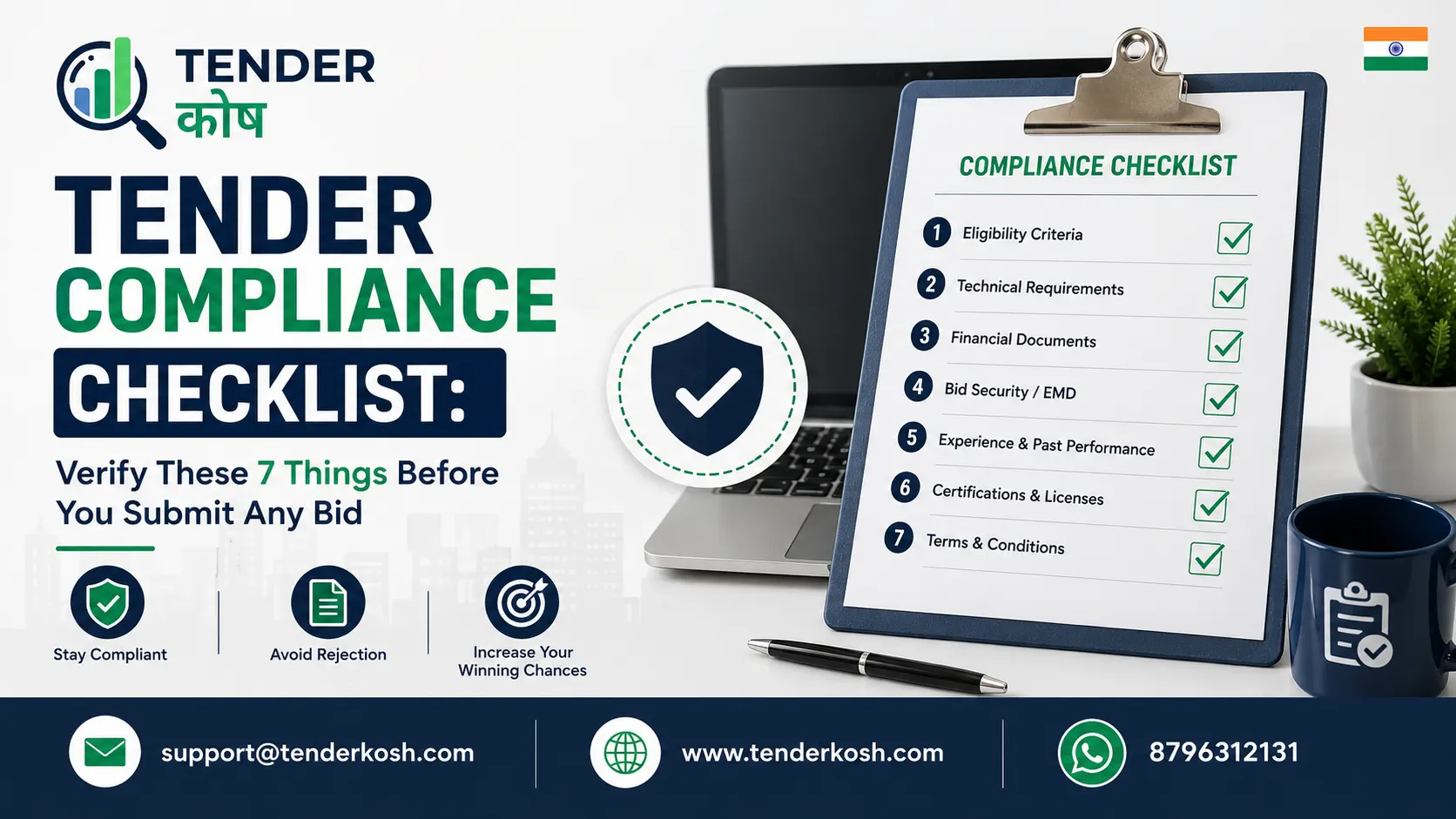
This guide gives you a complete, practical compliance checklist to run before every submission, organised into the seven areas that decide whether your bid survives the first cut. Whether you are an MSME, a contractor, or an EPC firm, working through these checks before you submit is what separates the bids that get evaluated from the bids that get rejected.
Key Takeaways
Many bidders assume technical evaluation begins with experience, machinery, and capability. In reality, the first thing an evaluation committee checks is compliance: did the bidder follow every tender condition exactly? Only bids that clear this filter advance to detailed technical scoring and, eventually, price comparison. Skip a requirement, and your bid is ruled non-responsive — regardless of how strong it is.
| Evaluation Stage | What Is Checked | If You Fail |
|---|---|---|
| 1. Compliance Review First Filter | EMD, documents, declarations, registrations, eligibility | Immediate rejection — bid never advances |
| 2. Technical Evaluation | Experience, similar work, capacity, qualifications | Only reached if compliance clears |
| 3. Financial Bid | Price comparison among qualified bidders | Only the compliant and qualified compete on price |
This is the same dynamic that caused real, high-profile tender cancellations — bidders eliminated on paperwork, not capability. For a real-world example, see our breakdown of tender rejection over EMD and documentation errors.
Run through these seven areas before every submission. Each one is a common point of failure — and each is entirely within your control.
The Earnest Money Deposit is a mandatory condition in most tenders, and deviations are unforgiving. Verify the exact amount, the accepted payment method, the required bank guarantee format, the validity period, and that it is submitted before the deadline. If you are an MSME claiming exemption, ensure that exemption is correctly supported with valid Udyam registration.
The EMD figure matches the tender exactly — not rounded, not approximate.
Bank guarantee format and validity period match the tender’s specified requirements.
Paid by an accepted method and submitted before the deadline — no exceptions.
Beyond EMD, confirm the tender/processing fee is paid with valid proof, and that all financial documents are attached: audited statements, turnover certificates, and any solvency or banker’s documents the tender requires. A missing turnover certificate can fail you on eligibility even when your numbers are strong.
Re-read the eligibility clause and confirm you meet every condition — turnover thresholds, similar-work experience, contractor class or registration, and any sector-specific qualifications. Crucially, confirm you have the documentary proof for each, not just the underlying fact. Meeting a criterion but failing to evidence it is treated the same as not meeting it.
This is the most common failure point. Assemble every required document, current and correctly formatted, and check that all annexures are completed and signed.
| Document | Check |
|---|---|
| Firm Registration / Incorporation | Current and matches the bidding entity |
| GST & PAN | Valid, legible, and in the correct name |
| Udyam Registration (MSME) | Active and details match the bid |
| Experience / Completion Certificates | Cover the required similar-work thresholds |
| Authorisation / Power of Attorney | Signed by the correct authority |
| OEM Authorisation (if applicable) | Present, valid, and product-specific |
| Declarations & Annexures | All completed, signed, and stamped as required |
Confirm every document that requires a signature is signed by the authorised person, stamped where needed, and that your Digital Signature Certificate (DSC) is valid and correctly applied for online submission. An expired DSC or an unsigned declaration is enough to invalidate an otherwise complete bid.
Before you finalise anything, re-check the tender for corrigenda. An amendment can change the deadline, EMD, eligibility, or specifications after publication — and a corrigendum carries the same legal force as the original tender. Always build and submit against the latest version.
Tip: Re-open the tender page close to the deadline specifically to check for a new corrigendum. Our guide on how to find corrigenda on GeM, CPPP and state portals shows exactly where to look on each platform.
Finally, confirm the practical details: documents are in the required file formats and sizes, uploaded to the correct covers (technical vs financial), nothing price-related has leaked into the technical cover, and the full submission is completed well before the deadline — not in the final minutes, when portal load and connectivity issues cause avoidable failures.
Never submit in the last few minutes. Portal slowdowns, upload failures, and DSC glitches near the deadline cause bids to be lost even when every document is ready. Aim to complete your final upload with hours to spare, then use the remaining time for a last compliance pass rather than a frantic submission.
| Area | Verify Before Submission |
|---|---|
| EMD & Bid Security | Correct amount, format, validity, method, and timing — or valid MSME exemption |
| Tender Fee & Financials | Fee paid with proof; audited statements and turnover documents attached |
| Eligibility | Every criterion met and evidenced with the right documents |
| Documents & Annexures | All present, current, correctly formatted, completed, and signed |
| Signatures & DSC | Authorised signatures, stamps, and a valid digital signature |
| Latest Corrigendum | Submitting against the most recent amendment, not the original |
| Format & Deadline | Correct file formats, correct covers, uploaded well before the deadline |
Build it into your process. The bidders who rarely get disqualified are not luckier — they simply never submit without a final compliance pass. Make this seven-point checklist a fixed, non-negotiable step in your bid workflow, owned by a specific person, and your rejection rate on technicalities will fall sharply.
MSMEs have real advantages in government tenders — EMD exemption, purchase preference, and relaxed turnover and experience criteria. But these benefits only apply if claimed correctly, with current Udyam registration and details that match your bid exactly. Treat your MSME documentation as part of the compliance checklist, not an afterthought. For the full set of provisions, see our guide on MSME benefits in government tenders.
A strong compliance checklist protects each bid — but you still have to catch every corrigendum and deadline across the tenders you’re chasing. TenderKosh tracks tenders and their amendments across 1,000+ government procurement portals, with alerts on changes to deadlines, EMD, and specifications, so you always bid against the latest requirements and never lose work to a missed update.
Browse Live Tenders View Plans Why TenderKoshIn government tendering, the difference between winning and losing is often not experience, capability, or price — it is attention to detail at the moment of submission. A complete tender compliance checklist turns that detail from a risk into a routine, ensuring your bid clears the compliance filter and actually gets the evaluation it deserves.
Before you submit your next bid, run the seven checks: EMD, fees and financials, eligibility, documents and annexures, signatures and DSC, the latest corrigendum, and format and deadline. Submit the most compliant bid, not just the most competitive one — because only a compliant bid ever gets the chance to win.
A tender compliance checklist is a structured list of every mandatory requirement a bidder must satisfy before submitting a government bid. It typically covers financial items like EMD and tender fee, documentation such as licences, certificates and declarations, eligibility and qualification criteria, and procedural points like the latest corrigendum and submission deadline. Running through the checklist before submission ensures a bid is not rejected as non-responsive at the compliance stage, which is where a large share of bids are eliminated before price or capability is even assessed.
Most tenders are rejected at the compliance stage because the first stage of technical evaluation is a compliance review, not a capability assessment. Before authorities look at experience, machinery, or price, they check whether the bidder followed every tender condition exactly — correct EMD, complete documentation, signed declarations, valid registrations, and eligibility compliance. A single missing document, an incorrect EMD, or an expired certificate can make an otherwise strong bid non-responsive, so the bidder loses to the checklist rather than to a competitor.
The documents usually required in a government tender include firm or company registration, GST and PAN, Udyam registration for MSMEs, audited financial statements and turnover proof, similar-work or experience certificates, authorisation letters or power of attorney, OEM authorisation where applicable, and signed declarations and annexures. The exact list is specified in the Notice Inviting Tender, and every required document must be present, current, correctly formatted, and signed at the time of submission, because most authorities will not allow missing documents to be added later.
To avoid EMD-related rejection, match the Earnest Money Deposit exactly to the tender’s requirements — the correct amount, the accepted payment method, the required bank guarantee format, the specified validity period, and submission before the deadline. Many MSMEs are exempt from EMD under government procurement policy, but exemption must be claimed correctly with valid Udyam registration. Always re-check the EMD clause against the latest corrigendum, since amendments can change the amount or format mid-tender.
Yes. You should always re-check a tender for corrigenda before submitting, because a corrigendum can change the deadline, eligibility criteria, EMD, or specifications after the original tender was published — and a corrigendum has the same legal force as the original document. Bidding against an outdated version is a common and avoidable cause of rejection. Re-open the tender page close to the deadline and confirm you are submitting against the latest corrigendum, not the original Notice Inviting Tender.
This article is general information, not advice. It has been compiled from publicly available sources — government releases and notifications, official portals, published tender documents and trade reporting — and reflects our understanding at the time of writing. It is not legal, financial, tax or professional advice, and it does not create any advisory relationship.
Public procurement changes constantly. Tender terms, eligibility criteria, thresholds, fees, deadlines, scheme conditions and government policy are revised frequently, often through corrigenda issued mid-window and sometimes without wide notice. Figures and rules that were accurate when published may already have changed by the time you read this.
Always verify against the primary source before you act or bid. The tender document, the issuing authority's official portal and the relevant government notification are the authoritative sources. Where anything in this article differs from them, the official source prevails. Do not rely on this page — or on any third-party summary — as the basis for a bid, an investment or a compliance decision.
TenderKosh is a private tender-intelligence platform. We are not a government body, and we are not affiliated with, endorsed by or acting on behalf of any government department, ministry, PSU or procurement portal. Names, marks and portals referenced belong to their respective owners and are used for identification only. External links are provided for convenience; we do not control and are not responsible for third-party content.
While we take reasonable care, we make no warranty as to the accuracy, completeness or currency of this content, and accept no liability for any loss or damage arising from reliance on it.Spotted something wrong or out of date? Please tell us at support@tenderkosh.com — we correct errors promptly.See our full Disclaimer.
Discover relevant tenders, monitor corrigenda, compare opportunities, and move from document reading to structured action.