
TenderKosh for EPC teams
Turn tender reading into faster bidding decisions.
Discover relevant tenders, monitor corrigenda, compare opportunities, and move from document reading to structured action.
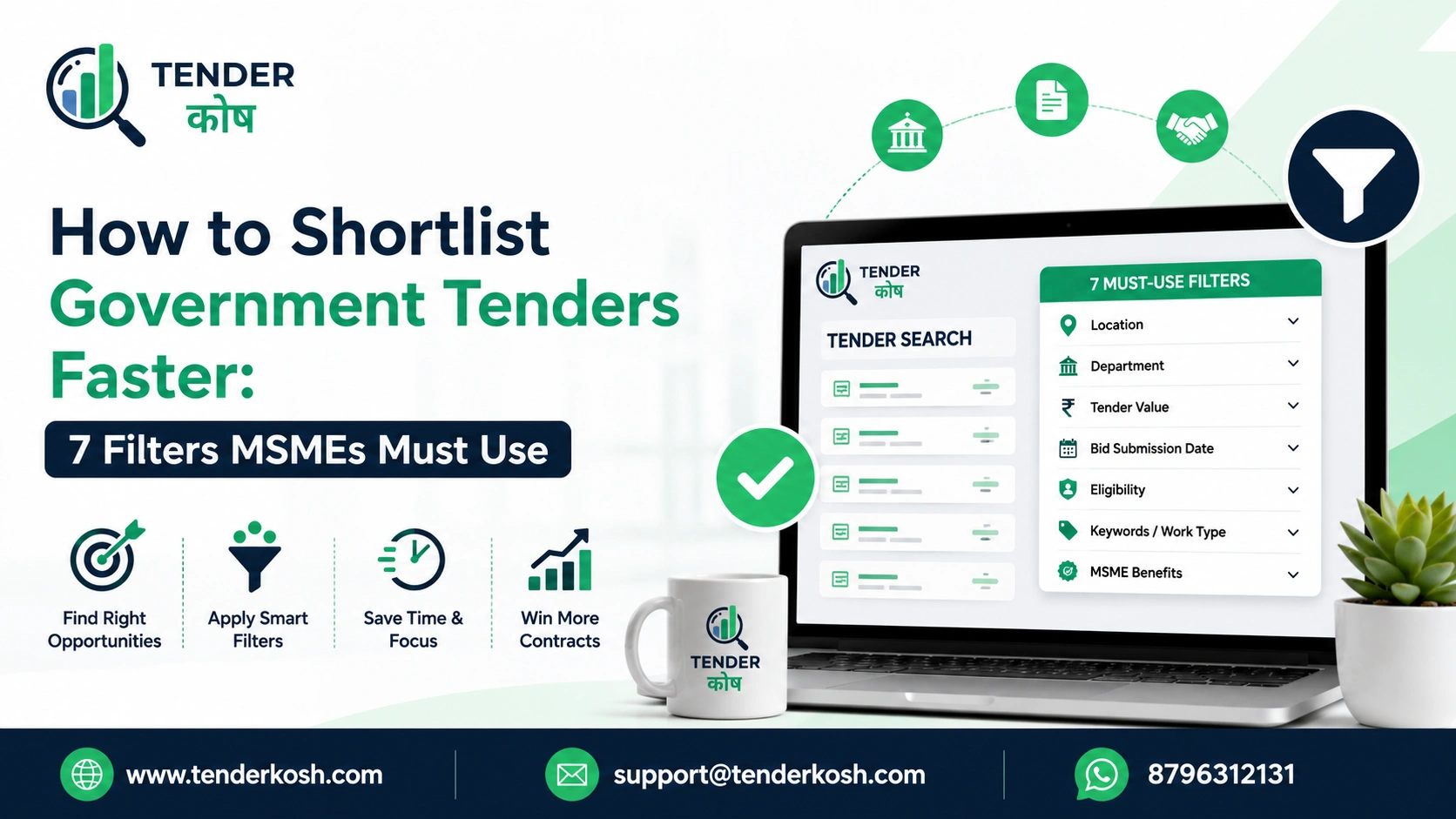
For most MSMEs, the biggest waste in government bidding is not losing tenders — it is spending days preparing bids for tenders they were never going to win. Thousands of tenders are floated every week, and it is tempting to chase as many as possible. But the businesses that win consistently do the opposite: they shortlist government tenders quickly, reject the wrong ones in minutes, and concentrate their effort on the handful they can realistically secure.
This guide gives you a practical, repeatable framework to shortlist government tenders faster — a set of filters you apply in order so that a tender either earns your bid time or gets dropped early. Master this, and you’ll stop drowning in unwinnable bids and start putting your best effort where it actually pays off.
Key Takeaways
Before fixing the problem, it helps to name it. Most bid-time waste comes from a few predictable habits — and recognising them is the first step to a faster process.
| Common Habit | Why It Wastes Time |
|---|---|
| Reading the whole tender first | Hours spent studying a tender you don’t even qualify for |
| Chasing every opportunity | Thin effort spread across many bids instead of strong effort on a few |
| Bidding above your capacity | Preparing for work you can’t deliver, then withdrawing or under-performing |
| Ignoring competition and margin | Winning low-value, low-margin work that isn’t worth the effort |
| Browsing portals manually | Hours lost searching instead of evaluating and bidding |
Winning bidders are ruthless screeners. The teams with the best win rates don’t have more time — they waste less of it. They decide fast whether a tender is worth pursuing, say no often, and pour their energy into the small set of tenders where they have a genuine edge. Shortlisting well is the highest-leverage skill in government bidding.

Apply these seven filters in order. The moment a tender fails one, stop and move on — there is no point checking profitability on a tender you’re not eligible for. Ordered this way, most unsuitable tenders are rejected in the first minute or two.
Before anything else, confirm you meet the mandatory qualification criteria — turnover, experience, similar-work requirements, registrations, and any contractor class or category. This filter saves the most time, because a tender you cannot qualify for should be dropped instantly, however attractive it looks. If you clearly don’t meet a mandatory criterion, stop reading and move on.
Check whether the tender’s value and scope match your capacity. A contract far larger than anything you’ve delivered is a risk, not an opportunity — and one far too small may not be worth the effort. Look for tenders in the range your business can execute confidently and profitably.
Consider whether you can actually deliver at the required location within the terms. Distance, logistics, local presence requirements, and mobilisation costs can quietly turn a promising tender into a loss-maker. Filter out work you can’t service efficiently.
Estimate how crowded the tender is likely to be. Generic, low-barrier tenders attract dozens of bidders and brutal price competition. Tenders with specialised requirements, niche experience, or higher qualification bars usually mean fewer competitors — and a better chance for a capable MSME to win on merit rather than the lowest price.
Weigh the likely margin against the effort to bid and deliver. A tender that ties up your team for weeks for a razor-thin margin is rarely worth it when a better opportunity exists. Be honest about whether the reward justifies the work.
Check whether you can realistically prepare a strong, compliant bid before the deadline — including arranging EMD, documents, and any approvals. If the timeline is too tight to bid well, a rushed submission usually means a rejected one. Sometimes the right call is to skip it and prepare properly for the next.
Finally, consider the buyer. A well-funded department with a reliable payment record is worth more than a marginally larger tender from a buyer known for long delays. Factoring payment reliability into your shortlist protects your working capital and your peace of mind.
| # | Filter | Reject If… |
|---|---|---|
| 1 | Eligibility | You don’t meet a mandatory qualification criterion |
| 2 | Value & Scope | Too large for your capacity or too small to be worthwhile |
| 3 | Location | You can’t deliver there efficiently or economically |
| 4 | Competition | Overcrowded, low-barrier, pure price war with no edge for you |
| 5 | Profitability | Margin doesn’t justify the bid and delivery effort |
| 6 | Deadline | Too little time to prepare a strong, compliant bid |
| 7 | Buyer/Payment | Buyer has a poor or slow payment record |
The power of the framework is speed. Each tender should get a rapid go / no-go verdict — not a deep study. Turn the seven filters into a simple mental (or written) checklist your team runs in a couple of minutes.
Run the seven filters quickly. If a tender fails any early filter, reject it immediately — don’t read the rest of the document.
Only tenders that pass all seven filters make your shortlist. These are the ones worth your full, detailed bid effort.
Pour your team’s time into the shortlisted tenders — strong concepts, tight compliance, and competitive pricing where you can win.
Two great bids beat ten rushed ones. The point of shortlisting is not to do less work — it’s to move your effort from unwinnable bids to winnable ones. A focused MSME that submits a few excellent, fully-compliant bids consistently outperforms one that scatters weak bids across everything it finds.
Once the framework is habit, the next gain is removing the time spent finding tenders in the first place — which for many MSMEs is where hours quietly disappear.
Define the categories, value ranges, and locations that fit your business once, and reuse them — so you only see relevant tenders, not everything.
Set up alerts for tenders matching your saved criteria, so new opportunities come to you instead of you hunting across portals daily.
Use a single dashboard that aggregates tenders from many portals, so you screen everything in one place rather than logging into ten sites.
Don’t forget corrigenda. A tender you’ve shortlisted can change through a corrigendum — new deadline, revised eligibility, or amended scope — which may move it from “go” to “no-go” or vice versa. Re-check shortlisted tenders for amendments before you commit. See our guide on how to find corrigenda on GeM, CPPP and state portals.
Shortlisting decides which tenders you bid on. Winning them comes down to execution — and the same discipline that made your shortlist tight should carry into the bid itself.
| Step | What to Do |
|---|---|
| Prepare Thoroughly | Assemble documents, financials, and a strong technical response for each shortlisted tender |
| Claim MSME Benefits | Use EMD exemption, purchase preference, and relaxations you’re entitled to |
| Run a Compliance Check | Verify EMD, documents, and eligibility before submission — never lose on a technicality |
| Submit Early | Complete your upload well before the deadline to avoid last-minute portal issues |
For the detailed final check before you submit, use our tender compliance checklist, and to make the most of your small-business advantages, see our guide on MSME benefits in government tenders.
The fastest way to shortlist government tenders is to stop browsing portals altogether. TenderKosh aggregates tenders from 1,000+ government procurement portals into one dashboard — filter by category, value, and location, save your criteria, and get alerts on matching tenders and corrigenda. Spend your time bidding on winnable tenders, not searching for them.
Browse Live Tenders View Plans Why TenderKoshThe MSMEs that win the most government work are rarely the ones that bid on the most tenders. They are the ones that shortlist government tenders ruthlessly — applying eligibility, value, location, competition, profitability, deadline, and payment filters in order, and rejecting the wrong tenders in minutes so their real effort goes only to winnable ones.
Build the seven-filter framework into your routine, make every tender a quick go / no-go decision, use saved searches and alerts to stop wasting time browsing, and re-check shortlisted tenders for corrigenda. Do that, and you’ll bid less, win more, and finally stop pouring bid time into tenders you were never going to secure.
MSMEs can shortlist government tenders faster by applying a fixed set of filters in order — eligibility, value fit, location and delivery feasibility, competition level, profitability, deadline feasibility, and buyer payment reliability — and rejecting any tender that fails a filter before reading further. The goal is to spend only a few minutes deciding whether a tender is worth pursuing, so that detailed bid effort is reserved for the small number of tenders you can realistically win. Using saved search criteria and alerts also removes the time spent manually browsing multiple portals.
MSMEs waste time on the wrong tenders because they read tenders in full before checking whether they even qualify, chase tenders that are too large or too competitive, apply for work outside their capacity or location, and pursue low-margin tenders that are not worth the effort. Without a quick, consistent screening process, teams spend hours preparing bids they were never going to win, which drains time and resources away from the tenders they could actually secure.
The first thing to check when shortlisting a tender is eligibility — whether your business meets the mandatory qualification criteria such as turnover, experience, similar-work requirements, registrations, and any contractor class or category. Checking eligibility first saves the most time, because a tender you cannot qualify for should be rejected immediately, no matter how attractive it looks. Only after a tender passes the eligibility filter is it worth spending time on value, competition, profitability, and the remaining checks.
MSMEs decide if a tender is worth bidding for by weighing whether they qualify, whether the value and scope fit their capacity, how much competition they expect, whether the margin justifies the effort, whether the deadline is realistic, and whether the buyer has a reliable payment record. A tender is worth bidding for when the business clearly qualifies, can deliver it well, expects a reasonable chance of winning, and can earn an acceptable margin with manageable risk. If several of these are weak, the time is usually better spent on a stronger opportunity.
Yes. Tender-tracking platforms help MSMEs shortlist government tenders faster by consolidating tenders from many portals into one place, letting users filter by category, value, location, and keywords, and sending alerts for tenders that match saved criteria. This removes the hours spent manually browsing multiple portals and surfaces relevant opportunities automatically, so the team can focus its screening and bidding time on tenders that fit its capability rather than searching for them.
This article is general information, not advice. It has been compiled from publicly available sources — government releases and notifications, official portals, published tender documents and trade reporting — and reflects our understanding at the time of writing. It is not legal, financial, tax or professional advice, and it does not create any advisory relationship.
Public procurement changes constantly. Tender terms, eligibility criteria, thresholds, fees, deadlines, scheme conditions and government policy are revised frequently, often through corrigenda issued mid-window and sometimes without wide notice. Figures and rules that were accurate when published may already have changed by the time you read this.
Always verify against the primary source before you act or bid. The tender document, the issuing authority's official portal and the relevant government notification are the authoritative sources. Where anything in this article differs from them, the official source prevails. Do not rely on this page — or on any third-party summary — as the basis for a bid, an investment or a compliance decision.
TenderKosh is a private tender-intelligence platform. We are not a government body, and we are not affiliated with, endorsed by or acting on behalf of any government department, ministry, PSU or procurement portal. Names, marks and portals referenced belong to their respective owners and are used for identification only. External links are provided for convenience; we do not control and are not responsible for third-party content.
While we take reasonable care, we make no warranty as to the accuracy, completeness or currency of this content, and accept no liability for any loss or damage arising from reliance on it.Spotted something wrong or out of date? Please tell us at support@tenderkosh.com — we correct errors promptly.See our full Disclaimer.
Discover relevant tenders, monitor corrigenda, compare opportunities, and move from document reading to structured action.