
TenderKosh for EPC teams
Turn tender reading into faster bidding decisions.
Discover relevant tenders, monitor corrigenda, compare opportunities, and move from document reading to structured action.
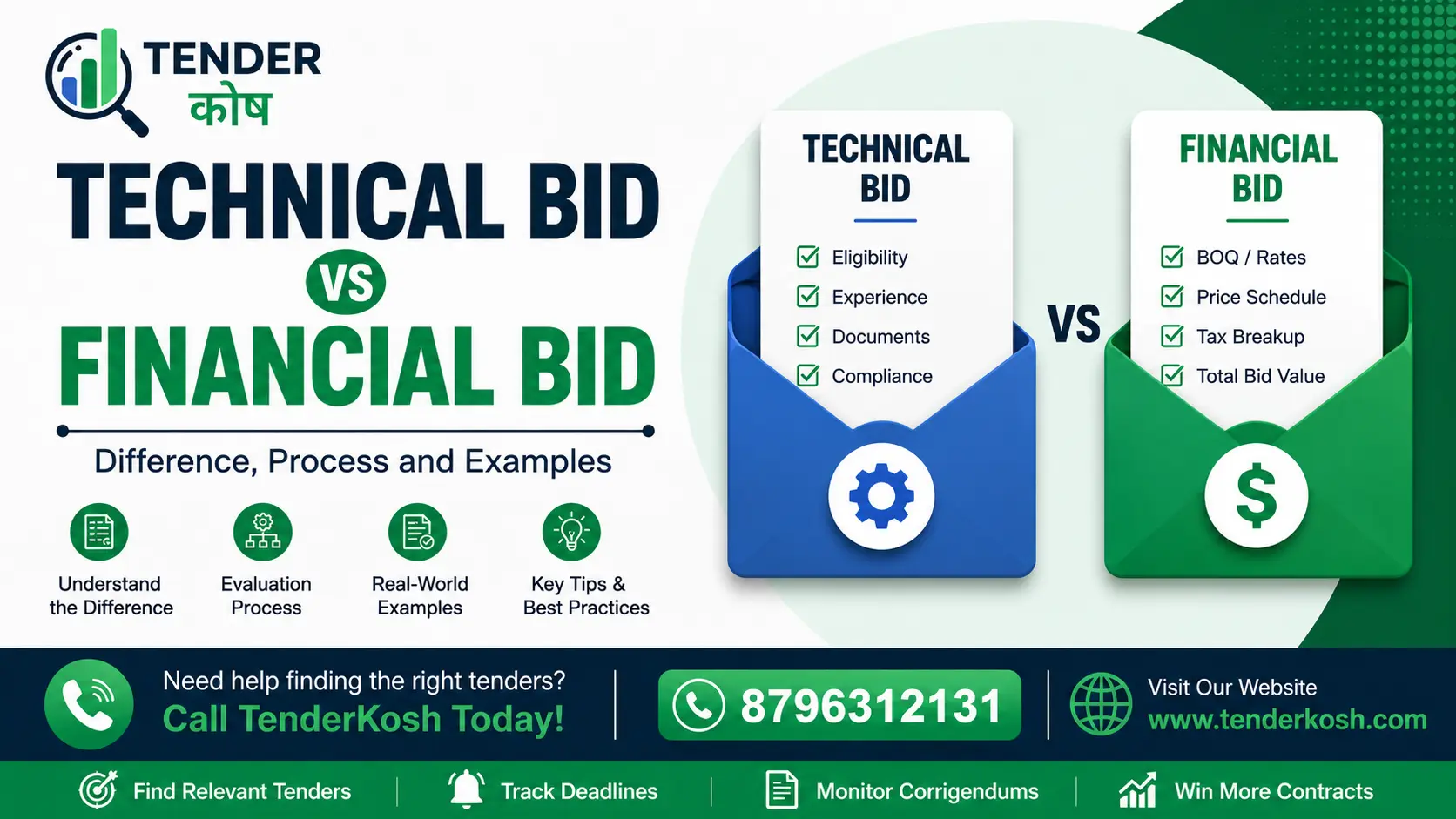
In most government tenders in India, bidders are required to submit two separate bids: a Technical Bid and a Financial Bid. These are evaluated independently and in sequence — only bidders who qualify technically are allowed to compete on price.
This two-bid system — also called the two-envelope or two-cover system — is the standard evaluation framework used across GeM, CPPP, Railways, PSUs, defence procurement, and most state government tenders. Understanding how each bid works, what to include, and where bidders commonly go wrong is essential for any business competing in government procurement.
Key Takeaways
A Technical Bid is the first envelope submitted in a two-bid tender. It contains all non-price information that proves a bidder’s eligibility, capability, and compliance with the tender’s technical and qualification requirements. No pricing — not even indicative costs — should appear anywhere in the Technical Bid.
The tendering authority evaluates Technical Bids to shortlist qualified bidders. Bidders who do not meet the Technical Qualifying Criteria (TQC) are disqualified at this stage and their Financial Bids are returned unopened.
Technical Bids typically contain the following documents:
Critical rule: If any pricing information — including a unit rate, indicative cost, or discount — appears in the Technical Bid envelope, the entire bid can be disqualified. Technical and Financial Bids must be kept strictly separate at all times.
A Financial Bid is the second envelope submitted in a two-bid tender. It contains only the pricing information — the bidder’s quoted rates, BOQ (Bill of Quantities), total bid value, and tax breakdowns. Financial Bids are opened only after Technical Bid evaluation is complete and technically qualified bidders are declared.
The tendering authority ranks all qualified bidders by their Financial Bid price. The lowest evaluated bidder — called L1 — is typically offered the contract, subject to negotiations and approval by the competent authority.
Financial Bids typically contain:
Important: Never modify the BOQ structure provided by the tendering authority. Bidders must fill only the rate and amount columns. Changing item descriptions, units, or quantities — even to correct an apparent error — can result in disqualification. Raise a pre-bid query if you find an error in the BOQ before the deadline.
The table below summarises the core differences between a Technical Bid and a Financial Bid across all major parameters relevant to government tender submission in India.
| Parameter | Technical Bid | Financial Bid |
|---|---|---|
| Purpose | Proves eligibility, capability, and technical compliance | Provides the price at which the bidder will execute the work or supply |
| Evaluated by | Technical Evaluation Committee (TEC) | Finance or Procurement Committee — after TEC clearance only |
| Opened when | On the technical bid opening date specified in the tender | Only after technical evaluation is complete and results are declared |
| Contains | Eligibility documents, experience proof, certifications, EMD | BOQ, rate schedule, total bid price, GST breakup |
| Pricing allowed? | No — any price reference leads to disqualification | Yes — this is the only cover where prices should appear |
| Outcome | TQ (Technically Qualified) or NTQ (Not Technically Qualified) | L1, L2, L3 ranking by lowest evaluated price |
| If disqualified | Result declared; documents retained by authority | Financial Bid returned unopened or deleted from portal |
| EMD submitted here? | Yes — always in the Technical Bid | No |
| Portal label | Cover 1 / Envelope 1 / Technical Cover | Cover 2 / Envelope 2 / Financial Cover |
| MSME benefit declared here? | Yes — Udyam certificate and exemption declaration in Technical Bid | Price preference matching declared here where applicable |
The two-bid system follows a strict sequential process. Understanding each stage helps bidders prepare the right documents at the right time and avoid errors that cause disqualification or missed deadlines.
| Stage | Action | What Happens |
|---|---|---|
| Stage 1 | Tender published on e-portal | Tender document released on GeM, CPPP, state portal, or PSU portal with eligibility criteria, technical specifications, BOQ format, and separate submission instructions for each cover. |
| Stage 2 | Pre-bid meeting and corrigendum period | Bidders may attend the pre-bid meeting, raise queries on TQC, specifications, or BOQ, and receive official clarifications. Corrigenda are issued on the portal — all must be tracked before submission. |
| Stage 3 | Bidders prepare and upload both covers | Technical Bid documents compiled and Financial Bid BOQ priced. Both uploaded to the portal as separate covers before the submission deadline. |
| Stage 4 | Technical Bid opening (Cover 1 opened) | The tendering authority opens all Technical Bids on the declared date. Bidders or their authorised representatives can attend. No pricing information is visible at this stage. |
| Stage 5 | Technical Evaluation Committee (TEC) reviews bids | Each bidder’s documents are checked against qualifying criteria — turnover, experience, certifications, EMD validity, and technical compliance. TQ or NTQ status is assigned to each bidder. |
| Stage 6 | Technical evaluation results declared | List of technically qualified bidders published on the portal. NTQ bidders are notified and their Financial Bids are returned or deleted from the system. |
| Stage 7 | Financial Bid opening (Cover 2 opened) | Only the Financial Bids of TQ bidders are opened. Prices are read out or published. Bidders are ranked L1 (lowest) to Ln (highest evaluated price). |
| Stage 8 | Negotiation and contract award | L1 bidder is invited for negotiations in some tenders. Contract is awarded after approval from the competent authority. Performance security is submitted before work commencement. |
TenderKosh tracks live two-bid tenders across GeM, CPPP, PSUs, solar, EPC, civil, electrical, and railway sectors — so your team never misses a submission or opening date.
Find Live Tenders Explore TenderKoshThe two-bid system is used across virtually every sector of Indian government procurement. The examples below show what goes into each bid cover for different tender types.
| Tender Type | Tendering Authority | Technical Bid: What Is Required | Financial Bid: What Is Quoted |
|---|---|---|---|
| Solar EPC Project | SECI / NTPC / State DISCOM | Prior EPC experience in MWp, net worth, turnover proof, technical team credentials, equipment make approval list | BOQ with module supply, civil works, mounting structure, inverter, BOS, and O&M rates per MWp |
| Road Construction | NHAI / State PWD / MoRTH | Similar road project completion certificates, key personnel CVs, equipment ownership proof, ISO certification | Item-rate BOQ for earthwork, sub-base, base course, bituminous layers, structures, and road furniture |
| IT Services | NIC / MeitY / State IT Dept | Technical approach document, team profiles with CVs, solution architecture, data security compliance, past project references | Manpower rates per role per month, or lump sum price with milestone-linked payment schedule |
| Medical Equipment Supply | CMSS / State Health Dept / AIIMS | Product technical datasheet, CDSCO regulatory approval, ISO 13485, after-sales service network proof, warranty terms | Unit price per equipment, installation charges, AMC rates per year |
| Consultancy / PMC | World Bank / ADB-funded projects | Firm profile, key expert CVs, methodology, work plan, experience in similar assignments scored against evaluation matrix | Personnel costs per person-month, reimbursable expenses, total contract value |
| GeM Goods Supply | Central / State Govt GeM Buyers | OEM authorisation letter for resellers, product compliance documents, GeM Vendor Assessment certificate, Udyam certificate if claiming MSME preference | Unit rate per item as per GeM price schedule or bid format |
Technical Bid evaluation is based on pre-defined Technical Qualifying Criteria (TQC) published in the tender document. These criteria are objective and binary — a bidder either meets them or does not. The most common TQC parameters used in Indian government tenders are:
Minimum annual turnover in any 2 of the last 3 financial years, positive net worth, and working capital or bank credit facility proof. Verified through CA-certified audited financial statements.
Completion of projects of a specified type, value, and scale within a defined look-back period — typically 5 to 7 years. Evidenced by work orders and client-issued completion certificates as a pair.
ISO, BIS, NABL, CDSCO, or sector-specific approvals. GeM Vendor Assessment for product sellers. Udyam Registration for MSME preference claims.
Important: TQC parameters are set before the tender is published and cannot be changed during evaluation. If a bidder does not meet even one mandatory criterion, they are disqualified regardless of how competitive their price is. Read every TQC clause before deciding to bid.
Not all government tenders use the two-bid system. Some tenders — particularly for standard goods, small-value procurement, or rate contracts — use a single-bid system where technical and financial information are submitted together. Understanding when each system applies helps bidders prepare the correct structure from the start.
| Parameter | Single-Bid (One Cover) | Two-Bid (Two Cover) |
|---|---|---|
| Used for | Standard goods, low-value procurement, rate contracts, GeM direct purchase | Complex works, EPC contracts, high-value services, infrastructure projects |
| Submission structure | Single envelope with both eligibility and price together | Separate envelopes or covers for technical and financial bids |
| Evaluation sequence | Simultaneous review of eligibility and price | Sequential: technical first, financial only after TQ is declared |
| Price visibility | Price visible to all immediately on opening — less strategic flexibility | Price protected until technical clearance — better for complex pricing |
| Common portals | GeM (many categories), small-value CPPP tenders | CPPP, state e-tender portals, Railways, defence, PSU infrastructure projects |
| MSME benefit claim | Claimed in the single cover along with price | Eligibility documents and exemption claims go in Cover 1; price preference matching in Cover 2 |
Most bid disqualifications in two-bid tenders are caused by avoidable document and process errors. The following mistakes are the most frequent — along with the correct approach for each.
| Mistake | Which Cover Affected | Impact | How to Avoid |
|---|---|---|---|
| Including any price in the Technical Bid | Technical Bid | Immediate disqualification of the entire bid | Double-check every document in Cover 1. Remove any rate, cost estimate, or financial figure not explicitly required in the technical cover instructions. |
| Missing or expired EMD | Technical Bid | Non-responsive bid — disqualified without evaluation | Submit EMD as per the exact format, amount, and validity specified. Verify MSME EMD exemption eligibility before skipping. |
| Wrong financial years for turnover documents | Technical Bid | Turnover criterion not met; disqualification | Read the TQC carefully — tenders specify exact year combinations. Submit audited statements for the years required, not the most favourable years. |
| Completion certificates not issued by the client | Technical Bid | Experience criterion rejected | Submit certificates issued and signed by the actual client. Pair each work order with its corresponding completion certificate from the same organisation. |
| Documents uploaded in the wrong cover | Both | Documents appear in wrong envelope — bid may be NTQ or price exposed prematurely | Map each document to the correct cover using the tender’s document checklist before upload. Review the portal cover structure carefully before final submission. |
| Ignoring corrigenda after submission | Both | Bid lapses, deadline missed, or eligibility conditions changed without bidder awareness | Monitor the portal for corrigenda throughout the bid period. Corrigenda can change TQC, EMD amounts, BOQ quantities, or submission deadlines. |
| Leaving BOQ items blank in Financial Bid | Financial Bid | Disqualification or severe financial loss if contract is awarded at zero rate | Every BOQ item must have a rate. Cross-check that all rows are filled before submitting Cover 2. |
| Not declaring MSME price preference eligibility | Financial Bid | L1 matching benefit not applied even if eligible | Declare MSME price preference eligibility in the correct portal field. Upload Udyam certificate in Cover 1 and select the preference option where available. |
Use the following checklist to verify your Technical Bid is complete before uploading to the e-tender portal. Each item must be confirmed before the submission deadline.
Certificate of incorporation, GST registration, PAN card, Udyam Registration Certificate, and any sector-specific licences or approvals required by the tender.
Audited balance sheets and P&L statements for the required years. CA-certified turnover certificate if separately required. Solvency certificate or bank credit letter where specified in TQC.
Work orders and client-issued completion certificates for similar projects. Each certificate must state project value, completion date, and nature of work — matching TQC parameters exactly.
Bank guarantee, demand draft, or bid security declaration for exempt MSMEs. Verify amount, validity date, and beneficiary name match the tender exactly. See EMD in Government Tenders for full guidance.
Filled technical compliance statement or deviation sheet. Product datasheets, drawings, or specifications where required. Confirm zero pricing appears in any of these documents before upload.
ISO, BIS, GeM Vendor Assessment certificate, NABL, CDSCO, or any sector-specific quality certification listed as mandatory or preferred in the tender document.
TenderKosh monitors submission deadlines, technical bid opening dates, and corrigendums across GeM, CPPP, PSUs, and sector portals — so your team stays ahead of every critical date.
Explore Live Tenders View PlansTenderKosh helps businesses find and track two-bid government tenders across portals where separate Technical and Financial Bid submission is standard — including CPPP, GeM, SECI, NTPC, Railways, CPWD, state PWDs, and sector-specific PSUs. Instead of checking multiple portals manually each day, businesses use TenderKosh to discover, filter, and monitor tenders from one platform.
| TenderKosh Feature | Benefit for Two-Bid Tender Participants |
|---|---|
| Live tender discovery | Find two-bid tenders across EPC, solar, civil, electrical, IT, supply, and infrastructure sectors before submission deadlines close. |
| Keyword and sector search | Search by work type, department, project value, or location to find tenders that match your technical qualifying profile. |
| Corrigendum monitoring | Get alerts when tender documents, TQC parameters, BOQ quantities, or bid deadlines are revised after initial publication. |
| Multi-portal coverage | Tracks GeM, CPPP, SECI, NTPC, Railways, CPWD, IOCL, and 100+ government procurement portals from one platform. |
| Opportunity shortlisting | Filter tenders by value, sector, and eligibility match — saving time versus checking each portal manually every day. |
The two-bid system — Technical Bid and Financial Bid — is the standard evaluation framework for most significant government tenders in India. Understanding the difference between the two bids, what each must contain, how sequential evaluation works, and which mistakes cause disqualification is fundamental for any business competing in government procurement.
Technical qualification is the gate. Financial competitiveness is the key. Businesses that prepare both bids rigorously — and consistently track the right tenders before deadlines — build stronger and more predictable government order pipelines. Platforms like TenderKosh.com help businesses discover live two-bid tenders, monitor corrigenda, and stay ahead of submission timelines across all major procurement portals.
A Technical Bid contains eligibility and capability documents — experience, turnover, certifications, and EMD — with no pricing. A Financial Bid contains only the price — BOQ rates, total bid value, and tax breakup. In a two-bid tender, Technical Bids are evaluated first. Financial Bids of only technically qualified bidders are then opened.
Including any pricing information — a unit rate, indicative cost, or discount — in the Technical Bid envelope is grounds for immediate disqualification of your entire bid. The Technical Bid must contain only eligibility and capability documents as specified in the tender instructions.
No. Only Technical Bids are opened at the technical bid opening event. Financial Bids remain sealed and are opened separately — only after all Technical Bids have been evaluated and technically qualified bidders are declared. Prices are revealed only at the Financial Bid opening event.
TQ stands for Technically Qualified and NTQ stands for Not Technically Qualified. These are the outcomes of Technical Bid evaluation. TQ bidders proceed to Financial Bid opening. NTQ bidders are disqualified and their Financial Bids are returned unopened or deleted from the portal.
EMD is always submitted as part of the Technical Bid (Cover 1). It is a pre-condition for technical evaluation. Bids without valid EMD — or without a valid bid security declaration for exempt bidders — are rejected without evaluation. Learn more in our guide on EMD in Government Tenders.
L1 refers to the lowest evaluated bidder in the Financial Bid ranking. After Financial Bids are opened, bidders are ranked from L1 (lowest price) to Ln (highest price). The L1 bidder is typically offered the contract, subject to negotiation and approval. See our guide on L1 vs L2 bidders for more detail.
Yes — eligible Micro and Small Enterprises can claim EMD exemption in many government tenders by uploading a valid Udyam Registration Certificate in the Technical Bid and selecting the exemption option on the portal. However, not every tender allows EMD exemption, so the EMD clause must be checked in each specific tender document. See our full guide on MSME benefits in government tenders.
You can use TenderKosh live tender search to discover two-bid tenders across EPC, solar, civil, electrical, IT, railway, and supply sectors — from GeM, CPPP, PSU portals, and 100+ other government procurement sources, all tracked from one platform.
Discover relevant tenders, monitor corrigenda, compare opportunities, and move from document reading to structured action.