TenderKosh for EPC teams
Turn tender reading into faster bidding decisions.
Discover relevant tenders, monitor corrigenda, compare opportunities, and move from document reading to structured action.
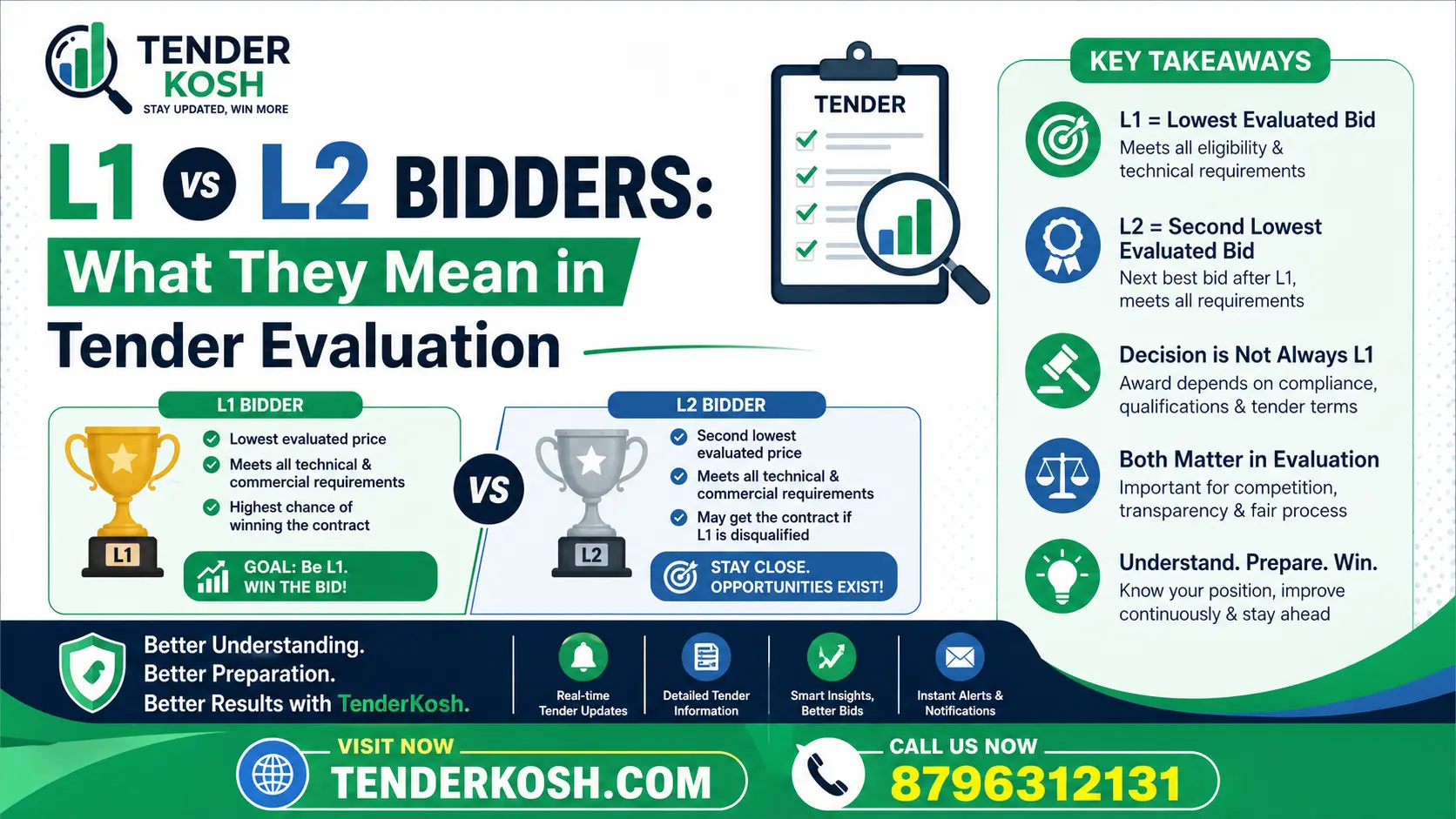
L1 vs L2 Bidders are among the most important concepts in government tender evaluation. Understanding how L1 (Lowest Bidder) and L2 (Second Lowest Bidder) work can significantly improve your chances of winning tenders.
L1 stands for Lowest Bidder — the company that quotes the lowest price among all technically qualified bidders in a tender.
Only bidders who pass the technical evaluation stage are considered for financial comparison. Among them, the lowest quote becomes L1, followed by L2, L3, and so on.
| Criteria | L1 Bidder | L2 Bidder |
|---|---|---|
| Position | Lowest Price | Second Lowest Price |
| Winning Chance | Very High | Conditional |
| Selection | Meets all criteria | If L1 fails |
| Strategy | Competitive + compliant | Backup readiness |
| Company | Quoted Price | Rank |
|---|---|---|
| Company A | ₹95 Lakhs | L1 |
| Company B | ₹98 Lakhs | L2 |
| Company C | ₹1.02 Crore | L3 |
| Company D | ₹1.05 Crore | L4 |
No. Even L1 bidders can be rejected if they fail to meet compliance, documentation, or technical requirements.
If the L1 bidder fails to sign the contract or is disqualified, the authority may move to the L2 bidder. This makes L2 a critical backup position in tendering.
Track tenders, monitor updates, and improve your L1 success rate with smart tools.
📞 Call Now: 8796312131
Discover relevant tenders, monitor corrigenda, compare opportunities, and move from document reading to structured action.