
TenderKosh for EPC teams
Turn tender reading into faster bidding decisions.
Discover relevant tenders, monitor corrigenda, compare opportunities, and move from document reading to structured action.
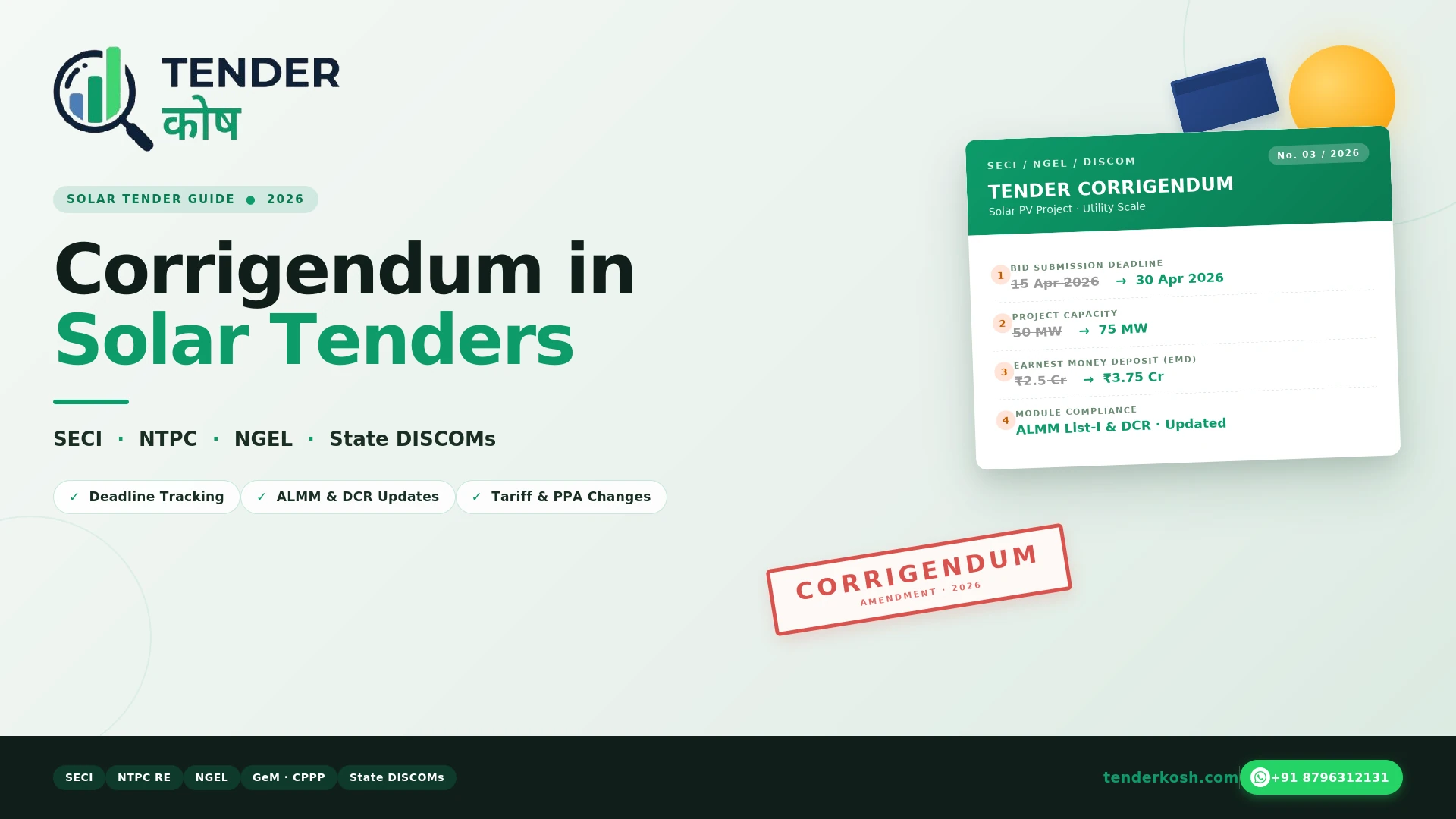
Solar tenders in India move fast. So do the rules around them. Every week, SECI, NTPC Green Energy, and state DISCOMs release fresh corrigendums that change deadlines, technical specs, eligibility rules, or scope.
Miss one, and your bid can be rejected on a technicality. Catch it in time, and you can still win the project — sometimes with better terms.
This guide explains everything Indian solar bidders need to know about corrigendums in 2026. You will learn what corrigendums are, why they matter more in solar than in other sectors, who issues them, and how to track them without losing sleep.
A corrigendum is an official amendment to a tender that has already been published. The issuing agency uses it to correct errors, change conditions, or update timelines.
In solar tenders, corrigendums usually fall into one of these buckets:
Once issued, the corrigendum becomes legally binding. It overrides the original tender on every point it touches. Bidders must follow the latest version, not the first one they downloaded.
Solar projects sit at the intersection of policy, technology, and finance. All three move quickly. As a result, solar tenders see more amendments than civil or supply contracts.
Here is what drives the volume:
Quick context: SECI alone has issued thousands of tenders, including programs like solar-wind hybrid, RTC, FDRE, and rooftop RESCO models. Each new program structure brings fresh ambiguity — and fresh corrigendums.
This is the most frequent type. The original bid submission date is pushed by 7, 15, or even 30 days. SECI’s January 2026 RESCO Tranche-VIII tender, for example, was floated and then revised before bidding closed. Capacity was bumped from 13.04 MW to 17.77 MW after a corrigendum.
Module wattage, cell technology, ALMM list version, BESS round-trip efficiency, or PCS specifications get updated. In rooftop tenders, mounting structure design and net-metering terms are often revised through corrigendums.
Turnover thresholds, net-worth requirements, or EMD amounts are softened to widen participation — or tightened to filter out weaker bidders. For instance, a recent NGEL hydrogen tender set turnover at ₹59 crore over the last three years and EPC experience at ₹47 crore. Such numbers can move during the tender window.
Total tender capacity, project locations, or PPA tenure may be modified. SECI sometimes adds “greenshoe” capacity through a corrigendum, allowing it to expand award size at the same tariff.
After every pre-bid meeting, the issuing agency releases bidder queries and official answers. When those answers change tender terms, they appear as a corrigendum — not just minutes.
Ceiling tariffs, escalation clauses, payment security mechanisms, or curtailment provisions may be amended. These are the costliest corrigendums to miss because they directly hit project IRR.
TenderKosh sends instant alerts the moment a corrigendum hits any solar tender you are tracking — across SECI, NGEL, GeM, and every state DISCOM portal.
The Solar Energy Corporation of India (SECI) is a Navratna PSU under the Ministry of New and Renewable Energy. It is the largest solar tender issuer in the country.
SECI issues tenders for utility-scale solar, hybrid, RTC, FDRE, BESS, manufacturing-linked PLI projects, and rooftop solar under the RESCO model. Each program has its own bidding cycle — and each cycle produces multiple corrigendums.
Where SECI publishes corrigendums:
SECI corrigendums typically arrive in three waves: right after the pre-bid meeting, mid-way through the bid window, and a final one within 48 hours of the original deadline. Plan for all three.
NTPC Limited, India’s largest power generator, runs its renewable energy business through NTPC Green Energy Limited (NGEL). NGEL targets 60 GW of renewable capacity by 2032. To get there, it tenders constantly.
NGEL issues tenders for solar PV plants, BESS, hybrid projects, green hydrogen infrastructure, and O&M services. Recent examples include a 540 MW O&M tender for Nokhra and Devikot solar plants in Rajasthan, and a hydrogen refuelling station at Kandla, Gujarat.
Where NGEL and NTPC publish corrigendums:
NGEL solar tenders use a two-envelope structure: technical bid in Envelope 1, financial bid in Envelope 2. Corrigendums most often touch:
Bidders should also watch for corrigendums on Class-I and Class-II local supplier classification, which affects eligibility under Make in India provisions.
State DISCOMs and state nodal agencies issue some of the largest solar tenders in the country. They are also the hardest to track. Each state runs its own portal, with its own format and its own corrigendum publishing rhythm.
Here are the major state-level solar tendering bodies and where they publish:
| State / Agency | What they tender | Where corrigendums appear |
|---|---|---|
| GUVNL (Gujarat) | Utility-scale solar, hybrid, BESS | guvnl.com tender section, state e-procurement portal |
| RUMSL (Madhya Pradesh) | Solar parks, mega projects (Rewa, Agar, Neemuch) | rumsl.mp.gov.in, MPPGCL e-tender portal |
| MSEDCL (Maharashtra) | Mukhyamantri Saur Krishi Vahini (agri feeder solar), DISCOM PPAs | mahatenders.gov.in, MSEDCL portal |
| RREC / RVUNL (Rajasthan) | Solar parks, RUVNL PPAs | energy.rajasthan.gov.in, sppp.rajasthan.gov.in |
| TANGEDCO (Tamil Nadu) | Utility solar, group captive, hybrid | tneb.tnebnet.org, tntenders.gov.in |
| UPNEDA (Uttar Pradesh) | Rooftop, PM-KUSUM Component-C, agri solar | upneda.org.in, etender.up.nic.in |
| KREDL (Karnataka) | Solar parks (Pavagada), KUSUM, rooftop RESCO | kredl.karnataka.gov.in, eproc.karnataka.gov.in |
| APGENCO / NREDCAP (Andhra Pradesh) | Utility solar, KUSUM-A and KUSUM-C tenders | nredcap.in, apeprocurement.gov.in |
| HAREDA / HVPNL (Haryana) | Rooftop, PM-KUSUM, DISCOM PPAs | etenders.hry.nic.in, hareda.gov.in |
State DISCOM tenders carry their own quirks. PSPCL recently announced results for a 500 MW solar auction. Puducherry’s rooftop programs run through SECI but settle at state-level discom rates. Each portal has different corrigendum naming conventions, file formats, and email-alert reliability.
⚠ Common bidder mistake: Many bidders register on only one or two portals and miss corrigendums on related state portals where the same project’s PPA actually sits. If you are bidding on a Tamil Nadu solar park, watch TANGEDCO, the state e-procurement portal, and CPPP — corrigendums can drop on any of them.
The manual approach has three steps. First, register on every relevant portal — SECI, NGEL, NTPC eProcure, CPPP, GeM, and each state portal you bid on. Second, set up email alerts where available (most state portals have unreliable alert systems). Third, check each portal manually every 24-48 hours during a live bid window.
This works. But it eats 8-12 hours a week for a serious bidder.
The smarter approach uses an aggregator that watches every portal in real time, normalises corrigendum data, and pings you the moment something changes on a tender you are tracking.
Corrigendums create urgency. The team that responds fastest usually wins. Here is the response checklist:
There is no legal cap. Large SECI and NGEL tenders frequently receive 5 to 10 corrigendums during a bid window. Smaller state DISCOM tenders usually see 1 to 3.
Yes. Once published on the official portal, the corrigendum becomes part of the tender document. Bidders are expected to track and comply, regardless of whether they received an email alert.
You can raise objections during the pre-bid clarification window or through formal representation to the issuing agency. In rare cases, bidders approach the High Court or CERC if a corrigendum violates published bidding guidelines.
A corrigendum corrects or modifies existing tender terms. An addendum adds new information without changing what was already published. In practice, Indian agencies often use the terms interchangeably.
Sometimes. If the deadline is extended, the EMD validity must usually be extended too. Always re-read the EMD clause after every corrigendum and reissue the bank guarantee if needed.
The SECI tenders portal at seci.co.in/tenders is the primary source. CPPP and GeM mirror the same documents within a few hours. For RESCO and rooftop programs, GeM is often the fastest channel.
Register on the state e-procurement portal, the DISCOM website, and CPPP. Better still, use a tender aggregator like TenderKosh that monitors all three simultaneously and sends real-time alerts.
⚡ Built for solar bidders
TenderKosh tracks every solar tender across SECI, NGEL, NTPC, GeM, CPPP, and all state DISCOM portals. Get instant alerts on corrigendums, deadline changes, and eligibility revisions — so your team can focus on winning bids, not chasing PDFs.
Have a question on a specific solar tender corrigendum? Drop it in the comments below — our team responds to every query.
Discover relevant tenders, monitor corrigenda, compare opportunities, and move from document reading to structured action.