TenderKosh for EPC teams
Turn tender reading into faster bidding decisions.
Discover relevant tenders, monitor corrigenda, compare opportunities, and move from document reading to structured action.
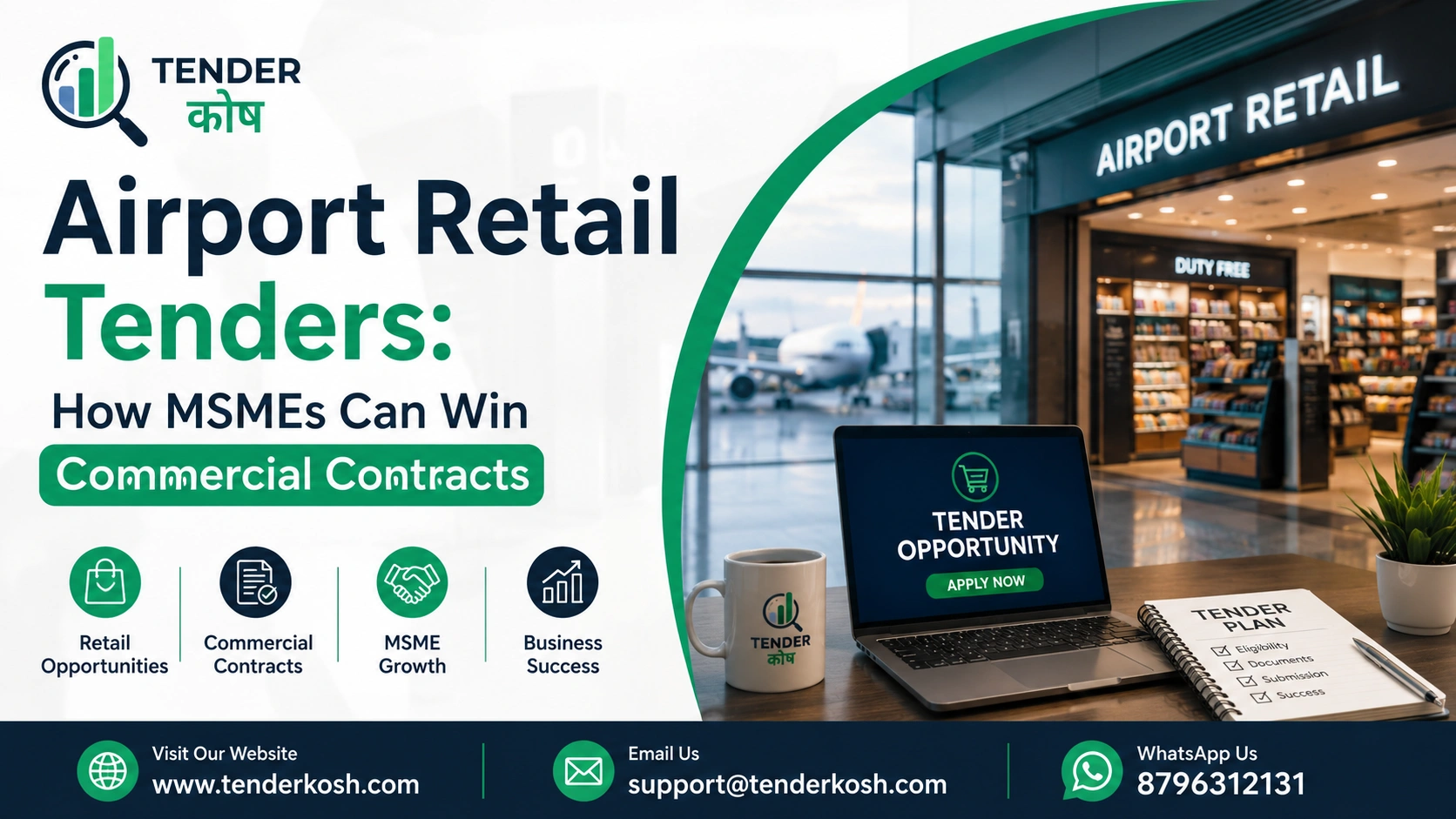
Every airport is a high-footfall, high-spend marketplace — and the shops, cafes, kiosks, lounges, and services inside it are awarded through competitive bidding. Many small business owners assume these airport retail tenders are reserved for giant duty-free operators and national chains. In reality, a growing share of airport commercial opportunities is genuinely accessible to MSMEs, regional brands, and specialist operators — if you understand how the process works and bid smartly.
This guide explains how airport retail tenders and commercial concessions work, why they are a real opportunity for small businesses, exactly what MSMEs should prepare, and a smart, step-by-step bidding approach to help you win commercial space at an airport. Whether you run a food brand, a speciality store, or a service business, here is how to compete for a spot in one of the most valuable retail environments in the country.
Key Takeaways
Unlike a goods-supply tender where the government buys products, airport commercial tenders are about the airport leasing or licensing its valuable commercial space. The airport operator invites businesses to bid for the right to run an outlet or service, and typically awards it to the bidder offering the best combination of financial return and business quality. What is on offer is far broader than most people realise.
| Category | Examples of Airport Commercial Opportunities |
|---|---|
| Retail | Speciality stores, bookshops, souvenirs, electronics, regional products, kiosks |
| Food & Beverage | Cafes, quick-service restaurants, food courts, bakeries, beverage counters |
| Duty-Free & Travel Retail | Duty-free stores and travel-retail concessions (usually larger operators) |
| Services | Lounges, spas, currency exchange, baggage services, car rentals |
| Advertising & Media | Advertising space, digital displays, and branding rights |
| Parking & Ground Services | Car parking, transport desks, and passenger-facing services |
The financial model is what makes airport tenders different from ordinary procurement. Instead of the airport paying you, you pay the airport for the right to operate — and the structure of that payment is central to how bids are won.
Most concessions require a minimum guaranteed fee (often monthly or annual) that you pay regardless of your sales — the airport’s assured income.
On top of the guarantee, the airport usually takes a percentage of your revenue, so it shares in your success as sales grow.
Beyond money, airports evaluate your brand, concept, business plan, and ability to meet strict design, safety, and operational standards.
Price is not the only thing that wins. Because airports want the right mix of quality, brand appeal, and passenger experience — not just the highest bidder — a strong, well-presented concept with realistic projections can beat a rival who simply quoted a higher fee. For MSMEs, this is the opening: you may not outspend a large chain, but you can out-think and out-concept them.
The perception that airports are closed to small businesses is outdated. Several trends have opened genuine space for MSMEs and regional brands.
| Trend | Why It Helps Small Businesses |
|---|---|
| Demand for a Diverse Mix | Airports want regional brands, local products, and unique concepts — not just national chains |
| Growing Regional Airports | Expanding tier-2 and tier-3 airports have lower thresholds and less competition than metros |
| Smaller Formats | Kiosks, counters, and small outlets need less capital than flagship stores |
| Sub-Concession Routes | MSMEs can operate under a master concessionaire rather than bidding as the prime |
| Local & Cultural Appeal | Authentic regional food and craft brands offer exactly the local flavour airports seek |
Winning airport retail tenders is as much about preparation as ambition. Before you bid, assemble a complete, professional package across three areas: documentation, concept, and finance.
| Document | Why It’s Needed |
|---|---|
| Business Registration & GST | Establishes your legal entity and tax compliance |
| Udyam Registration | Confirms MSME status and unlocks applicable benefits |
| Audited Financials & Turnover Proof | Demonstrates financial capacity to run the concession |
| Experience Evidence | Retail or F&B track record supporting your capability |
| Declarations & Annexures | Signed compliance and eligibility documents per the tender |
This is where MSMEs can genuinely stand out. Prepare a clear brand concept, an outlet design aligned to the airport’s guidelines, a product or menu plan suited to travellers, realistic revenue projections, and a staffing and operations plan. A distinctive, well-presented concept signals to the airport that you will enhance the passenger experience — which is what they are really buying.
Plan for the full cost, not just the fee. Airport concessions require more upfront capital than many first-time bidders expect. Budget for the Earnest Money Deposit (EMD), the minimum guaranteed concession fee, the security deposit, and — often the biggest item — the fit-out investment to build your outlet to airport standards. Under-estimating the fit-out and working-capital needs is a common reason small businesses struggle after winning. Confirm every financial requirement in the tender before committing.
You don’t win airport retail tenders by trying to outbid everyone everywhere. You win by bidding intelligently — choosing the right opportunities and presenting the strongest possible case. Here is a seven-point approach.
Tier-2 and tier-3 airports have lower thresholds and less competition. Winning there builds the track record you need for bigger airports later.
Bid for kiosks, small outlets, or speciality counters that match your capital and capability — not flagship spaces meant for large chains.
Present a distinctive, traveller-friendly brand and a polished proposal. A memorable concept can win over a bigger but generic competitor.
Explore operating as a sub-concessionaire under a master concessionaire, or partnering with a firm that has airport experience to strengthen your bid.
Offer a concession fee you can actually sustain from realistic sales. Over-bidding to win, then failing to pay, damages you more than losing.
Match every eligibility, document, and EMD requirement exactly. See our tender compliance checklist before you submit.
The seventh rule — bid selectively. It is better to submit two outstanding, fully-prepared bids than ten rushed ones. Concentrate your effort on the airports and formats where your concept genuinely fits and your finances comfortably stretch. A focused, high-quality bid strategy beats scattering thin bids across every opportunity.
Airport retail and commercial tenders are spread across AAI, private operators, and multiple portals — easy to miss if you only watch one. TenderKosh tracks airport, retail, and commercial tenders across 1,000+ government and public procurement portals, with alerts on new tenders and corrigenda, so you spot the right opportunity early and bid fully prepared.
Browse Live Tenders View Plans Why TenderKoshAirport retail tenders are no longer the exclusive preserve of global duty-free giants. As airports chase a richer, more local retail mix and regional airports multiply, real opportunities are opening for MSMEs, regional brands, and specialist operators willing to bid smartly. The key is to understand the concession model, prepare a complete package — documentation, a standout concept, and honest financials — and choose your battles carefully.
Small businesses win airport commercial contracts not by outspending big players, but by out-preparing and out-concepting them at the right airports and in the right formats. Start regional, lead with a distinctive concept, price what you can sustain, get every compliance detail right, and bid selectively. Do that, and a spot in one of India’s highest-footfall retail environments is well within reach.
Airport retail and commercial tenders are procurement processes through which airport operators award the right to run commercial outlets and services inside airport premises — such as retail shops, food and beverage outlets, duty-free stores, lounges, kiosks, advertising space, car parking, and other passenger services. Instead of buying goods, the airport is leasing or licensing commercial space, usually to the bidder offering the best combination of concession fee (often a minimum guaranteed amount plus a revenue share), business plan, and experience. These tenders are floated by operators including the Airports Authority of India and private airport companies.
Yes. While flagship duty-free and large retail concessions often go to big operators, many airport commercial opportunities — smaller kiosks, regional-airport outlets, food stalls, speciality retail, services, and sub-concessions — are accessible to MSMEs and small businesses. Airports increasingly want a diverse retail mix, including regional brands and local products, which creates openings for smaller players. MSMEs can also participate as partners or sub-concessionaires to a master concessionaire, or focus on tenders at smaller and regional airports where competition and financial thresholds are lower.
To bid for airport retail and commercial tenders, MSMEs should prepare business registration and GST documents, Udyam registration, audited financials and turnover proof, a strong business and concept plan for the outlet, relevant retail or F&B experience evidence, and the financial capacity for the concession fee, security deposit, fit-out investment, and Earnest Money Deposit. A clear brand concept, realistic revenue projections, and compliance with the airport’s design, safety, and operational guidelines are often as important as price in winning the concession.
Airport commercial tenders are usually evaluated on a combination of the financial offer and the quality of the proposal. The financial component often includes a minimum guaranteed concession fee plus a percentage revenue share, so the airport earns regardless of sales. The technical or qualitative component considers the bidder’s experience, brand and concept, business plan, financial strength, and ability to meet operational and design standards. Bidders must also clear eligibility and compliance requirements before their commercial offer is considered.
Airport retail and commercial tenders are published by airport operators on their own tender pages and on central procurement portals. In India, the Airports Authority of India (AAI) publishes commercial and non-aeronautical tenders on its e-tender portal and the Central Public Procurement Portal, while private airport operators publish opportunities on their corporate websites. Because these opportunities are spread across many operators and portals, businesses often use a tender-tracking platform to monitor airport commercial tenders in one place.
This article is general information, not advice. It has been compiled from publicly available sources — government releases and notifications, official portals, published tender documents and trade reporting — and reflects our understanding at the time of writing. It is not legal, financial, tax or professional advice, and it does not create any advisory relationship.
Public procurement changes constantly. Tender terms, eligibility criteria, thresholds, fees, deadlines, scheme conditions and government policy are revised frequently, often through corrigenda issued mid-window and sometimes without wide notice. Figures and rules that were accurate when published may already have changed by the time you read this.
Always verify against the primary source before you act or bid. The tender document, the issuing authority's official portal and the relevant government notification are the authoritative sources. Where anything in this article differs from them, the official source prevails. Do not rely on this page — or on any third-party summary — as the basis for a bid, an investment or a compliance decision.
TenderKosh is a private tender-intelligence platform. We are not a government body, and we are not affiliated with, endorsed by or acting on behalf of any government department, ministry, PSU or procurement portal. Names, marks and portals referenced belong to their respective owners and are used for identification only. External links are provided for convenience; we do not control and are not responsible for third-party content.
While we take reasonable care, we make no warranty as to the accuracy, completeness or currency of this content, and accept no liability for any loss or damage arising from reliance on it.Spotted something wrong or out of date? Please tell us at support@tenderkosh.com — we correct errors promptly.See our full Disclaimer.
Discover relevant tenders, monitor corrigenda, compare opportunities, and move from document reading to structured action.