TenderKosh for EPC teams
Turn tender reading into faster bidding decisions.
Discover relevant tenders, monitor corrigenda, compare opportunities, and move from document reading to structured action.
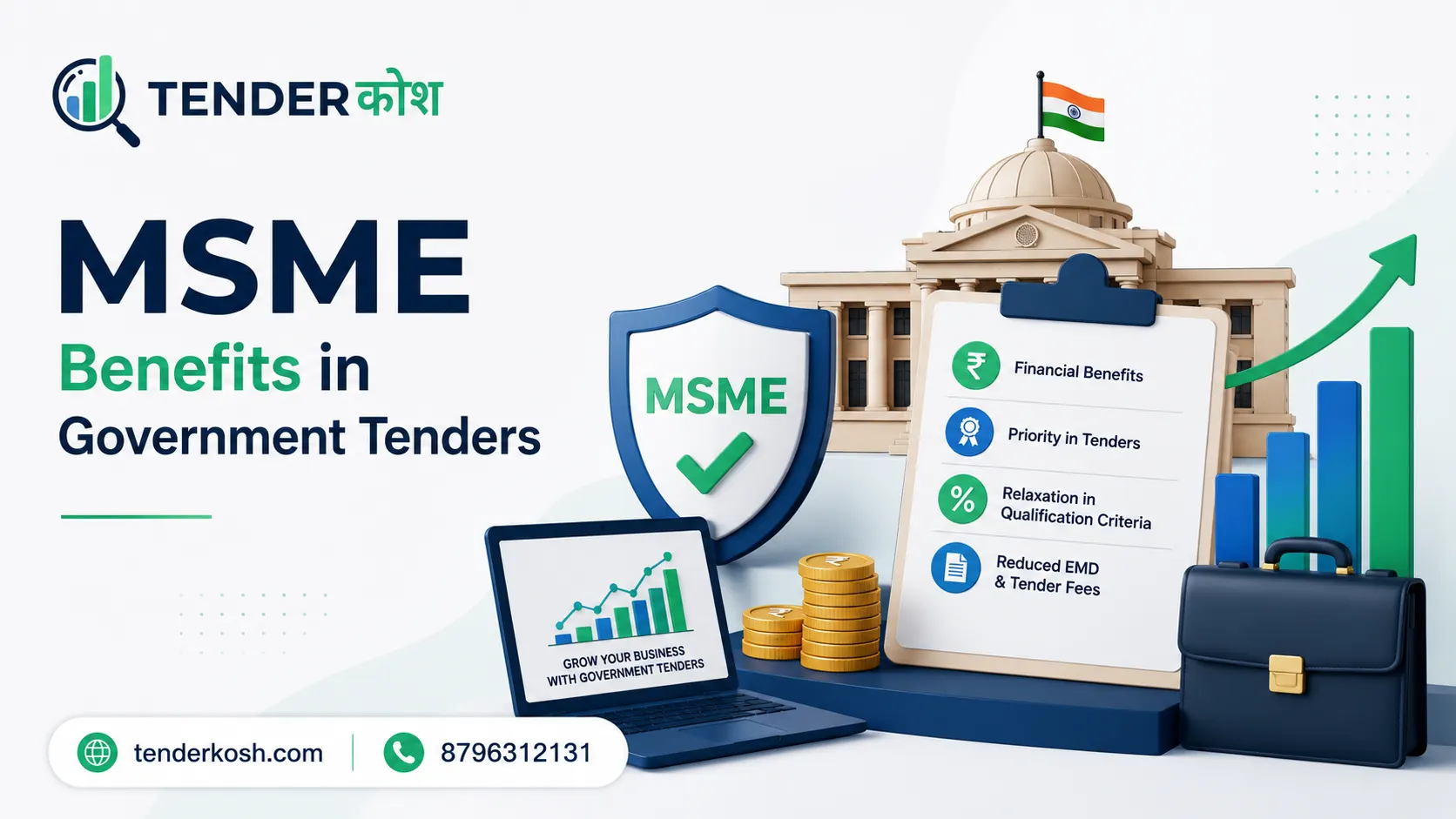
MSME benefits in government tenders help eligible Micro and Small Enterprises compete with larger companies by reducing bid costs, relaxing certain eligibility barriers, and improving access to public procurement opportunities. These benefits are mainly available to Udyam-registered Micro and Small Enterprises under the Public Procurement Policy for MSEs.
If your business supplies products or services to government departments, CPSEs, PSUs, GeM buyers, or tendering authorities, understanding these benefits can directly affect your bid eligibility, cash flow, and tender success rate. This guide explains the major MSME tender benefits, who qualifies, how to claim them, and the mistakes that commonly lead to rejection.
Key Takeaways
The Public Procurement Policy for Micro and Small Enterprises is a government procurement framework created to improve market access for MSE suppliers. It applies to procurement by Central Ministries, Government Departments, Central Public Sector Enterprises, and other covered procurement agencies.
The policy exists because smaller suppliers often face barriers such as high EMD amounts, high turnover requirements, prior experience conditions, and competition from large enterprises. The procurement policy reduces some of these barriers while keeping competition, quality, and delivery capability central to the tender process.
Important: The policy mainly supports Micro and Small Enterprises. Medium Enterprises may receive some MSME-related benefits under other schemes, but full procurement preference benefits are generally designed for MSEs.
MSME tender benefits are available when the bidder meets the eligibility conditions of the tender and holds valid enterprise registration. The most important requirement is a valid Udyam Registration Certificate that matches the business category, ownership, and activity declared in the bid.
Eligibility still depends on the tender document. Some tenders may allow exemptions, while others may limit benefits because of special procurement rules, quality standards, security requirements, or project-specific eligibility conditions.
The following MSME benefits directly affect tender participation, bid cost, qualification, pricing strategy, and payment protection. Each benefit should be checked against the specific tender clause before submission.
Central Ministries, Government Departments, and Public Sector Undertakings are required to set an annual target of at least 25% procurement from Micro and Small Enterprises. This procurement target creates a structured demand pool for MSE suppliers across product and service categories.
For MSMEs, this means government procurement is not only open to large vendors. Eligible small businesses can compete for supply, manufacturing, services, maintenance, IT, electrical, civil, healthcare, railway, renewable energy, and infrastructure-related contracts.
The MSE procurement target includes specific sub-targets for inclusive business ownership. Out of the 25% annual procurement target, 4% is earmarked for MSEs owned by SC/ST entrepreneurs and 3% is earmarked for MSEs owned by women entrepreneurs.
To claim these benefits, the enterprise must provide ownership proof that supports the declaration. In most procurement contexts, ownership should be clearly documented and aligned with portal registration, Udyam details, and bid declarations.
The procurement policy identifies 358 items reserved for exclusive procurement from MSEs. For these items, eligible Micro and Small Enterprises receive a protected procurement opportunity because the competition from non-MSE bidders is restricted.
This benefit is especially relevant for manufacturers and suppliers dealing in standardised products, consumables, equipment, components, and government supply categories where reserved procurement applies.
Earnest Money Deposit exemption is one of the most useful MSME benefits in government tenders. Many tenders require bidders to deposit EMD before participation, and these amounts can range from thousands to several lakhs depending on the tender value.
Eligible MSEs can often claim EMD exemption by uploading their valid Udyam Registration Certificate and selecting the applicable exemption option during bid submission.
Tip: Always check whether the tender specifically permits MSE EMD exemption. Do not assume exemption unless the tender document, portal field, or corrigendum supports it.
Registered MSEs may receive tender document sets free of cost in applicable government tenders. This reduces the cost of participation, especially for businesses that evaluate and apply for multiple tenders every month.
The tender fee waiver is useful for new bidders because it allows them to explore more opportunities without paying document fees for every tender. However, the waiver should be claimed according to the exact portal and tender instructions.
The MSE price preference rule can help eligible MSE bidders compete against larger non-MSE bidders. If an MSE bidder quotes within the L1 + 15% price band and the L1 bidder is not an MSE, the MSE may be allowed to match the L1 price and supply at least 25% of the tendered value, subject to tender terms.
| Example | Meaning |
|---|---|
| L1 bidder quote is ₹100 | This is the lowest price discovered in the tender. |
| MSE bidder quote is ₹114 | The MSE quote is within the L1 + 15% band. |
| MSE agrees to match ₹100 | The MSE may receive partial order allocation if the tender permits price preference. |
This benefit must be claimed correctly during bid submission. If the MSE bidder does not declare eligibility, upload documents, or accept price matching when required, the benefit may not be applied.
Many tenders include turnover and prior experience criteria to evaluate bidder capability. In eligible cases, Micro and Small Enterprises may receive relaxation from strict turnover or prior experience requirements.
This relaxation is important for smaller companies that have technical capability but do not yet meet the financial scale of larger competitors. The relaxation is not automatic in every tender, so bidders should read the eligibility clause and any MSME-specific conditions carefully.
Delayed payments are a major working-capital problem for small businesses. Under the MSMED framework, buyers are expected to make payment within the prescribed period, and delayed payment beyond the allowed period can attract statutory interest liability.
This protection improves cash-flow security for MSE suppliers after goods or services are accepted. If payment is delayed, eligible MSEs can use the MSME delayed payment mechanism and related dispute resolution channels.
Government e-Marketplace allows sellers to link their business identity and Udyam details so that buyers can identify MSME sellers during procurement. Correct MSME tagging improves visibility and helps buyers apply procurement preferences where applicable.
For GeM bids, MSME benefits depend on accurate seller profile data, valid Udyam linkage, correct category mapping, and compliance with bid conditions. A mismatch between GeM details and Udyam details can create avoidable eligibility issues.
The MSME classification limits were revised with effect from 1 April 2025. These limits determine whether an enterprise falls under Micro, Small, or Medium classification based on investment and turnover.
| Enterprise Category | Investment Limit | Turnover Limit | Procurement Benefit Relevance |
|---|---|---|---|
| Micro Enterprise | Up to ₹2.5 crore | Up to ₹10 crore | Eligible for full MSE procurement benefits where tender conditions allow. |
| Small Enterprise | Up to ₹25 crore | Up to ₹100 crore | Eligible for full MSE procurement benefits where tender conditions allow. |
| Medium Enterprise | Up to ₹125 crore | Up to ₹500 crore | Classified as MSME, but full public procurement preference benefits generally focus on Micro and Small Enterprises. |
For tendering, the most important distinction is between MSME classification and MSE procurement preference. A business may be an MSME, but many public procurement benefits are specifically written for Micro and Small Enterprises.
The difference between an eligible MSE bidder and a non-MSE bidder is visible in bid cost, eligibility relaxation, procurement preference, and payment protection. The comparison below shows how these benefits affect tender participation.
| Tender Factor | Eligible Micro or Small Enterprise | Non-MSME Bidder |
|---|---|---|
| EMD Requirement | May be exempt where tender conditions allow. | Usually required to pay EMD. |
| Tender Document Fee | May receive free tender sets or fee waiver. | Usually pays the tender document fee. |
| Price Preference | May receive L1 matching opportunity within the L1 + 15% band. | Generally no MSE price preference. |
| Turnover Relaxation | Possible where MSE relaxation is allowed. | Must usually satisfy the stated turnover criteria. |
| Reserved Items | Eligible to participate in MSE-reserved procurement items. | Restricted where items are reserved for MSEs. |
| Payment Protection | Can use MSE delayed payment protections where applicable. | Does not receive the same MSE-specific delayed payment protection. |
MSME tender benefits are not always applied automatically. The bidder must usually claim the benefit through the portal field, technical bid documents, declarations, and supporting certificates.
Practical Rule: Treat MSME benefits as a claim that must be supported by documents. A valid certificate helps only when it is uploaded correctly and mapped to the relevant tender condition.
In the 2025 Lifecare Innovations Pvt. Ltd. vs Union of India judgment, the Supreme Court discussed the legal force and implementation of the MSE procurement policy. The Court clarified that an individual MSE does not have an automatic right to receive a fixed minimum procurement share, but the policy creates a statutory obligation for authorities to implement the procurement mandate effectively.
The judgment is important for MSME bidders because it recognises that grievance mechanisms can examine unreasonable tender conditions, including conditions that may disadvantage Micro and Small Enterprises. This makes documentation, eligibility review, and timely grievance escalation important for MSE bidders facing restrictive tender terms.
Most MSME tender rejections happen because bidders either fail to claim the benefit correctly or submit documents that do not match the tender requirement. The following mistakes should be checked before every submission.
MSME benefits apply across many government procurement categories where Micro and Small Enterprises supply products, execute services, or support project delivery. The benefit is especially relevant in sectors with frequent government buying.
| Industry | Common Tender Opportunities |
|---|---|
| Electrical and Electronics | Panels, cables, transformers, meters, lighting, control systems, and maintenance contracts. |
| Civil and Infrastructure | Small civil works, repair contracts, road works, building maintenance, and local infrastructure projects. |
| IT and Networking | Hardware supply, software services, networking equipment, AMC, cybersecurity, and system integration. |
| Healthcare and Medical Supply | Medical equipment, consumables, hospital furniture, diagnostics, and maintenance services. |
| Renewable Energy | Solar EPC support, electrical equipment, O&M services, batteries, mounting structures, and components. |
| Railways and PSUs | Manufacturing components, maintenance services, industrial supply, fabrication, and workshop items. |
TenderKosh helps MSMEs, contractors, OEMs, suppliers, distributors, and service providers discover live tenders, track corrigenda, monitor eligibility clauses, and reduce rejection risk across GeM, CPPP, PSU, state, infrastructure, EPC, renewable energy, and government procurement portals.
Explore Live TendersGet Tender SupportMSME benefits in government tenders include EMD exemption, tender fee waiver, procurement preference, price preference, reserved item procurement, possible turnover or experience relaxation, and delayed payment protection for eligible Micro and Small Enterprises.
Yes. A valid Udyam Registration Certificate is generally required to claim MSME or MSE benefits in government tenders. The certificate should match the bidder entity and should be uploaded with the technical bid where required.
No. Medium Enterprises are part of the MSME classification, but full public procurement preference benefits generally apply to Micro and Small Enterprises under the MSE procurement policy.
No. EMD exemption depends on the tender document, procurement category, buyer conditions, and portal instructions. MSME bidders should verify the EMD clause before assuming exemption.
The L1 + 15% price preference allows an eligible MSE bidder quoting within 15% of the lowest non-MSE bidder to match the L1 price and supply at least 25% of the tendered value, subject to tender terms and policy applicability.
The main document is the Udyam Registration Certificate. Depending on the tender, bidders may also need GST, PAN, ownership documents, SC/ST or women-owned enterprise proof, OEM authorization, financial statements, experience certificates, and portal-specific declarations.
An MSE can raise grievances through the appropriate procurement grievance mechanism when tender conditions appear unreasonable or disadvantageous. The 2025 Lifecare Innovations judgment discussed the role of grievance mechanisms in examining unreasonable tender conditions affecting MSEs.
Discover relevant tenders, monitor corrigenda, compare opportunities, and move from document reading to structured action.