TenderKosh for EPC teams
Turn tender reading into faster bidding decisions.
Discover relevant tenders, monitor corrigenda, compare opportunities, and move from document reading to structured action.
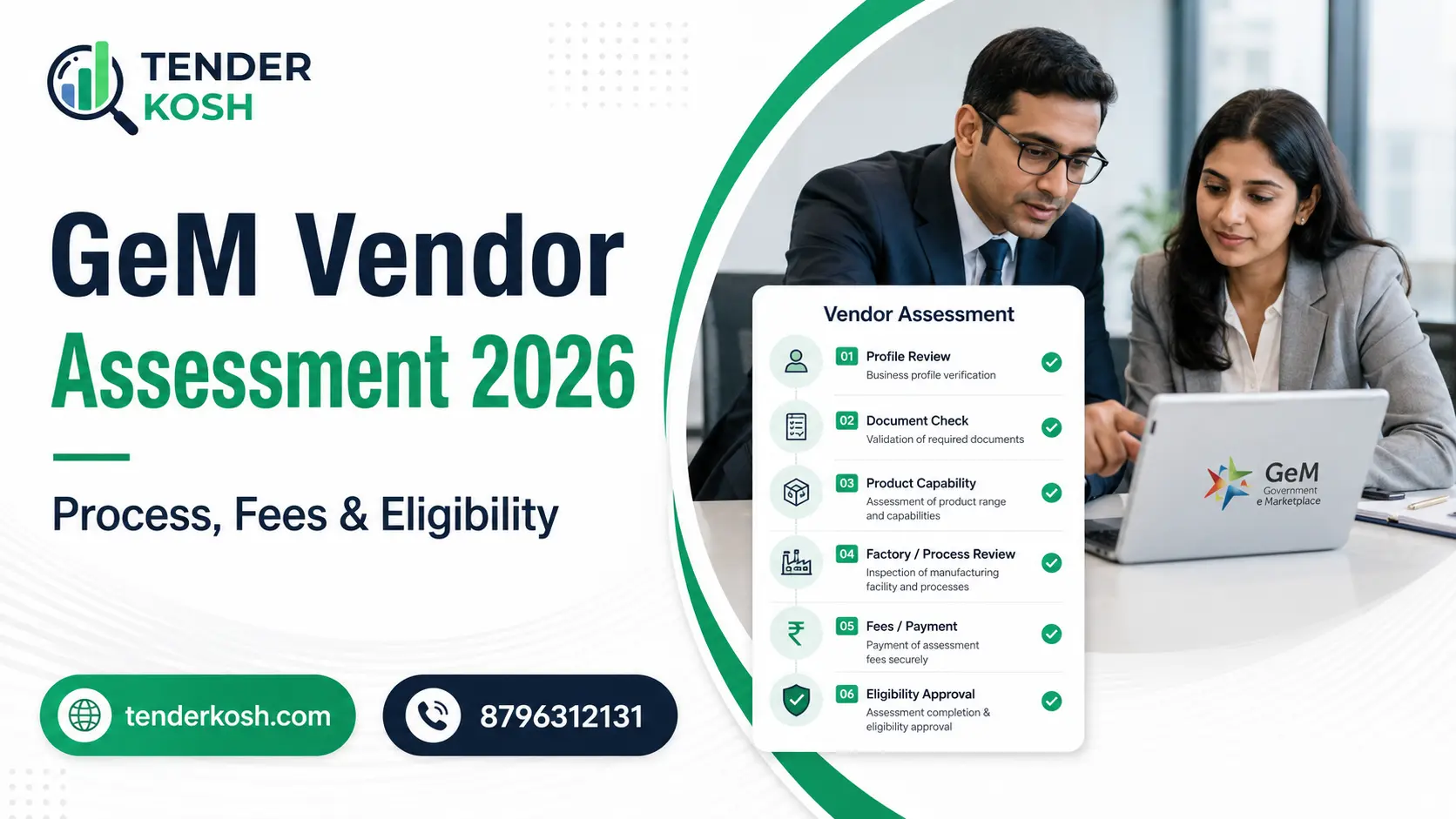
On the Government e-Marketplace (GeM), not every seller can bid for every order. For a large share of products, especially those sold by manufacturers, buyers want assurance that the vendor behind the listing is genuine, capable, and financially sound. That assurance comes from GeM Vendor Assessment, an independent check of a seller’s credentials that unlocks access to restricted categories and high-value bids.
If you are an OEM, or you have ever come across a tender you could not bid on because it was limited to “assessed sellers”, this is the process standing between you and that opportunity. This guide explains what GeM Vendor Assessment is, who needs it, what the assessment actually checks, how the process works step by step, and how it affects your ability to win government tenders.
Key Takeaways
GeM Vendor Assessment is a structured verification of a seller’s business credentials, conducted by an independent assessment agency empanelled by GeM (the Quality Council of India has historically handled these assessments, though the assigned agency can vary). The goal is simple: to confirm that the seller behind a product listing actually exists, is financially viable, and has the capability to deliver what it claims to supply.
The outcome is recorded against the seller’s profile on GeM. Buyers can then see that a vendor has been independently assessed, which is exactly the kind of credibility signal that lets a small or unknown supplier compete against established names. For manufacturers, the assessment is also the gateway to being recognised as an OEM on the platform.
Vendor Assessment is not required of every seller for every product, but it becomes mandatory in several common situations. You will need it if any of the following applies to you:
Resellers are a different case. A reseller usually does not need its own manufacturing assessment; instead it needs a valid OEM Authorization Certificate from the manufacturer to sell branded products. Some sellers may also qualify for exemptions or relaxed requirements based on existing certifications or status, and these rules are revised periodically, so confirm your specific situation on the GeM portal before assuming you are exempt.
The assessment looks at a seller across a few core dimensions, each chosen to answer a specific question a buyer would otherwise have to take on trust. Understanding these dimensions helps you prepare the right evidence in advance.
| What Is Checked | Why It Matters |
|---|---|
| Legal and business existence | Confirms the entity is genuinely registered (PAN, GST, incorporation details). |
| Financial capability | Checks turnover, net worth, and banking to gauge whether the seller can fulfil orders. |
| Operational and manufacturing capacity | For OEMs, verifies the facility, machinery, and production capacity behind the listing. |
| Quality systems and certifications | Reviews relevant licences and certifications (such as BIS or ISO) where applicable. |
| Authenticity of declared products | Confirms the seller actually makes or supplies the product lines it has listed. |
GeM offers two assessment modes, and the difference matters for both speed and cost. The video-based mode was introduced to make assessment faster and cheaper for the majority of sellers, while the on-site mode is used where a physical inspection is necessary.
| Mode | How It Works | Best Suited For |
|---|---|---|
| Video-based | A remote, live video walkthrough of your premises and documents with the assessor. | Most sellers; faster turnaround and lower cost. |
| On-site (physical) | An assessor visits your premises or factory in person. | Manufacturing categories or cases where a video walkthrough is insufficient. |
The process is initiated from your GeM seller dashboard and runs through the assigned agency. Completing your profile thoroughly before you start is the single biggest factor in a smooth assessment.
GeM charges a fee for Vendor Assessment, payable online when you initiate the request. The exact amount is revised from time to time and differs slightly between the video-based and on-site modes, so check the current fee on the portal rather than relying on a figure quoted elsewhere.
The assessment outcome is typically valid for around three years. After that period, you need to undergo re-assessment to keep your assessed status active, which is why it pays to track your expiry date well before it lapses.
Tip: Treat your assessment expiry like a licence renewal. If it lapses, you can be locked out of bids restricted to assessed sellers until re-assessment is complete.
Vendor Assessment directly shapes which tenders you can chase. Many GeM bids are restricted to assessed sellers, so without an active assessment you simply will not be able to participate, regardless of how competitive your price is. For manufacturers, assessment is also what allows you to sell as an OEM and to authorise resellers downstream.
It is worth seeing where this fits in the wider picture. Vendor Assessment is one of several eligibility layers on GeM, alongside a valid Udyam Registration and an accurate seller profile. A gap in any one of them can stop a bid, and an incomplete vendor assessment is among the reasons we list in our guide on MSME eligibility and rejection in GeM tenders.
Once your Vendor Assessment is active, make it count. Track live GeM tenders, corrigendum updates, and government bids across railways, EPC, infrastructure, renewable energy, civil, electrical, and PSU sectors on TenderKosh.
Explore Live TendersView PlansMost assessment delays come from preparation gaps rather than the assessment itself. These are the issues that most often slow sellers down or lead to an unfavourable outcome.
No. It is mandatory for OEMs and for bids or categories restricted to assessed sellers. Whether you need it depends on what you want to sell and the bids you intend to participate in.
The assessment outcome is typically valid for around three years, after which you must undergo re-assessment to keep your assessed status active.
Yes. GeM charges a fee, payable online when you initiate the request. The amount is revised periodically and varies between the video-based and on-site modes, so check the current rate on the portal.
Vendor Assessment verifies your own business credentials and capability. An OEM Authorization Certificate is the manufacturer’s permission for a reseller to sell its branded products. A reseller generally needs OEM authorization rather than its own manufacturing assessment.
Yes. GeM offers a video-based assessment in which an assessor conducts a live remote walkthrough of your premises and documents. An on-site visit is used where a physical inspection is required.
Some sellers may qualify for exemptions or relaxed requirements based on existing certifications or status, but these rules change from time to time. Confirm your specific eligibility on the GeM portal before assuming a relaxation applies.
Official Reference: Check the current Vendor Assessment process, fees, and policies on the official GeM portal: gem.gov.in
Discover relevant tenders, monitor corrigenda, compare opportunities, and move from document reading to structured action.