TenderKosh for EPC teams
Turn tender reading into faster bidding decisions.
Discover relevant tenders, monitor corrigenda, compare opportunities, and move from document reading to structured action.
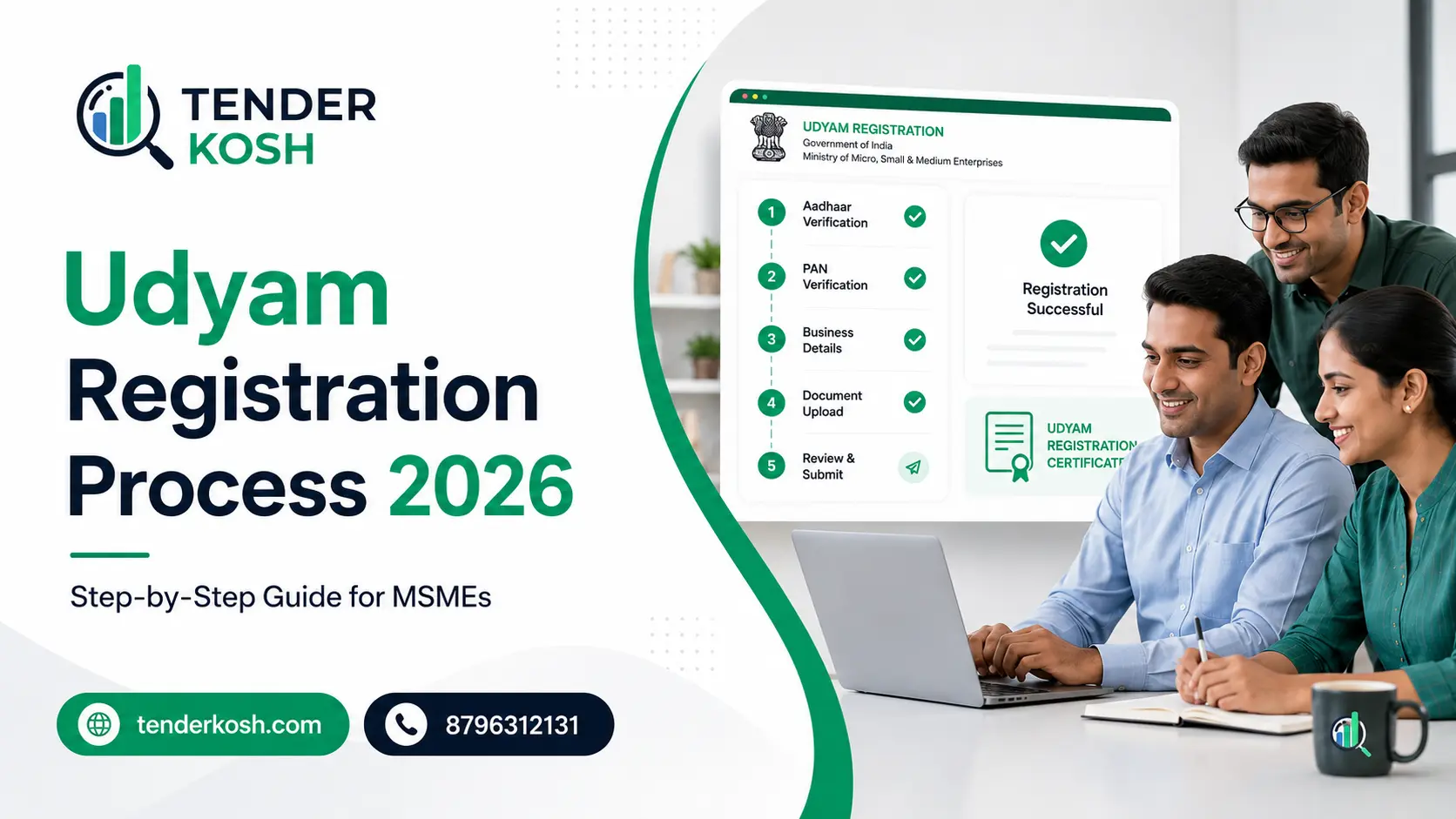
If you run a small business in India, Udyam Registration is the single document that unlocks the most. It is the government’s official recognition that your enterprise qualifies as an MSME, and it is the key to collateral-free loans, government tenders, delayed-payment protection, and a long list of subsidies. It is also free, paperless, and based entirely on self-declaration, so there is no good reason to put it off.
This guide explains what Udyam Registration is, who needs it, the documents you actually need, and the exact step-by-step process to register on the official portal. It also covers the benefits, how the registration stays valid over time, and the common mistakes that cause trouble later, especially once you start bidding for government tenders.
Key Takeaways
Udyam Registration is the official online process through which a business is recognised as a Micro, Small, or Medium Enterprise (MSME) by the Ministry of Micro, Small and Medium Enterprises. It was launched on 1 July 2020 and replaced the older Udyog Aadhaar Memorandum (UAM) system.
The process is fully digital and self-declaration based, which means you do not upload any proof documents. Once you submit your details, the system generates a permanent Udyam Registration Number (URN) and an e-certificate carrying a dynamic QR code. That certificate is your proof of MSME status everywhere it matters — banks, buyers, and government procurement portals.
Good to know: Udyam Registration is free on the official government portal. You do not need an agent or a paid service to complete it.
Any enterprise engaged in manufacturing or providing services can register, including proprietorships, HUFs, partnership firms, LLPs, private and public companies, cooperatives, societies, and trusts. Since July 2021, retail and wholesale traders are also allowed to register, mainly to access priority-sector lending benefits.
To qualify as an MSME, your enterprise must stay within the official investment and turnover limits. These are composite limits, so an enterprise is classified by whichever criterion places it in the higher category. The limits below reflect the revised classification effective 1 April 2025; confirm the current figures on the official portal before you rely on them, as thresholds are periodically updated.
| Category | Investment in Plant & Machinery / Equipment | Annual Turnover |
|---|---|---|
| Micro | Up to ₹2.5 crore | Up to ₹10 crore |
| Small | Up to ₹25 crore | Up to ₹100 crore |
| Medium | Up to ₹125 crore | Up to ₹500 crore |
Export turnover is excluded when calculating the turnover figure, which means strong exporters can stay within their MSME category even as overall sales grow.
Because registration is self-declaration based, you do not upload scanned documents. You only need a few numbers and details on hand before you start:
You will notice that investment and turnover are not on this list. That is deliberate — the portal pulls those figures directly from your PAN-linked income tax records and GST returns, so the classification reflects your actual filings rather than a self-estimate.
The full process takes only a few minutes if your Aadhaar, PAN, and GST details are in order. Follow these steps on the official Udyam Registration portal:
No PAN or GST yet? Informal micro enterprises that fall below the GST threshold can register through the Udyam Assist Platform (UAP) via designated agencies such as banks, which then formalises them as MSMEs.
Udyam Registration is not just a certificate — it is the eligibility gate for a wide range of financial, legal, and procurement benefits. The most useful ones are summarised below.
| Benefit | Why It Matters |
|---|---|
| Collateral-free loans (CGTMSE) | Access to bank credit without pledging security, up to the scheme limit. |
| Priority-sector lending | Easier and often cheaper credit, as banks treat MSME loans as priority lending. |
| Delayed-payment protection | Buyers must pay micro and small suppliers within the statutory time limit, with interest on delays. |
| Government tender benefits | EMD and tender-fee exemption, the 25% MSE procurement target, and purchase preference. |
| Subsidies and reimbursements | Concessions on ISO certification, patent and trademark fees, and interest subvention. |
| State-level incentives | Electricity, stamp duty, and registration concessions that vary by state. |
The delayed-payment protection deserves a closer look because it carries real legal weight. Under the MSMED Act, buyers must pay micro and small suppliers within the agreed period, capped at 45 days, and a delay attracts compound interest. A linked income-tax provision (Section 43B(h), effective from FY 2023-24) goes further: a buyer can claim a tax deduction on amounts owed to micro and small suppliers only in the year the payment is actually made. Together, these rules give registered MSEs genuine leverage to get paid on time, and unpaid dues can be pursued through the MSME Samadhaan portal.
If government procurement is part of your growth plan, Udyam Registration is non-negotiable. On the Government e-Marketplace (GeM), your Udyam certificate is the proof that lets you claim MSE benefits — EMD exemption, tender-fee exemption, and purchase preference. Without it, you are treated as a non-MSE bidder and lose those advantages.
One detail trips up a lot of sellers: the legal name, PAN, and GST on your Udyam certificate must match your GeM seller profile exactly, because GeM validates these fields automatically. A small mismatch is one of the most common reasons MSME bids are rejected during technical evaluation. We cover this in detail in our guide on MSME eligibility and rejection in GeM tenders.
Once your MSME registration is active, start winning with it. Track live GeM tenders, corrigendum updates, and government bids across railways, EPC, infrastructure, renewable energy, civil, electrical, and PSU sectors on TenderKosh.
Explore Live TendersView PlansA Udyam Registration is permanent — there is no renewal and no expiry date. What does change over time is your classification, which is reviewed annually based on the investment and turnover figures in your ITR and GST returns.
If your enterprise grows past its current limits, it graduates to the next category, but the change is cushioned: an enterprise that crosses into a higher category retains its existing status for a transition period rather than losing benefits overnight. You should still keep your details current on the portal, since outdated information can create mismatches when buyers or banks verify your status.
Most Udyam problems are avoidable. These are the ones that cause the most trouble later, particularly when you start bidding for tenders.
Yes. Udyam Registration is completely free on the official government portal. You do not need to pay an agent or a third-party service.
Yes. An Aadhaar number is mandatory — of the proprietor, managing partner, karta, or authorised signatory, depending on the type of organisation.
No. The process is self-declaration based, so no proof documents are uploaded. Your PAN and GST details are validated automatically, and investment and turnover are pulled from your filings.
No. It is permanent with no renewal. Your classification is reviewed annually based on your ITR and GST data, but the registration itself does not expire.
Yes. Since July 2021, retail and wholesale traders can register under Udyam, mainly to access priority-sector lending benefits.
Yes. The older Udyog Aadhaar (UAM) system has been discontinued. Existing holders must register afresh on the Udyam portal to keep their MSME benefits.
Your Udyam certificate is the proof of MSME status required to claim EMD exemption, tender-fee exemption, and purchase preference on GeM. The details must match your GeM seller profile exactly to avoid rejection.
Official Reference: Register and verify the latest MSME classification rules on the official Udyam portal: udyamregistration.gov.in
Discover relevant tenders, monitor corrigenda, compare opportunities, and move from document reading to structured action.