

TenderKosh for EPC teams
Turn tender reading into faster bidding decisions.
Discover relevant tenders, monitor corrigenda, compare opportunities, and move from document reading to structured action.
Tender eligibility criteria for two projects that look nearly identical on paper — same sector, similar value, comparable scope — can differ sharply because eligibility is never set from the work alone.
It is shaped by five compounding factors: project risk, funding source, department policy, technical complexity, and procurement method. Change any one of these and the eligibility clause changes with it, even if the BOQ looks nearly the same.
Bidders who track tenders across sectors run into this constantly. Two road projects of similar length and budget, floated a few months apart, can ask for wildly different minimum turnover, years of experience, or technical certifications.
It is tempting to read this as inconsistency, or even error, on the buyer’s side. Usually, it isn’t. Tender eligibility criteria are a deliberate risk-management tool.
Five distinct forces feed into how tightly or loosely that tool gets calibrated for any given tender — often invisibly, because the tender document rarely explains its own reasoning.
This guide walks through each of those five factors in turn and explains the logic a procuring authority applies when setting tender eligibility criteria. It shows why treating tender eligibility criteria as arbitrary is exactly what causes experienced bidders to misjudge a tender they thought they understood. The underlying logic matters more than any single tender’s numbers, because the numbers change every time.
Key Takeaways
On this page
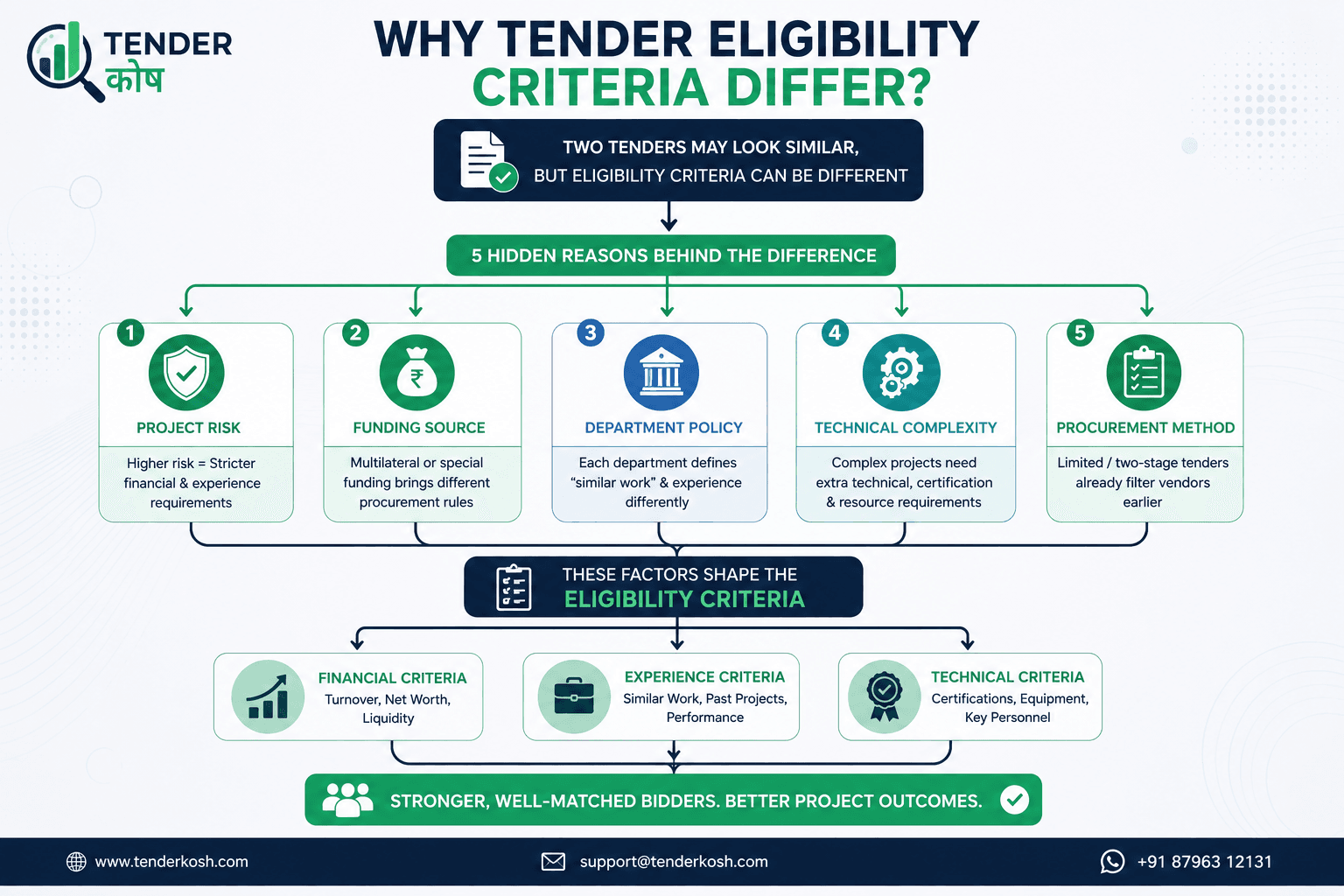
Figure 1: Five hidden factors that determine tender eligibility criteria.
Tender eligibility criteria exist to filter out bidders who cannot realistically deliver a specific contract. “Realistically deliver” depends on far more than the physical scope of work described in the BOQ. That’s the core reason two projects that look similar on the surface can carry very different qualification bars.
General Financial Rules govern how central government eligibility clauses must be framed. Rule 173 requires that a bidding document be self-contained, unambiguous, and clearly spell out the criteria for eligibility, including experience, technical capability, and financial position.
But the rule tells a department how to state its criteria, not what the specific numbers should be. That judgment is left to the procuring authority, tender by tender. It is shaped by everything happening around the contract: how much is riding on it going wrong, whose money is paying for it, which department’s internal habits apply, how specialised the work is, and which procurement route was chosen to award it.
The Central Vigilance Commission has repeatedly cautioned departments against both ends of this judgment call. Prequalification criteria can be vaguely defined enough to let unqualified bidders in, or stringent enough to be effectively tailor-made for one preferred vendor.
Both distortions are real risks precisely because tender eligibility criteria are a judgment call rather than a fixed formula. That’s exactly why two similar-looking tenders, judged by two different people or processes, can land in two different places.
The more a project’s failure would cost — in money, safety, public disruption, or reputational damage — the tighter a buyer will set financial and experience thresholds. Risk, not size, is often the real variable driving tight tender eligibility criteria.
Two contracts of identical value can carry very different risk profiles. A road resurfacing contract and a bridge-strengthening contract of the same budget are not equivalent risks. A resurfacing failure is inconvenient and repairable, while a bridge failure is catastrophic and irreversible.
The CVC’s long-standing guidance on turnover illustrates this directly. Turnover thresholds are meant to be proportionate to the estimated project value, commonly capped around twice that value.
A buyer assessing a high-consequence project will often set turnover and prior-experience requirements at the upper end of what’s defensible. The cost of an unqualified bidder failing is far higher than the cost of a smaller eligible bidder pool.
Risk-driven tightening shows up in predictable places: higher minimum net worth, a longer track record of “similar work,” and a larger EMD and performance guarantee. Sometimes it adds mandatory safety certifications too.
None of this is really about physical scope. It’s about how much the buyer needs to de-risk one decision: will this bidder actually deliver.
Where the money for a project comes from can change the entire eligibility framework, not just the numbers inside it. Externally funded projects are frequently bound by the funder’s own procurement rules, not just domestic ones. This is one of the most overlooked reasons two similar tenders diverge.
A project funded purely through domestic budgetary allocation is governed by GFR and the procuring department’s own manual. A project co-funded by a multilateral lender — the World Bank, the Asian Development Bank, JICA, or similar — is often bound by that lender’s own procurement guidelines instead.
That can mean an entirely different eligibility structure: different debarment and sanctions lists, different rules on foreign bidder participation, and different documentation requirements than a purely domestic tender would ask for.
Funding source also interacts with domestic preference policy. Purchase-preference and local-content rules can apply differently, or not at all, depending on how a project is funded and which ministry’s policy governs it.
A domestically funded tender may carry a local-content or MSME-reservation clause that a comparable, externally funded project in the same sector does not carry. Two tenders that look identical in the BOQ can end up with genuinely different eligible bidder pools purely on this basis.
Check the funding line, not just the scope. If a tender document references external financing or a specific development bank, read the tender eligibility criteria even more carefully — they may follow a framework that has nothing to do with the domestic norms you’re used to.
Every ministry, PSU, and department operates its own internal procurement manual layered on top of GFR. Those manuals routinely define core eligibility concepts — like “similar work” or required years of experience — differently from one buyer to the next.
This is why the same contractor bidding what looks like the same category of work across two departments can face two different rulebooks, and different tender eligibility criteria as a result.
CPWD, individual state PWDs, Indian Railways, and various PSUs each maintain their own standard bidding documents, refined over years of internal practice and past disputes. One department’s manual might define “similar work” narrowly, requiring experience in the exact same structure type. Another defines it broadly enough to include adjacent categories of construction.
One department might require three years of average turnover data; another, five. These aren’t random variations. They usually trace back to a department’s own risk history, past litigation, or internal audit findings.
This factor is also where organisational culture becomes visible in a tender document. Departments burned by underqualified contractors in the past tend to write tighter tender eligibility criteria going forward.
Departments with a strong vendor track record sometimes keep looser, standard criteria simply because it hasn’t caused a problem. None of this is stated in the tender itself — it’s institutional memory, expressed through eligibility clauses.
The more specialised or technically demanding the work, the more tender eligibility criteria shift from purely financial filters toward technical and personnel-based ones. Certifications, equipment ownership, and named experts start to matter more than turnover.
A straightforward, commoditised supply or simple civil work tends to rely on standard markers: turnover, net worth, general experience, and EMD. A technically demanding contract adds a different layer entirely.
Specialised instrumentation, advanced water treatment, or niche electrical and signalling systems often require proof of equipment ownership, sector-specific certifications, and named key personnel with verified experience in that exact technology.
This is the factor most likely to make two tenders of similar budget feel unrecognisable in their tender eligibility criteria. A ₹50 crore standard road contract and a ₹50 crore tunnel-boring contract share almost nothing technically, even at similar financial thresholds.
Strong generalist bidders sometimes get caught out here, assuming financial qualification alone will carry them through a tender whose real filter is technical.
Track live tenders across EPC, infrastructure, renewable energy, civil, electrical, and PSU sectors — and compare tender eligibility criteria side by side — in one dashboard.
Whether a contract is awarded through open tendering, limited tendering, single-source procurement, or a two-stage process changes how much eligibility screening happens inside the tender document itself. Two projects with identical scope can carry very different published tender eligibility criteria purely because of the route used.
Open tenders, the most common route for major public works, tend to carry the most detailed, self-contained eligibility sections. The bidder pool is unrestricted, so the document has to do all the filtering work on its own.
Limited tenders draw from a pre-approved, empanelled vendor list. They often carry lighter published tender eligibility criteria, because much of the qualification work already happened during empanelment.
Single-source or proprietary procurement, reserved for narrow circumstances under GFR, may carry criteria that exist mainly to document why only one vendor was considered.
Two-stage and Expression-of-Interest-led procurement adds another layer. Capability can be assessed in a first stage, with detailed bids invited only from those who clear it.
A tender procured this way can look, on the surface, like it has “lighter” tender eligibility criteria in its main bidding document. In reality, the heavy filtering already happened in a stage the casual reader may not have noticed.
No single factor sets tender eligibility criteria in isolation. In practice, all five interact, and it’s the combination that produces the specific numbers you see in a live tender. Seeing the interaction is more useful than treating each factor as a separate checklist item.
Consider two water-supply projects of similar budget. One is a routine pipeline extension in a small town, funded from state budgetary allocation, procured through open tender under the state PWD’s standard manual, using low-complexity technology.
The other is a large-scale desalination plant, co-funded by a multilateral development bank, procured under that bank’s own guidelines with a two-stage qualification process, involving high-complexity treatment technology.
Even with identical contract values, the second project carries tighter financial thresholds, a different rulebook for part of its tender eligibility criteria, department-specific technical annexures, named experts, and a first-stage qualification round invisible in the final document.
The pipeline project carries none of these layers. Same sector, same rough budget, completely different eligibility architecture.
Here is how each factor typically pulls tender eligibility criteria tighter or looser, and where to look for its signature in a live tender. Use this as a quick reference when two similar-looking tenders don’t match your expectations.
| Factor | Typical Effect on Eligibility | Where to Spot It |
|---|---|---|
| Project risk | Higher-consequence projects get tighter turnover, net worth, and experience thresholds. | Look at EMD/PBG size and how narrowly “similar work” is defined. |
| Funding source | Externally funded projects may follow the lender’s own rules, not just GFR. | Check the tender’s financing clause for a named bank or loan agreement. |
| Department policy | Internal manuals set different experience windows and definitions across buyers. | Compare the same clause across two tenders from different departments. |
| Technical complexity | Adds certification, equipment, and named-personnel requirements beyond financial filters. | Look for annexures requiring CVs, licenses, or equipment ownership proof. |
| Procurement method | Open tenders carry heavier published criteria; limited/two-stage tenders may carry lighter visible criteria. | Check whether the tender references an empanelled list or a prior qualification stage. |
The practical implication is simple: never assume a new tender’s tender eligibility criteria based on a similar-looking one you’ve bid before. Read each one as its own document, shaped by its own combination of these five factors. Pattern-matching from memory is exactly what causes experienced bidders to misjudge a tender’s real qualification bar.
A useful habit is to actively ask, for any tender you’re evaluating, which of the five factors is doing the most work. Is this a high-risk project where the buyer is clearly de-risking through financial thresholds?
Is there a funding clause pointing to an external lender’s rulebook? Does the department’s manual explain an unusually narrow experience definition?
Is the work technically unusual enough to justify personnel and certification requirements? Was this procured through a route where some qualification already happened earlier, off-page?
Answering these questions turns tender eligibility criteria from an opaque hurdle into a readable signal about what the buyer actually cares about for this specific contract.
Most misjudged bids in this area come from assuming consistency where none was promised. These are the specific comparison mistakes worth avoiding.
Every one of these mistakes comes from reading a new tender through the lens of an old one. The fix is the same discipline that protects bidders elsewhere in the process: read the specific document in front of you, every time.
A short, repeatable review checks all five factors before you commit time to a bid. It takes far less effort than discovering a mismatch after you’ve started preparing documents.
Bidders who run this check consistently stop being surprised by tenders that “should” look familiar but don’t.
Comparing tender eligibility criteria across live tenders, sector by sector, is easier with a dashboard that surfaces the actual clauses instead of a manual portal-by-portal search. TenderKosh’s live tender feed is built for exactly that kind of comparison.
Keep these terms handy when comparing eligibility clauses across tenders.
| Term | What It Means |
|---|---|
| Prequalification criteria (PQ) | The minimum financial, technical, and experience thresholds a bidder must meet to be considered. |
| Similar work | A department-defined standard for what counts as relevant past experience; definitions vary by buyer. |
| Net worth requirement | A minimum financial strength threshold, distinct from turnover, used to gauge stability. |
| Multilateral funding | Project financing from an institution like the World Bank or ADB, which can bring its own procurement rules. |
| GFR (General Financial Rules) | The core rulebook governing how central government tenders must be structured and conducted. |
| Empanelment | A pre-approval process that qualifies vendors in advance, often used ahead of limited tendering. |
| Two-stage tendering | A process where capability/eligibility is assessed first, with detailed bids invited only from qualifiers. |
| Restrictive/tailor-made criteria | Eligibility conditions drawn so narrowly they effectively favour one bidder, discouraged under CVC guidance. |
Now that you understand why tender eligibility criteria vary, go deeper with these guides:
Tender eligibility criteria are shaped by five factors beyond just the physical scope of work: project risk, funding source, department policy, technical complexity, and procurement method. Two projects can look similar in budget and sector but differ sharply in eligibility because these factors combine differently for each one.
Higher-consequence projects — where failure would be costly, unsafe, or hard to reverse — tend to get tighter turnover, net worth, and experience thresholds, even if the contract value is similar to a lower-risk project. Risk, not size, often drives how strict a clause is.
Yes. Projects funded even partly by a multilateral lender such as the World Bank or ADB are often required to follow that lender’s own procurement guidelines, which can differ from GFR-based domestic norms on eligibility, debarment checks, and foreign bidder participation.
Each department or PSU maintains its own procurement manual, and these manuals define “similar work” and required experience windows differently based on that department’s own history and internal practice. There is no single, universal definition across all Indian government tenders.
Yes. Technically demanding contracts frequently add certification requirements, proof of equipment ownership, and named key personnel with verified qualifications, on top of the standard turnover and net worth criteria used for simpler, commoditised work.
This is often explained by procurement method. Limited tenders draw from a pre-approved, empanelled vendor list, so much of the qualification work already happened earlier. Two-stage tenders assess capability in an earlier round, which can make the final bidding document’s published criteria look lighter than a comparable open tender.
Not necessarily. The Central Vigilance Commission cautions against vague or tailor-made criteria that unfairly restrict competition, but a strict clause can also be a legitimate response to genuine project risk or technical complexity. Bidders should check whether the strictness is explained by risk, funding, or complexity before assuming it’s improper.
Check each tender’s risk signals, funding clause, issuing department, technical annexures, and procurement route individually, rather than assuming a past similar tender’s criteria will carry over. Use the clarification window to confirm anything ambiguous before committing time to a bid.
Official Reference: Central Vigilance Commission guidance on prequalification criteria and Rule 173 of the General Financial Rules 2017, governing transparency, competition and fairness in the procurement process, are published on the CVC and Ministry of Finance portals: cvc.gov.in.
Discover relevant tenders, monitor corrigenda, compare opportunities, and move from document reading to structured action.