TenderKosh for EPC teams
Turn tender reading into faster bidding decisions.
Discover relevant tenders, monitor corrigenda, compare opportunities, and move from document reading to structured action.
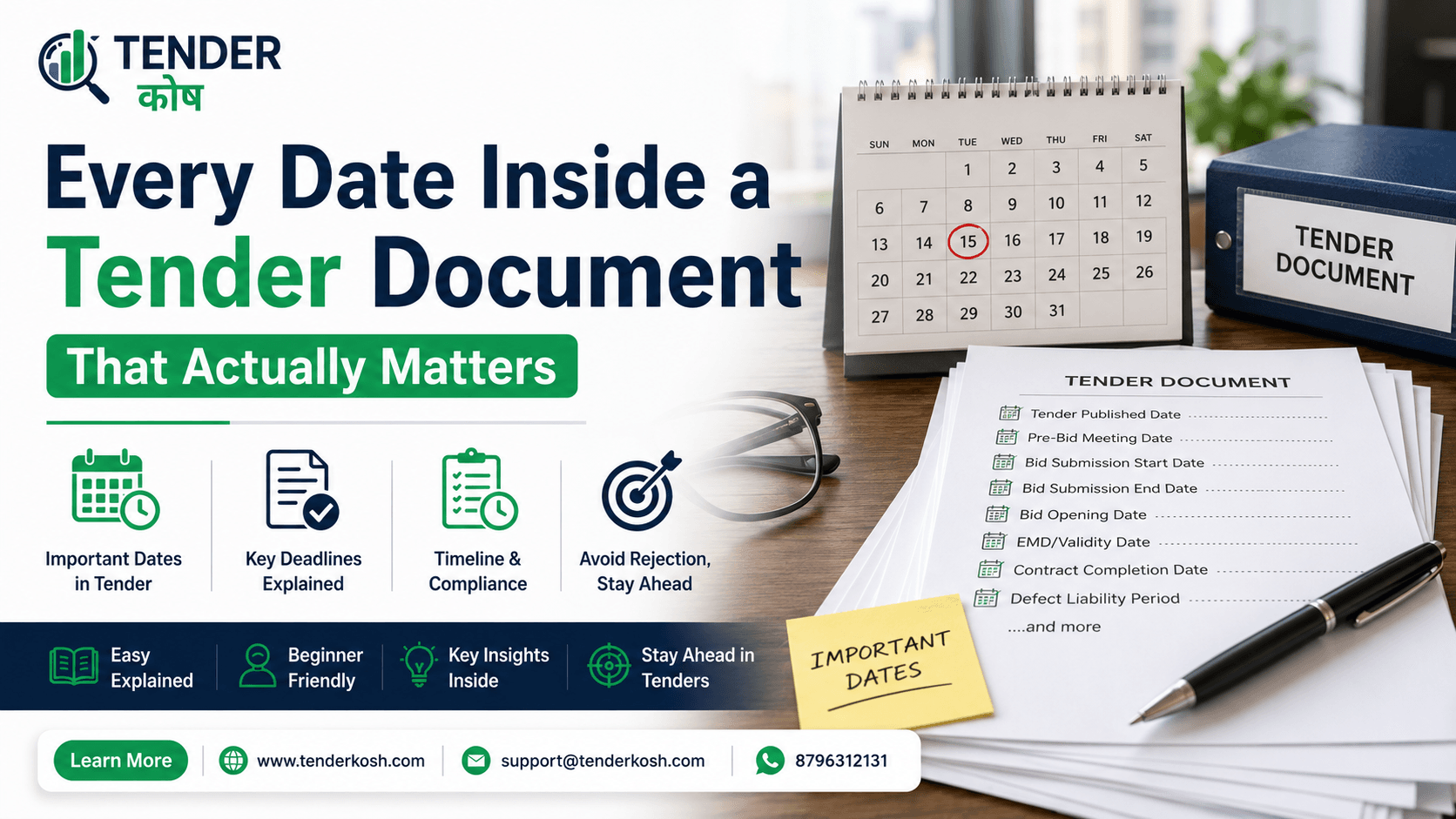
Tender document dates go far beyond the bid submission deadline — and missing any one of them can disqualify your bid or cost you money after you win. The tender document dates that actually matter include the clarification deadline, pre-bid meeting, corrigendum release, bid submission, bid opening, bid validity, delivery period, and warranty period. Each governs a different obligation, and treating the document as a single “deadline” is one of the most expensive mistakes a bidder can make.
Almost every first-time bidder makes the same error with tender document dates: they open a tender, scroll straight to the submission deadline, mark it on a calendar, and treat everything else as background noise. Then they lose — not because their price was wrong, but because they missed a clarification window, skipped a pre-bid meeting, bid against a superseded version of the document, or let their bid validity lapse before award. The deadline was never the only date that mattered.
A tender is a legal timeline, not a single event. From the moment it is published to the day the warranty finally expires, a chain of dates governs what you can ask, what you must submit, how long your offer stays binding, when you must deliver, and how long you remain liable afterwards. Each date carries its own consequence, and the gaps between them are where organised bidders quietly beat disorganised ones.
This guide walks through every tender document date that genuinely matters, in the order you will encounter them, and explains what each one obligates you to do. Read it top to bottom the first time so the full timeline clicks into place, then use the table of contents to jump back to any single date when you have a live tender in front of you. Wherever a date hides a trap — bid validity extensions, delivery penalties, warranty start-points — we slow down, because those are exactly the places bidders lose money.
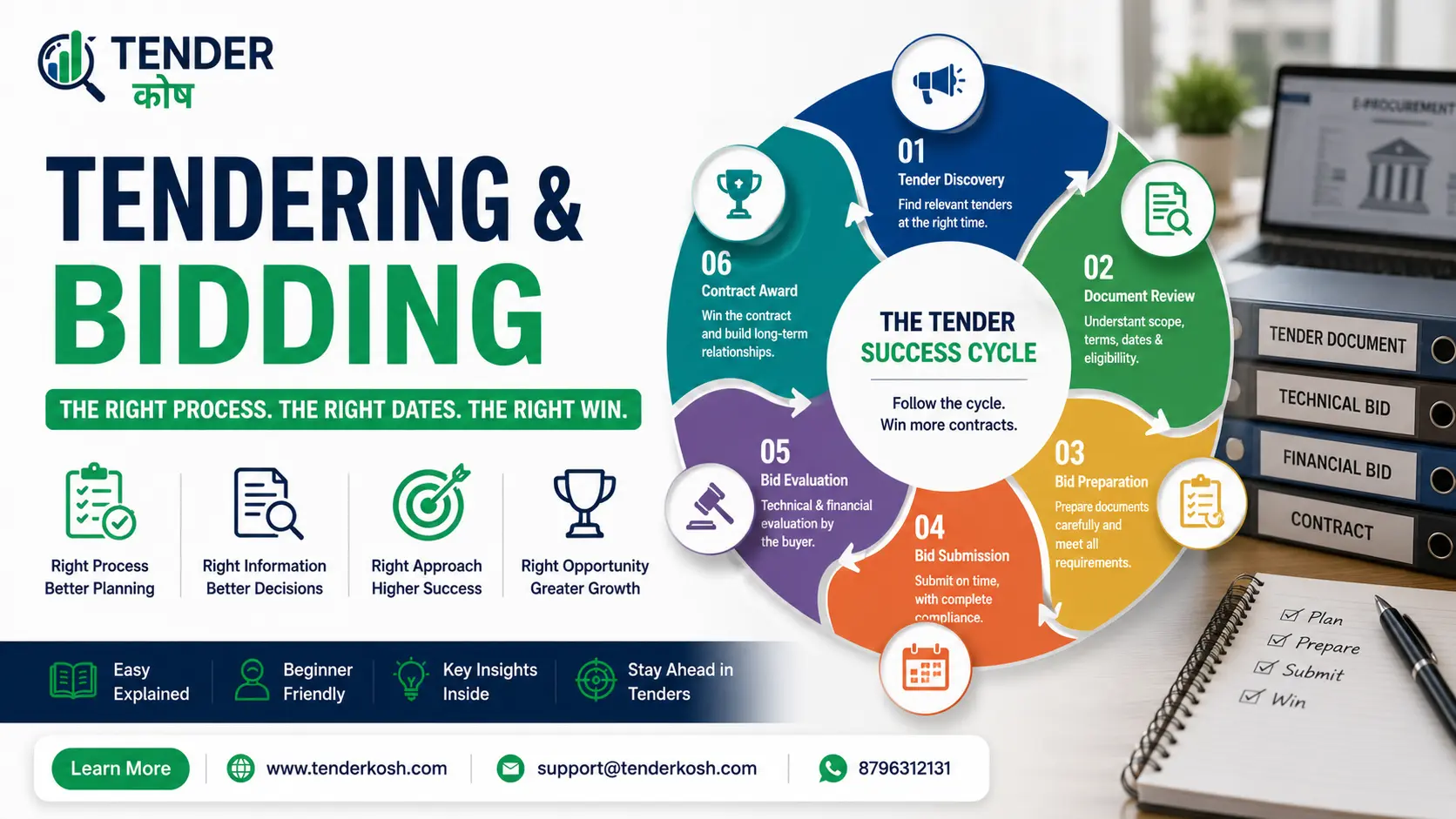
Key Takeaways
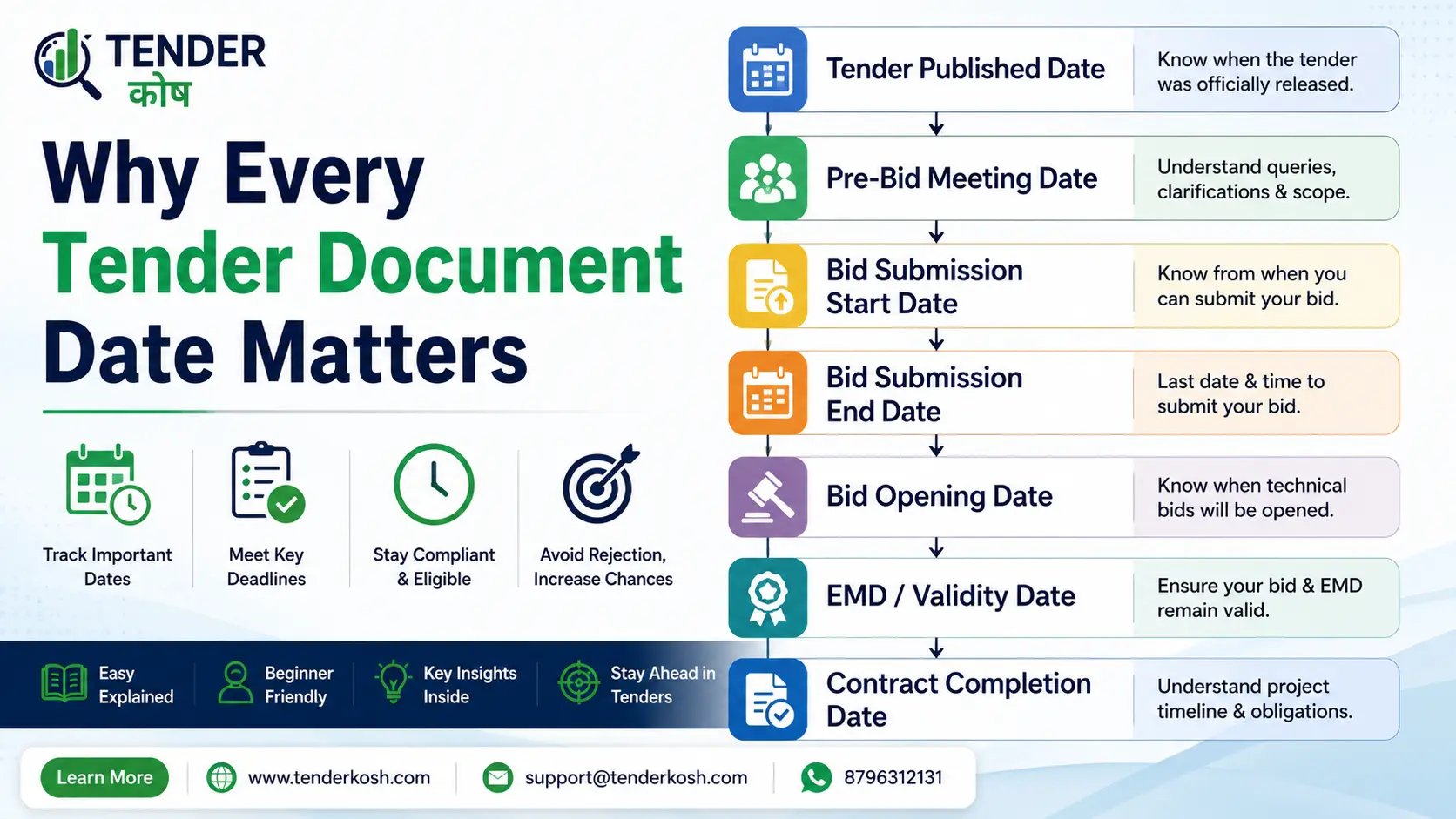
Every date in a tender document creates a legal obligation, a deadline, or a right — and each one has a consequence for missing it. A tender is a structured procurement process governed by rules, and those rules are anchored to tender document dates. Understanding the timeline is not administrative housekeeping; it is core bid strategy.
Think of a tender as a relay race with several batons. The first stretch is about understanding the tender and getting your questions answered. The middle stretch is about preparing and submitting a compliant, competitive bid. The final stretch — the one most beginners never even picture at bid stage — is about delivering what you promised and standing behind it through the warranty. Drop the baton at any handover and the whole race is lost, no matter how fast you ran the other legs.
The consequences of missing tender document dates are not evenly distributed, which is what makes them dangerous. Some dates are hard cut-offs where being one minute late means automatic exclusion — the submission deadline is the obvious one. Others are softer but still costly: skip the clarification window and you carry ambiguity into your bid; ignore a corrigendum and you may be disqualified for non-compliance; let bid validity lapse and you can forfeit your bid security. And the dates that fall after award — delivery and warranty — convert directly into financial penalties if you misjudge them. Learning which dates are hard and which are soft is the first layer of tender literacy.
The practical takeaway is simple: extract every date from a tender the moment you download it, map them all onto a single calendar, and understand what each one obligates you to do. The bidders who do this consistently are the ones who never lose a contract to a technicality. You can watch live tenders and their corrigendum updates in one place on TenderKosh’s live tender feed, which removes the risk of missing an amendment buried on a procurement portal.
The publication date is the day the tender goes live on the procurement portal, and it starts the clock on every other tender document date. Every subsequent date — clarification, pre-bid, submission — is measured from here, so it is the anchor of the entire timeline.
This date matters more than beginners assume, because the window between publication and submission is often shorter than it looks. A tender might be “open for 21 days,” but once you subtract the time needed to attend a pre-bid meeting, wait for the agency’s clarifications, absorb any corrigendum, arrange your bid security, and assemble qualification documents, the genuine preparation window can shrink to a week or less. The bidders who spot a tender on its publication date, rather than a fortnight later, hold a real advantage that has nothing to do with capability.
Speed is a competitive edge. Two bidders with identical qualifications do not have identical odds if one saw the tender on day one and the other on day twelve. The early bidder has more time to raise clarifications, line up documents, and model a sharp price. This is precisely why serious bidders monitor tender feeds daily rather than checking portals occasionally — the publication date is a starting gun, and you want to hear it fire.
The clarification deadline is the last date by which you can submit written questions to the tendering authority about anything unclear in the document. It is one of the most underused rights a bidder has, and letting it pass in silence is a missed opportunity that beginners rarely appreciate until it hurts them.
Tender documents are written by the buyer, and they are frequently ambiguous, contradictory, or silent on details that matter to your bid. Does a technical specification allow an equivalent product, or only one exact model? Is a particular certification mandatory or preferred? How exactly will a scoring criterion be applied? The clarification window is your formal, on-the-record channel to ask — and the agency’s written answers become binding, often issued to all bidders through a corrigendum so everyone competes on the same understanding.
The strategic point most newcomers miss is that a well-framed clarification question can quietly reshape a tender in your favour. If a specification appears to lock in a single manufacturer, a clarification asking whether equivalents are acceptable can open the field. If an eligibility clause is ambiguous, a clarification can confirm you qualify before you invest days in a bid. Because answers are shared with everyone, you are not tipping your hand about price — you are simply removing risk. Treating the clarification deadline as a genuine tool, rather than a formality to ignore, is a mark of an experienced bidder.
Do not wait until the last hour. Submit clarification questions early in the window, not on the deadline itself. Agencies need time to respond, and answers that arrive close to the submission deadline leave you scrambling. Reading the document thoroughly in the first day or two — specifically hunting for ambiguities — is what lets you use this deadline well.
The pre-bid meeting is a scheduled session where the tendering authority explains the tender and answers bidders’ questions face to face (or online), usually held before the clarification deadline closes. It is your single best opportunity to understand the buyer’s real intent and to surface issues that a written query might not fully resolve.
A pre-bid meeting serves several purposes at once. The agency walks through the scope, the qualification criteria, and the evaluation method, often revealing emphasis and intent that the written document only implies. Bidders raise doubts and hear not just the answer but the reasoning behind it. And crucially, questions raised or agreed in the meeting frequently lead to formal amendments — so the pre-bid meeting is often the origin of the corrigendum that follows.
For a beginner, attending is almost always worth it even when the meeting is optional. You learn the vocabulary the agency uses, you hear the questions your competitors are asking (which tells you where the tricky parts are), and you build a small amount of familiarity with the officials who will run the process. Some tenders make attendance mandatory for eligibility, in which case missing it disqualifies you outright — another reason this date belongs on your calendar in bold. Even where it is not mandatory, skipping it means forfeiting your clearest window into what the buyer actually wants.
Track live tenders with clarification deadlines, pre-bid meeting dates, and corrigendum alerts across railways, EPC, infrastructure, renewable energy, civil, electrical, and PSU sectors — all in one dashboard.
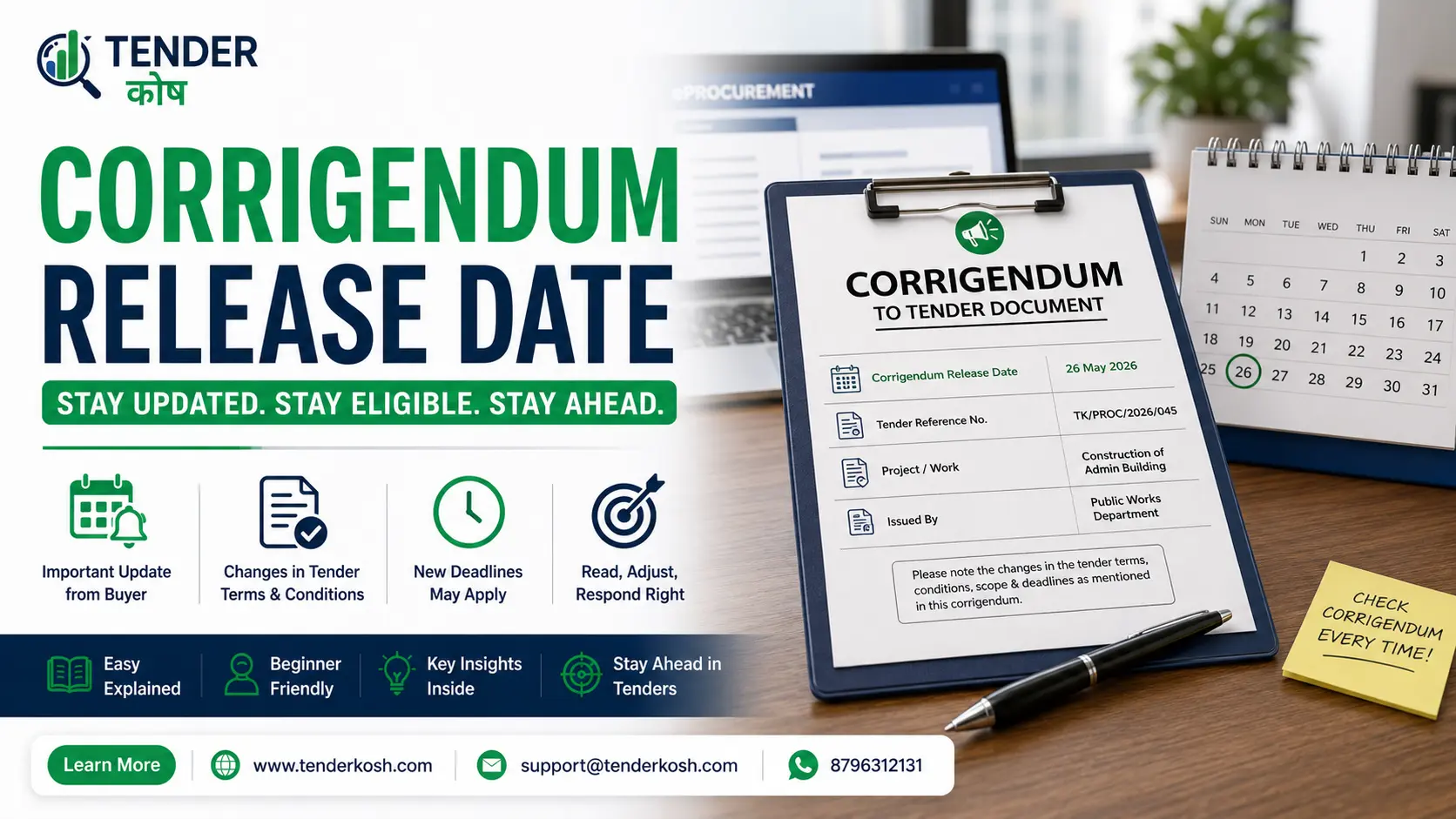
A corrigendum is an official amendment to a live tender, and its release date marks the moment the tender’s terms may have changed — including its dates. Corrigenda are among the most consequential and most overlooked events in the whole process, because they can silently invalidate a bid prepared against an earlier version.
A corrigendum can change almost anything: it can extend or shorten the submission deadline, revise a technical specification, add or remove an eligibility requirement, correct an error, or incorporate the answers from the clarification and pre-bid stages. Large tenders often see several corrigenda before submission closes. Each one is officially part of the tender, which means the version you must comply with is the latest amended version — not the original you downloaded on day one.
This is exactly where disciplined bidders separate from careless ones. Imagine preparing a meticulous bid over two weeks, only to discover on submission day that a corrigendum three days earlier added a certification requirement you do not meet, or moved the deadline forward. It happens constantly. The defence is simple but requires vigilance: re-check the tender portal for corrigenda regularly throughout your preparation, and always right before you submit. Because corrigenda can appear at any point and reshape tender document dates without warning, a tender-tracking service that pushes corrigendum alerts to you is worth far more than its cost — a single missed amendment can waste weeks of work.
The corrigendum trap: the most common way a technically strong bid gets rejected is non-compliance with a corrigendum the bidder never saw. Always confirm you are working from the latest amended version of the document, and re-verify on the day you submit. If a corrigendum extends the deadline, do not assume all other dates shifted with it — read exactly which dates changed.
The bid submission deadline is the exact date and time by which your complete bid must be uploaded or delivered, and it is an absolute hard cut-off. This is the date everyone knows — but even here, beginners make costly errors by underestimating how unforgiving it is.
On most e-procurement portals, the system simply stops accepting submissions the instant the deadline passes. There is no grace period, no “my internet failed,” no late upload. A bid that is 99% uploaded at the cut-off is a bid not submitted. This is why experienced bidders treat the stated deadline as if it were several hours earlier than it really is, building in a buffer for slow uploads, digital-signature glitches, large attachments, and last-minute portal congestion — which is real, because many bidders leave submission to the final hours.
The deadline also interacts with the other tender document dates in ways worth planning around. It is the endpoint of your clarification and corrigendum-watching window, so your final compliance check should happen just before you submit, not days earlier. It is the point after which your bid validity period begins counting. And it typically triggers the bid opening that follows. Treating submission as the culmination of the whole front half of the timeline — rather than an isolated finish line — is what keeps a bid from failing on a technicality at the last moment.
The bid opening date is when the tendering authority formally opens the submitted bids, usually starting with the technical bids. In most large tenders this follows a two-envelope structure, and understanding the opening sequence tells you how your bid will actually be judged.
Under the common two-envelope system, technical and financial bids are submitted together but opened separately. On the bid opening date, the agency opens the technical envelopes first and screens each bidder against the qualification criteria. Only the bidders who clear this technical gate have their financial bids opened at all — often on a later date, and sometimes through a live reverse auction. This sequence is why qualification matters more than price: a financial bid that is never opened cannot win, however low it is.
For bidders, the opening dates are useful markers even though you may not need to do anything on them. They tell you when to expect results at each stage, when a reverse auction might be scheduled, and when to be available if the agency seeks post-opening clarifications on your documents. Knowing the opening schedule also helps you plan your bid validity, because your offer must remain valid from submission all the way through opening, evaluation, and award — which brings us to one of the most misunderstood tender document dates of all.
The bid validity period is the length of time your submitted offer remains legally binding and cannot be withdrawn or changed — typically 90, 120, or 180 days from the submission deadline. It is one of the most important dates for beginners to understand, because it quietly commits you far longer than the submission itself.
When you submit a bid, you are not just meeting a deadline — you are making a binding offer that the agency can accept at any point within the validity window. During this period, your price is locked, your terms are fixed, and you cannot walk away without consequences. If you withdraw or alter your bid while it is still valid, you typically forfeit your bid security (EMD) and may be barred from future tenders. The validity period exists precisely to give the agency time to evaluate, negotiate, and award while holding bidders to their offers.
The trap for newcomers is twofold. First, evaluation often takes longer than expected, and agencies routinely request that bidders extend their bid validity before it expires. Refusing an extension can mean losing the contract; agreeing means your price stays locked even longer, so you must be confident it still works. Second, a lapse in validity at the wrong moment — if you forget to extend and the original period expires before award — can invalidate your bid or cost you the security. The lesson is to know your validity expiry date precisely, watch for extension requests, and factor the possibility of a long lock-in into the price you bid in the first place.
Bid validity and your price are linked. If your offer can be held binding for 180 days, your costs — material prices, exchange rates, labour — might move against you in that time. Experienced bidders price in a cushion for a long validity window rather than assuming award will be quick. Never treat bid validity as a formality; it is a genuine commitment of your money and your capacity.
The EMD (Earnest Money Deposit) validity is how long your bid security must remain valid, and it is usually tied to — and slightly longer than — the bid validity period. Bidders often overlook this alignment, and a mismatch can get an otherwise compliant bid rejected.
Earnest Money Deposit is the bid security you lodge to show your offer is serious and made in good faith. It is commonly submitted as a bank guarantee or an equivalent instrument, and the tender will specify both the amount and the date until which it must stay valid. Because the agency needs the security to remain enforceable throughout evaluation and award, the required EMD validity typically extends a bit beyond the bid validity period — giving a margin for the award to be finalised while the security is still live.
The practical risk is a date mismatch. If your bank guarantee expires before the required EMD validity date, your bid can be treated as non-compliant even if everything else is perfect. And when bid validity is extended, the EMD validity usually has to be extended in step — a coordination task that is easy to forget in the rush of a live process. The habit that protects you is to read the required EMD validity date explicitly, arrange the instrument to cover it with a buffer, and update it whenever validity is extended. Small, dull, and absolutely capable of sinking a bid if ignored.

The award date is when the agency issues the Letter of Award (LoA) to the winning bidder, and the contract signing date is when the binding agreement is formally executed. These dates mark the transition from competing for the work to being obligated to perform it.
The Letter of Award is the official notification that you have won. It typically comes with conditions and deadlines of its own: a window within which you must accept, submit a performance guarantee, and sign the contract. Missing these post-award deadlines can cost you the contract and your bid security, so the timeline does not relax the moment you win — in some ways it intensifies. A common beginner error is to celebrate the LoA and then move slowly on the acceptance and performance-guarantee steps, not realising those carry hard deadlines too.
The contract signing date matters because it often becomes the reference point for what comes next. In many tenders, the delivery period and other obligations are counted from the date of the contract or the LoA, not from the day you actually start work. That makes the signing date the hinge between the bidding phase and the performance phase — and it sets the clock running on the two dates that govern the rest of your relationship with the buyer: delivery and warranty.
The delivery period is the time you are given to supply the goods, complete the work, or commission the project, usually counted from the contract or award date — and missing it triggers financial penalties. This is the first of the two post-award tender document dates that beginners routinely underestimate at bid stage.
The delivery or completion period is a core commercial term, not a soft target. The tender specifies how long you have — a number of days, weeks, or months from a defined start point — and your bid is an implicit promise to meet it. Fall behind, and most contracts impose liquidated damages: a pre-agreed penalty, often a percentage of the contract value per week or month of delay, up to a capped maximum. Beyond a certain point, prolonged delay can let the agency terminate the contract, encash your performance guarantee, and in some cases bar you from future tenders. The delivery period, in other words, has real teeth.
The critical discipline is to assess the delivery period before you bid, not after you win. Ask honestly whether your supply chain, your workforce, and your logistics can realistically meet it, allowing for the delays that always occur — late materials, weather, approvals, site access. If the period is tight, that risk should be reflected in your price, or you should reconsider bidding at all. Many bidders win on an attractive price and then lose the profit — and more — to liquidated damages because they never stress-tested whether the delivery period was achievable. Reading this date as a binding commitment, and pricing the risk of missing it, is what separates a profitable contract from a painful one.
Delivery delays cost real money. Liquidated damages are not a theoretical clause — they are deducted from your payment automatically in most contracts. Before you bid, map the delivery period against a realistic project schedule with buffers, and confirm your suppliers can commit to it in writing. A delivery period you cannot meet turns a winning bid into a losing contract.
The warranty period (sometimes called the defect liability period) is the length of time after delivery during which you remain responsible for fixing defects or failures at your own cost. It is the last major date in a tender’s life, it extends your obligations well beyond delivery, and it is frequently ignored at bid stage — to bidders’ cost.
Once you have delivered the goods or completed the work, you are not free of the contract. The warranty or defect liability period keeps you on the hook: if the equipment fails, the workmanship proves defective, or performance falls short of what was promised, you must repair or replace it at your own expense for the whole warranty term. Contracts often secure this obligation by retaining a portion of your payment, or by holding a performance guarantee, until the warranty period ends. So a meaningful slice of your money can stay locked up for months or years after you have finished the job.
For beginners, the warranty period has two important implications for how you bid. First, it is a real cost that belongs in your price: the risk of defects, the spare parts, the service visits, and the capital tied up in retained payments all have to be funded, and a bid that ignores them can turn an apparent profit into a loss. Second, the length and terms of the warranty vary widely between tenders, so you must read exactly how long it runs, what it covers, and when it starts — because a warranty that begins at delivery is very different from one that begins at final acceptance or commissioning. Treating the warranty period as an afterthought is how bidders discover, too late, that the contract was less profitable than it looked. Reading it as a priced, planned obligation is how experienced bidders protect their margins.
Here is every key tender document date in the order it typically occurs, with what it governs and why it matters. Use this as a quick reference whenever you open a new tender — extract the actual date for each row onto your own calendar.
| Date | What It Governs | Why It Matters |
|---|---|---|
| Publication / Release | The tender goes live; the clock starts. | Spotting it early gives you more preparation time than rivals. |
| Clarification deadline | Last date to submit written queries. | Your formal chance to fix ambiguities before bidding. |
| Pre-bid meeting | Agency explains the tender and answers questions. | Best window into buyer intent; sometimes mandatory. |
| Corrigendum release | Official amendment to terms or dates. | You must comply with the latest version, not the original. |
| Bid submission deadline | Complete bid must be uploaded. | Absolute hard cut-off; no late submissions accepted. |
| Bid opening | Technical (then financial) bids are opened. | Determines who clears the technical gate to price stage. |
| Bid validity | How long your offer stays binding. | Locks your price; may need extension before award. |
| EMD validity | How long bid security must remain valid. | A lapse or mismatch can void a compliant bid. |
| Award / LoA & signing | Winner notified; contract executed. | Carries its own acceptance and guarantee deadlines. |
| Delivery / completion period | Time to supply or finish the work. | Missing it triggers liquidated damages. |
| Warranty / defect liability | Post-delivery responsibility for defects. | A priced obligation; retained payments hinge on it. |
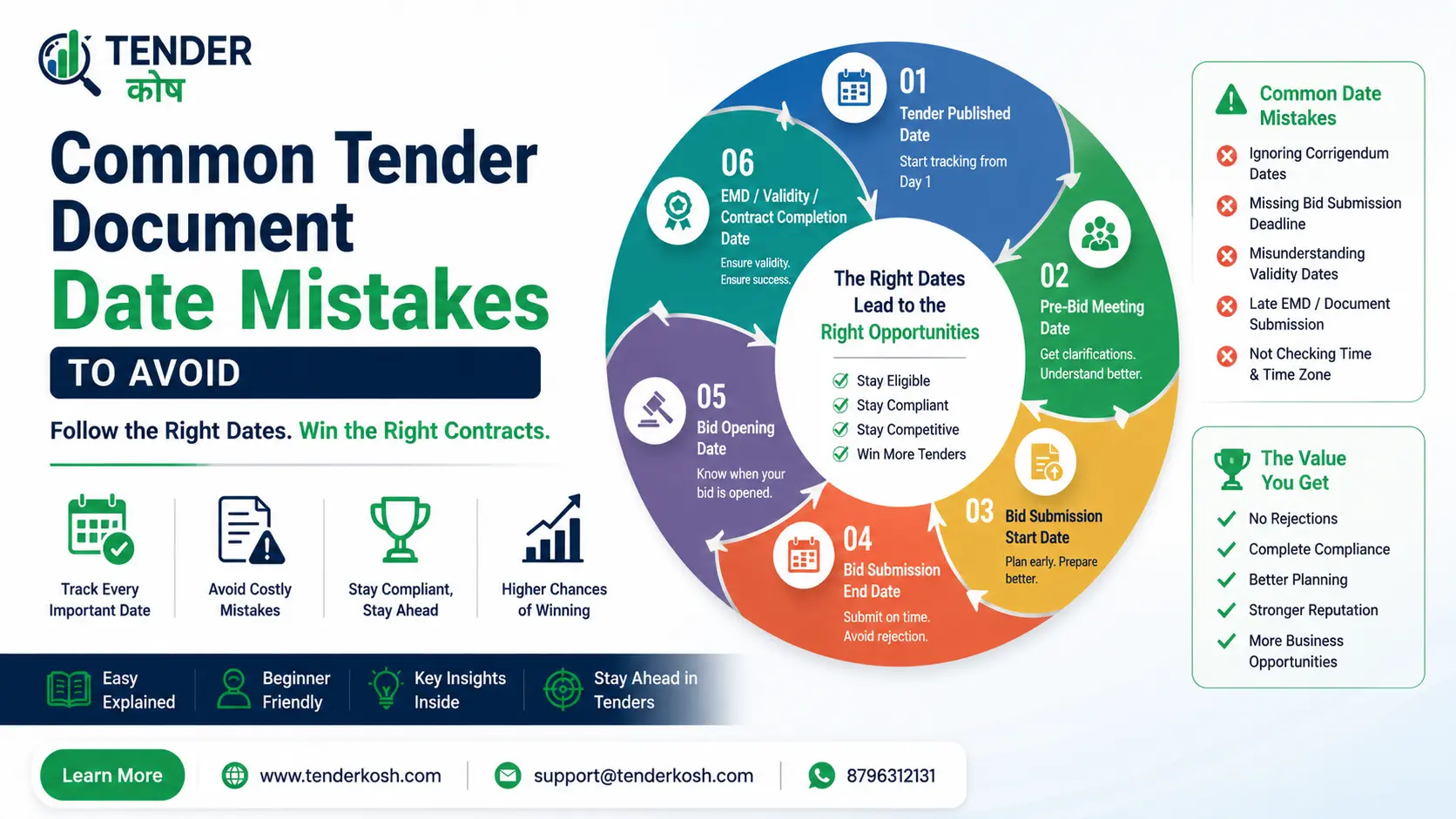
Most tender document date failures come from treating the tender as a single deadline instead of a connected timeline. These are the traps to sidestep from your very first bid.
The pattern running through every one of these is the same: they are failures of tracking and reading tender document dates, not of capability. Nobody loses a contract because they were incapable of noting a date; they lose because they watched one date and ignored the rest. That is reassuring, because tracking dates is entirely within your control. Extract every date on day one, map them to a calendar, watch for corrigenda, and you will already be ahead of a large share of the field.
To track tender document dates reliably, extract them all at download, put them on one calendar with reminders, and monitor the portal for corrigenda until you submit. A simple, repeatable system beats memory and good intentions every time.
Manual tracking of tender document dates across multiple government portals is exactly where busy bidders slip, because corrigenda and new tenders appear without warning and rarely notify you. A dashboard that aggregates live tenders and pushes updates — deadlines, pre-bid dates, and corrigendum alerts — in one place is the difference between reacting to changes and being blindsided by them. That is precisely what TenderKosh’s live tender feed is built for, so the dates that matter reach you before they pass rather than after.
Keep this glossary handy as you read tender documents — recognising these date-related terms on sight is half the battle.
| Term | What It Means |
|---|---|
| Clarification deadline | Last date to submit written questions about the tender to the agency. |
| Pre-bid meeting | A session where the agency explains the tender and answers bidders’ questions. |
| Corrigendum | An official amendment to a live tender — a changed date, spec, or clause. |
| Bid submission deadline | The exact date and time by which the complete bid must be submitted. |
| Bid opening | The date the agency formally opens submitted bids, usually technical first. |
| Bid validity | How long a submitted offer stays legally binding, often 90–180 days. |
| EMD | Earnest Money Deposit — bid security showing a serious, good-faith offer. |
| LoA | Letter of Award — the official notification that a bidder has won. |
| Delivery / completion period | The time allowed to supply goods or finish the work after award. |
| Liquidated damages | A pre-agreed penalty deducted for late delivery or completion. |
| Warranty / defect liability period | The time after delivery during which you must fix defects at your cost. |
| Performance guarantee | Security held to ensure you deliver and honour the warranty. |
Now that you know every tender document date that matters, go deeper with these guides:
There is no single most important tender document date — a tender is a connected timeline. The bid submission deadline is the hardest cut-off, but the clarification deadline, corrigendum releases, bid validity, delivery period, and warranty period each carry their own consequences. Missing any one of them can disqualify a bid or cost money after award.
The clarification deadline is the last date by which bidders can submit written questions to the tendering authority about anything unclear in the document. The agency’s answers are usually binding and shared with all bidders, often through a corrigendum, so everyone competes on the same understanding.
At a pre-bid meeting, the tendering authority explains the scope, qualification criteria, and evaluation method, and answers bidders’ questions in person or online. Points raised often lead to a formal corrigendum. Attendance is sometimes mandatory for eligibility, so missing it can disqualify a bidder outright.
A corrigendum is an official amendment to a live tender — a changed deadline, revised specification, or added clause. It matters because bidders must comply with the latest amended version, not the original. Preparing a bid against an outdated version is a common reason strong bids are rejected.
Bid validity is the period — often 90 to 180 days from submission — during which your offer stays legally binding and cannot be withdrawn or changed. Agencies may ask you to extend it before award; refusing can cost the contract, and letting it lapse can void your bid or forfeit your bid security.
The delivery or completion period is usually counted from the contract signing date or the Letter of Award, not from when you actually begin work. Read the tender carefully to confirm the exact start point, because missing the delivery deadline typically triggers liquidated damages deducted from your payment.
It depends on the tender. A warranty or defect liability period may begin at delivery, at final acceptance, or at commissioning — and the difference can be months. Always read the exact start point, duration, and coverage, because retained payments or performance guarantees are often held until the warranty ends.
Liquidated damages are a pre-agreed penalty for late delivery or completion, usually a percentage of the contract value per week or month of delay, up to a capped maximum. They are typically deducted automatically from your payment, which is why an unrealistic delivery period can turn a winning bid into a loss.
Extract every tender document date the moment you download a tender, put them on a single calendar with reminders set days in advance, and monitor the portal for corrigenda until you submit. Using a tender aggregation platform that pushes deadline and corrigendum alerts removes the risk of manual checking — TenderKosh does exactly this for live tenders.
Official Reference: Tender terms, dates, and corrigenda for central government procurement are published on the Central Public Procurement Portal: eprocure.gov.in

Discover relevant tenders, monitor corrigenda, compare opportunities, and move from document reading to structured action.