TenderKosh for EPC teams
Turn tender reading into faster bidding decisions.
Discover relevant tenders, monitor corrigenda, compare opportunities, and move from document reading to structured action.
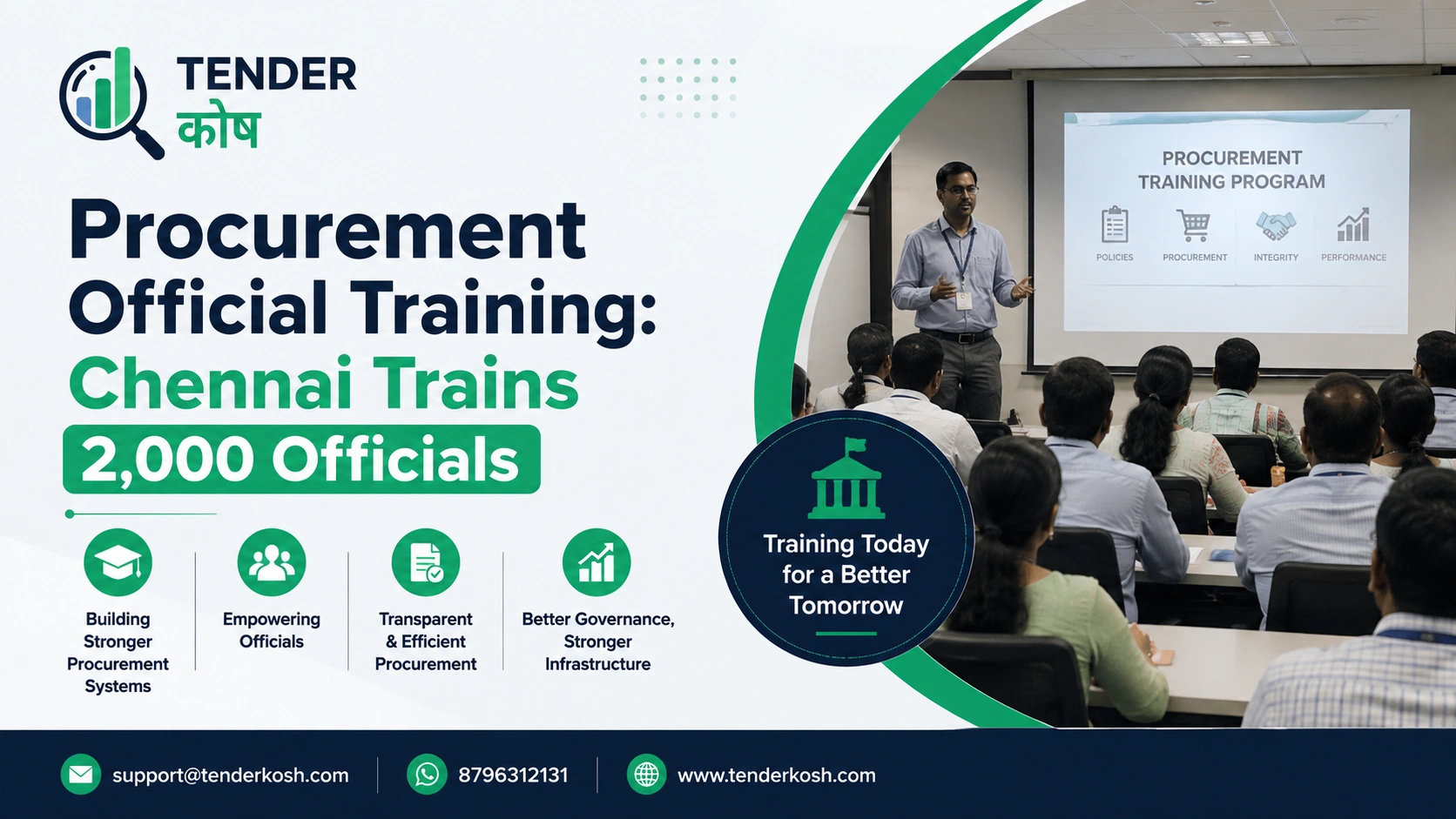
Procurement official training just became the centrepiece of Chennai’s tender reform, not the e-procurement portal it already runs. The Greater Chennai Corporation has launched a first-of-its-kind programme to train nearly 2,000 officials, from Assistant Engineers to Chief Engineers, in tendering rules and evaluation practice.
The signal for bidders is bigger than one city’s training calendar. Digital portals standardised how tenders are published. This is the first serious move to standardise how the humans reading those tenders actually think.
Most tender reform stories are about systems: a new e-procurement platform, a digitised bid portal, a mandatory online submission rule. Chennai’s story is different.
The Greater Chennai Corporation already runs e-procurement. Its portal already enforces submission deadlines and standard bidding documents. What it hasn’t had, until now, is a formal programme to train the officials who actually evaluate what comes through that portal.
That gap is common across Indian procurement, and it’s exactly what this training programme is designed to close. This article explains what Chennai is actually doing, why it matters even if you never bid on a Chennai tender, and what better-trained evaluators tend to mean for bidders in practice.
Key Takeaways
On this page
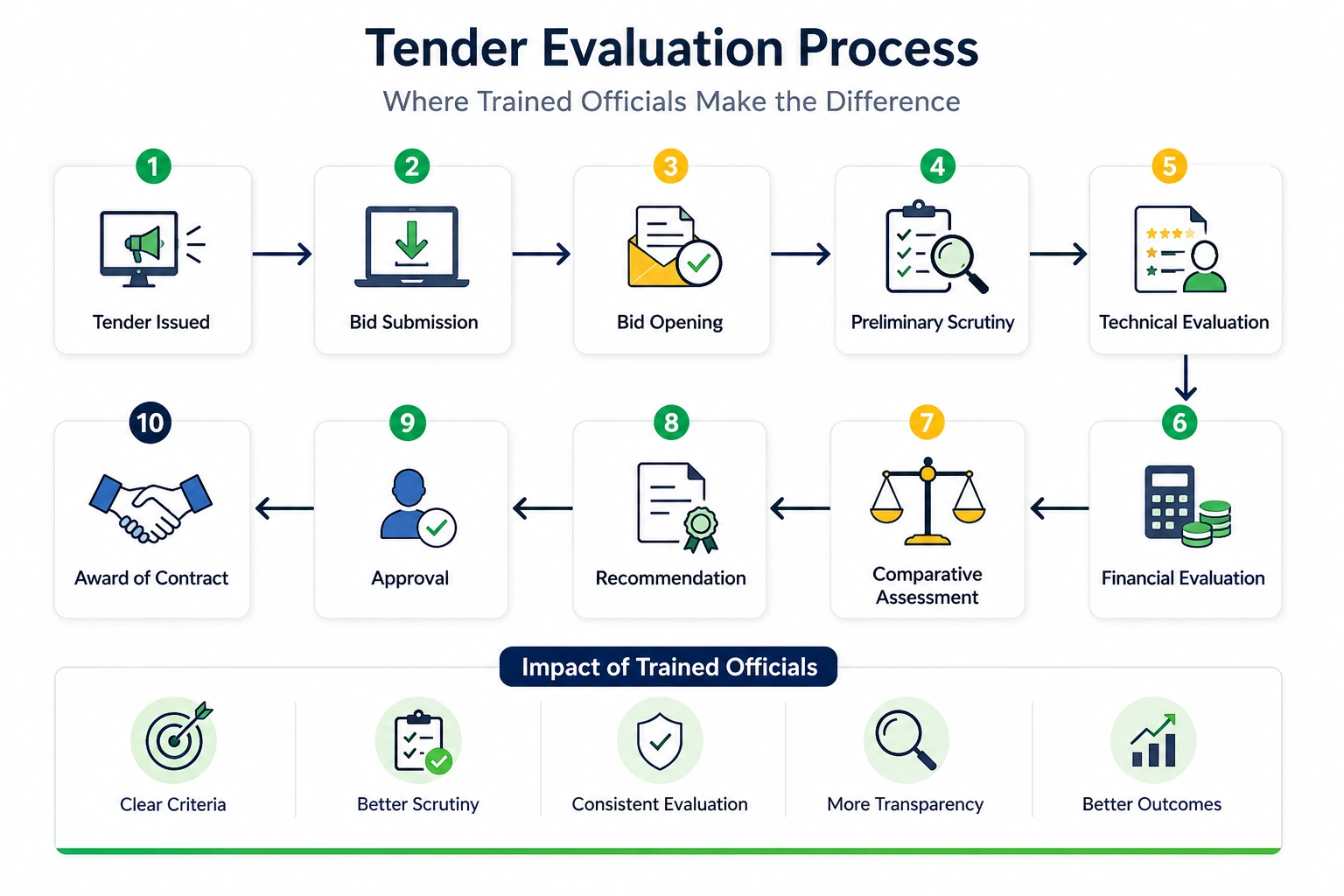
The Greater Chennai Corporation has decided to provide specialised procurement official training to nearly 2,000 officials, for the first time in the civic body’s history. The initiative sits under the direct leadership of the Corporation Commissioner.
Participants span the full engineering hierarchy involved in tendering, from Assistant Engineers up to Chief Engineers. These are the officials who issue tenders, scrutinise bids, and sign off on evaluations across Chennai’s civic departments.
The sessions run over five days, held as half-day modules during the last week of July 2026. That structure lets officials keep handling live tenders while attending training, rather than pulling them off duty entirely.
This programme didn’t emerge in isolation — it follows a period of intense scrutiny on Tamil Nadu’s public procurement, with disciplinary and criminal action against officials found guilty of corruption.
Officials have pointed to a striking number behind this decision: more than 2,000 tenders across municipalities, public works, highways, and transport departments have reportedly been cancelled over irregularity allegations in recent years.
The recurring complaints are familiar to anyone who tracks Indian public tenders closely: pre-determined outcomes, restrictive conditions favouring specific bidders, unusually short bidding windows, and contract cancellations that spiral into arbitration disputes.
Each of those problems has delayed real civic projects. Training nearly 2,000 officials is Chennai’s attempt to address the root cause, not just the symptoms showing up in cancelled tenders.
E-procurement portals are genuinely valuable, but they were never designed to fix the specific problems Chennai is now targeting through procurement official training. Understanding that distinction is the real story here.
A portal enforces process. It timestamps submissions, prevents late uploads, standardises document formats, and creates an audit trail. All of this matters, and none of it is trivial.
But a portal cannot evaluate a bid. It cannot judge whether a technical specification is genuinely restrictive or genuinely necessary. It cannot tell whether an evaluator scored two similar bids consistently, or gave one an unexplained edge.
Those are judgment calls, made by a human official reading a document. No amount of digitisation touches that layer — which is exactly the layer procurement official training is built to reach.
This is the core shift bidders should register. Reform is moving from “can the system be gamed” questions — which portals answer well — to “can the evaluator be misled, pressured, or inconsistent” questions, which only trained judgment can answer.
Track live EPC, infrastructure, renewable-energy, civil, electrical, and PSU tenders in one dashboard, with evaluation criteria and key compliance requirements clearly organised.
Procurement official training doesn’t change the rules a bidder must follow — it changes how consistently and carefully those rules get applied. That has three practical effects worth planning around.
First, expect more consistent technical scrutiny. A trained evaluator is less likely to accept a vague compliance statement, and more likely to check every claim against the tender’s actual requirements.
Second, expect fewer discretionary decisions. Untrained evaluators often fall back on informal judgment when a bid is ambiguous. Trained evaluators are more likely to apply a documented standard consistently across every bidder.
Third, expect greater weight on documentation quality and compliance. If evaluators are trained to check paperwork rigorously, a technically strong bid with weak documentation stops being a safe bet.
The programme’s module list is a useful preview of exactly what a better-trained evaluator will be checking more carefully on your next Chennai tender.
| Module | What It Trains Officials to Do |
|---|---|
| Tender issuance procedures | Draft eligibility criteria and specifications that are clear and defensible, not accidentally restrictive. |
| Scrutiny and evaluation of bids | Apply consistent, documented standards when comparing competing bids. |
| Procurement rules | Correctly apply the procedural rules governing tender processes. |
| Tender transparency | Recognise and avoid practices that create the appearance, or reality, of favouritism. |
| E-tendering and e-procurement | Use the digital portal’s features correctly and consistently. |
| Project evaluation and estimation | Assess technical proposals and cost estimates with greater rigour. |
Chennai’s procurement official training fits a broader shift visible across Indian public procurement over the past couple of years: after a first wave of digitisation, attention is turning to the people operating those digital systems.
E-procurement adoption across Indian states and municipal bodies has been substantial for years now. Most major tenders already move through some form of digital portal.
What has lagged behind is standardised, mandatory training for the officials responsible for interpreting and evaluating what those portals process. Chennai’s programme is one of the more visible, large-scale efforts to close that specific gap.
Bidders who track procurement reform across cities should watch for similar training announcements elsewhere. A civic body that has already digitised its tender process, and is now investing in evaluator training on top of it, is signalling a genuinely more rigorous evaluation environment ahead.
Here are the core figures behind Chennai’s procurement official training initiative, useful as a quick reference.
| Detail | Figure |
|---|---|
| Officials being trained | Nearly 2,000 |
| Participant range | Assistant Engineers to Chief Engineers |
| Training duration | 5 days, half-day sessions |
| Scheduled period | Last week of July 2026 |
| Tenders reportedly cancelled over irregularities | More than 2,000, across multiple departments |
| Led by | Greater Chennai Corporation Commissioner |
| First time this training has been run | Yes, a first-of-its-kind initiative for GCC |
None of this requires a different bidding strategy — procurement official training rewards the same disciplined approach that always protects a bid, just with less room for the informal exceptions that sometimes carried a weaker bid through in the past.
Procurement official training of this kind tends to catch a specific type of bidder off guard — not incompetent bidders, but ones who had adapted to a looser evaluation environment.
This is a slow-moving, structural reform, not a single news event — the useful habit is watching for its downstream effects rather than the training calendar itself.
Reforms like this eventually show up as small, concrete changes inside ordinary tender documents — sharper eligibility language, more precise clarification answers, fewer last-minute cancellations. TenderKosh’s live tender feed is a useful way to watch for those changes as they start appearing.
Keep these terms handy as this reform develops.
| Term | What It Means |
|---|---|
| Greater Chennai Corporation (GCC) | The municipal body governing the City of Chennai, running its own e-procurement and tendering process. |
| Procurement official training | Structured instruction for government officials on tendering rules, evaluation methods, and procurement procedures. |
| Bid scrutiny | The evaluator’s process of checking a submitted bid against eligibility and technical requirements. |
| Discretionary decision | An evaluation choice made on informal judgment rather than a documented, consistent standard. |
| Restrictive tender condition | An eligibility or technical clause drawn narrowly enough to unfairly limit competition. |
| E-procurement portal | A digital platform that manages tender publication, submission, and process compliance. |
| Arbitration dispute | A formal disagreement between a contractor and buyer resolved outside regular courts, often following a cancelled or contested tender. |
Now that you understand what Chennai’s procurement official training means for bidders, go deeper with these guides:
The Greater Chennai Corporation is running a first-of-its-kind training programme for nearly 2,000 officials, from Assistant Engineers to Chief Engineers, covering tender issuance, bid scrutiny, procurement rules, transparency, e-procurement, and project evaluation.
The programme follows Tamil Nadu’s intensified anti-corruption drive in public procurement, after more than 2,000 tenders across departments were reportedly cancelled over allegations of irregularities, favouritism, and restrictive conditions.
E-procurement portals standardise process: submission deadlines, document formats, and audit trails. Procurement official training targets judgment: how evaluators interpret specifications, scrutinise bids, and apply standards consistently. The two are complementary, not overlapping.
Bidders can generally expect more consistent technical scrutiny, fewer informal or discretionary decisions, and greater emphasis on documentation quality and compliance. Bids that relied on ambiguity or informal flexibility become riskier.
No formal national mandate currently requires it, but Chennai’s programme fits a broader pattern of Indian procurement reform shifting focus from digital infrastructure toward evaluator capability. Other civic bodies are likely to watch its results closely.
The programme runs over five days, in half-day sessions, scheduled for the last week of July 2026, allowing officials to continue handling live tenders while completing the training.
Official Reference: Tender notices and procurement updates from the Greater Chennai Corporation are published on its official portal: chennaicorporation.gov.in

Discover relevant tenders, monitor corrigenda, compare opportunities, and move from document reading to structured action.