

TenderKosh for EPC teams
Turn tender reading into faster bidding decisions.
Discover relevant tenders, monitor corrigenda, compare opportunities, and move from document reading to structured action.
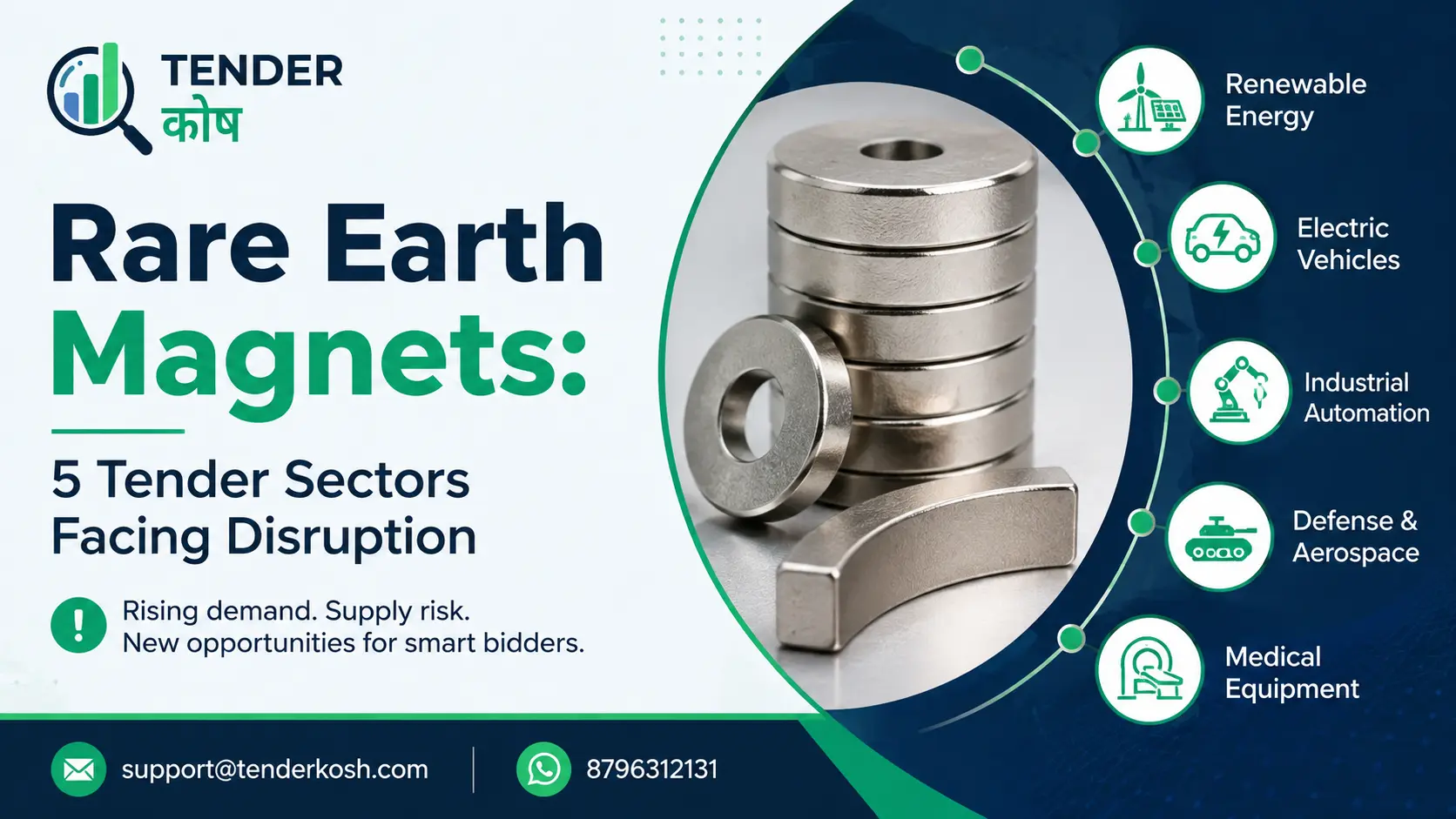
Rare earth magnets sit quietly inside almost every EV motor, wind turbine, defence radar, and missile guidance system that Indian tenders procure — and right now, nearly all of them are imported, with China controlling the processing step that turns raw ore into a finished magnet.
India and Myanmar are deepening cooperation on rare earth mining, centred on Myanmar’s Kachin state, as New Delhi looks for supply routes that don’t run through Beijing. Nothing is signed yet. But if this cooperation matures alongside India’s own domestic rare earth magnets manufacturing push, it could gradually ease one of the biggest hidden supply-chain risks sitting inside EV, wind, and defence tenders today.
This is a genuinely unusual story to bring into a tender-focused blog. It isn’t about a procurement rule, a document deadline, or an eligibility clause. It’s about a mineral. But that mineral — or rather, the family of elements it belongs to — is the reason certain tenders exist in their current form at all.
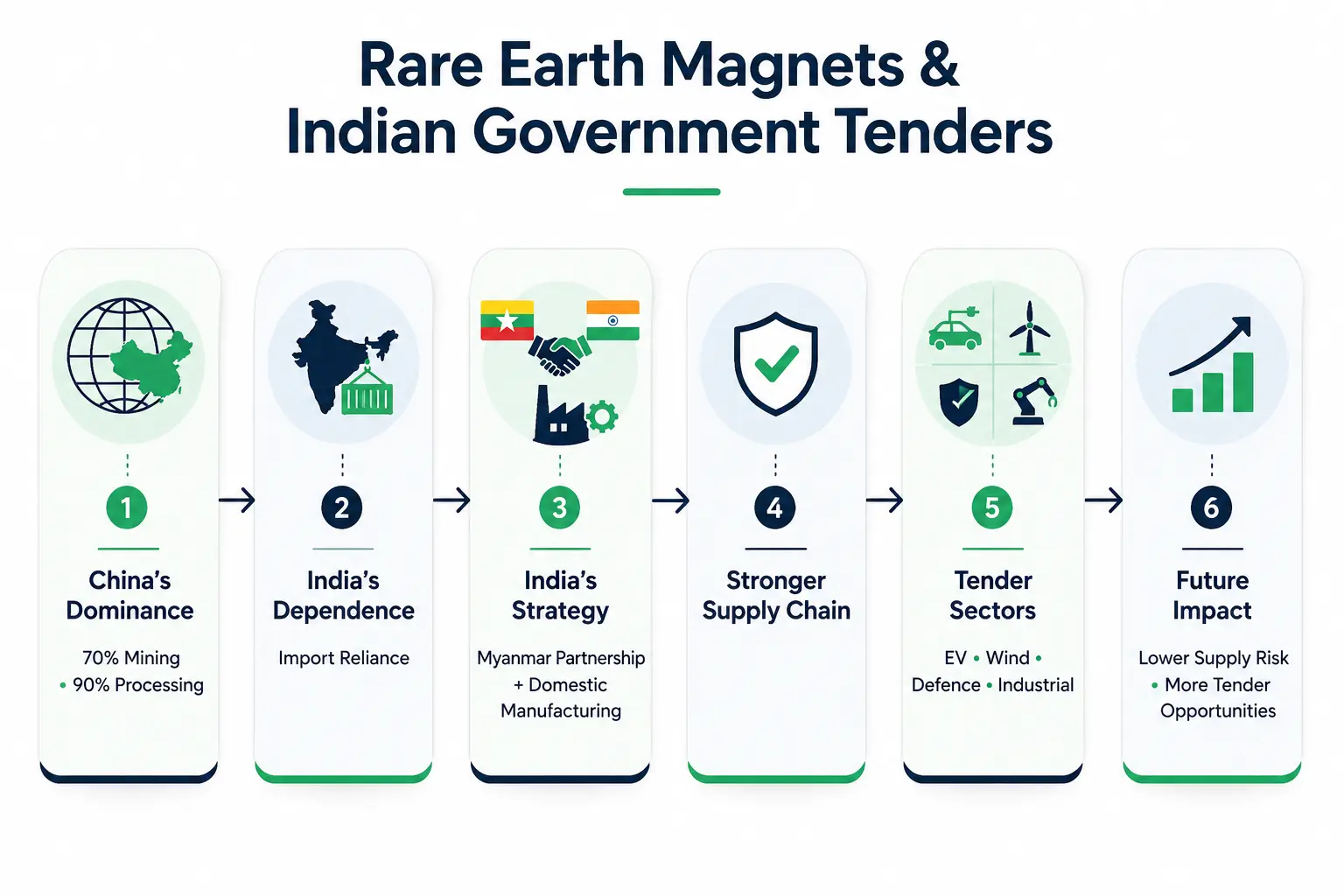
Every EV motor tender, every wind turbine EPC contract, every defence electronics procurement carries an invisible dependency on rare earth magnets, and on the handful of countries that can turn raw ore into a finished, usable magnet. This article explains what rare earth magnets actually are, why China’s grip on them matters, what India and Myanmar are actually doing about it (and what they aren’t, yet), and how all of this could realistically filter down into the tenders bidders track every day.
Key Takeaways
On this page
Rare earth magnets are permanent magnets made from alloys of rare earth elements, and they are far stronger for their size than ordinary magnets. That strength-to-size ratio is exactly why modern electric motors, generators, and guidance systems depend on them.
The most common type is the neodymium-iron-boron, or NdFeB, magnet. A smaller, more heat-resistant category uses samarium-cobalt (SmCo), often preferred in defence and aerospace applications where operating temperatures run high.
“Rare earth” is somewhat misleading as a name. These elements aren’t geologically rare; they’re rarely found in concentrations that are economical to mine, and even more rarely processed into usable metals and magnets close to the mine site. That processing gap — separating rare earth oxides, converting them to metals, then to alloys, then to finished sintered magnets — is the real bottleneck in the global supply chain, and it’s the part almost no country outside China has built at scale.
China mines roughly 70% of the world’s rare earth elements, but its real leverage comes from controlling about 90% of global processing and refining capacity. Even countries with their own rare earth deposits often still depend on China to turn that ore into a usable magnet.
India illustrates this gap clearly. The country holds the world’s fifth-largest rare earth reserves, yet accounts for less than 1% of global production. India currently imports roughly 55,000 metric tonnes of rare earth elements a year, with about 65% of that sourced from China.
China has used this near-monopoly as geopolitical leverage before, tightening export controls on rare earths and rare earth magnets during periods of trade tension, including restrictions reported in April and October 2025. Each tightening ripples straight into manufacturers who depend on imported magnets — and, downstream, into the tenders those manufacturers bid on.
This is why rare earth magnets are a tender issue, not just an industrial one. A sudden export restriction doesn’t just raise a manufacturer’s cost.
It can delay EV motor deliveries, wind turbine generator shipments, and defence electronics components mid-contract, turning a supply-chain problem into a liquidated-damages problem for the bidder holding the contract.
India and Myanmar are deepening cooperation on rare earth mining, and the centre of gravity is Myanmar’s Kachin state — a region that supplies close to half the world’s heavy rare earth elements, historically shipped to China for processing. This cooperation is real, but it is still early-stage.
India’s Ambassador to Myanmar, Abhay Thakur, addressed the India-Myanmar Mining & Minerals Forum in Mandalay in July 2026, describing rare earth cooperation as a win-win opportunity for both countries. Around 200 participants attended, including six Indian companies and nine Myanmar business and mining associations.
The Indian companies named as engaged in this outreach include the state-owned IREL, along with NTPC Mining, Himadri Speciality Chemical, Oceanic Sands, PrNd Metal & Magnets, Jai Puri Holdings, and Midwest Advanced Materials. Two Indian delegations focused specifically on rare earths and critical minerals visited Myanmar, first in December 2024 and again in February 2026.
The relationship has also drawn high-level political attention. Myanmar’s junta leader-turned-president, Min Aung Hlaing, visited India in May and June 2026, with rare earth cooperation reportedly part of the discussion.
One detail worth stating plainly, because it shapes how uncertain this story still is: much of Myanmar’s Kachin rare earth mining sits in territory controlled by the Kachin Independence Army, an ethnic armed organisation, rather than under the direct administration of Myanmar’s central government. Reporting has indicated Indian interest in exploring the collection and transport of mineral samples from these areas. No government-to-government supply agreement between India and Myanmar has been publicly announced as of this writing.
Alongside the Myanmar outreach, India has moved separately and concretely on building its own domestic rare earth magnet manufacturing capacity — and this domestic push is arguably the more tender-relevant development right now.
In November 2025, the Union Cabinet approved a ₹7,280 crore Scheme to Promote Manufacturing of Sintered Rare Earth Permanent Magnets. It targets 6,000 metric tonnes per annum of integrated manufacturing capacity, split across five beneficiaries selected through global competitive bidding, each building roughly 1,200 tonnes per annum of capacity.
The scheme covers the full “midstream” value chain that India has historically lacked: converting rare earth oxides into metals, metals into alloys, and alloys into finished sintered magnets. It runs for seven years, including a two-to-three-year gestation period before any beneficiary begins commercial production.
In March 2026, a separate but related PLI initiative under the Electronics Component Manufacturing Scheme approved a ₹700 crore facility for rare earth magnets in Uttar Pradesh, notable for being built on indigenous technology and intellectual property. The 2026–27 Union Budget added dedicated Rare Earth Corridors in Odisha, Kerala, Andhra Pradesh, and Tamil Nadu, aimed at mining, processing, research, and manufacturing.
Put together, India’s domestic demand for rare earth permanent magnets, currently around 4,000 to 5,000 tonnes per annum and met entirely through imports, is expected to roughly double by 2030. That is the gap these schemes, and any successful Myanmar sourcing arrangement, are ultimately trying to close.
Follow live tenders across EPC, renewable energy, defence electronics, and PSU sectors, and see how evolving PLI and local-content clauses show up in real bidding documents, in one dashboard.
Rare earth magnets aren’t a niche industrial input — they sit inside five categories of Indian tenders that bidders track constantly. Here’s specifically why each one depends on them.
Most high-efficiency EV traction motors use permanent magnet synchronous motors built around NdFeB magnets. Government EV procurement, fleet electrification tenders, and PLI-linked auto component contracts all inherit this dependency directly.
Direct-drive wind turbine generators, increasingly common in newer renewable energy EPC contracts, use large NdFeB magnet assemblies to generate electricity without a gearbox. A magnet supply disruption can delay turbine delivery inside a renewable EPC contract’s completion period.
Radar systems, sensors, communication equipment, and precision-guided components across defence procurement rely on rare earth magnets and related materials for compact, high-performance electromagnetic components.
Actuators and guidance electronics in missile systems use rare earth magnets for the precise, high-torque-to-weight motors that steering and control surfaces require. This is one of the most strategically sensitive dependencies in the entire list.
Servo motors and precision robotics used in manufacturing automation, including equipment purchased through PSU and industrial modernisation tenders, rely on the same class of magnets for compact torque delivery.
None of this changes a live tender’s eligibility criteria or BOQ overnight — but if external sourcing and domestic manufacturing of rare earth magnets both mature over the next few years, three effects are plausible for bidders in these five sectors.
First, domestic manufacturing tenders in EV components, wind turbine generators, and defence electronics could accelerate, as manufacturers gain confidence that rare earth magnets supply won’t be their limiting factor.
Second, PLI-linked procurement may expand further. As REPM scheme beneficiaries come online over the next two to three years, expect more tenders to carry local-content or PLI-linked preference clauses tied to domestically manufactured magnets and components.
Third, defence and renewable EPC tenders could see a gradual reduction in supply-chain risk premiums. Bidders currently price in a buffer for potential magnet-supply disruption; a more diversified, partly domestic supply chain reduces the justification for that buffer over time.
It’s worth being precise about how early-stage the rare earth magnets story still is, because overreacting to a promising headline is its own kind of tender risk. Several genuine uncertainties remain unresolved.
Here are the core figures behind the rare earth magnets story, useful as a quick reference the next time this topic comes up in a tender briefing.
| Metric | Figure |
|---|---|
| China’s share of global rare earth mining | ~70% |
| China’s share of global rare earth processing/refining | ~90% |
| India’s global rare earth reserve rank | 5th largest |
| India’s share of global rare earth production | Less than 1% |
| India’s annual rare earth element imports | ~55,000 metric tonnes |
| Share of India’s rare earth imports from China | ~65% |
| India’s REPM manufacturing scheme outlay | ₹7,280 crore (approved Nov 2025) |
| Target domestic REPM manufacturing capacity | 6,000 tonnes per annum |
| India’s current rare earth magnet demand | ~4,000–5,000 tonnes per annum, fully imported |
| Share of world’s heavy rare earths from Myanmar’s Kachin state | ~50% |
This is exactly the kind of geopolitical-industrial story that’s easy to overreact to, in either direction. These are the specific misreadings worth avoiding.
The rare earth magnets story will develop over years, not weeks, so a light, periodic tracking habit works better than obsessive daily monitoring.
Supply-chain stories like this one eventually show up as ordinary clauses inside ordinary tenders — a local-content requirement here, a PLI-linked preference there. TenderKosh’s live tender feed is a useful way to catch those changes as they start appearing in real bidding documents.
Keep these rare earth magnets terms handy as this story develops.
| Term | What It Means |
|---|---|
| Rare earth elements (REE) | A group of 17 chemically similar elements used in high-performance magnets, electronics, and catalysts. |
| NdFeB magnet | Neodymium-iron-boron magnet, the most common rare earth magnet type, used in EV motors and wind turbines. |
| SmCo magnet | Samarium-cobalt magnet, more heat-resistant, often used in defence and aerospace applications. |
| REPM Scheme | India’s ₹7,280 crore Scheme to Promote Manufacturing of Sintered Rare Earth Permanent Magnets, approved November 2025. |
| Midstream processing | The stage converting rare earth oxides into metals, alloys, and finished magnets — India’s historic capability gap. |
| PLI (Production Linked Incentive) | A government scheme offering financial incentives tied to domestic manufacturing output. |
| Rare Earth Corridors | Dedicated zones announced in the 2026–27 Union Budget for mining, processing, research, and manufacturing of rare earths. |
| Kachin state | A region in northern Myanmar supplying close to half the world’s heavy rare earth elements. |
Now that you understand how rare earth magnets connect to Indian tenders, go deeper with these guides:
Rare earth magnets are essential components in EV motors, wind turbine generators, defence electronics, missile guidance systems, and industrial automation equipment — all categories regularly procured through Indian government tenders.
No formal government-to-government supply agreement has been publicly announced. Cooperation is at the forum, delegation, and corporate business-to-business stage, centred on Myanmar’s Kachin state, with high-level political engagement but no finalised deal as of this writing.
China mines about 70% of the world’s rare earths but its real control comes from processing roughly 90% of global supply. Even countries with their own rare earth deposits, including India, often still depend on China to refine that ore into usable metals and magnets.
India approved a ₹7,280 crore scheme in November 2025 to build 6,000 tonnes per annum of domestic rare earth permanent magnet manufacturing capacity, added a ₹700 crore PLI-backed facility in Uttar Pradesh in March 2026, and announced dedicated Rare Earth Corridors in the 2026–27 Union Budget.
If domestic manufacturing and diversified sourcing both mature, EV motor and wind turbine generator manufacturers face less risk of magnet supply disruption, which could reduce the risk premiums bidders currently price into these tenders and support more PLI-linked procurement preferences over time.
This is a multi-year story. India’s domestic magnet manufacturing scheme alone requires roughly two to three years of gestation before commercial production begins, and any India-Myanmar sourcing arrangement is still in an early, exploratory phase.
Much of the Kachin state mining activity sits in territory controlled by the Kachin Independence Army, an ethnic armed organisation, rather than under the direct administration of Myanmar’s central government. This adds genuine political and security uncertainty to any future sourcing arrangement.
Official Reference: Details on India’s Scheme to Promote Manufacturing of Sintered Rare Earth Permanent Magnets are published on the Prime Minister of India’s official portal: pmindia.gov.in
Discover relevant tenders, monitor corrigenda, compare opportunities, and move from document reading to structured action.