TenderKosh for EPC teams
Turn tender reading into faster bidding decisions.
Discover relevant tenders, monitor corrigenda, compare opportunities, and move from document reading to structured action.
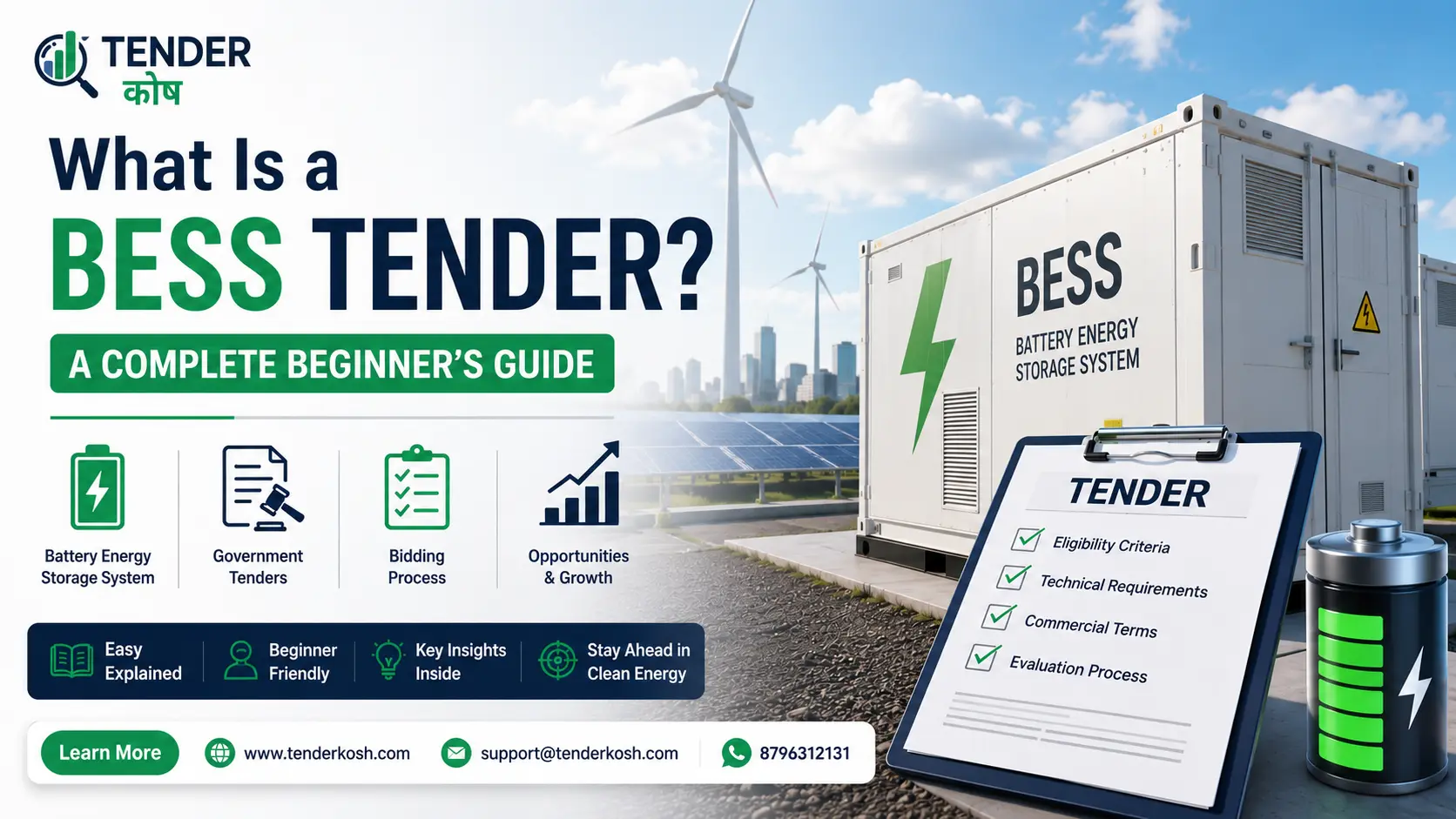
A BESS tender is a competitive bidding process in which a government agency, PSU, or power utility invites companies to build, supply, or operate a Battery Energy Storage System (BESS). Put simply, it is how the government buys giant batteries that store electricity and release it when the grid needs it most — and in 2026, it has become one of the fastest-growing tender categories in India’s power sector.
If you have come across phrases like “SECI BESS tender”, “standalone battery storage auction”, or “VGF-supported storage project” and felt like everyone was speaking a different language, you are in the right place. This guide breaks down the BESS tender from absolute zero — no energy-sector background needed.
Here is why it is worth your five minutes: India is quietly building one of the largest energy-storage pipelines on the planet, and every gigawatt-hour of it flows through a tender. That means a steady stream of opportunities for developers, EPC contractors, and equipment suppliers who understand how these bids work. By the end of this page, you will understand exactly what a BESS tender is, why so many are being floated, who can bid, and how to chase your first one.
Key Takeaways
On this page
A BESS, or Battery Energy Storage System, is a large bank of batteries that stores electricity and feeds it back to the grid on demand. These are not the batteries in your phone — think shipping-container-sized units packed with lithium-iron-phosphate (LFP) cells, sitting next to a substation, charging when power is cheap and discharging when it is scarce.
Every grid-scale BESS is described by two numbers: its power in megawatts (MW) — how fast it can charge or discharge — and its energy in megawatt-hours (MWh) — how much it can store in total. A “125 MW / 500 MWh” system can deliver 125 MW for four hours. That four-hour window is the magic number in Indian tenders, because it is exactly what is needed to cover the evening demand peak after solar fades.
A BESS tender is a public invitation to bid, issued by a government body or utility that wants a battery storage project built or supplied. The tender document spells out the size, location, technical standards, and contract terms, and companies compete to win it — usually through a reverse auction where the lowest qualified bid takes the contract.
In most large BESS tenders in India, bidders are first screened on technical and financial grounds, and only the qualified ones then compete on price. Depending on the tender, that “price” might be the storage tariff a developer will charge, or the lowest capital subsidy (VGF) they need to make the project work. It is the same competitive-bidding logic you see across government procurement — the kind of live opportunities you can track on TenderKosh — applied to a highly specialised asset.
BESS tenders are booming because India has built a mountain of solar power it cannot fully use — and battery storage is the only way to unlock it. This mismatch has a nickname in the industry: the “duck curve.”
Here is the problem in plain terms. India has crossed 250 GW of installed renewable capacity, but solar floods the grid at midday and vanishes by evening — precisely when homes and businesses draw the most power. Without storage, that cheap daytime solar is wasted, and utilities burn expensive fuel to cover the evening. Batteries soak up the surplus and release it after sundown. Every unit of storage the country needs has to be procured through a tender, which is why the pipeline keeps swelling.
Just how big is this wave? As per Central Electricity Authority (CEA) projections, India needs roughly 37 GWh of BESS capacity by 2027 and around 236 GWh by 2031–32. To accelerate it, the Ministry of Power has scaled its Viability Gap Funding scheme from about 4 GWh in 2023 to a fresh 30 GWh push backed by roughly ₹5,400 crore — expected to unlock close to ₹33,000 crore of investment. In short: this is a multi-lakh-crore procurement wave that is only just getting started. (Figures reflect public policy announcements current as of mid-2026; storage policy moves fast, so verify the latest numbers against official MNRE and SECI notifications before you bid.)
There is an even bigger reason to pay attention: a CEA advisory in early 2025 recommended embedding a minimum of 10% BESS (of two-hour duration) into all new solar tenders. Translation — storage is being baked into ordinary renewable procurement, not just floated as standalone auctions. If you bid on solar tenders today, you will be bidding on storage tomorrow whether you planned to or not.
BESS tenders in India are issued by central agencies like SECI and NTPC, transmission utilities like Power Grid, and state-level DISCOMs. Knowing who floats them tells you exactly where to look for opportunities. Here are the most active issuers as of 2026.
| Issuer | Type | What They Tender |
|---|---|---|
| SECI (Solar Energy Corporation of India) | Central nodal agency | The largest share of standalone and VGF-backed BESS auctions, often as bid coordinator for states. |
| NTPC | Central PSU | Standalone BESS and thermal-plus-storage EPC packages. |
| NLC India / NHPC | Central PSUs | Storage tenders tied to their generation portfolios. |
| Power Grid (PGCIL) | Transmission utility | Grid-support and transmission-linked BESS projects. |
| State DISCOMs / agencies (GUVNL, RVUNL, GRIDCO, etc.) | State-level | State-specific storage, often additive to the central pipeline. |
Trying to watch all of these portals by hand is where most newcomers burn out. A single dashboard that aggregates live BESS and renewable-energy tenders across SECI, NTPC, PSUs, and state agencies saves hours every week — which is exactly what TenderKosh’s live tender feed is built for.
The four main types of BESS tenders are standalone BESS, solar-plus-storage, FDRE, and EPC contracts. Each one changes who is best placed to bid and how the project earns money, so recognising them early is half the battle.
| Tender Type | What It Involves | Best Suited To |
|---|---|---|
| Standalone BESS | A pure battery project that charges from the grid and discharges on demand, usually VGF-supported. | Developers who want to own and operate storage assets. |
| Solar-plus-Storage (Hybrid) | A solar plant bundled with a battery so it can supply power beyond daylight hours. | Renewable developers integrating storage into generation. |
| FDRE (Firm & Dispatchable Renewable Energy) | Round-the-clock or on-demand clean power blending solar, wind, and storage into guaranteed supply windows. | Large developers able to combine multiple technologies. |
| EPC (Engineering, Procurement & Construction) | A turnkey contract to build the system for an owner who will operate it themselves. | Contractors and suppliers who build rather than own. |
If you are a contractor or equipment supplier rather than an asset owner, EPC tenders are usually your fastest entry point — and there is a lot more to say about winning them. Our in-depth BESS Tenders in India — Complete EPC Guide covers bid strategy, technical specifications, and supplier qualification in detail. Think of this page as the “what and why,” and that guide as the “how.”
VGF (Viability Gap Funding) is a one-time government capital subsidy that makes otherwise unviable battery projects financially workable. It is the single most important concept for a beginner to grasp, because it is what turns a “too expensive to build” project into a bankable one.
Here is the twist that surprises most newcomers: in a VGF auction, developers often compete by bidding for the lowest subsidy they need — not the highest tariff. In India’s programme, the first VGF tranche offered up to roughly ₹27 lakh per MWh (about 30% of capital cost). As battery prices fell, the second tranche from mid-2025 trimmed this to around ₹18 lakh per MWh. And to claim VGF at all, projects must now meet a minimum 20% domestic content requirement.
The one number that decides everything: Your VGF bid. Ask for too much and a rival undercuts you. Ask for too little and the project bleeds money. Building a realistic cost model to pin down that number is the core skill separating winners from the rest — and it is exactly the sort of homework the tender document expects you to have done before you click “submit.”
Choose BOO if you want to own and earn from the asset for years; choose EPC if you just want to build it and hand it over. This one decision shapes which tenders you should even be looking at.
Most standalone BESS tenders run on a Build-Own-Operate (BOO) model. The winning developer finances, builds, owns, and runs the battery for the contract period, earning revenue from a storage contract with the buyer. This suits companies with capital and an appetite for long-term infrastructure.
The EPC model is the opposite. The tenderer already owns the project and simply wants someone to engineer, procure, and construct it, then walk away. No ownership, no long operation — just delivery and payment. This is the right lane for construction firms, system integrators, and equipment suppliers who do not want the asset sitting on their books.
Track live BESS, solar-plus-storage, and renewable energy tenders — plus corrigendum alerts and government bids across railways, EPC, infrastructure, renewable energy, civil, electrical, and PSU sectors — all in one place.
Explore Live Tenders View PlansAny company can bid on a BESS tender if it meets the financial, technical, and equipment-certification criteria and is registered on the relevant e-procurement portal. Issuers screen bidders hard before price ever enters the picture, so qualification comes first.
Smaller firms and MSMEs are not shut out — many participate as suppliers, sub-contractors, or partners. If you are an MSME planning to bid on government projects, getting your paperwork right first matters enormously; our Udyam Registration guide and MSME eligibility and rejection guide explain the common mistakes that get bids thrown out before evaluation even begins.
Remember the golden rule of tender evaluation: the technical stage decides more outcomes than the price bid. Financial bids are usually opened only for bidders who have already cleared the technical checks, so a low price cannot rescue a non-compliant bid.
To bid on a BESS tender, track the right portals, register early, get your financial and technical documents ready, and model your economics before submitting. The path from “interested” to “bidding” is more manageable than it looks — here is the beginner’s roadmap.
If the qualification and registration side feels daunting, you are not alone — it trips up nearly every first-timer. It is worth understanding how vendor vetting works in government procurement more broadly; our GeM Vendor Assessment guide walks through the same kind of credibility checks that BESS issuers rely on.
Most first-time BESS bids fail on avoidable preparation gaps, not on genuine lack of competitiveness. These are the traps to sidestep from day one.
Now that you know what a BESS tender is, go deeper with these guides:
BESS stands for Battery Energy Storage System — a large installation of batteries that stores electricity and releases it back to the grid when needed, typically to cover evening demand peaks after solar generation fades.
A BESS tender is a public invitation to bid, issued by a government agency or utility that wants a battery energy storage project built, supplied, or operated. Companies compete for the contract, usually through a reverse auction won by the lowest qualified bid.
Any company that meets the tender’s financial, technical, and equipment-certification criteria and is registered on the relevant e-procurement portal can bid. This includes renewable developers, EPC contractors, and equipment suppliers, depending on the tender type.
VGF (Viability Gap Funding) is a one-time government capital subsidy that makes otherwise unviable storage projects financially workable. In many auctions, developers compete by bidding for the lowest subsidy they need, rather than the highest tariff.
India has added huge amounts of solar and wind but lacks the storage to use that power around the clock. Government targets — around 236 GWh of storage by 2031–32 per CEA projections — plus expanded VGF support have triggered a large and rapidly growing pipeline of BESS tenders.
No. Developers typically partner with a qualified BESS supplier rather than manufacture cells themselves. What matters is that the equipment you propose meets the tender’s technical certifications, such as IEC 62619, and any domestic-content requirement.
You can find them on the official SECI, NTPC, and state agency portals, or track them all in one place through a tender aggregation platform. TenderKosh lists live BESS and renewable-energy tenders, with corrigendum alerts, so you never miss a deadline.
Discover relevant tenders, monitor corrigenda, compare opportunities, and move from document reading to structured action.