TenderKosh for EPC teams
Turn tender reading into faster bidding decisions.
Discover relevant tenders, monitor corrigenda, compare opportunities, and move from document reading to structured action.
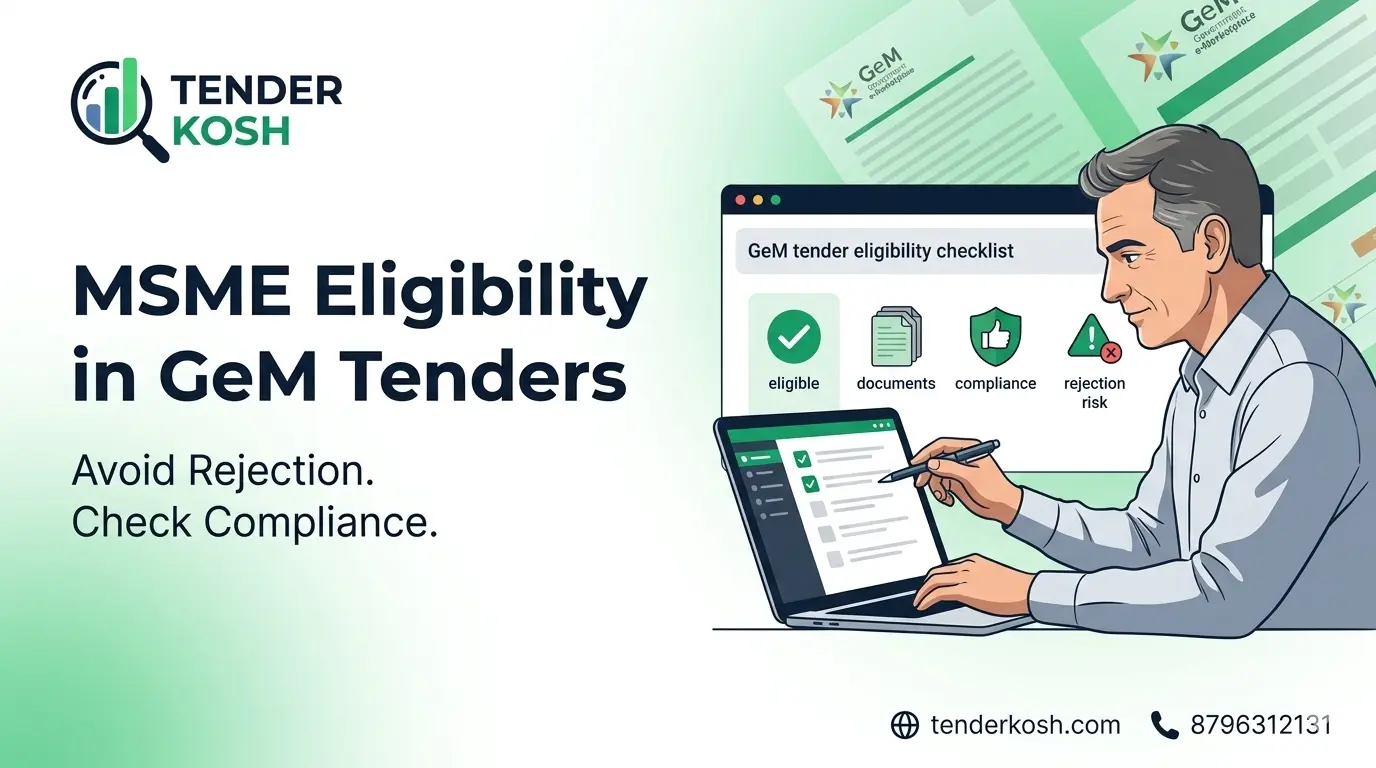
For a micro, small, or medium enterprise, the Government e-Marketplace (GeM) is one of the largest sales channels in the country. But getting an order starts with clearing eligibility, and that is exactly where most MSMEs lose out. The surprising part is that price is rarely the reason. The majority of MSME bids are knocked out during technical evaluation, long before the financial bid is even opened, over issues like a mismatched Udyam certificate, an expired ISO licence, or missing OEM authorization.
The good news is that almost all of these rejections are preventable. MSME eligibility on GeM really comes down to three things: a valid Udyam Registration, an active and accurate GeM seller profile, and compliance with the specific conditions written into each tender. Get those three right and you remove most of the rejection risk before you ever submit.
This guide walks through the eligibility rules, the benefits MSMEs are entitled to, the most common reasons bids get rejected, and a practical pre-bid checklist you can run before every submission.
Key Takeaways
| What is GeM and Why MSME Status Matters | MSME Eligibility Criteria |
| Benefits for MSMEs in GeM | Common Rejection Reasons |
| Pre-Bid Checklist | What to Do After Rejection |
| FAQs | Related Guides |
The Government e-Marketplace (GeM) is India’s central online procurement platform used by ministries, departments, PSUs, railways, CPSEs, and public institutions to purchase goods and services digitally.
MSME status matters in GeM tenders because the Public Procurement Policy for MSEs provides procurement benefits to Micro and Small Enterprises. These benefits include Earnest Money Deposit (EMD) exemption, tender fee exemption, and procurement preference in eligible tenders.
| MSME Benefit | Why It Matters |
|---|---|
| EMD Exemption | Reduces upfront working capital burden during bidding. |
| Tender Fee Exemption | Allows MSMEs to participate in more tenders at lower cost. |
| Procurement Preference | Improves chances of winning eligible government tenders. |
| Reserved Procurement Targets | Government departments must procure a fixed percentage from MSEs. |
MSME eligibility in GeM tenders is determined through four independent compliance layers. Businesses must satisfy all four conditions to claim MSME procurement benefits successfully.
The business must fall within the official MSME investment and turnover limits defined under government MSME classification rules. The limits below reflect the revised classification effective 1 April 2025; confirm the current figures on the official GeM and MSME portals before bidding, as thresholds are periodically updated.
| Category | Investment Limit | Annual Turnover Limit |
|---|---|---|
| Micro Enterprise | Up to ₹2.5 crore | Up to ₹10 crore |
| Small Enterprise | Up to ₹25 crore | Up to ₹100 crore |
| Medium Enterprise | Up to ₹125 crore | Up to ₹500 crore |
Udyam Registration is mandatory for claiming MSME benefits in GeM tenders. The legal name, PAN, GST, and business details must exactly match the GeM seller profile, because GeM validates these fields automatically.
The business must maintain an active seller profile on GeM with updated product categories, certifications, OEM details, and bank verification information.
Every GeM tender includes separate qualification requirements related to turnover, experience, technical specifications, OEM authorization, certifications, and financial capability.
Important: MSME registration does not override the technical eligibility conditions written in the tender document.
Government procurement policy gives Micro and Small Enterprises multiple participation advantages in public procurement.
| Benefit | Practical Impact |
|---|---|
| EMD Exemption | Reduces bid participation cost for MSMEs. |
| Tender Fee Exemption | Allows businesses to apply for more opportunities. |
| 25% Procurement Target | Government departments must source minimum procurement from MSEs. |
| L1 + 15% Purchase Preference | MSEs may receive supply opportunities by matching L1 pricing. |
Most MSME bid rejections happen during technical evaluation. Procurement departments validate bidder eligibility before opening financial bids.
| Rejection Reason | How It Causes Disqualification |
|---|---|
| Udyam and GeM profile mismatch | System cannot validate MSME status automatically. |
| Expired certificates | Compliance documents become invalid during evaluation. |
| Missing OEM authorization | Reseller authorization requirement is not fulfilled. |
| Turnover non-compliance | Business does not meet minimum financial eligibility. |
| Incorrect product category | Quoted item fails technical matching requirements. |
| Technical specification mismatch | Product does not satisfy mandatory bid parameters. |
| Incomplete document uploads | Evaluator cannot verify eligibility correctly. |
| Incorrect GST or BOQ values | Financial bid inconsistency causes rejection. |
| EMD exemption claimed without proof | Udyam certificate or supporting proof is missing. |
| Vendor Assessment incomplete | Restricted GeM category participation is blocked. |
| Ignoring corrigendum updates | Bid becomes outdated or non-compliant. |
| Blacklisting or caution status | Seller account participation is restricted. |
The checklist below helps businesses reduce the most common technical rejection risks before bid submission.
Discover live GeM tenders, corrigendum updates, procurement opportunities, and government bids across railways, EPC, infrastructure, renewable energy, civil, electrical, and PSU sectors.
Explore Live TendersView PlansGeM tender rejection does not permanently block future participation. Businesses should first identify the exact rejection reason mentioned in the evaluation summary.
If the rejection happened because of documentation gaps, profile mismatches, or expired certificates, businesses can correct the issue and participate in future tenders.
If the evaluation appears incorrect, businesses can use the representation or grievance mechanism available on the GeM portal.
Udyam Registration is mandatory for claiming MSME procurement benefits such as EMD exemption and purchase preference. A business can register and bid on GeM without it, but it will be treated as a non-MSE bidder.
The most common rejection reason is a mismatch between Udyam Registration details and the GeM seller profile, because GeM validates the name, PAN, and GST fields automatically.
Micro and Small Enterprises generally receive EMD exemption benefits if valid Udyam Registration proof is submitted with the bid.
Yes. Government buyers evaluate technical compliance first. Financial bids are opened only for technically qualified bidders, so a low price cannot rescue a technically non-compliant bid.
Businesses should maintain accurate compliance documentation, monitor corrigendum updates, and verify eligibility conditions before bid submission.
Official Reference: Verify the latest MSME procurement policies and GeM eligibility rules on the official GeM portal: gem.gov.in
Discover relevant tenders, monitor corrigenda, compare opportunities, and move from document reading to structured action.