TenderKosh for EPC teams
Turn tender reading into faster bidding decisions.
Discover relevant tenders, monitor corrigenda, compare opportunities, and move from document reading to structured action.
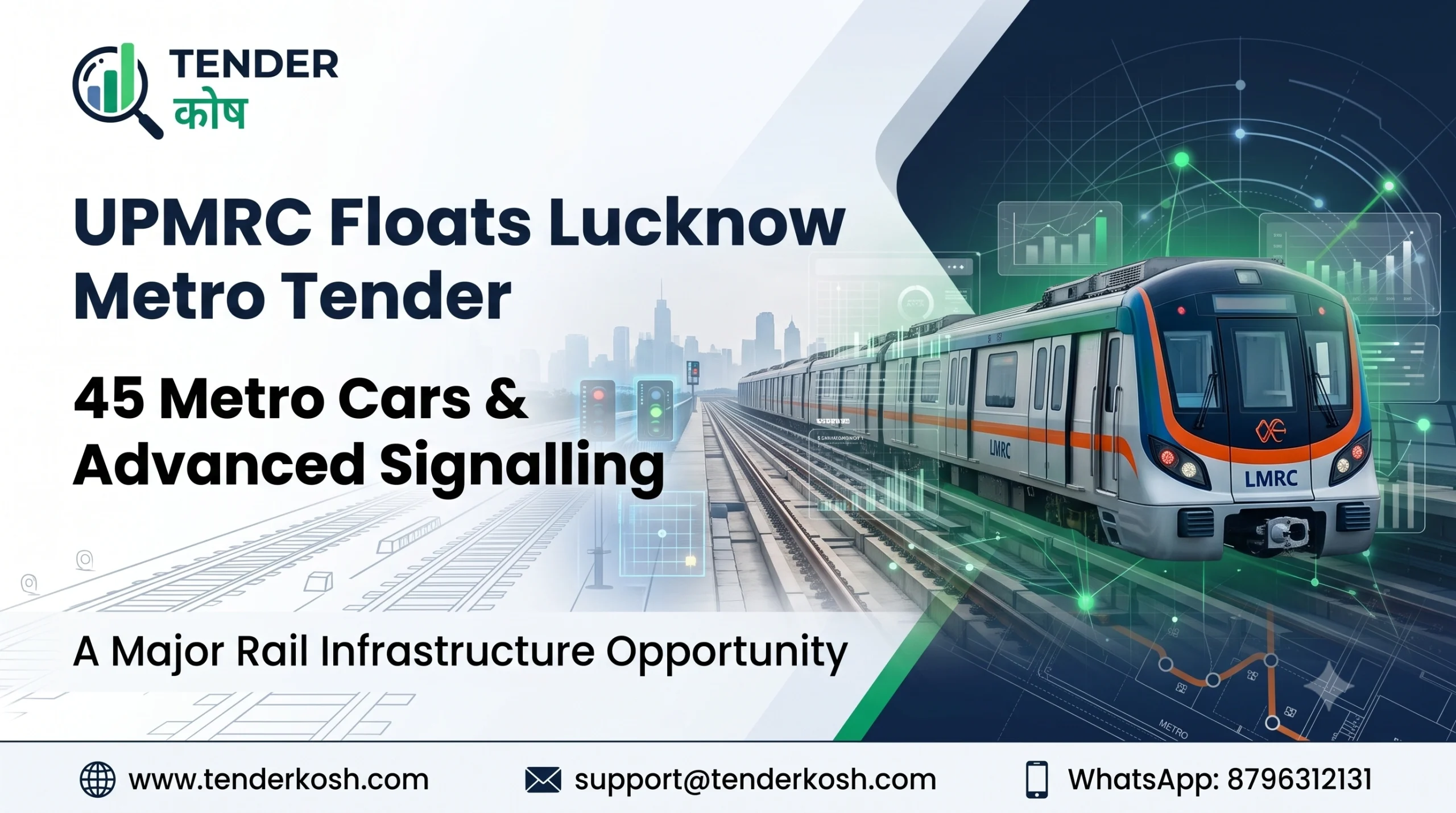
Uttar Pradesh Metro Rail Corporation Limited (UPMRC) has floated one of the year’s most significant urban-rail procurements: a global Lucknow Metro tender for 45 standard-gauge metro cars together with a modern signalling and train control system for the Phase-1B expansion. For rolling-stock manufacturers, signalling technology providers, and the wider rail supply chain, this integrated tender (reference LKRS-02) is a headline opportunity in India’s fast-growing metro sector.
This guide breaks down exactly what UPMRC is procuring, the key tender dates and EMD, the full scope of work, why the Phase-1B expansion matters for Lucknow, and what the tender means for bidders and the sub-tier supply chain. Whether you are a lead manufacturer or a component supplier, here is what you need to know about this Lucknow Metro tender.
Key Takeaways
A note on details and dates: The figures below — tender reference, EMD, contract period, and dates — are drawn from public reporting of the UPMRC tender notice (Rail Analysis India, citing UPMRC). Tender terms and timelines can change through corrigenda. Always confirm the current scope, EMD, and submission dates against the official UPMRC tender document before preparing your bid.
| Tender Detail | Information |
|---|---|
| Tender Reference Number | LKRS-02 |
| Procuring Authority | Uttar Pradesh Metro Rail Corporation Limited (UPMRC) |
| Scope | 45 standard-gauge metro cars + signalling & train control system |
| EMD Amount | ₹6,70,00,000 (₹6.70 crore) |
| Contract Period | 45 months from commencement of work |
| Document Sale Start | 01 May 2026, 12:00 PM |
| Pre-Bid Meeting | 20 May 2026, 11:00 AM |
| Bid Submission | 03 June 2026 (11:00 AM) to 16 June 2026 (03:00 PM) |
| Bid Opening | 17 June 2026, 03:00 PM |
The tender is not a simple coach-supply order — it covers the full lifecycle of metro coach deployment and system integration, combining rolling stock and signalling in a single contract. The scope includes:
Design and engineering of 45 standard-gauge metro cars to UPMRC’s specifications for the Phase-1B network.
Manufacturing and supply of the rolling stock — the core of the contract and the largest value component.
Installation of modern signalling and train control systems, integrated with the new rolling stock for reliable operation.
Testing and commissioning of all systems to ensure the cars and signalling operate safely and reliably together.
Training of personnel for operations and maintenance, so UPMRC can run and sustain the new fleet effectively.
Delivering rolling stock and signalling as one aligned package — improving reliability, safety, and implementation speed.
Why the integrated approach matters: By combining rolling-stock procurement with signalling in a single contract, UPMRC aims to ensure compatibility between trains and control systems, achieve cost efficiency, and speed up implementation. For bidders, it means the winning party must bring — or partner for — both metro manufacturing and signalling capability, raising the technical bar and rewarding firms that can deliver a complete, integrated solution.
The Phase-1B expansion is a critical step in addressing Lucknow’s rising urban-mobility demand. As the city’s population and traffic congestion grow, the addition of new metro cars will significantly improve passenger capacity and reduce wait times — while the advanced signalling and train control systems point toward automation, better headway management, and higher safety standards.
| Benefit | What It Delivers |
|---|---|
| Higher Capacity | 45 new cars increase how many passengers the network can carry, easing crowding |
| Reduced Wait Times | More rolling stock supports higher-frequency services and shorter headways |
| Automation & Safety | Modern signalling enables automation, better headway management, and fewer human errors |
| Future-Ready Network | Integrated systems position Lucknow for sustainable, efficient long-term growth |
As a global tender for integrated rolling stock and signalling, this Lucknow Metro tender is aimed at major metro manufacturers and signalling technology providers with the scale to design, build, and commission at this level. But a contract of this size creates a supply chain that reaches far beyond the lead bidder.
| Participant | Typical Role |
|---|---|
| Rolling-Stock Manufacturers | Lead bidders for design and manufacture of the 45 metro cars |
| Signalling & Train-Control Providers | Lead or JV partners delivering the signalling and control systems |
| Component & Sub-System Suppliers | Suppliers of traction, braking, doors, HVAC, interiors, electronics, and more |
| Testing, Commissioning & Training Firms | Specialist services supporting the winning contractor’s delivery |
| MSME & Specialist Vendors | Niche component and service providers into the prime’s supply chain |
The sub-tier opportunity: Even firms that cannot bid as the lead manufacturer can benefit. Metro projects of this scale generate sustained demand for components, sub-systems, and specialist services throughout the 45-month contract. Positioning early as a qualified supplier to the eventual winner is a realistic route in for MSMEs and specialist vendors. For how small firms maximise their advantages, see our guide on MSME benefits in government tenders.
Download the official UPMRC tender document and confirm the current scope, EMD, eligibility, and dates — and check for any corrigendum before you commit.
The ₹6.70 crore EMD is substantial. Arrange the bid security in the specified form and validity well ahead of the submission window.
Because rolling stock and signalling are bundled, ensure you can deliver both — through in-house capability or a joint venture with a signalling partner.
Compile documented metro or rail rolling-stock and signalling experience — central to clearing the technical bid on a project of this complexity.
High-value tenders are lost on technicalities as often as on price. Run a full pre-submission check — see our tender compliance checklist.
Dates and terms on major tenders often shift through amendments. Monitor for corrigenda — see our guide to finding corrigenda.
India’s metro rail sector is generating high-value tenders across UPMRC, DMRC, and dozens of other transit authorities. TenderKosh tracks metro, rail, and infrastructure tenders — plus corrigenda — across 1,000+ government procurement portals, so you catch opportunities like the Lucknow Metro tender early and bid against the latest requirements.
Browse Live Tenders View Plans Why TenderKoshUPMRC’s tender for 45 standard-gauge metro cars and advanced signalling marks a crucial advance in Lucknow’s urban transit — an integrated rolling-stock-plus-signalling contract that promises enhanced safety, efficiency, and capacity for the Phase-1B network. By bundling trains and control systems, UPMRC is prioritising compatibility and faster implementation, while opening the door to global manufacturers and technology providers.
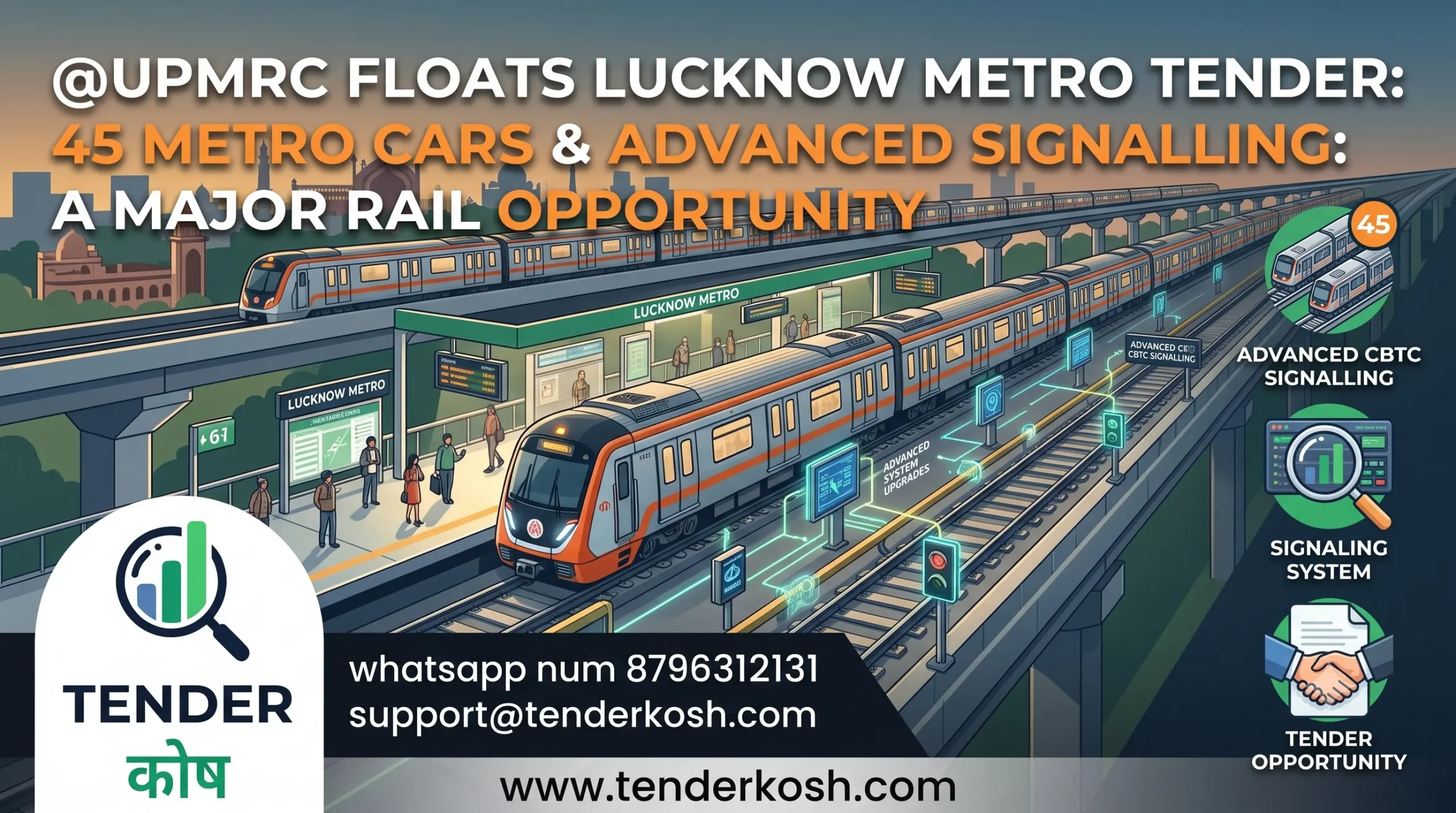
For the rail supply chain, the message is clear: this Lucknow Metro tender is both a headline opportunity for lead bidders and a deep sub-tier pipeline for component and service suppliers. Confirm the live terms, plan the EMD, line up integrated capability, and track the tender closely — because opportunities of this scale in India’s growing metro sector reward the firms that prepare early and bid with precision.
The UPMRC Lucknow Metro Phase-1B tender (reference LKRS-02) is a global tender floated by Uttar Pradesh Metro Rail Corporation Limited for the design, manufacture, supply, testing, commissioning, and training of 45 standard-gauge metro cars, along with a modern signalling and train control system. It supports the Phase-1B expansion of the Lucknow Metro, aiming to boost passenger capacity, improve safety, and modernise the network. The contract period is 45 months from the commencement of work.
The Earnest Money Deposit (EMD) specified for the UPMRC Lucknow Metro Phase-1B tender (LKRS-02) is ₹6,70,00,000 — that is, ₹6.70 crore. As with all large tenders, bidders must furnish the EMD exactly as specified and in the accepted form and validity, and should re-check the requirement against the latest tender document and any corrigendum before submission.
The scope covers the full lifecycle of metro coach deployment and system integration: design and engineering of 45 standard-gauge metro cars, manufacturing and supply of the rolling stock, installation of signalling and train control systems, testing and commissioning of all systems, and training of personnel for operations and maintenance. Combining rolling stock and signalling in a single integrated contract is intended to ensure compatibility, cost efficiency, and faster implementation.
Because it is a global tender for integrated rolling stock and signalling, the Lucknow Metro tender is aimed at major metro rolling-stock manufacturers and signalling technology providers with the capability to design, build, and commission metro cars and train control systems at scale. Such tenders typically require strong turnover, relevant metro or rail experience, technical and financial capacity, and substantial bid security. Smaller firms often participate as sub-contractors, component suppliers, or joint-venture partners rather than lead bidders.
The Lucknow Metro Phase-1B expansion is important because it addresses rising urban mobility demand in a growing city. Adding 45 new metro cars increases passenger capacity and reduces wait times, while the advanced signalling and train control systems support automation, better headway management, higher-frequency services, and improved safety. The project reflects a broader national push toward sustainable, efficient urban transport, and it opens opportunities for global technology providers in India’s expanding metro sector.
This article is general information, not advice. It has been compiled from publicly available sources — government releases and notifications, official portals, published tender documents and trade reporting — and reflects our understanding at the time of writing. It is not legal, financial, tax or professional advice, and it does not create any advisory relationship.
Public procurement changes constantly. Tender terms, eligibility criteria, thresholds, fees, deadlines, scheme conditions and government policy are revised frequently, often through corrigenda issued mid-window and sometimes without wide notice. Figures and rules that were accurate when published may already have changed by the time you read this.
Always verify against the primary source before you act or bid. The tender document, the issuing authority's official portal and the relevant government notification are the authoritative sources. Where anything in this article differs from them, the official source prevails. Do not rely on this page — or on any third-party summary — as the basis for a bid, an investment or a compliance decision.
TenderKosh is a private tender-intelligence platform. We are not a government body, and we are not affiliated with, endorsed by or acting on behalf of any government department, ministry, PSU or procurement portal. Names, marks and portals referenced belong to their respective owners and are used for identification only. External links are provided for convenience; we do not control and are not responsible for third-party content.
While we take reasonable care, we make no warranty as to the accuracy, completeness or currency of this content, and accept no liability for any loss or damage arising from reliance on it.Spotted something wrong or out of date? Please tell us at support@tenderkosh.com — we correct errors promptly.See our full Disclaimer.
Discover relevant tenders, monitor corrigenda, compare opportunities, and move from document reading to structured action.