TenderKosh for EPC teams
Turn tender reading into faster bidding decisions.
Discover relevant tenders, monitor corrigenda, compare opportunities, and move from document reading to structured action.
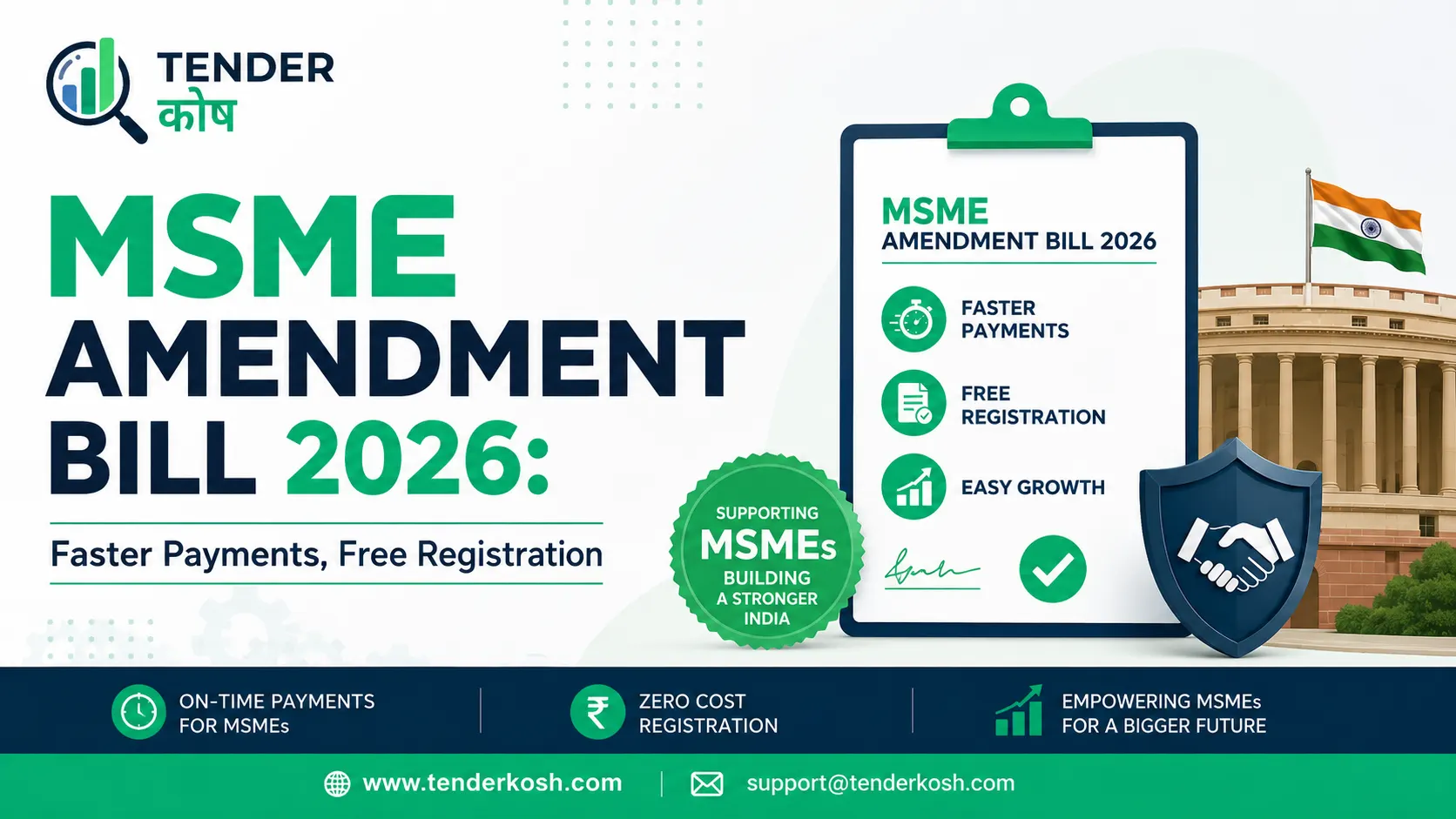
The MSME Amendment Bill 2026 amends the MSMED Act, 2006 to attack the sector’s oldest problem — getting paid on time. It was passed by the Rajya Sabha on 3 August 2026 and the Lok Sabha on 7 August 2026.
The headline changes: hard timelines on payment disputes, central public sector enterprises required to settle MSME invoices through TReDS, statutory permanence for a free and voluntary Udyam registration portal, and decriminalisation of minor procedural lapses.
If you supply goods or services to a government department, a PSU, or a large corporate buyer, delayed payment is probably not an abstract policy issue for you. It is the reason you have chased an invoice for eight months, funded a payroll from an overdraft, or declined a tender you could have won because your working capital was tied up in someone else’s accounts payable.
The MSME Amendment Bill 2026 is aimed squarely at that problem. It does not create a new law from scratch — it amends the framework that has governed the sector since 2006, which has now completed twenty years. What follows is what actually changed, what it means specifically if you bid for government work, and what still has to happen before any of it reaches you.
Key Takeaways
On this page
The amendment groups into four areas: payment enforcement, invoice financing, registration, and compliance liability. Taken together they shift the MSMED framework from stating what buyers should do toward giving small enterprises machinery to make it happen.
| Area | The Old Pain Point | What the Amendment Does |
|---|---|---|
| Payment disputes | Proceedings before facilitation councils could run for years | Time limits on mediation and arbitration, plus interim relief on long appeals |
| Recovering an award | Winning an award and collecting on it were different things | Recovery through district authorities as arrears of land revenue |
| Working capital | Cash locked in receivables through the credit period | CPSE invoice settlement routed through TReDS for discounting |
| Registration | Portal status resting on executive notification | Statutory permanence for a digital, free, voluntary Udyam portal |
| Compliance | Criminal exposure for minor filing errors | Decriminalisation, with warnings and civil penalties instead |
| Classification | Definitional ambiguity across notifications | Twin criteria of investment in plant and machinery plus turnover written into the Act |
The payment provisions are the heart of the MSME Amendment Bill 2026, and they work by attacking delay at three separate points. The underlying obligation is unchanged: where a written agreement exists, the agreed payment period to a micro or small enterprise cannot exceed 45 days from acceptance or deemed acceptance. What changes is what happens when a buyer ignores it.
Mediation must conclude within 90 days, and where the dispute proceeds to arbitration, the award must be delivered within a further 90 days. Online dispute resolution is part of the modernised mechanism.
Why it matters: the old weapon of choice for a delaying buyer was time itself. A defined clock removes it.
Where an appeal against an award remains pending beyond six months, courts are to order release of at least 50% of the awarded amount to the MSME in the meantime.
Why it matters: appealing purely to defer payment stops being free. Half the money moves while the argument continues.
Mediated settlements and arbitration awards can be recovered by district authorities — collectors and deputy commissioners — where the buyer’s assets are located, using the same machinery as unpaid government dues.
Why it matters: this is the single most consequential change. An unenforceable award is a piece of paper; a recoverable one is leverage.
Every central public sector enterprise is to settle invoices for procurement of goods or services from MSMEs on the Trade Receivables Discounting System. The Bill also creates an enabling mechanism for states to nudge their own public sector enterprises toward invoice discounting.
TReDS is an electronic platform on which trade receivables are financed or discounted. In practice: once your invoice to a CPSE is accepted on the platform, banks and NBFCs bid to buy that receivable, and you take payment now at a small discount instead of waiting out the credit period. The buyer still pays on their schedule — but they pay the financier, not you.
Why this matters more than it first appears for tender bidders. Working capital is the quiet disqualifier in public procurement. Contractors routinely skip tenders they could win because EMD, performance guarantees and mobilisation costs on a live contract have already consumed their headroom. Converting CPSE receivables into cash faster does not just improve one project’s cash flow — it increases how many tenders you can pursue at once.
The Bill provides statutory permanence to the Udyam Registration Portal as a digital, free and voluntary platform. Registration is not compulsory, and the government has been explicit on that point.
But “voluntary” deserves a caveat that generic coverage of the MSME Amendment Bill 2026 tends to skip. If you sell to government, Udyam registration is what unlocks the benefits — procurement preferences reserved for MSEs, EMD exemptions where a tender permits them, and price-matching privileges in certain evaluations. An unregistered MSME is voluntarily declining those advantages. The registration is optional; the consequences of skipping it are not.
The classification test is now in the Act itself. MSME status rests on twin criteria — investment in plant and machinery, and turnover. Having this written into the statute rather than resting on notification alone reduces the ambiguity that has caused disputes about who qualifies for which benefit.
Faster payment only helps if you are bidding on the right work. Track live tenders across GeM, CPPP, CPSEs and state portals in one dashboard, filtered by your category, value range and MSME eligibility — with corrigendum alerts so a late change never costs you a bid.
Minor filing mistakes and procedural delays no longer carry automatic criminal exposure. The framework moves toward warnings and civil penalties for small lapses, which is a meaningful change in posture for owner-run businesses where the person filing returns is often also the person running operations.
On the institutional side, states can constitute additional Micro and Small Enterprises Facilitation Councils with simplified membership criteria. More councils with clearer deadlines is the mechanism intended to clear the backlog that made the old delayed-payment route feel pointless to many small suppliers.
Most commentary on this Bill treats MSMEs as a single category. If you sell to government specifically, the effects are sharper and more concrete.
One caution worth stating plainly. Nothing here removes the commercial reality that pursuing a payment dispute against a large buyer can affect your future relationship with them. The Bill makes the legal route faster and more enforceable; it does not make the decision to use it cost-free. Weigh that as you always have — just with better odds now.
Passage by both Houses is a milestone, not a switch being flipped. Being clear about this matters, because a supplier who assumes protections are live today may be disappointed when they try to rely on them.
Implementation quality will decide whether the MSME Amendment Bill 2026 becomes a structural change or another well-intentioned statute. The provisions are sound; the delivery is the open question.
The suppliers who benefit first will be the ones already set up to use the mechanisms on day one. None of the following requires waiting for the rules.
The Micro, Small and Medium Enterprises Development (Amendment) Bill, 2026 was passed by the Rajya Sabha on 3 August 2026 and by the Lok Sabha on 7 August 2026. It amends the MSMED Act, 2006, which completed twenty years since notification.
No. It amends the MSMED Act, 2006 rather than replacing it. Some coverage has described it as a replacement, but the legislation is an amendment bill that strengthens the existing framework around delayed payments, registration, dispute resolution and decriminalisation.
No. The Bill gives statutory permanence to the Udyam Registration Portal as a digital, free and voluntary registration platform. Registration remains voluntary — but in practice, an MSME that does not register cannot claim the benefits that depend on it, including procurement preferences and EMD exemptions in government tenders.
Under the MSMED framework, where a written agreement exists, the agreed payment period to a micro or small enterprise cannot exceed 45 days from the date of acceptance or deemed acceptance of goods or services. The 2026 amendment does not remove this rule; it strengthens the machinery for enforcing it when a buyer does not comply.
The Bill provides that central public sector enterprises must settle invoices for procurement of goods or services from MSMEs on the Trade Receivables Discounting System. TReDS is an electronic platform where trade receivables can be financed or discounted, letting a supplier convert an approved invoice into cash before the buyer’s payment date rather than waiting out the credit period.
Passage by both Houses is not the final step. Presidential assent, notification of the Act’s commencement, and the framing of rules and operational guidelines all follow, and different provisions can commence on different dates. Treat the changes as confirmed in direction but check the notified commencement and rules before relying on any specific timeline.
That is the intent. Mediated settlements and arbitration awards can be recovered by district authorities where the buyer’s assets are located, using the machinery applied to arrears of land revenue. Combined with the requirement that courts release at least half the awarded amount when an appeal runs past six months, this is designed to close the gap between winning an award and receiving the money.
The MSME Amendment Bill 2026 is a genuine attempt to fix the enforcement gap rather than restate the principle. Small enterprises already had a right to be paid in 45 days. What they lacked was a fast route to a decision and a practical way to collect on one. Time-bound mediation and arbitration, interim release during long appeals, and recovery through district revenue machinery address exactly that.
For suppliers to government and CPSEs, the TReDS mandate is the change most likely to show up in your bank account first — and better liquidity translates directly into the ability to chase more tenders at once. Get your Udyam registration current, get onto a TReDS platform, tighten your documentation, and be ready to use the mechanisms the day the rules are notified.
Note: This article summarises the Micro, Small and Medium Enterprises Development (Amendment) Bill, 2026 based on official statements from the Ministry of MSME and public reporting current at the time of writing. It is general information, not legal advice. Provisions take effect on notification and may be modified by rules; specific timelines, thresholds and procedures should be verified against the notified Act and rules, or with a qualified professional, before you rely on them in a dispute.
This article is general information, not advice. It has been compiled from publicly available sources — government releases and notifications, official portals, published tender documents and trade reporting — and reflects our understanding at the time of writing. It is not legal, financial, tax or professional advice, and it does not create any advisory relationship.
Public procurement changes constantly. Tender terms, eligibility criteria, thresholds, fees, deadlines, scheme conditions and government policy are revised frequently, often through corrigenda issued mid-window and sometimes without wide notice. Figures and rules that were accurate when published may already have changed by the time you read this.
Always verify against the primary source before you act or bid. The tender document, the issuing authority's official portal and the relevant government notification are the authoritative sources. Where anything in this article differs from them, the official source prevails. Do not rely on this page — or on any third-party summary — as the basis for a bid, an investment or a compliance decision.
TenderKosh is a private tender-intelligence platform. We are not a government body, and we are not affiliated with, endorsed by or acting on behalf of any government department, ministry, PSU or procurement portal. Names, marks and portals referenced belong to their respective owners and are used for identification only. External links are provided for convenience; we do not control and are not responsible for third-party content.
While we take reasonable care, we make no warranty as to the accuracy, completeness or currency of this content, and accept no liability for any loss or damage arising from reliance on it.Spotted something wrong or out of date? Please tell us at support@tenderkosh.com — we correct errors promptly.See our full Disclaimer.
Discover relevant tenders, monitor corrigenda, compare opportunities, and move from document reading to structured action.