TenderKosh for EPC teams
Turn tender reading into faster bidding decisions.
Discover relevant tenders, monitor corrigenda, compare opportunities, and move from document reading to structured action.
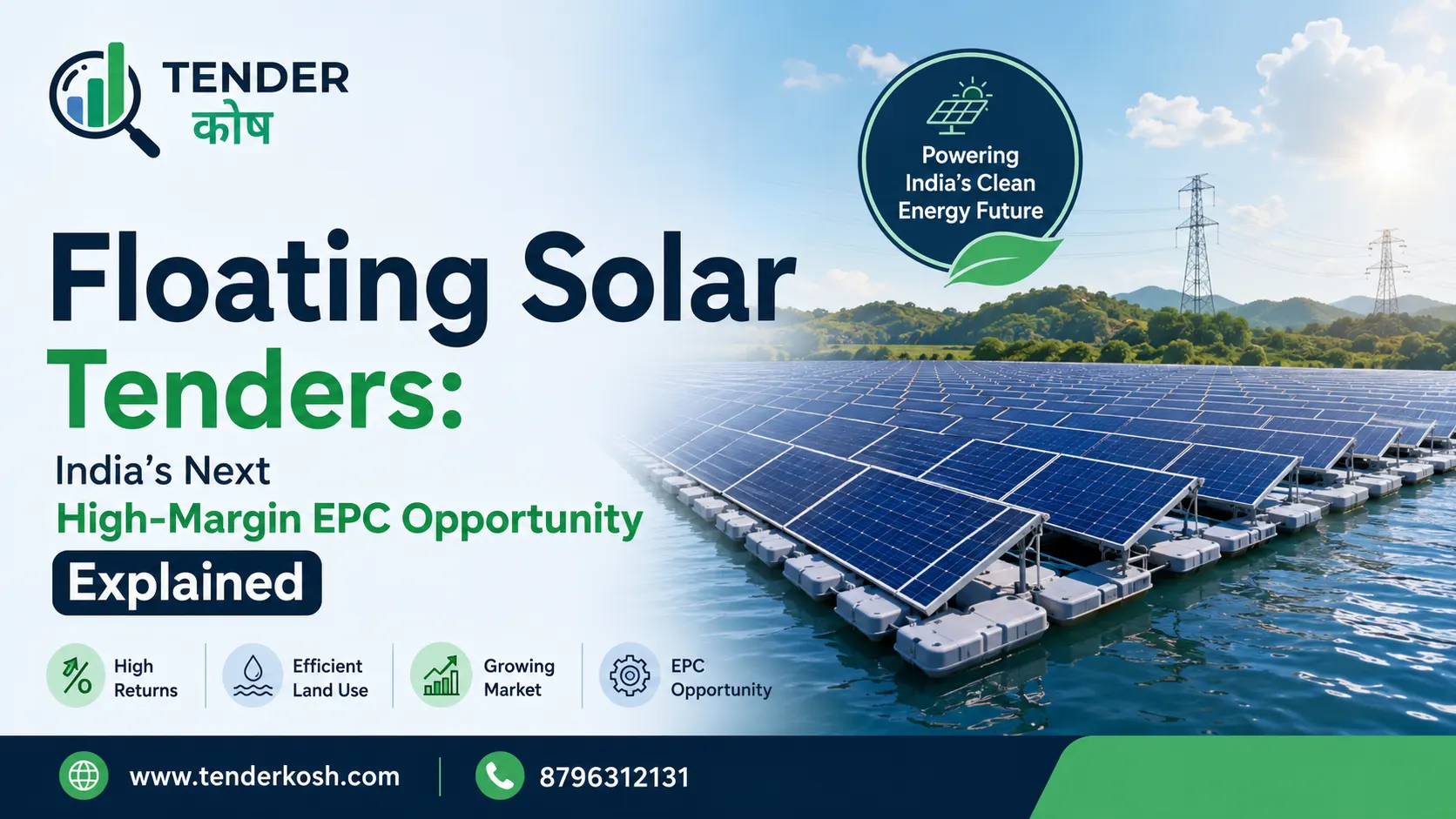
For years, India’s solar story has been driven by large ground-mounted projects spread across vast parcels of land — utility-scale solar parks, state solar programmes, DISCOM procurements, and central renewable initiatives. But as India’s renewable ambitions keep growing, one challenge is becoming impossible to ignore: land. Across many states, developers face delays tied to land acquisition, environmental clearances, right-of-way issues, and local approvals. That is why procurement agencies are once again turning toward an alternative that has been quietly gaining momentum — and why floating solar tenders are returning to the spotlight.
Recent activity, including a floating solar project reported at a reservoir in Mangaluru, is reinforcing a trend that renewable professionals have been watching closely. While still smaller than conventional utility-scale solar, floating solar is gradually re-entering the tender market — and for specialised EPC contractors, it may become one of the most attractive, high-margin opportunities of the next few years.
A note on sourcing: The Mangaluru reservoir project and other examples referenced here are based on reported developments. Specific project scope, capacity, and timelines should be confirmed against the issuing authority’s official tender notification before relying on them. The broader analysis of why floating solar is gaining ground is sector context, not a forecast of any single tender’s outcome.
Key Takeaways
India has ambitious renewable targets, but developers increasingly run into the same wall: finding suitable land. Large solar projects need land parcels that are contiguous, legally available, grid-accessible, and environmentally compliant — and in many regions, acquiring such land is becoming more complex and expensive.
Floating solar addresses this directly by using existing water bodies instead of competing for land. That single shift creates an entirely different project-development model — and a new pipeline of floating solar tenders.
| Suitable Water Body | Why It Works for Floating Solar |
|---|---|
| Reservoirs & Dams | Large, stable water surfaces with existing grid and infrastructure access nearby |
| Irrigation Tanks | Widely distributed across states, often managed by departments now exploring solar |
| Water Treatment Ponds | Controlled environments suited to mid-sized installations |
| Industrial Water Bodies | Captive sites where industries can pair generation with on-site demand |
One recent example drawing industry attention is a floating solar tender associated with a reservoir in Mangaluru. On its own, the project may look modest next to large utility-scale parks. But procurement professionals are watching it because it reflects a broader shift: agencies managing water infrastructure, reservoirs, irrigation systems, and public utilities are increasingly exploring floating solar deployment. For EPC firms, that signals future renewable opportunity may not be limited to traditional ground-mounted projects.
The interest goes beyond developers. Tender-tracking teams and procurement consultants are monitoring floating solar because it solves several structural problems at once.
Land procurement is one of the biggest causes of renewable project delay. Floating solar significantly reduces this by leveraging existing water bodies instead.
In suitable locations, planning can be more streamlined because large-scale land acquisition processes may be avoided altogether.
States can generate renewable energy without diverting agricultural or industrial land — politically and economically attractive.
A dual benefit: Beyond power generation, floating solar installations can reduce water evaporation by partially covering a reservoir’s surface. In water-scarce regions, that conservation benefit makes the technology doubly attractive to the departments that manage these water bodies — which is exactly why new buyers are entering this market.
This is where the opportunity becomes genuinely interesting. Unlike conventional solar, floating solar requires specialised engineering capabilities. Contractors must manage floating platform systems, anchoring mechanisms, mooring designs, water-resistant electrical infrastructure, and specialised maintenance procedures. These requirements create a higher technical barrier to entry — and in procurement markets, higher barriers usually mean lower competition.
| Conventional Ground-Mounted Solar | Floating Solar |
|---|---|
| Most solar EPC firms can execute it | Far fewer firms have proven floating-solar expertise |
| Crowded bidding, intense price competition | Reduced bidder competition |
| Lower technical qualification thresholds | Higher technical qualification thresholds |
| Margins under sustained pressure | Better margins and value-added services |
Tender Market Reality: Many conventional solar EPC contractors can execute ground-mounted projects. Far fewer possess proven floating solar expertise. For specialised firms, floating solar can become a premium segment rather than a commoditised one — a place where engineering, not just the lowest price, wins the work.
Many EPC businesses still focus almost exclusively on utility-scale solar, state programmes, DISCOM procurements, and central agency tenders. Those opportunities remain important — but competition has intensified, and margins are under pressure. Floating solar offers a different path: instead of competing solely on price, contractors can compete on engineering expertise, technical capability, project experience, and specialised execution.
Renewable Market Insight: The next renewable opportunity may not be defined by project size — it may be defined by specialisation. As land challenges continue to affect solar deployment, this is one of the few renewable segments where technical expertise can still create a meaningful, durable competitive advantage.
Many observers think so. India has thousands of potential floating solar sites across major reservoirs, dam networks, irrigation infrastructure, public water bodies, and industrial reservoirs. States investing heavily in both renewable energy and water infrastructure are natural candidates to expand floating solar tenders.
| Potential Adopter States | Why They Fit |
|---|---|
| Karnataka | Active renewable push and significant reservoir infrastructure |
| Maharashtra & Gujarat | Strong solar programmes plus extensive water and irrigation networks |
| Telangana & Andhra Pradesh | Large irrigation systems and growing renewable ambitions |
| Madhya Pradesh & Rajasthan | High solar potential with reservoirs suited to floating deployment |
Project economics and site suitability will determine adoption rates, but the overall direction appears favourable.
Floating solar is not without risk. A clear-eyed view of the challenges is what separates firms that build durable capability from those that bid unprepared.
Businesses looking to capitalise on this trend should watch both the emerging buyers and the emerging tender language — because floating solar opportunities often surface at the state level before becoming mainstream procurement categories.
Water resource departments, reservoir management authorities, state renewable agencies, public utilities, and dam operators are the new sources of floating solar tenders.
Track terms like “floating solar EPC,” “reservoir solar projects,” “floating PV systems,” “water body solar installation,” and “dam-based solar projects.”
Watch state portals early — many of these opportunities appear there before they scale into broader national procurement categories.
Floating solar opportunities often appear first on scattered state and water-department portals — easy to miss if you only watch the big renewable agencies. TenderKosh tracks solar, floating solar, and hybrid tenders across 1,000+ government procurement portals, with corrigendum alerts, so you spot this high-margin niche early and bid prepared.
Browse Live Tenders View Plans Why TenderKoshFloating solar is no longer an experimental concept. It is increasingly a practical solution to one of India’s biggest renewable challenges — land availability. As procurement agencies search for faster ways to deploy renewables, floating solar tenders are attracting renewed attention across multiple states.
For EPC contractors, the opportunity goes beyond winning another solar tender. It is a chance to enter a specialised, technically demanding segment where expertise matters, competition is lower, and margins may be stronger than traditional ground-mounted work. The question is no longer whether floating solar will grow — it is whether your business will develop floating solar capabilities before the next wave of tenders arrives.
A floating solar project installs photovoltaic panels on water bodies such as reservoirs, dams, lakes, irrigation tanks, and ponds instead of on land. The panels sit on engineered floating platforms anchored and moored to the water body, with water-resistant electrical infrastructure carrying power to the grid. Floating solar lets developers generate renewable energy on underutilised water surfaces rather than competing for scarce, expensive land.
Floating solar tenders are increasing because land has become one of the biggest bottlenecks for ground-mounted solar — developers face delays from land acquisition, environmental clearances, right-of-way issues, and local approvals. Floating solar sidesteps much of this by using existing reservoirs, dams, and irrigation tanks. It also helps reduce water evaporation, which is attractive for water-scarce regions. As agencies look for faster ways to deploy renewables, floating solar is returning to the tender spotlight across multiple states.
They can be. Floating solar requires specialised engineering — floating platforms, anchoring and mooring systems, water-resistant electrical infrastructure, and specialised maintenance procedures. These create a higher technical barrier to entry, and in procurement markets higher barriers usually mean fewer qualified bidders and lower competition. For contractors with proven floating-solar capability, this often translates into better margins, higher qualification thresholds, and the chance to compete on expertise rather than purely on price.
Floating solar tenders are typically issued by state and central renewable energy agencies, water resource departments, dam and reservoir authorities, irrigation departments, and public utilities that manage water infrastructure. Because these buyers sit across both the energy and water-management sides of government, opportunities often appear first at the state level before becoming a mainstream procurement category.
Floating solar carries risks that ground-mounted projects do not. These include engineering complexity from water-based installation, specialised operations and maintenance procedures, weather and environmental exposure such as wind loads and water-level fluctuations, and technical qualification requirements that many conventional solar contractors do not yet meet. These very challenges, however, are what keep competition lower — so early capability development can become a lasting competitive advantage.
Discover relevant tenders, monitor corrigenda, compare opportunities, and move from document reading to structured action.