
TenderKosh for EPC teams
Turn tender reading into faster bidding decisions.
Discover relevant tenders, monitor corrigenda, compare opportunities, and move from document reading to structured action.
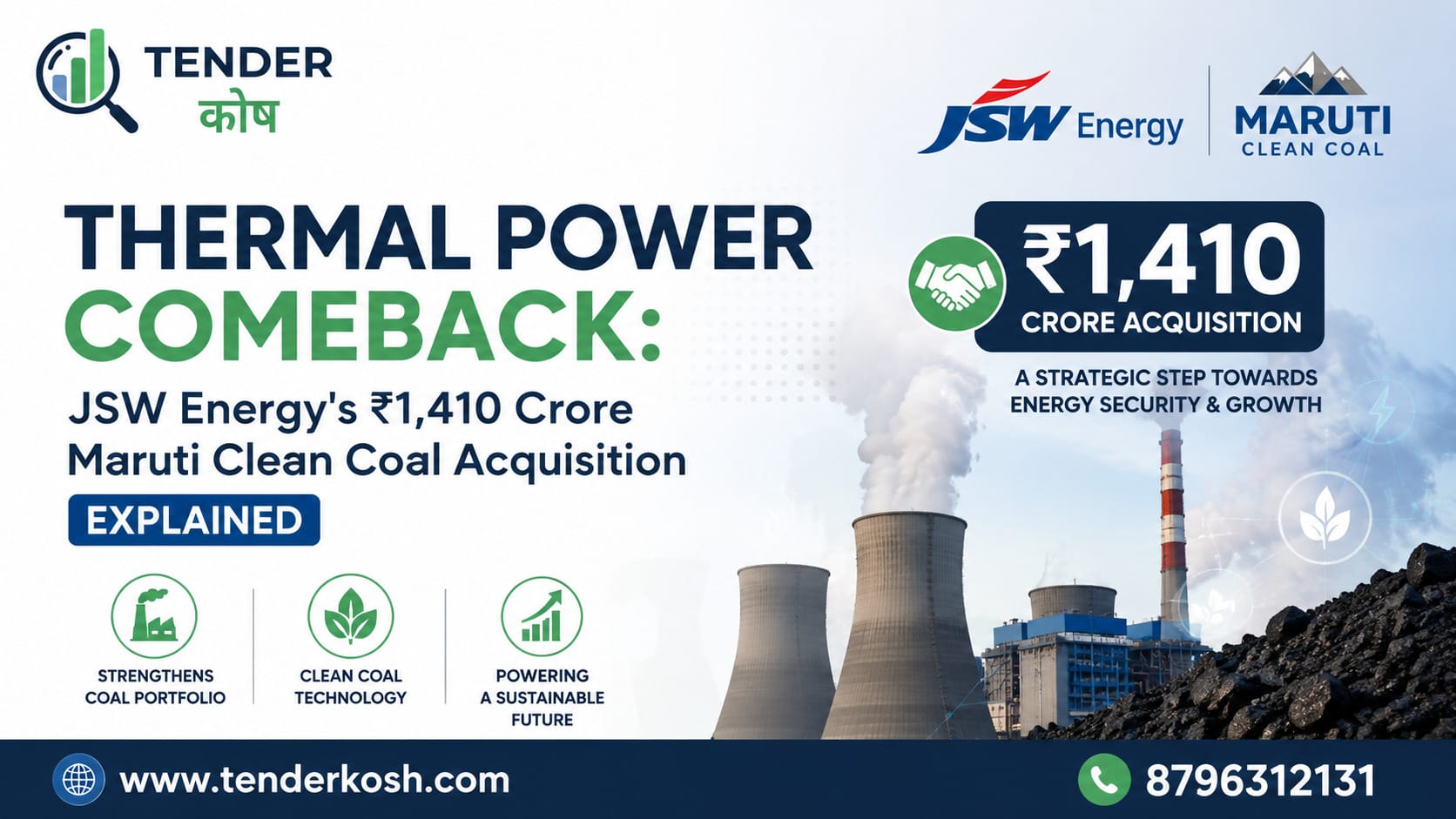
In a move that signals India’s renewed focus on base-load generation, JSW Energy has signed a definitive agreement to acquire a 100% equity stake in Maruti Clean Coal and Power Limited (MCCPL) for an enterprise value of about ₹1,410 crore. This is not just another corporate transaction — it is a calculated bet on the role of thermal power in India’s energy future, made at a time when the country is facing surging electricity demand and the government is pushing to add a large block of new thermal capacity by the early 2030s.
For anyone following India’s power sector — investors, EPC contractors, equipment suppliers, and policy watchers — this deal is a useful window into a bigger story: thermal power is not being abandoned in the green-energy race; it is being rebalanced alongside renewables. This guide breaks down exactly what JSW Energy is buying, why the timing matters, and what the renewed thermal push means for the power-sector supply chain.
A note on sourcing: The details below are based on JSW Energy’s press release and reporting by Economic Times Energy (mid-June 2026). Financial figures for FY26 are estimates, the deal is subject to regulatory approvals and lender consent, and capacity targets are as stated by the company and government. Verify the latest figures and deal status against the official JSW Energy disclosure and stock-exchange filings before relying on specifics.
Key Takeaways
| Parameter | Detail |
|---|---|
| Acquirer | JSW Energy Limited |
| Target Company | Maruti Clean Coal & Power Ltd (MCCPL) |
| Stake Acquired | 100% equity |
| Enterprise Value | ₹1,410 crore (subject to closing adjustments) |
| Power Plant | 300 MW thermal plant, Korba, Chhattisgarh |
| Sellers | Kolahai Infotech Pvt Ltd & SFI Parcel Services Pvt Ltd |
| Expected Completion | July 31, 2026 |
| Post-Acquisition Thermal Capacity | ~5,958 MW installed |
The headline is a 300 MW plant, but the real value lies in what surrounds it: contracted revenue, locked-in fuel, and a strategic location in India’s coal heartland.
MCCPL’s Korba plant is structured as a revenue machine with multiple income streams, which is why management has described it as earnings accretive from day one.
| Revenue Stream | Capacity | Duration / Basis |
|---|---|---|
| Rajasthan DISCOMs (via PTC India) | 195 MW | ~14 years remaining |
| Chhattisgarh DISCOM | 5% of capacity | Variable cost |
| Merchant Market | Remaining ~100 MW | Spot pricing |
For a thermal power producer, fuel security is everything. The Korba plant’s coal supply is reported to be secured through a long-term Fuel Supply Agreement (FSA) with South Eastern Coalfields Limited (SECL) for around 1.0 million tonnes annually, plus additional allocations under the government’s SHAKTI scheme. Given how badly coal price volatility has hurt thermal producers in the past, this locked-in supply is one of the most attractive features of the asset.
| Financial Metric | FY24 | FY25 | FY26 (Estimated) |
|---|---|---|---|
| Revenue | ₹789 crore | ₹754 crore | ₹787 crore |
| EBITDA | — | — | ₹279 crore |
Revenue has stayed broadly stable despite market fluctuations, with the FY26 estimate showing a modest rebound from FY25 — and the estimated EBITDA pointing to healthy operational efficiency.
The 300 MW addition lifts installed thermal capacity from about 5,658 MW to roughly 5,958 MW — a meaningful boost for a company with aggressive growth targets and large projects under construction.
The deal directly supports JSW Energy’s stated target of reaching 30 GW of total generation capacity by 2030. Reliable base-load thermal complements its growing solar, wind, and hydro portfolio.
With revenue near ₹787 crore and EBITDA around ₹279 crore annually, the asset immediately strengthens cash flows — critical for funding the heavy capital investment a 30 GW build-out requires.
The Korba plant adds a Chhattisgarh presence in India’s coal heartland, with guaranteed fuel access — strengthening the company’s footprint across the Chhattisgarh–Rajasthan power corridor.
Coal runs around the clock, unlike intermittent solar and wind. Adding base-load thermal makes the overall portfolio more resilient and better able to meet firm-power commitments.
The acquisition lands just as policy momentum swings back toward thermal capacity addition — positioning JSW Energy ahead of a multi-year build-out cycle.
Why is a major energy company buying a coal plant when the world is racing toward green energy? The answer lies in India’s energy reality — where reliability, demand growth, and grid stability currently outweigh the pull of renewables alone.
| Challenge | Why It Pushes India Back Toward Thermal Power |
|---|---|
| Renewable Intermittency | Solar works only when the sun is out; wind is unpredictable — neither guarantees round-the-clock supply |
| Storage Costs | Large-scale energy storage remains expensive, limiting how much renewables can substitute for base-load |
| Demand Boom | Post-pandemic electricity demand has surged, straining existing capacity |
| Grid Stability | Coal provides dependable base-load power that keeps the grid stable |
| Supply-Chain Risk | Geopolitical tensions have at times disrupted renewable-energy supply chains |
Thermal power is being rebalanced, not retired. The Union government has signalled plans to add a large block of new thermal capacity by 2031–32 to meet rising demand, and industry analysts expect thermal generation investments to rise substantially over the following few fiscal years. JSW Energy’s acquisition is timed precisely with this policy shift — and it is far from alone, with players like Adani Power and NTPC also expanding thermal portfolios.
An immediate earnings boost from a day-one accretive asset, a scale-up toward the 30 GW target, and a more balanced thermal-plus-renewable portfolio that supports firm-power commitments.
Continued private-sector confidence in thermal power, acceleration toward the government’s capacity-addition target, and improved regional power security in the Chhattisgarh–Rajasthan corridor.
A clear signal that private thermal power remains viable despite ESG pressures — keeping the pressure on peers like Adani Power, NTPC, and Tata Power to scale their own base-load strategies.
For TenderKosh’s core audience, the most important angle is not the share price — it is the supply chain. A renewed thermal capacity build-out, layered on top of the renewable push, generates a long pipeline of tenders and sub-tier opportunities across the power sector.
| Opportunity Area | What It Involves | Who Can Participate |
|---|---|---|
| EPC Contracts | Engineering, procurement and construction of new and expanded plants | EPC firms and large infrastructure contractors |
| Boilers, Turbines & BoP | Main plant equipment and balance-of-plant systems | Heavy equipment manufacturers and sub-system suppliers |
| Coal Handling & Ash Systems | Material handling, conveyors, and ash-disposal infrastructure | Material-handling and industrial equipment firms |
| Emission Control | FGD, ESP, and other pollution-control systems for compliance | Environmental and emission-control technology providers |
| O&M & Spares | Long-term operations, maintenance, and spare-part supply | O&M service providers and MSME component makers |
Where these opportunities surface: Power-sector tenders flow from generators, state DISCOMs, and PSUs such as NTPC, plus sub-tier sourcing released by EPC contractors. Because they are spread across multiple portals and buyer websites, suppliers who track power-sector tenders centrally — and act early — are best placed to win a share of the capacity expansion. For how the tender process itself works, see our guide on Technical Bid vs Financial Bid.
The target’s name — Maruti Clean Coal and Power — naturally raises a question: is this cleaner-coal technology, or marketing positioning? In general, “clean coal” can refer to higher efficiency (less coal per unit of electricity), reduced emissions of sulphur, mercury, and particulates, and stronger environmental compliance. The plant’s long-term SECL fuel agreement and SHAKTI allocations suggest it meets standard environmental norms, but the public information does not specify advanced clean-coal technology — so the “clean” label may be as much about ESG-era positioning as about a specific technical claim. We flag this neutrally rather than drawing a conclusion.
India’s thermal and renewable build-out will generate thousands of tenders across generators, DISCOMs, and PSUs over the coming years. TenderKosh tracks live tenders, corrigenda, and sub-tier opportunities from 1,000+ government procurement portals — so you spot power-sector opportunities early and bid before the competition does.
Browse Live Tenders View Plans Why TenderKoshJSW Energy’s ₹1,410 crore acquisition of MCCPL is more than adding 300 MW to its portfolio. It is a calculated bet on India’s rising electricity demand, the government’s thermal capacity expansion, coal’s continuing role in grid stability, and the immediate cash flow the Korba asset brings. As management framed it, the transaction is a step toward building a balanced, resilient portfolio that meets the country’s rising energy needs while delivering returns.
In a world racing toward green energy, the deal is a reminder that — at least for the contracted life of assets like Korba, and likely beyond — thermal power still has a firm seat at India’s energy table. For suppliers and contractors, that means a multi-year pipeline of opportunity worth tracking now.
JSW Energy has signed a definitive agreement to acquire a 100% equity stake in Maruti Clean Coal and Power Limited (MCCPL) for an enterprise value of about ₹1,410 crore, subject to closing adjustments. The key asset is a 300 MW coal-based thermal power plant in Korba, Chhattisgarh, with secured long-term coal supply and existing power-supply contracts. The deal is reported to be earnings accretive from day one and is expected to complete by July 31, 2026.
Thermal power provides reliable round-the-clock base-load electricity, which balances the intermittency of solar and wind. With India facing surging post-pandemic electricity demand, high energy-storage costs, and grid-stability needs, the government has pushed to add large amounts of thermal capacity by the early 2030s. For JSW Energy, the Korba plant adds dependable cash flow and base-load capacity that complements its growing renewable portfolio, supporting a balanced energy mix rather than replacing renewables.
The 300 MW addition raises JSW Energy’s installed thermal capacity from about 5,658 MW to roughly 5,958 MW, contributing toward its stated goal of reaching 30 GW of total generation capacity by 2030. The asset also strengthens cash flows — reported revenue of around ₹787 crore and EBITDA near ₹279 crore in the relevant period — which helps fund the large capital investment required to hit that growth target.
The Union government has signalled plans to add a large block of new thermal capacity by 2031-32 to meet rising electricity demand and ensure grid stability — reported figures range from roughly 80 GW upward. Industry analysts have estimated that thermal generation investments could rise substantially over the following few fiscal years. This policy backdrop is the context in which private players like JSW Energy and Adani Power are expanding their thermal portfolios.
The Korba plant’s fuel supply is reported to be secured through a long-term Fuel Supply Agreement (FSA) with South Eastern Coalfields Limited (SECL) for around 1.0 million tonnes annually, along with additional allocations under the government’s SHAKTI coal-linkage scheme. Locked-in fuel supply is significant because coal price volatility has historically been a major risk for thermal power producers in India.
A renewed thermal capacity build-out creates opportunities across the power-sector supply chain — EPC work, boilers and turbines, balance-of-plant equipment, coal handling, emission-control systems, and long-term operations and maintenance. These flow through tenders from generators, state DISCOMs, and PSUs like NTPC, as well as sub-tier sourcing by EPC contractors. Suppliers who track power-sector tenders early are best placed to win a share of this capacity expansion.
Discover relevant tenders, monitor corrigenda, compare opportunities, and move from document reading to structured action.