TenderKosh for EPC teams
Turn tender reading into faster bidding decisions.
Discover relevant tenders, monitor corrigenda, compare opportunities, and move from document reading to structured action.
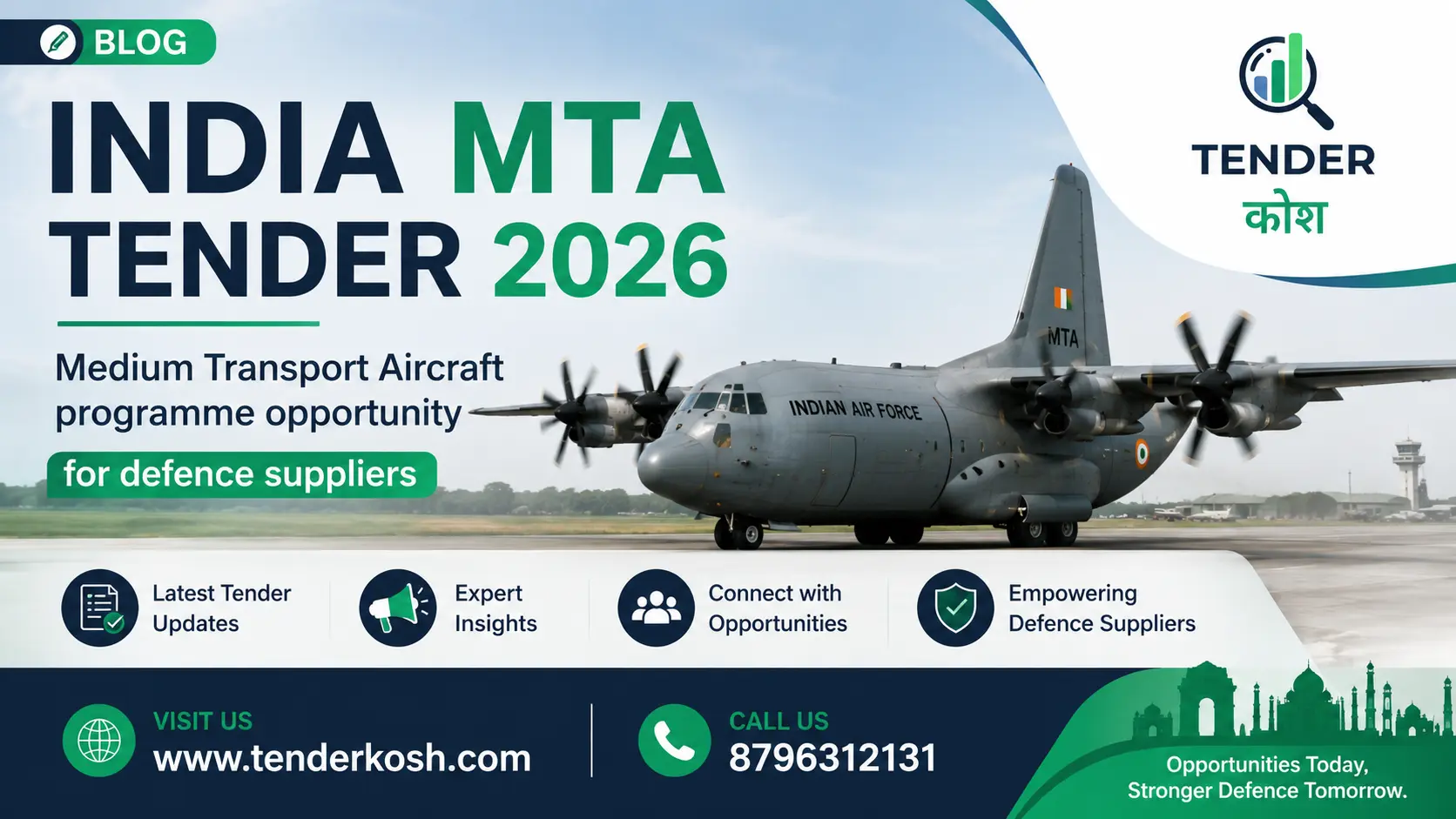
India’s defence procurement ecosystem may soon witness one of its largest transport aircraft acquisitions in decades. Brazilian aerospace major Embraer has indicated that the Indian government is expected to move forward with its Medium Transport Aircraft (MTA) tender — a military transport aircraft tender covering approximately 60 to 80 aircraft — a programme industry observers estimate could be worth billions of dollars. For defence manufacturers, aerospace suppliers, MRO providers, and component makers, this is far more significant than a routine aircraft purchase.
The reason is simple: a deal of this scale is never just about the aircraft. It is about offsets, localisation, technology transfer, and a multi-year supply chain that opens real opportunities for Indian industry. This guide explains what the MTA tender is, who is competing, and — most importantly for our readers — exactly how aerospace and defence suppliers can position to win a share of the work.
Key Takeaways
A note on status and value: The MTA tender is at an early, pre-RFP stage, and details here are based on public statements and media reports — including comments by Embraer’s leadership reported by Reuters and covered by Indian outlets such as The Economic Times. The headline value (often cited in the ₹1 lakh crore / billions-of-dollars range) is an unconfirmed industry estimate, not an official figure. Aircraft counts, payload classes, and the final field of contenders may all change once the Ministry of Defence issues a formal Request for Proposal. Treat every figure here as indicative and verify against the latest official notification before committing resources.
The real prize is the industrial ecosystem, not the flyaway aircraft. In modern defence procurement, the long-term value for domestic industry comes from component sourcing, technology transfer, and decades of maintenance and support — not the one-time purchase. For Indian aerospace and engineering suppliers, the MTA tender is best read as a multi-year supply-chain opportunity that begins now, at the positioning stage.
The Indian Air Force is gradually modernising its transport fleet. Several legacy aircraft, particularly the ageing Antonov An-32, will require replacement in the coming years. The proposed Medium Transport Aircraft programme aims to bridge the operational gap between lighter tactical aircraft and heavy-lift platforms — a strategically important segment for military logistics and rapid deployment.
The future aircraft is expected to deliver a demanding capability set:
Operate from short and semi-prepared runways, essential for forward bases and high-altitude airfields where conventional transports cannot reliably land.
Support troop and cargo transportation across the 18–30 tonne payload band, filling the gap between tactical lifters and heavy strategic aircraft.
Conduct humanitarian and disaster-relief missions, a recurring and high-visibility role for IAF transport fleets across the region.
Enable rapid logistics deployment to move men and materiel quickly across India’s challenging and varied geography.
Potentially support aerial refuelling, extending the reach of other platforms — a capability the KC-390, for example, is designed to offer.
Support special-operations roles, increasingly important given India’s evolving security environment and multi-front requirements.
The competition around the MTA tender is expected to attract some of the world’s leading military aircraft manufacturers, each pairing a proven platform with an India localisation pitch.
| Aircraft | Manufacturer | Approx. Payload | India Angle |
|---|---|---|---|
| KC-390 Millennium Flagship Bid | Embraer (Brazil) | ~26 tonnes | Growing adoption among NATO-aligned nations; Embraer has signalled willingness to localise production and build a manufacturing ecosystem in India, potentially its first military aircraft facility outside Brazil. |
| C-130J Super Hercules | Lockheed Martin (USA) | ~19–20 tonnes | Already operational with the IAF, benefiting from a proven in-service track record. Lockheed Martin has previously announced plans to expand manufacturing and support in India through industry partnerships. |
| A400M Atlas | Airbus (Europe) | ~37 tonnes | Airbus already has a strong India footprint through the C295 programme executed with Tata Advanced Systems, giving it an established local manufacturing base to build on. |
Why the contender field matters to suppliers: Each OEM brings a different existing Indian supply chain. Airbus already works with Tata on the C295; Lockheed has long-standing India partnerships; Embraer would be building a fresh ecosystem. Whichever wins, the localisation partner network is where component and MRO opportunities will flow — so it pays to understand each OEM’s Indian industrial strategy now.
The real story behind the MTA tender may not be the aircraft at all. Defence procurements of this scale increasingly carry obligations that push value into the domestic industry — and that is where Indian suppliers can win.
| Ecosystem Layer | What It Involves | Who Can Participate |
|---|---|---|
| Offset Obligations | The foreign OEM must reinvest a share of contract value into Indian defence industry via sourcing, ToT, or services | Tier-1 and Tier-2 Indian defence and aerospace firms with relevant capability |
| Component Manufacturing | Local production of structural parts, sub-assemblies, and systems for the aircraft | Precision engineering and aerospace component manufacturers |
| Composites & Materials | Supply of composite structures and specialised aerospace-grade materials | Composite material manufacturers and advanced materials firms |
| Defence Electronics | Avionics sub-systems, wiring, sensors, and electronic components | Defence electronics suppliers and embedded systems firms |
| Ground Support Equipment | Tooling, handling, and ground support systems for fleet operations | GSE providers and industrial equipment manufacturers |
| MRO | Maintenance, Repair & Overhaul across the multi-decade fleet life | Defence MRO companies and service providers |
Embraer has publicly stated that winning the contract could lead to its first military aircraft production facility outside Brazil — potentially creating a new aerospace manufacturing ecosystem within India. That kind of commitment is exactly what generates sub-tier work for domestic suppliers over many years.
Many businesses watch the MTA tender only for the final aircraft contract, which only one OEM will win. The larger, more accessible long-term value lies in the supporting industrial ecosystem — and that requires preparation before the programme moves from tendering to execution.
Register as a defence vendor with the Ministry of Defence / DDP and the relevant DPSUs. This is the baseline that makes you visible and eligible for sub-tier and offset opportunities.
Pursue aerospace quality compliance such as AS9100 and engage with DGAQA processes. Without these, OEMs and Tier-1s cannot place you in their supply chains, however competitive your price.
Identify which contenders fit your capability and approach their Indian partners early. Strategic alliances formed before award are far stronger than cold outreach afterwards.
Understand the offset and indigenisation requirements likely to accompany the tender, and document precisely where your products or services fit. Make it easy for an OEM to choose you.
Monitor the SRIJAN indigenisation portal and DPSU pages (HAL, BEL, BDL) for component and sub-system opportunities that flow from large programmes like this one.
Position now, but act on the formal Request for Proposal. Pre-qualification criteria, timelines, and offset terms only become binding once the MoD issues the official tender.
Unlike a single-portal procurement, defence and aerospace opportunities are spread across government bodies, indigenisation portals, and the procurement pages of individual defence PSUs. Knowing where to look is half the battle.
| Channel | What It Carries | Best For |
|---|---|---|
| MoD / DDP | Major acquisition tenders, RFIs and RFPs, defence procurement policy | Tracking the headline programme and its formal notifications |
| SRIJAN Portal | Indigenisation opportunities for components and sub-systems | MSMEs and component makers seeking import-substitution work |
| DPSU Pages (HAL, BEL, BDL) | Sub-tier tenders, vendor development, supply-chain opportunities | Suppliers wanting to enter established defence supply chains |
| GeM | Non-sensitive items, consumables, support equipment | Routine supply to defence establishments via a single catalogue |
| OEM & Tier-1 Channels | Offset and localisation sourcing released directly by primes | Firms targeting offset participation on specific programmes |
Why aggregation matters: A serious aerospace supplier would otherwise need to monitor the MoD, SRIJAN, GeM, and several DPSU portals continuously — plus OEM partner announcements — to catch every opportunity tied to a programme like this. Missing a single sub-tier notification or offset window can cost a multi-year supply position. This is exactly the fragmentation problem a tender-tracking platform solves.
The MTA tender is just one of thousands of opportunities moving through India’s defence and government procurement system. TenderKosh tracks tenders, corrigenda, and sub-tier opportunities from 1,000+ government portals — so you spot the right programme early and position before the competition does.
Browse Live Tenders View Plans Why TenderKoshIndia’s military transport aircraft tender refers to the Indian Air Force’s planned Medium Transport Aircraft (MTA) programme, expected to cover approximately 60 to 80 aircraft in the 18–30 tonne payload class. The programme is intended to replace the ageing Antonov An-32 fleet and bridge the gap between lighter tactical aircraft and heavy-lift platforms. Industry observers estimate it could be worth billions of dollars, with global manufacturers including Embraer, Lockheed Martin, and Airbus expected to compete, each with significant Make in India localisation commitments.
The leading contenders reported are the Embraer KC-390 Millennium (around 26 tonnes payload, with Embraer signalling willingness to set up a manufacturing ecosystem in India), the Lockheed Martin C-130J Super Hercules (already in IAF service with a proven track record), and the Airbus A400M (from a company already established in India through the C295 programme with Tata Advanced Systems). The final field will depend on the formal Request for Proposal issued by the Ministry of Defence.
Indian suppliers rarely bid for the aircraft itself, but they can participate in the much larger industrial ecosystem around the contract — offset obligations, component manufacturing, precision engineering, composites, defence electronics, ground support equipment, and MRO. To qualify, suppliers typically need defence vendor registration, aerospace quality certifications such as AS9100, and the ability to meet OEM supply-chain and quality-compliance requirements. Positioning early, before the contract moves from tender to execution, is the key advantage.
Defence offsets are obligations placed on a foreign OEM to reinvest a portion of the contract value back into the Indian defence industry, typically through local sourcing, technology transfer, manufacturing, or services. For a large programme like the Medium Transport Aircraft tender, offset and localisation requirements can channel a significant share of the deal value to Indian suppliers. This is why the offset and Make in India provisions accompanying the tender often matter more to domestic industry than the headline aircraft purchase itself.
The Indian Air Force is modernising its transport fleet because several legacy aircraft, particularly the ageing Antonov An-32, will require replacement in the coming years. The proposed Medium Transport Aircraft programme aims to fill the operational gap between lighter tactical aircraft and heavy-lift transports, with capabilities for short and semi-prepared runway operations, troop and cargo transport, disaster relief, rapid logistics deployment, and potentially aerial refuelling and special operations.
Indian defence and aerospace procurement opportunities are published across several channels, including the Ministry of Defence and Department of Defence Production portals, the SRIJAN indigenisation portal for components, the Government e-Marketplace (GeM) for non-sensitive items, and the procurement pages of defence PSUs such as HAL, BEL, and BDL. Sub-tier and offset opportunities are often released directly by OEMs and their Indian partners. Because these are scattered across many portals, suppliers typically use a tender-tracking platform to monitor all of them in one place.
Discover relevant tenders, monitor corrigenda, compare opportunities, and move from document reading to structured action.