TenderKosh for EPC teams
Turn tender reading into faster bidding decisions.
Discover relevant tenders, monitor corrigenda, compare opportunities, and move from document reading to structured action.
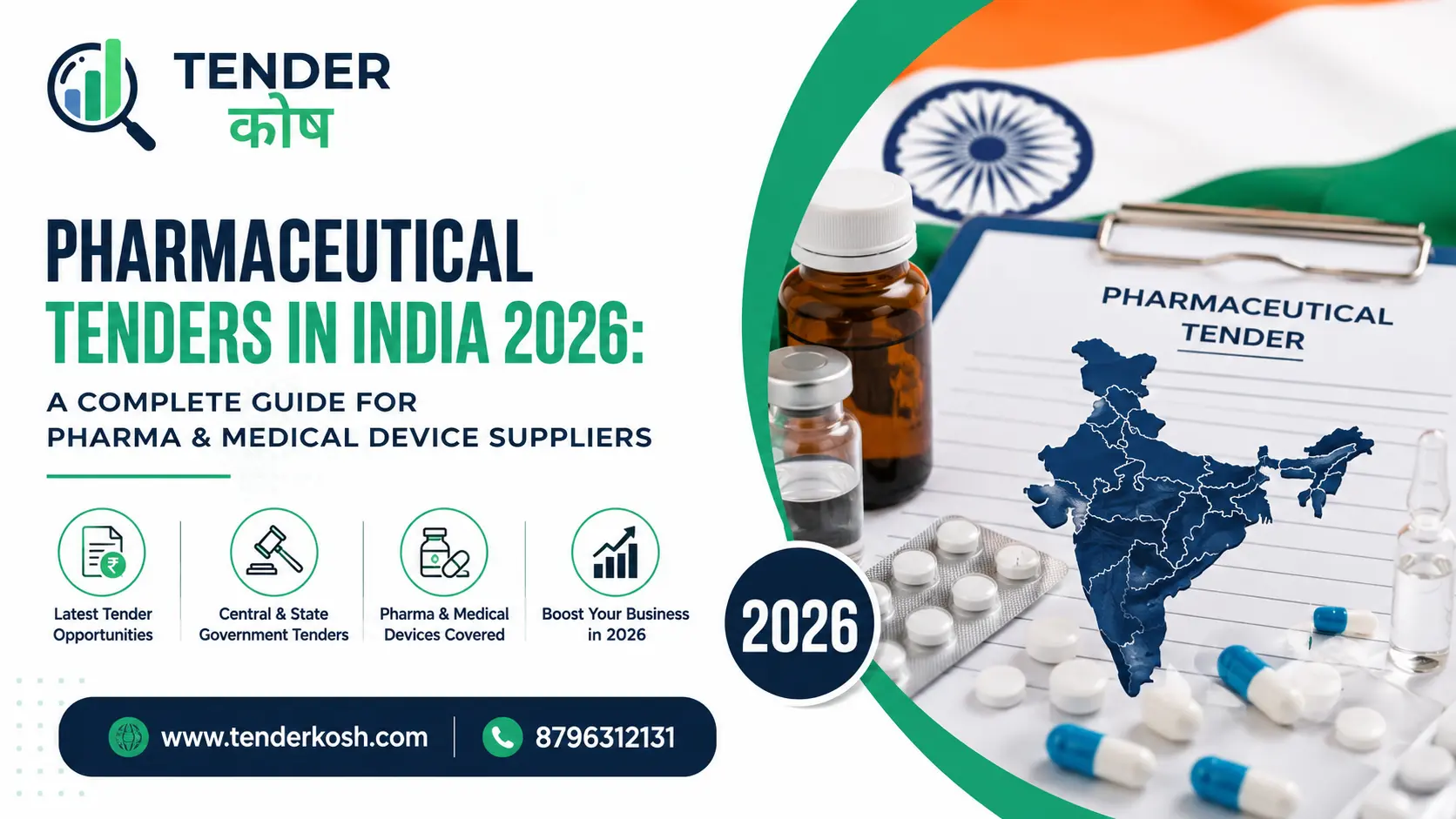
India’s public health system is one of the largest buyers of medicines and medical devices in the world. Every year, central ministries, state drug corporations, AIIMS hospitals, ESIC facilities, defence medical services, and thousands of public hospitals procure billions of rupees worth of pharmaceutical products through formal tenders. For any pharma manufacturer, importer, or distributor, pharmaceutical tenders represent the single largest and most reliable demand channel available in the country.
But the pharma tendering landscape is also one of the most fragmented and compliance-heavy in government procurement. Licences, GMP certification, CDSCO approvals, product registration, batch testing, and price-bid strategy all have to align before you can win a single supply order. This guide explains exactly how pharmaceutical tenders work in India in 2026, where they are published, who can bid, what certifications you need, and how MSME pharma units can use government policy to win contracts against much larger competitors.
Key Takeaways
Government is the most reliable buyer a pharma supplier can have. Unlike private distributors, government rate contracts run for a fixed term, cover an entire state’s hospital network, and guarantee a clear specification and payment framework. The real advantage of pharmaceutical tenders is not demand — it is the stability of recurring orders once you clear the compliance bar and track every relevant tender before the submission deadline closes.
Pharmaceutical tenders are formal, competitive processes through which a government body invites licensed suppliers to bid for the supply of a defined list of medicines, consumables, or medical devices. The process is designed to ensure transparency, the lowest responsible price, and verified product quality — which is exactly why understanding how pharmaceutical tenders are structured gives serious suppliers a clear edge.
Here is how a typical pharma tender moves from publication to supply:
A procuring agency — say a state medical services corporation — publishes a tender listing the drugs or devices required, quantities or estimated demand, technical specifications, and eligibility criteria. It appears on the agency’s e-procurement portal and often on CPPP or GeM.
Suppliers submit a technical bid (licences, GMP, product registration, certificates) and a financial bid (price). The technical bid is evaluated first. Only suppliers who clear technical scrutiny have their price bids opened — a key reason compliance matters more than price alone.
The agency verifies drug licences, GMP/WHO-GMP status, CDSCO registration, batch testing and stability data, and prior supply record. Samples may be called for physical and lab testing. Any gap in documentation leads to technical rejection regardless of how competitive the price is.
Among technically qualified bidders, price bids are opened and the lowest valid quote (L1) is identified for each product line. Many tenders allow MSMEs to match L1 within a price band to secure a share of the order — a powerful provision for small units.
The winning supplier receives a supply order or rate contract. Under a rate contract, the agreed price is locked for the contract period, and individual hospitals place purchase orders against it whenever they need stock — generating repeat business.
The supplier delivers against each purchase order. Each batch is subject to quality control testing at the warehouse. Once goods pass QC and are accepted, the supplier raises an invoice — and payment follows the agency’s budget cycle, which is often where delays appear.
Government pharmaceutical tenders are not on a single website. They are spread across central platforms and dozens of state-level corporations, each with its own portal, format, and registration process. Knowing where to look is half the battle.
| Platform / Agency | What It Procures | Buyer Base | Best For |
|---|---|---|---|
| GeM — Medicine MSME | Routine medicines, consumables, surgical items, basic equipment | Central & state hospitals, AIIMS, ESIC, ministries | Suppliers wanting a single national catalogue and recurring direct purchase orders |
| CMSS (Central Medical Services Society) | Drugs, vaccines, and devices for national health programmes | Ministry of Health & Family Welfare | Large-volume manufacturers supplying national immunisation and disease programmes |
| CPPP (Central Public Procurement Portal) | All central government tenders, including health departments | Central ministries, PSUs, autonomous bodies | Tracking central-government pharma and medical equipment tenders in one place |
| TNMSC (Tamil Nadu) | Medicines, surgicals, equipment on rate contract | Tamil Nadu government hospitals | One of India’s most respected and high-volume state drug procurement models |
| KMSCL (Kerala) | Drugs, diagnostics, devices | Kerala government health institutions | Suppliers targeting the South India public health network |
| RMSCL / state corporations | State-specific drug and device rate contracts | Respective state hospital networks | Region-focused suppliers building state-by-state rate contracts |
| Defence & Railway medical | Medicines and devices for armed forces and railway hospitals | AFMSD, Railway health units | Suppliers with consistent quality record and security clearances |
Why aggregation matters: A pharma supplier active across five states would otherwise need to monitor GeM, CMSS, CPPP, and five separate state portals every single day — plus track corrigenda that change specifications or deadlines mid-tender. Missing a single corrigendum can disqualify an otherwise winning bid on pharmaceutical tenders. This is exactly the fragmentation problem a tender-tracking platform solves.
Pharmaceutical tenders are won in the technical bid long before price is ever opened. The procuring agency must be certain the product is legally manufactured, quality-assured, and traceable. These are the documents and approvals that typically decide technical qualification.
| Requirement | What It Covers | Why the Agency Asks for It |
|---|---|---|
| Drug Manufacturing / Wholesale Licence | Licence under the Drugs and Cosmetics Act 1940 (Forms 25/28 for manufacturing, 20B/21B for wholesale) | Confirms the supplier is legally authorised to manufacture or distribute the product |
| GMP / WHO-GMP Certificate | Good Manufacturing Practice compliance; WHO-GMP for higher-value and export-grade tenders | Assures the agency that production meets defined quality and safety standards |
| CDSCO Registration | Central Drugs Standard Control Organisation registration for notified drugs and medical devices | Required for regulatory compliance, especially for devices under the Medical Device Rules |
| Product Registration with Agency | Pre-registration of each product/brand with the procuring corporation | Ensures only vetted products enter the bid evaluation for that specification |
| Batch Testing & Stability Data | QC reports, stability studies, shelf-life documentation | Verifies efficacy and shelf-life across the supply period |
| Turnover & Experience | Minimum annual turnover and prior supply track record | Demonstrates capacity to fulfil large orders reliably — relaxed for MSMEs |
| Non-Blacklisting Declaration | Self-declaration that the firm is not debarred by any government agency | Protects the agency from contracting with previously non-performing suppliers |
The most common reason for technical rejection is documentation, not product quality. Expired licences, missing GMP renewal, an unregistered product variant, or a mismatched batch report will disqualify a bid before price is even considered. Build a master compliance folder, track every licence renewal date, and re-verify it against each tender’s specific requirements before submission. For a deeper breakdown of how technical scrutiny works, see our guide on Technical Bid vs Financial Bid.
Small and medium pharma manufacturers often assume pharmaceutical tenders are dominated by large players. In practice, government procurement policy is deliberately structured to give MSMEs a competitive entry point — if they know how to use it.
Udyam-registered Micro and Small Enterprises are typically exempt from paying Earnest Money Deposit, freeing up working capital that would otherwise be locked for the duration of the tender process.
Many tenders allow MSMEs whose bid is within a defined band of the lowest bid (L1) to match that price and secure a share — often 25% — of the order quantity, even if a larger firm quoted marginally lower.
Minimum turnover and prior-supply thresholds are relaxed for MSMEs, allowing newer or smaller units to qualify for tenders that would otherwise be out of reach on size criteria alone.
To use these benefits, your unit must hold a current Udyam Registration and ensure the registration details match your tender submissions. The full set of small-business provisions in public procurement is detailed in our guide on MSME Benefits in Government Tenders.
Winning pharmaceutical tenders is only half the journey — getting paid on time is the other half. Government pharma payments frequently run 60 to 120 days behind because of budget cycles, bill verification, and fund-release procedures. For an MSME supplier delivering on a rate contract across dozens of hospitals, this delay can choke working capital and limit the ability to bid on the next tender.
Two RBI- and government-backed mechanisms directly address this.
The Trade Receivables Discounting System (TReDS) lets MSME pharma suppliers sell their accepted government invoices to banks and NBFCs and receive payment within T+2 days — without waiting for the buyer’s full credit period. All CPSEs and companies above ₹250 crore turnover are now mandatorily on TReDS, and the RBI’s 2026 directions have made onboarding faster by removing due diligence friction. For the full picture, read our detailed guide on the RBI TReDS Directions 2026.
For invoices already overdue beyond the 45-day statutory limit under the MSMED Act, suppliers can file a recovery complaint on the MSME Samadhaan portal, which routes the dispute to a state facilitation council for conciliation and arbitration. Our step-by-step walkthrough is in MSME Samadhaan: Delayed Payment Recovery.
Use both tools in parallel. Activate TReDS prospectively on every new accepted invoice to keep cash flowing, and use Samadhaan to recover any invoices that have already slipped past the deadline. Together they keep your working capital healthy so you can keep bidding on — and winning — new pharmaceutical tenders.
Compile every licence, GMP/WHO-GMP certificate, CDSCO registration, and product registration in one folder with renewal dates flagged. Re-verify it against each tender’s specific requirement before you submit.
List your products on GeM Medicine and register with the drug corporations of the states you want to supply — TNMSC, KMSCL, RMSCL, and others. Keep product catalogues and price lists continuously updated.
Verify your Udyam Registration is active and details are correct to unlock EMD exemption, L1 matching, and turnover relaxations. Lapsed Udyam details cost you these MSME benefits at the bid stage.
Specifications and deadlines change through corrigenda mid-tender. Missing one can disqualify a strong bid. Use a single tracking dashboard rather than checking ten portals manually. See our corrigenda tracking guide.
Register on all three TReDS platforms now so that when your first government invoice is accepted, you can convert it to cash within days rather than waiting on the budget cycle.
When choosing which pharmaceutical tenders to pursue, favour agencies with strong payment records and active TReDS registration. Predictable payment removes working-capital risk from your bid planning.
Pharmaceutical tenders are scattered across GeM, CMSS, CPPP, and dozens of state drug corporations. TenderKosh tracks all of them in one dashboard — live medicine, device, and consumable tenders from 1,000+ government procurement portals, with corrigendum alerts and buyer payment insights so you bid only on the opportunities worth winning.
Browse Live Tenders View Plans Why TenderKoshPharmaceutical tenders are formal procurement processes through which government bodies, hospitals, state medical service corporations, and public sector undertakings purchase medicines, vaccines, surgical items, diagnostic kits, and medical devices from approved suppliers. In India, these are floated on platforms like GeM, the Central Medical Services Society (CMSS), and various state drug procurement corporations. Suppliers compete on price, quality certification, and delivery capability to win supply contracts that are often worth crores and run for one to three years.
Government pharmaceutical tenders are published across multiple portals. The main central platforms are GeM for routine medicines and consumables, CMSS under the Ministry of Health for national programmes, and the Central Public Procurement Portal (CPPP). At the state level, dedicated drug procurement corporations such as TNMSC (Tamil Nadu), KMSCL (Kerala), and RMSCL (Rajasthan) run their own e-tender portals. Because tenders are scattered across 1,000-plus portals, suppliers typically use an aggregator to track all opportunities in one place.
Manufacturers, importers, and authorised distributors of pharmaceutical products and medical devices can apply, provided they hold valid licences. Key requirements typically include a manufacturing or wholesale drug licence under the Drugs and Cosmetics Act, valid CDSCO registration where applicable, GMP/WHO-GMP certification, GST registration, and product-specific approvals. Many tenders also require minimum turnover, prior supply experience, and product registration with the procuring agency. MSME pharma units enjoy relaxations on turnover, EMD, and prior-experience criteria.
A rate contract fixes the price of a medicine or device for a defined period (usually one to two years) without committing to a fixed quantity — government hospitals then place purchase orders against that agreed rate as and when they need stock. A supply tender, by contrast, is for a specific quantity to be delivered within a defined timeline. Rate contracts give suppliers predictable pricing and repeat orders across many institutions, while supply tenders are one-time bulk orders. Most state drug corporations operate on the rate-contract model.
The core certifications are a valid drug manufacturing or marketing licence under the Drugs and Cosmetics Act 1940, GMP (Good Manufacturing Practice) certification — increasingly WHO-GMP for higher-value tenders — and CDSCO registration for medical devices and notified products. Many tenders additionally ask for non-conviction certificates, a market-standing certificate, BIS certification for devices, and proof that the product is not blacklisted. Quality-control documentation such as batch testing reports and stability data is verified during technical evaluation before any price bid is opened.
MSME pharma manufacturers receive several benefits under the Public Procurement Policy for Micro and Small Enterprises, including exemption from Earnest Money Deposit (EMD), relaxation in prior turnover and experience requirements, free or discounted tender documents, and a 25 percent procurement reservation in many departments. MSMEs registered on Udyam can also access faster invoice payments through TReDS and benefit from price-matching provisions that let them match the lowest bid (L1) to secure a share of the order. These provisions significantly lower the entry barrier for small pharma units.
GeM Medicine is the dedicated category on the Government e-Marketplace through which central and state government hospitals, AIIMS, ESIC facilities, and other public health institutions procure medicines, consumables, and equipment. Pharma suppliers list their licensed products with verified specifications, quality certificates, and CDSCO/licence details. Buyers then procure through direct purchase, bid, or reverse auction depending on order value. GeM brings transparency and a single national catalogue, but suppliers must keep registrations, licences, and price lists continuously updated to remain eligible for orders.
Pharma suppliers to government hospitals often face payment delays of 60 to 120 days because of budget cycles, fund-release procedures, and bill-verification steps. MSME pharma suppliers can manage this gap using TReDS, an RBI-regulated platform where they sell accepted invoices to banks and NBFCs and receive early payment within T+2 days. For invoices already overdue beyond the 45-day statutory limit, suppliers can file a recovery complaint on the MSME Samadhaan portal. Used together, these tools protect working capital while bidding on new tenders.
Discover relevant tenders, monitor corrigenda, compare opportunities, and move from document reading to structured action.