
TenderKosh for EPC teams
Turn tender reading into faster bidding decisions.
Discover relevant tenders, monitor corrigenda, compare opportunities, and move from document reading to structured action.
MSME Samadhaan Portal is India’s statutory online mechanism for micro and small enterprises to recover delayed payments from government departments, PSUs, and private buyers under the MSMED Act, 2006.
Delayed payments remain the single most reported crisis for MSMEs in government procurement. According to MSME Ministry data, over ₹40,000 crore in MSME dues were locked in delayed payment disputes at any given time — the bulk of it owed by government departments and public sector undertakings. The law is unambiguously on your side. The challenge is knowing how to use it. This guide walks you through exactly what MSME Samadhaan is, who can file, what documents you need, and how the five-step process works from complaint to recovery.
Key Takeaways
MSME Samadhaan is an online portal launched by the Ministry of Micro, Small and Medium Enterprises in October 2017. It provides a direct, statutory channel for micro and small enterprises to file delayed payment complaints against any buyer — government, PSU, or private — without engaging a lawyer or approaching a civil court.
The portal is available at samadhaan.msme.gov.in. A complaint filed on Samadhaan is automatically routed to the Micro and Small Enterprise Facilitation Council (MSEFC) of the state where the buyer is located. The MSEFC is a statutory body established under the MSMED Act with the power to summon buyers, conduct conciliation hearings, and pass binding arbitration awards under the Arbitration and Conciliation Act, 1996.
This is not a grievance hotline. The MSEFC award is legally equivalent to a civil court decree — and unlike most court proceedings, it typically resolves in months, not years. Understanding the process and using it correctly is one of the most impactful financial recovery tools available to any MSME in government procurement.
The law is on your side — but only if you act. Every day beyond the 45-day limit that your payment remains unpaid, compound interest accrues in your favour at approximately 18.75–20.25% per annum. A payment delayed by 18 months is not just a working capital problem — it is a recoverable financial asset. File, and claim every rupee.
MSME Samadhaan is not a welfare scheme — it is a statutory enforcement mechanism. Its authority comes directly from Sections 15 to 23 of the Micro, Small and Medium Enterprises Development (MSMED) Act, 2006. Every EPC contractor, vendor, or service provider who supplies goods or services to a government buyer needs to know what these sections say.
| Section | What It Says | Why It Matters to You |
|---|---|---|
| Section 15 | Buyers must pay within 45 days of delivery and acceptance. If there is no written agreement, payment is due within 15 days. No written agreement can specify a payment period exceeding 45 days. | Any contract clause requiring you to wait 60, 90, or 120 days for payment is legally void. The maximum is 45 days regardless of what the purchase order or agreement says. |
| Section 16 | Any amount unpaid after the due date attracts compound interest at three times the RBI bank rate, calculated monthly on the amount due from the buyer. | At approximately 18.75–20.25% per annum compounded monthly, the interest on a 12-month delayed payment significantly exceeds any bank lending rate — making early recovery financially critical. |
| Section 18 | Any MSME can refer a delayed payment dispute to the MSEFC. The MSEFC must first attempt conciliation. If conciliation fails, the case moves to arbitration under the Arbitration and Conciliation Act, 1996. | The MSEFC process is your primary forum. You do not need to approach a civil court — the MSEFC has full arbitral authority and its awards are enforceable as court decrees. |
| Section 19 | No application for setting aside an MSEFC award is maintainable in any court unless the applicant deposits 75% of the decreed amount with the court. | This is the Act’s most powerful buyer-deterrent. Even a buyer who contests your award and files in court must pay you 75% upfront. Most buyers settle rather than face this obligation. |
| Section 22 | Buyers who are companies must disclose amounts due to MSMEs and interest paid or payable in their annual financial statements and returns to the Registrar of Companies. | Large company buyers face reputational and regulatory risk if they delay MSME payments — creating additional incentive to settle through Samadhaan rather than resist. |
Eligibility for MSME Samadhaan is precisely defined. Filing without meeting the conditions results in automatic rejection. Confirm both criteria before starting the process.
The MSMED Act covers a wide range of buyers. You can file against:
For private buyers: The transaction must have originated from a written agreement or purchase order to establish the commercial relationship clearly. Verbal agreements with private buyers are difficult to enforce through MSEFC proceedings — always insist on a written order before beginning any supply or service engagement.
Gather everything listed below before you open the portal. Incomplete documentation is the primary reason for delays in MSEFC proceedings — and documents cannot typically be supplemented after filing without causing adjournments.
| Document | Purpose | What to Check |
|---|---|---|
| Udyam Registration Certificate | Portal login credential; proves Micro/Small status | Confirm 19-digit Udyam number and that registration was active at the time of supply |
| Purchase Order or Work Order | Establishes the commercial relationship and agreed terms | Must show scope of work, value, and agreed payment terms — keep the original |
| Invoice copies | Defines the amount in dispute | Include invoice date, number, amount, GST details. List all unpaid and partially paid invoices separately |
| Delivery Challans or Completion Certificates | Proves you fulfilled your obligation — critical for establishing the payment due date | Must show goods received date or service acceptance date. Signed or stamped by the buyer is strongest |
| Acknowledgement of Receipt | Confirms buyer accepted the goods or services — starts the 45-day clock | Email confirmation, stamped delivery note, or signed inspection report all qualify |
| Correspondence Records | Demonstrates the buyer was aware of the unpaid dues and chose to delay | Collect all reminder emails, letters, WhatsApp messages, and meeting notes. Date sequence matters |
| Bank Account Details | For credit of recovered dues after MSEFC award | IFSC, account number, and bank name matching your Udyam registration entity |
Visit samadhaan.msme.gov.in and click MSE under the applicant login section. Enter your Udyam Registration Number and the registered mobile number linked to it. Verify the OTP. Your enterprise details auto-populate — confirm name, address, and enterprise type before proceeding.
Click File Application. Enter buyer details (name, address, PAN, GSTIN, buyer type), transaction details (PO number, date, nature of supply), and invoice details (number, date, amount). Specify the exact date of delivery or completion — this is the date from which the 45-day clock ran.
Use the portal’s built-in interest calculator to compute the exact compound interest due. Enter principal outstanding, payment due date, and filing date. The system calculates 3x bank rate compounded monthly. Claim the full amount — you cannot revise upward after submission.
Upload PDF or JPG scans of all documents. Ensure every file is legible — blurry scans cause adjournments. Then select the correct MSEFC jurisdiction: the state where the buyer is located, not where you are. Filing in the wrong MSEFC is a common, costly error.
Review all entries carefully, then click Submit Application. The portal generates a unique Case Reference Number. Save this immediately — you will use it to track status at every stage. You and the buyer both receive confirmation. The MSEFC formally notifies the buyer of your complaint.
Monitor your case status using the Case Reference Number at samadhaan.msme.gov.in. If the MSEFC requests additional documents or schedules a hearing, respond within the specified timeframe. Delays from your side give the buyer’s counsel grounds to seek dismissal on procedural grounds.
Do not understate your claim. Many MSME owners reduce their claimed amount hoping to appear reasonable or to avoid souring the buyer relationship. The MSEFC will not award more than what you claimed. File for the full principal plus all entitled compound interest — you are legally entitled to every rupee of it.
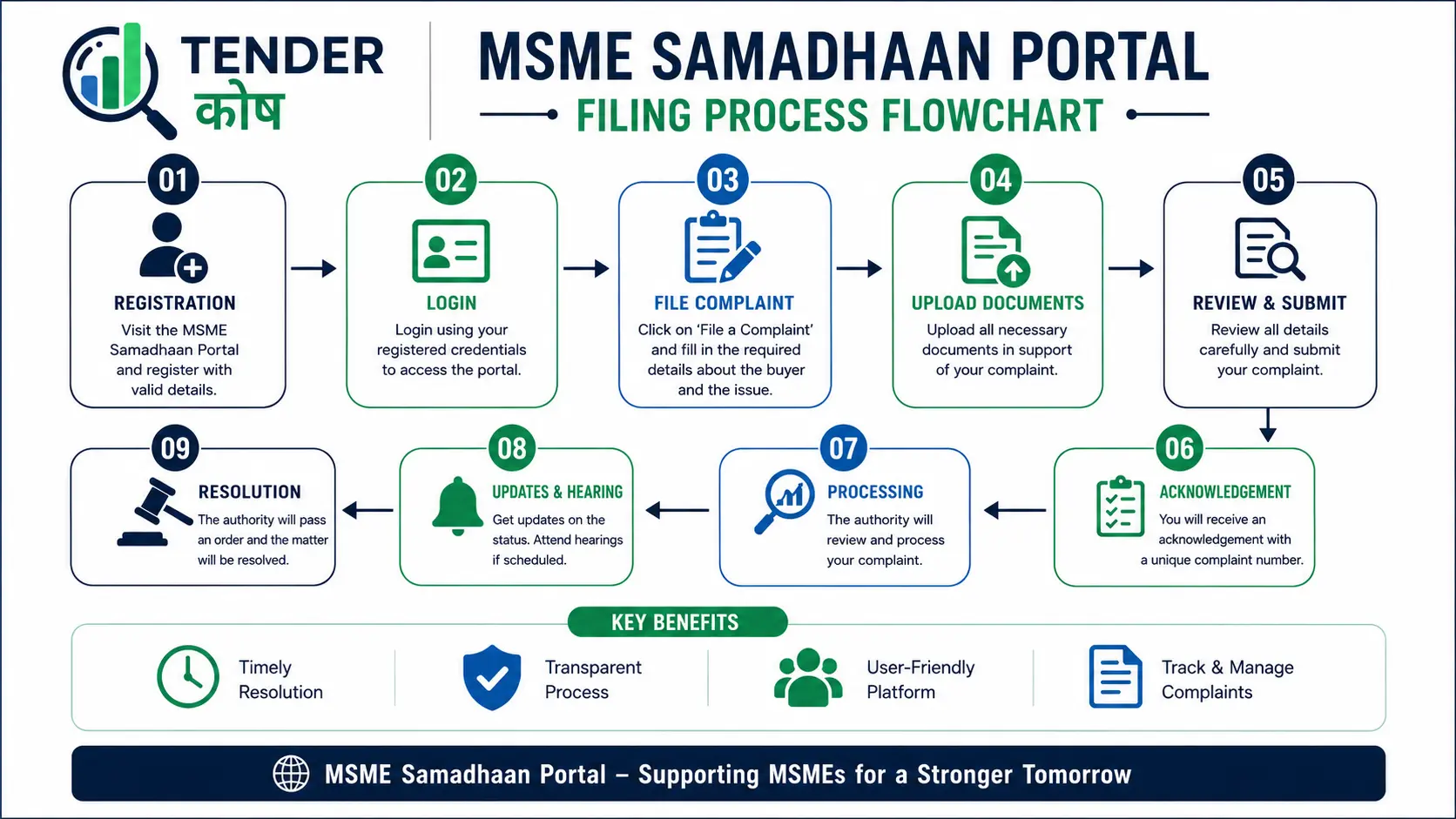
Filing is the beginning. Here is how the Micro and Small Enterprise Facilitation Council handles your case from receipt to resolution.
The MSEFC first reviews your application for completeness and jurisdictional validity. If anything is missing — a document, a required detail — they will contact you to furnish it. Once accepted, the MSEFC issues a formal notice to the buyer, requiring a written response within a specified period (typically 30–45 days).
Section 18 of the MSMED Act requires the MSEFC to attempt conciliation before proceeding to arbitration. The council facilitates a structured negotiation between you and the buyer — through written submissions, in-person hearings, or video conferences depending on the MSEFC’s procedures.
Conciliation typically resolves in 60–90 days when both parties cooperate. A significant proportion of cases settle at this stage — even the receipt of an MSEFC notice is often sufficient to prompt buyers who had been stonewalling to clear payment. If conciliation succeeds, a binding settlement agreement is recorded and the case is closed.
If conciliation fails or the buyer refuses to engage, the MSEFC converts proceedings to arbitration under the Arbitration and Conciliation Act, 1996. The MSEFC itself acts as the arbitral tribunal. Both parties submit evidence, affidavits, and arguments. The council then passes a binding arbitral award.
This award is legally equivalent to a civil court decree. Under Section 19, the buyer cannot appeal it in any court without first depositing 75% of the awarded amount. That provision alone resolves most disputes — buyers who realise they must deposit 75% upfront to continue contesting typically settle instead.
If the buyer refuses to comply with the arbitral award, you can apply for execution before the District Court. The court has authority to attach the buyer’s bank accounts, properties, and receivables to recover your dues. Execution is the final step — and it is rarely necessary, because the 75% deposit requirement makes prolonged resistance extremely costly for buyers.
State-wise MSEFC performance varies significantly. Before filing, check the Samadhaan public dashboard at samadhaan.msme.gov.in for state-wise statistics on applications filed, cases disposed, and amounts recovered. States like Gujarat, Maharashtra, and Tamil Nadu have more active MSEFCs with faster disposal. If your MSEFC is slow, you can escalate to the MSME Ministry via sampark.gov.in or the Udyog Helpline at 1800-180-6763.
The interest entitlement under the MSMED Act is one of the most powerful financial provisions in Indian commercial law — and most MSME owners significantly underestimate it.
Under Section 16, the applicable rate is three times the bank rate notified by the Reserve Bank of India. With the current RBI bank rate in the range of 6.25–6.75%, the applicable delayed payment interest is approximately 18.75–20.25% per annum, compounded monthly.
This interest runs from the day after payment was due — not from the date you discovered the delay, not from the date you sent a reminder, and not from the date you filed on Samadhaan. A payment that was due 18 months ago carries 18 months of compounded interest. The portal’s built-in calculator handles this computation automatically when you enter the payment due date and filing date.
| Payment Overdue By | Principal Example | Approximate Interest Accrued | Total Claim |
|---|---|---|---|
| 3 months | ₹10,00,000 | ₹47,000–₹50,000 | ₹10,47,000–₹10,50,000 |
| 6 months | ₹10,00,000 | ₹97,000–₹1,03,000 | ₹10,97,000–₹11,03,000 |
| 12 months | ₹10,00,000 | ₹2,04,000–₹2,18,000 | ₹12,04,000–₹12,18,000 |
| 18 months | ₹10,00,000 | ₹3,16,000–₹3,38,000 | ₹13,16,000–₹13,38,000 |
| 24 months | ₹10,00,000 | ₹4,34,000–₹4,66,000 | ₹14,34,000–₹14,66,000 |
The compounding effect means that every month you wait to file reduces your realised recovery relative to your total entitlement — even though the legal right to interest does not expire. File early.
The comparison is straightforward. For delayed payment disputes involving goods or services supplied by a Micro or Small Enterprise, MSME Samadhaan is decisively superior to civil litigation on every practical dimension.
| Parameter | MSME Samadhaan (MSEFC) | Civil Court |
|---|---|---|
| Filing cost | Free — online self-filing | Court fees (ad valorem on claim value) + lawyer fees |
| Typical resolution time | 3–9 months | 3–10 years |
| Interest rate | 3x RBI bank rate (~18.75–20.25% p.a.) compounded monthly — statutory | 18% or as per contract — discretionary |
| Legal representation | Not required | Mandatory for effective representation |
| Appeal deterrent | 75% deposit required before any court appeal | No equivalent provision — buyer can appeal freely |
| Government support | MSEFC is a state authority — proactive in notifying buyers and scheduling hearings | No dedicated support — case managed by your lawyer |
| Outcome enforceability | Award equivalent to civil court decree — directly executable | Decree directly executable |
| Buyer deterrence on notice | High — MSEFC notice from a state authority triggers compliance in many cases before hearing | Lower — court summons less immediately alarming to large institutional buyers |
Filing correctly maximises your chance of a fast resolution. Here is what experienced MSME vendors consistently recommend based on filed cases.
The single most common rejection reason. Without a valid Udyam Registration that was active at the time of supply, your application is invalid regardless of how strong your payment case is. Register first at udyamregistration.gov.in — then file.
Filing with the MSEFC of your own state instead of the buyer’s state. Jurisdiction follows the buyer — always. Incorrect filing results in your case being returned for refiling, causing weeks of delay and potentially complicating your timeline.
Missing purchase orders, blurry delivery challans, or unsigned invoices cause the MSEFC to call for supplementary documentation — creating adjournments and giving the buyer’s side time to prepare counterarguments. Scan everything clearly before uploading.
Claiming less than the full principal plus compound interest to appear reasonable or avoid damaging the buyer relationship. The MSEFC cannot award more than what you claimed. Your full statutory entitlement is your right — claim it entirely.
Failing to respond to MSEFC notices, document requests, or hearing schedules within the specified timeframe. Procedural non-compliance from the complainant gives the buyer’s counsel grounds to seek dismissal. Treat every MSEFC communication as urgent.
Absorbing losses for one, two, or three years hoping the buyer will eventually pay. Evidence degrades, witnesses become unavailable, and the buyer’s financial position may deteriorate. File as soon as the 45-day window closes without payment.
TenderKosh helps you identify government tenders from departments and PSUs with strong procurement records — so you can focus your bidding on buyers with clean payment histories. Track live tenders from 1,000+ portals including CPPP, GeM, IREPS, NTPC, and SECI from one dashboard.
Browse Government Tenders View Plans Why TenderKoshMSME Samadhaan is a Government of India online portal at samadhaan.msme.gov.in that enables Micro and Small Enterprises to file delayed payment complaints against government departments, PSUs, and private buyers. Complaints are referred to the Micro and Small Enterprise Facilitation Council (MSEFC) of the relevant state, which has statutory authority under the MSMED Act, 2006 to conduct conciliation and pass binding arbitration awards — enforceable as civil court decrees.
Only Micro and Small Enterprises with a valid Udyam Registration can file. Medium enterprises are excluded from the delayed payment provisions of the MSMED Act, 2006. Your Udyam Registration must have been active at the time you supplied the goods or services — not just at the time of filing. Register at udyamregistration.gov.in before starting the process.
You need your Udyam Registration certificate, the original purchase order or work order, copies of all unpaid invoices with GST details, delivery challans or completion certificates proving you fulfilled your obligation, written acknowledgement of receipt from the buyer, all correspondence records showing follow-up on the payment, and your bank account details for credit of recovered dues.
Conciliation typically concludes within 60 to 90 days when both parties cooperate. Many disputes resolve even before the first hearing — the MSEFC notice alone often prompts buyers to settle. If conciliation fails and the case moves to arbitration, total resolution can take 4 to 9 months depending on state MSEFC efficiency. The Samadhaan portal’s public dashboard shows state-wise disposal statistics — check your state’s responsiveness before filing.
Under Section 16 of the MSMED Act, 2006, you can claim compound interest at three times the RBI bank rate. With the current bank rate in the range of 6.25–6.75%, the applicable rate is approximately 18.75–20.25% per annum, compounded monthly. This interest runs from the day after payment was due — not from your filing date. The Samadhaan portal has a built-in calculator that computes your exact entitlement when you enter the payment due date and filing date.
Yes. The MSMED Act covers both government and private buyers. You can file against any private company — including large enterprises and listed companies — that has delayed payment for goods or services you supplied. For private buyer disputes, ensure you have a written purchase order or agreement to establish the commercial transaction formally. Verbal agreements with private buyers are difficult to enforce in MSEFC proceedings.
If the buyer fails to respond or cooperate, the MSEFC proceeds to arbitration ex parte — based on your submissions and evidence alone. The MSEFC passes an arbitration award in your favour. Under Section 19 of the MSMED Act, the buyer cannot appeal this award in any court without first depositing 75% of the awarded amount — a powerful deterrent against non-compliance. If the buyer still refuses to pay, you can apply for execution before the District Court, which can attach the buyer’s bank accounts and assets.
No. MSME Samadhaan is specifically designed for self-filing without legal representation. The portal guides you through each step, and the built-in interest calculator computes your entitlement automatically. For large disputed amounts above ₹50 lakh or complex contractual situations, consulting a lawyer before filing is advisable — but it is not a requirement to access the portal or initiate proceedings.
The applicable limitation period follows the general principle of three years from the date the payment became overdue. However, filing early is strongly advisable — evidence is fresher, witnesses are accessible, and buyers are more responsive when the delay is recent. Do not wait years hoping the buyer will pay voluntarily. File as soon as the 45-day statutory window closes without settlement.
Jurisdiction is determined by the state where the buyer is located — not where your enterprise is registered. If your buyer’s principal office or registered office is in Maharashtra and you are in Rajasthan, you file with the Maharashtra MSEFC. Filing in the wrong MSEFC is one of the most common errors in Samadhaan applications — it results in the case being returned for refiling, causing significant delays in your recovery.
Discover relevant tenders, monitor corrigenda, compare opportunities, and move from document reading to structured action.