TenderKosh for EPC teams
Turn tender reading into faster bidding decisions.
Discover relevant tenders, monitor corrigenda, compare opportunities, and move from document reading to structured action.
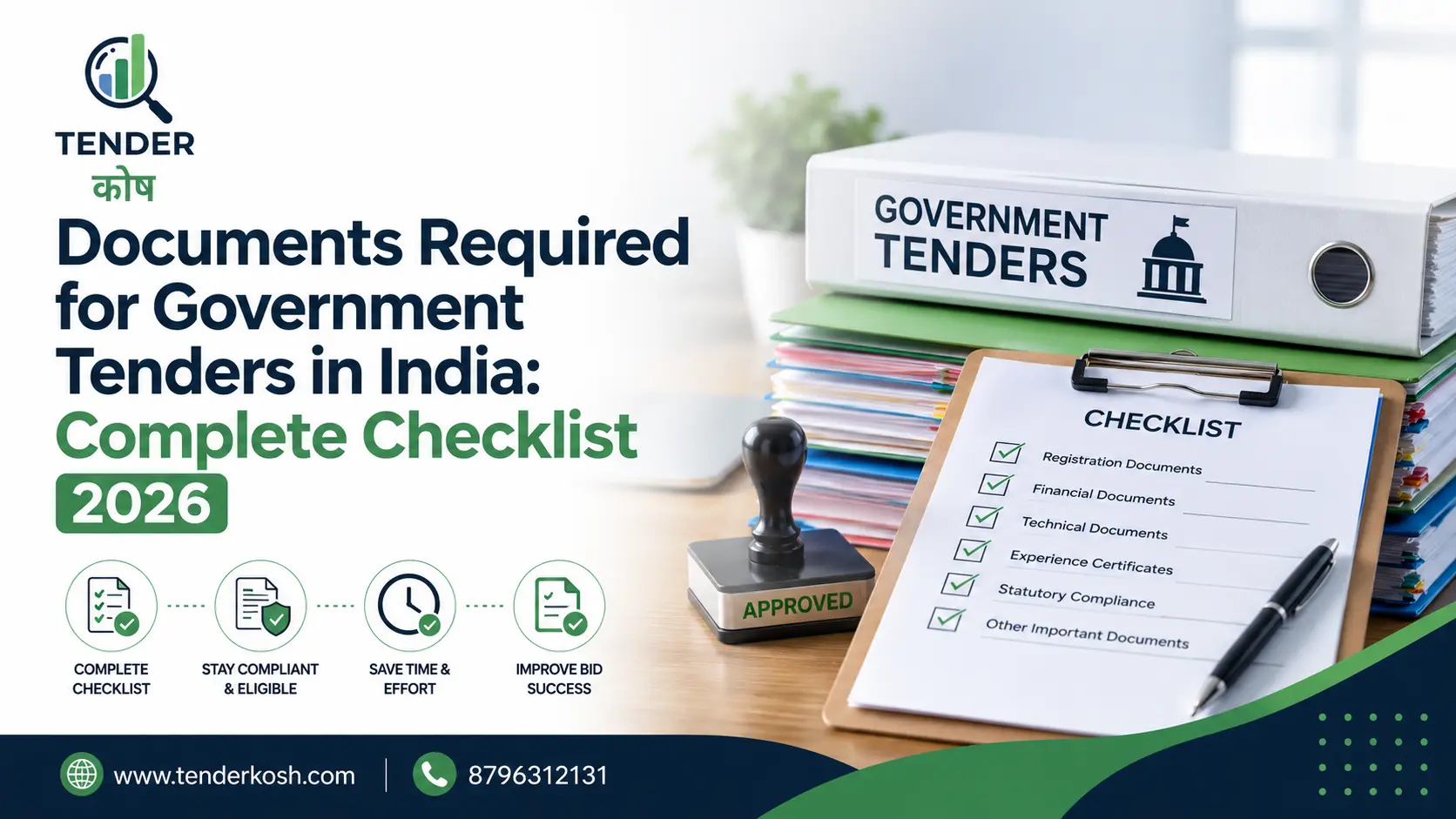
Documents required for government tenders in India fall into five categories — company registration, financial proof, work experience, statutory compliance, and sector certifications. Missing even one mandatory document, or uploading it in the wrong bid cover, leads to immediate disqualification — regardless of how competitive your price is.
This guide covers all 15 essential documents with exactly what each one must contain, why it is required, the most common mistake bidders make with it, and a pre-submission checklist you can use before every bid — whether you are bidding on CPPP, GeM, Railways, SECI, PSU portals, or state e-procurement platforms.
Key Takeaways
Government procurement in India uses taxpayer money. Every tender evaluation is designed to ensure that contracts are awarded only to businesses that are legally compliant, financially capable, and technically proven to deliver the work. Documents are not administrative formalities — they are the evidence the Technical Evaluation Committee uses to make that determination.
In a two-bid procurement system, documents in the Technical Bid (Cover 1) are evaluated first. Only bidders who pass the document check proceed to financial evaluation. The system is sequential and binary — a missing or non-compliant document results in Not Technically Qualified (NTQ) status, and your Financial Bid is returned unopened.
The practical impact: India’s government procurement market is worth ₹50–70 lakh crore annually. GeM alone has processed over ₹18 lakh crore cumulatively. Most bid rejections happen at the document stage — not at the price stage. Getting your documents right is the single highest-return activity in tender preparation.
A Class 3 DSC is mandatory for all e-procurement portals in India. It is issued by authorised certifying authorities such as eMudhra, Sify, NSDL, or CDAC and is valid for 1 or 2 years. The DSC must be registered in the name of the authorised signatory of the bidding company — not a director who is no longer active or a former employee.
Submit the company PAN — not the proprietor’s or director’s individual PAN. For sole proprietorships, the individual PAN is acceptable where the tender specifies. Ensure the name on the PAN matches the MCA-registered entity name exactly. Even a minor spelling variation — “Private” vs “Pvt.” — can trigger an entity name mismatch during evaluation.
The GST certificate must be current and the entity name must match the PAN and the company registration. If your business has amended its GSTIN — due to address change, ownership change, or state migration — ensure the submitted certificate reflects the current registration. Submitting an old certificate with a superseded GSTIN can trigger queries during evaluation.
The specific document varies by entity type: Private Limited or OPC companies submit the Certificate of Incorporation from MCA. Partnership firms submit the registered Partnership Deed. Sole proprietorships submit a proprietorship declaration, often on Rs. 100 stamp paper. LLPs submit the LLP Agreement and incorporation certificate.
Udyam Registration is the mandatory MSME registration since July 2020, replacing the older Udyog Aadhar and EM Part I/II registrations. The certificate is lifetime-valid but the classification is reassessed annually based on turnover and investment. Download the current certificate from the Udyam portal before each bid — the classification must match what you are claiming. Read the full guide on MSME benefits in government tenders to understand all the advantages this certificate unlocks.
Audited financial statements must be signed and sealed by a Chartered Accountant. Provisional accounts are not accepted where audited statements are required — regardless of whether the audit is pending. Most tenders require statements for the last 3 financial years. The specific combination — “any 2 of last 3” or “average of last 3” — is stated in the TQC clause and must be read carefully before deciding which years to submit.
A CA-certified turnover certificate is a standalone document issued by the company’s Chartered Accountant, summarising turnover for each required financial year. It is separate from the audited financial statements and is required in many tenders as an additional verification layer. Some tenders require turnover certificates based on audited accounts, while others accept GST-based turnover data — check the tender clause for what is accepted.
ITR filings must match the audited financial statements in terms of turnover and profit figures. Discrepancies between ITR and balance sheet raise questions during evaluation that may require clarification — delaying or endangering the bid. ITR is typically required for the same years as the financial statements, in the format specified by the tender (computation of income, acknowledgement, or full ITR form depending on the tender).
Work orders must be paired with completion certificates from the same client. A work order without a completion certificate proves the contract was awarded but not that it was completed. The work order must clearly state: the name of the awarding client organisation, the scope of work, the contract value, and the project start date. Multiple work orders from the same client or for the same project type are acceptable where aggregate experience is permitted by the TQC.
Completion certificates are the single most commonly rejected experience document in Indian government tenders. They must be issued and signed by the actual client organisation — the entity that awarded the work order — not a consultant, project management company, or subcontract principal. The certificate must state: project value at completion, completion date, nature of work performed, and the client’s assessment of satisfactory completion.
TenderKosh tracks live tenders across GeM, CPPP, SECI, NTPC, Railways, and 100+ government procurement portals — so you can identify tenders you are genuinely eligible for before spending time on document preparation.
Find Live Tenders View PlansEMD is submitted as a bank guarantee, demand draft, or online payment depending on the tender’s instructions. The amount, instrument type, validity period, and beneficiary name must exactly match the tender document — specifically the latest corrigendum version, since EMD amounts are frequently revised when project costs change. For eligible MSMEs, a signed Bid Security Declaration can be submitted in lieu of EMD where the tender explicitly permits exemption. Startups registered under DPIIT are also exempt in applicable tenders.
This is a self-declaration on company letterhead, signed by the authorised signatory. Most tenders provide a standard declaration format in the tender document — use the provided format rather than creating your own. The declaration must cover all group companies, subsidiaries, and associate firms in some tenders — read the declaration clause carefully to understand the scope required.
The non-collusion certificate is typically a standard form provided within the tender document. Fill it, sign it on company letterhead or the provided form, and upload it in Cover 1 as specified. Some tenders combine the non-collusion declaration with other declarations — read the tender instructions carefully to confirm whether it is a standalone document or part of a combined declaration form.
Common sector certifications include:
The BOQ (Bill of Quantities) is downloaded from the e-procurement portal and must be submitted in its original format with only the rate and amount columns filled in. Never modify item descriptions, quantities, or the structure. Every line item must have a rate — blank rates are treated as zero, which may result in executing that item at no cost if the contract is awarded. The total bid value must appear in both figures and words, and both must match exactly.
Registered Micro and Small Enterprises have access to significant procurement benefits — but claiming them requires the right documents submitted correctly. The table below covers the specific documents MSMEs need beyond the standard set, and exactly where each benefit applies.
| MSME Benefit | Document Required | Condition |
|---|---|---|
| EMD Exemption | Valid Udyam Registration Certificate + Bid Security Declaration on company letterhead | Only where the specific tender document’s EMD clause explicitly permits exemption. Not available in all tenders. |
| Tender Document Fee Waiver | Valid Udyam Registration Certificate | Available in tenders where fee waiver is mentioned for MSMEs. Confirm before skipping payment. |
| Price Preference (L1 + 15% Band) | Udyam Certificate + declaration of MSE status in the bid form | Must declare eligibility during bid submission and be willing to match L1 price. Applicable only in tenders that follow the MSE procurement policy. |
| SC/ST-Owned MSE Sub-Target | Udyam Certificate + ownership proof (Aadhaar-linked caste certificate or relevant document) | Available under the 4% SC/ST sub-target within the 25% MSE procurement mandate for central government buyers. |
| Women-Owned MSE Sub-Target | Udyam Certificate + proof of majority women ownership (shareholding documents) | Available under the 3% women-owned MSE sub-target within the 25% MSE procurement mandate. |
| NSIC-Specific Exemptions | NSIC Single Point Registration Certificate listing the specific product/service category | Exemption applies only to products and services listed on the NSIC certificate — not to all categories the MSME operates in. |
Government e-Marketplace tenders use the same core document set as CPPP tenders — but have specific GeM-platform requirements. Sellers must maintain an active and complete GeM seller profile as the foundation for all bid participation.
Active GeM seller account with correct business category, Udyam linkage, PAN and GST details. Profile completeness directly affects visibility to government buyers and eligibility for GeM bids and custom tenders.
Mandatory for OEMs in many product categories. Conducted by RITES and valid for 3 years. Without a valid VA certificate, OEMs cannot bid in Q1/Q2 product categories or access OEM panel features. Full details in our GeM VA guide.
Resellers must upload a valid OEM authorisation letter in their GeM profile — covering the specific product categories they are selling. A generic dealership letter is insufficient. The authorisation must name the specific product and be currently valid.
GeM-specific tip: Ensure your Udyam Registration is linked to your GeM profile — this is what activates MSME-specific benefits including EMD exemption in GeM bids. A mismatch between the Udyam details and your GeM profile data (PAN, business name, entity type) disables the MSME tagging and removes your eligibility for procurement preferences.
Most technical bid rejections trace back to the same avoidable document errors. Read these before every submission — and use our detailed guide on 12 real reasons bids get rejected for the full picture.
| Document Error | Frequency | Impact | Prevention |
|---|---|---|---|
| Expired DSC at submission | Very High | Bid not submitted — portal rejects upload | Check DSC expiry 45 days before any deadline. Test portal login before submission day. |
| Entity name mismatch across documents | High | NTQ — identity unverified | Use exact MCA-registered legal name on every document. Attach name-change certificate where applicable. |
| Completion certificate not from client | Very High | Experience rejected — NTQ | Request client-signed certificates at project closure. Certificates from consultants or PMCs are not substitutes. |
| Wrong financial years submitted | High | Turnover criterion not met — NTQ | Read the exact TQC turnover formula. Submit for the years specified — not the most favourable years. |
| EMD not updated after corrigendum | Medium | Non-responsive bid | Check for corrigenda within 48 hours of submission. EMD amount changes when project cost is revised. |
| Price found in Technical Bid cover | Medium | Entire bid disqualified immediately | Open every Cover 1 file individually. Search for rates, costs, or financial figures before uploading. |
| Expired ISO / BIS / GeM VA certificate | Medium | Mandatory certification missing — NTQ | Maintain a certification validity tracker. Initiate renewals 45 days before expiry — not after expiry. |
| Documents uploaded in wrong cover | Medium | Documents not evaluated in correct cover — NTQ | Use the portal’s preview function to verify cover contents before final submission. Never upload without a cross-check. |
Use this checklist for every government tender before hitting the submit button. It maps directly to the most common rejection reasons above.
| # | Check Item | What to Verify |
|---|---|---|
| 1 | DSC valid | Valid on submission date. Registered to current authorised signatory. Tested on portal. |
| 2 | Entity name consistent | Exact legal name matches across PAN, GST, Udyam, work orders, and bid form. No abbreviations. |
| 3 | EMD per latest corrigendum | Amount, instrument, validity, and beneficiary name match the most recent corrigendum — not the original tender. |
| 4 | Financial years correct | Audited statements and turnover certificate cover the exact years specified in the TQC clause. |
| 5 | Completion certs from client | Every certificate issued by the actual client. Paired with matching work order. States project value, date, and scope. |
| 6 | All certifications valid | ISO, BIS, GeM VA, NABL, Udyam — all valid on submission date. Renewals in progress do not count. |
| 7 | Corrigendum checked | Portal checked within 48 hours of submission for any amendments to TQC, EMD, BOQ, or deadline. |
| 8 | Cover 1 price-free | Every Cover 1 document opened individually. Zero pricing, costs, or financial figures in any file. |
| 9 | BOQ fully filled | Every BOQ line item has a rate. No blank rows. Total in figures matches total in words. |
| 10 | Submitted with buffer | All documents uploaded at least 24 hours before the deadline. Receipt saved. |
TenderKosh tracks live tenders, corrigendum updates, and submission deadlines across GeM, CPPP, SECI, NTPC, Railways, and 100+ government procurement portals — so your team bids on the right tenders with the right documents, every time.
Find Live Tenders View PlansThe 15 essential documents required for government tenders in India are: Class 3 DSC, PAN card, GST registration certificate, Certificate of Incorporation or Partnership Deed, Udyam Registration Certificate (for MSMEs), audited financial statements, CA-certified turnover certificate, Income Tax Returns, work orders, client-issued completion certificates, EMD or bid security declaration, non-blacklisting declaration, non-collusion certificate, sector-specific certifications such as ISO or BIS, and the filled BOQ or price schedule in the Financial Bid. The exact list varies per tender — always read the eligibility clause in the official tender document.
Yes. A Class 3 Digital Signature Certificate is mandatory for submitting bids on all e-procurement portals including CPPP, GeM, state portals, and PSU portals. Without a valid DSC, your bid cannot be uploaded regardless of how complete your other documents are. DSCs are valid for 1 or 2 years and must be renewed before expiry — renewal takes 3 to 5 working days minimum.
Registered Micro and Small Enterprises with a valid Udyam Registration Certificate may claim EMD exemption where the specific tender document explicitly permits it. EMD exemption is not automatic — it must be verified in each tender’s EMD clause before skipping the deposit. Learn more about the full range of MSME benefits in government tenders.
A work order proves the contract was awarded — it is issued by the client at the start of a project. A completion certificate proves the work was delivered satisfactorily — it is issued by the client after project acceptance. Both must come from the same client organisation and must be submitted as a pair. Completion certificates must not be self-certified or issued by consultants or subcontract principals.
For GeM tenders, the core documents required are an active GeM seller profile with valid Udyam linkage, PAN, GST registration, DSC, product compliance documents such as BIS licence where applicable, OEM authorisation letter for resellers, and a GeM Vendor Assessment certificate for OEMs in applicable product categories. Custom bid tenders on GeM may additionally require financial statements, experience documents, and a filled price schedule.
The most common document-related rejection reasons are: expired DSC at submission, entity name mismatch across PAN, GST, and Udyam documents, completion certificates not issued by the actual client, wrong financial years submitted for turnover criteria, EMD not updated after a corrigendum revised the project cost, and pricing found in the Technical Bid cover. See the full list in our guide on why bids get rejected.
Begin document preparation at least 7 to 10 days before the submission deadline for standard tenders, and 15 to 20 days for large EPC or infrastructure tenders. Upload all documents at least 24 hours before the deadline to account for portal slowdowns and file size issues. E-procurement portals do not accept late submissions under any circumstance.
An OEM authorisation letter is issued by the original equipment manufacturer confirming that a reseller is authorised to supply a specific product in a specific tender. It is required when a non-manufacturer bids on supply tenders. The letter must name the tendering authority, the exact product being supplied, and the tender reference number, and must be valid on the bid submission date. Generic dealership certificates are frequently rejected — always request a tender-specific authorisation.
Discover relevant tenders, monitor corrigenda, compare opportunities, and move from document reading to structured action.