TenderKosh for EPC teams
Turn tender reading into faster bidding decisions.
Discover relevant tenders, monitor corrigenda, compare opportunities, and move from document reading to structured action.
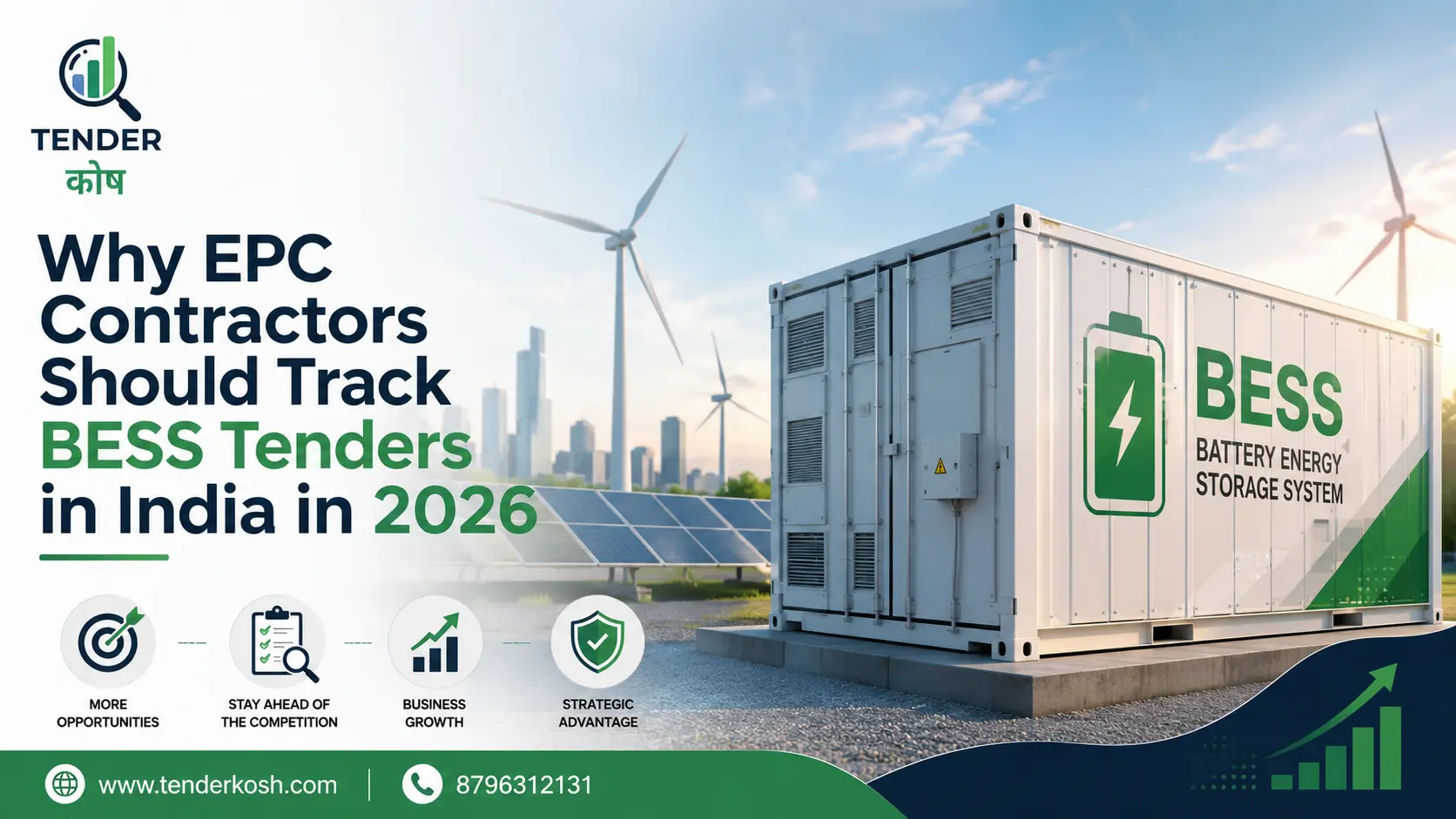
BESS tenders in India are growing rapidly as NTPC, SECI, GUVNL, and state DISCOMs issue large-scale battery energy storage projects across the country. For EPC contractors, renewable energy companies, and infrastructure firms, understanding BESS tender eligibility, project requirements, and upcoming opportunities is becoming essential in 2026.
In 2025 alone, 69 BESS tenders totalling over 102 GWh were floated — a 35% increase over 2024. India has tendered over 224 GWh of storage capacity but commissioned less than 1% of it. That execution gap is the work that needs to be done — and it requires EPC contractors at every scale. This guide covers what BESS tenders look like, who issues them, eligibility criteria, and how to get your first contract in this market.
Key Takeaways
A BESS tender in India is a government procurement notice that invites EPC contractors, developers, or technology providers to design, supply, install, and commission battery energy storage systems for grid-scale applications. These tenders are structured as two-bid procurements — a Technical Bid to establish eligibility and a Financial Bid for pricing — identical to the format used in solar EPC tenders.
BESS tenders are issued for three primary project types:
The BOQ (Bill of Quantities) in BESS tenders typically covers battery system supply, BMS and PCS installation, civil infrastructure, grid interfacing, commissioning, and O&M obligations — each with specific technical specifications and performance guarantee requirements.
The execution gap: India has tendered over 224 GWh of BESS capacity — but less than 1% was operational as of early 2026. This gap is not a sign of failure. It is the work that needs to be done — and that work requires EPC contractors at every scale to step up.
Three converging factors are pushing India’s BESS procurement from policy ambition into active contracts in 2026.
India added a record 44.6 GW of solar capacity in FY2025–26. As solar takes a larger share of the power mix, the mismatch between generation peaks (midday) and demand peaks (evening) is becoming structurally significant. DISCOMs cannot dispatch solar power at 7 PM when households need it most — unless it is stored. BESS is the most scalable technical solution, and the grid urgency is compressing procurement timelines.
The Union Cabinet’s Viability Gap Funding (VGF) scheme covers 43.2 GWh of BESS capacity, providing up to 40% of capital cost as budgetary support. The PLI scheme for Advanced Chemistry Cell (ACC) manufacturing carries a ₹18,100 crore outlay to build domestic supply. Inter-state transmission charges are waived for BESS projects co-located with renewable plants commissioned on or before June 2028. Together, these policy levers have transformed BESS from financially marginal to bankable — triggering the tender surge now visible in the market.
Lithium-ion battery costs have fallen sharply through 2024–25, with Levelized Cost of Storage (LCoS) now targeted at ₹5.50–6.60 per kWh under VGF-supported projects — down significantly from ₹96 lakh per MWh estimated as recently as 2023. Falling costs mean more projects clear the financial viability threshold, directly expanding the number of tenders reaching procurement stage.
BESS procurement in India is decentralised across central agencies, PSUs, and state utilities — each operating its own portal and procurement calendar. EPC contractors must track all relevant sources, as no single portal covers the full pipeline.
| Tendering Authority | Notable BESS Tenders (2025–2026) | Scale |
|---|---|---|
| NTPC / NTPC Green Energy | 2,500 MW/10,000 MWh across thermal stations; Fatehgarh 3,200 MWh (June 2026); Chhattisgarh EPC BESS 5 GWh | Largest single issuer of BESS EPC tenders by volume |
| SECI | Multiple standalone BESS and hybrid FDRE tenders; largest by capacity in 2025 | Central-level; multi-state deployment |
| GUVNL (Gujarat) | First to open and close BESS tenders in 2025; 360 MWh commissioned by January 2026 | State-level; fastest in execution |
| MSEDCL (Maharashtra) | 2,000 MW/4,000 MWh standalone BESS with VGF support | Second-largest state tender in 2025 |
| Tamil Nadu GENCO / TNGECL | Peak power and grid-support BESS; led state tendering scene in 2025 | State-level; technically complex specifications |
| KPTCL (Karnataka) | 500 MW/1,000 MWh BESS — 250 MWh awarded to Pace Digitek | State transmission utility |
| UPPCL, RVUNL, KREDL | State-level standalone BESS across Uttar Pradesh, Rajasthan, Karnataka | Rajasthan leading on actual commissioning pace |
The following represent the most significant active or recently awarded BESS procurement opportunities in India as of mid-2026. EPC contractors should monitor these issuing authorities’ portals and use TenderKosh to track new tenders, corrigenda, and deadline updates across all portals from one place.
| Project | Issuing Authority | Capacity | Status / Notes |
|---|---|---|---|
| Fatehgarh BESS | NTPC Green Energy Ltd | 3,200 MWh | Tender documents on sale June 5–15, 2026. Bid submission deadline June 25, 2026. New national benchmark for technical specifications. |
| NTPC Thermal Stations BESS | NTPC Ltd | 2,500 MW / 10,000 MWh (multi-site) | Largest BESS EPC tender by MWh volume. 500 MW per station across 5 thermal plants. 400 kV/220 kV interconnection. 20-year design life. |
| MSEDCL Standalone BESS | Maharashtra DISCOM | 2,000 MW / 4,000 MWh | VGF-supported. Multiple locations near MSEDCL/MSETCL substations. Second-largest state-level BESS tender. |
| NTPC Chhattisgarh EPC BESS | NTPC Vidyut Vyapar Nigam | 5 GWh (combined) | EPC model. Multi-site execution. Monitor NTPC portal for re-tender or follow-on packages. |
| KPTCL Karnataka BESS | Karnataka Power Transmission Corp | 500 MW / 1,000 MWh | 250 MW/500 MWh awarded to Pace Digitek. Confirm remaining package status on KPTCL portal. |
| West Bengal BESS | State electricity utility | 500 MW / 2,000 MWh | Utility-scale standalone. Requires substantial experience and financial credentials for direct bidding. |
Corrigendum alert: BESS tender specifications, deadlines, and eligibility criteria are frequently amended after initial publication. Always check the issuing authority’s portal for corrigenda before finalising your bid — even if you downloaded the document days ago. A single missed amendment can invalidate weeks of preparation.
EPC contractors experienced in ground-mounted solar will find meaningful overlap in BESS project execution — civil works, electrical infrastructure, grid interfacing — but also significant differences that affect both bid qualification and execution risk. Understanding these differences is essential before preparing a Technical Bid for any BESS tender.
| Parameter | Solar EPC | BESS EPC |
|---|---|---|
| Core technology | PV modules, inverters, mounting, cabling | Battery racks, BMS, PCS (Power Conversion System), thermal management, fire suppression |
| Grid interface complexity | Standard grid export at metering point | Bidirectional power flow; response time often under 50ms; CEA 2023 grid code compliance via simulation at Point of Interconnection |
| Performance guarantees | Generation yield and PR ratio | Round-trip efficiency (90–95%); 20-year cycle life; State of Health (SoH) degradation limits; penalty clauses for underperformance |
| Safety and compliance | IEC 61215, IEC 61730 for modules | IEC 62619 for battery safety; fire suppression design; thermal runaway management; significantly higher HSSE requirements |
| Experience TQC requires | MWp-based similar project completion certificates | MWh-based BESS project experience; grid-connected preferred; BMS commissioning capability often required |
| BOQ pricing complexity | Module, inverter, BOS, civil, O&M line items | Cell supply, BMS, PCS, thermal and fire systems, civil, grid interfacing, commissioning, performance bond — each requiring careful BOQ pricing |
| Supply chain risk | Module pricing; ALMM compliance | Battery cell price volatility; import dependence; 20% domestic content requirement under VGF |
Important for EPC bidders: NTPC’s Fatehgarh BESS tender (June 2026, 3,200 MWh) has introduced strict performance guarantees, penalty and remedy mechanisms, and mandatory insurance coverage requirements that were previously absent or untested at this scale. This tender is setting the new national technical benchmark — read its specifications before pricing any large BESS bid.
BESS EPC tender eligibility criteria are evolving as the market matures. Based on tenders issued by NTPC, SECI, and state utilities in 2025–26, the following TQC parameters are typically required. These criteria determine whether your Technical Bid qualifies before the financial bid is even opened. Understanding them before bidding prevents the most common reason for rejection — submitting experience documents that do not match the TQC definition.
| TQC Parameter | Typical Requirement | EPC Action Required |
|---|---|---|
| Similar work experience | Demonstrated experience in executing grid-scale BESS projects; system engineering, integration, and grid interfacing capability. Often specified as minimum MWh completed in a single project within a look-back period. | Build credentials through even small BESS installations — commercial, industrial, or subcontract work. Any MWh-scale completion certificate issued by the client is a starting credential. |
| Financial turnover | Annual turnover proportional to project value — typically 30–50% of the estimated contract value in any 2 of the last 3 financial years | Ensure CA-certified audited financials for the required years meet the threshold. For large tenders, consortium bidding may be necessary to meet turnover criteria collectively. |
| Net worth and liquidity | Positive net worth; demonstrated working capital capacity; bank credit lines often required | Maintain clean banking relationships. ECLGS 5.0 working capital support can help bridge liquidity gaps during project execution for eligible MSMEs. |
| Technical credentials | BMS commissioning capability; grid interfacing experience; IEC 62619 safety compliance familiarity; CEA grid code simulation capability | Partner with a BESS technology provider or OEM to demonstrate technical capability where direct experience is limited. Joint bidding is permitted in most BESS tenders. |
| Company registration | ROC certificate, GST, PAN, audited financials, relevant statutory clearances | Standard documentation — same as solar EPC. Ensure all certifications are current and entity name is consistent across every document submitted. |
| EMD / Bid Security | Varies by project value — bank guarantee or online payment to the tendering authority | Verify EMD amount and validity from the final corrigendum version. MSME bidders should confirm whether the specific tender permits EMD exemption before skipping the deposit. |
The scale of BESS tenders — 500 MWh, 1,000 MWh, 3,200 MWh — can make direct bidding feel out of reach for mid-sized EPC firms. But the pipeline creates multiple entry points at different scales and risk levels, and MSME EPC contractors can access specific benefits that reduce bid costs while building credentials.
Every large BESS project requires EPC execution. The contractors who win utility-scale tenders — L&T, BHEL, Adani, specialist storage developers — will subcontract civil works, electrical installation, BMS commissioning support, and O&M to regional partners. An EPC with even 200 kWh of BESS experience is building the credential that opens subcontracting relationships.
Factories, data centres, hospitals, and large commercial complexes are installing BESS for peak shaving, backup power, and open-access integration. These projects range from 500 kWh to 10 MWh — directly accessible to mid-sized EPCs. Each generates a client-issued completion certificate that builds TQC eligibility for government tenders.
Larger BESS tenders permit consortium bids where two or more companies combine experience and financial credentials. An EPC with solar experience can partner with a BESS technology integrator — providing civil and electrical capability while the partner contributes battery system expertise and relevant completion certificates.
Many tenders combine solar and battery storage — particularly FDRE tenders from SECI. An EPC with solar credentials has a natural entry into hybrid tenders where the battery component sits alongside a system they already know how to deliver.
Not all BESS tenders are GW-scale. State DISCOMs and electricity boards issue BESS tenders in the 10–200 MWh range — particularly for substation-level grid support. These are more accessible to regional EPCs and provide the experience base needed to qualify for larger tenders over time.
As 9.2 GWh of BESS capacity comes online in 2026, O&M contracts follow. O&M for BESS requires cell monitoring, BMS management, and cycle optimisation. O&M experience also counts as demonstrated BESS operational capability in some TQC frameworks.
BESS is a high-growth market — but it carries execution risks that differ from conventional solar EPC. Understanding these before preparing your BOQ and bid price protects margins and project viability.
| Risk | What It Means for EPC Contractors | How to Manage It |
|---|---|---|
| Battery cell price volatility | Lithium-ion cell prices — predominantly imported from China — can shift 10–20% within a bid-to-procurement window, directly squeezing EPC margins | Include price escalation provisions where permitted. Lock in cell supply agreements early after award. Price the BOQ with a clearly identified cost buffer. |
| PPA execution delays | DISCOMs delaying PPA signing after tender award create uncertainty for developers — and EPC subcontractors mobilised on expectation of early start. An estimated 40–55 GW of renewable capacity faces PPA bottlenecks. | Monitor project progress from tender award to PPA signing before committing supply chain resources. Build delay clauses into subcontract agreements with developers. |
| Strict performance guarantees | BESS tenders increasingly require round-trip efficiency guarantees, cycle life commitments, and penalty clauses for degradation — terms previously untested at this scale in India | Only accept performance commitments that your battery technology partner can back with manufacturer warranties. Never accept TQC performance terms that exceed your supplier’s guarantee. |
| Domestic content requirements under VGF | VGF-backed projects require minimum 20% domestic content — constraining supply options given India’s limited domestic cell manufacturing capacity | Identify domestically manufactured components (BMS, racks, PCS, civil works) that contribute to the 20% threshold. Factor compliance verification into project planning from day one. |
| Grid code compliance complexity | CEA 2023 amendments (fully enforceable from March 2025) require BESS projects to demonstrate grid code compliance through detailed simulations at the Point of Interconnection | Engage a power systems engineer or OEM with CEA grid code simulation capability before bid submission — not after contract award. |
BESS tenders are published across multiple portals — NTPC’s e-procurement portal, SECI’s website, CPPP (eprocure.gov.in), and individual state DISCOM and electricity board websites. Since there is no single aggregated source, EPC contractors must either monitor each portal separately or use a tender tracking platform.
The window for building BESS credentials before the market fully scales is 2026–2027. By 2028, the bidder pool for utility-scale BESS tenders will be significantly more competitive. Here is the practical action sequence for EPC contractors at different experience levels.
TenderKosh monitors BESS, solar, hybrid, and EPC tenders from NTPC, SECI, GUVNL, state DISCOMs, and 100+ government procurement portals — with corrigendum alerts, keyword search, and sector-wise filtering so your team never misses a relevant opportunity.
Find Live BESS Tenders View PlansA BESS (Battery Energy Storage System) tender is a government procurement notice inviting EPC contractors, developers, or technology providers to design, supply, install, and commission grid-scale battery storage infrastructure. BESS tenders are issued by NTPC, SECI, state DISCOMs, and state electricity boards — typically structured as two-bid procurements for standalone storage, solar-plus-storage hybrid, or thermal-plus-BESS projects.
Yes — if the contractor meets the Technical Qualifying Criteria specified in the tender. Solar EPC experience is directly relevant to hybrid solar-plus-BESS tenders. For standalone BESS tenders, the TQC typically requires demonstrated BESS-specific experience. Solar EPC contractors without direct BESS credentials can enter through consortium bidding with a BESS technology partner, or by first building credentials through smaller commercial BESS installations. Read the full guide on why bids get rejected to avoid common TQC errors.
The Central Electricity Authority (CEA) projects India will need 47.24 GW / 236.22 GWh of BESS capacity by 2031–32, as part of a total energy storage requirement of 73.93 GW including pumped hydro. The Ministry of Power’s National Framework for Energy Storage and the expanded VGF scheme are the primary policy instruments driving this deployment.
Viability Gap Funding (VGF) provides up to 40% of capital cost as budgetary support for BESS projects that would otherwise not be financially viable. For EPC contractors, VGF-backed projects mean the developer or DISCOM has a funded project — improving payment security. However, VGF projects require a minimum 20% domestic content, which constrains supply chain decisions and must be factored into BOQ pricing from the outset.
A standalone BESS tender procures only the battery storage system — charging from the grid and discharging during peak demand. A solar-plus-BESS or hybrid tender procures both the solar plant and battery storage as an integrated project, often with firm or dispatchable output requirements (FDRE). Standalone BESS tenders require deeper battery-specific expertise. Hybrid tenders are more accessible to solar EPCs with BESS technology partnerships.
The most significant active BESS tender as of June 2026 is NTPC Green Energy’s Fatehgarh BESS (3,200 MWh), with bid submission closing June 25, 2026. Other major tenders include NTPC’s 2,500 MW/10,000 MWh multi-station BESS, MSEDCL’s 2,000 MW/4,000 MWh standalone BESS (Maharashtra), and West Bengal’s 500 MW/2,000 MWh tender. Use TenderKosh to track current BESS tenders in real time.
The primary agencies issuing BESS tenders in India are NTPC and NTPC Green Energy (largest by volume), SECI (largest by capacity in 2025), GUVNL (Gujarat), MSEDCL (Maharashtra), Tamil Nadu GENCO, KPTCL (Karnataka), RVUNL (Rajasthan), and UPPCL (Uttar Pradesh). CPPP (eprocure.gov.in) publishes notices from central ministry departments. PSU portals — NTPC, PGCIL, BHEL — publish their own procurement independently.
MSMEs can participate through direct bidding on smaller state-level tenders in the 10–200 MWh range, subcontracting civil or electrical work from prime EPC winners, or consortium bidding with a BESS technology partner. Registered Micro and Small Enterprises may also claim EMD exemption and procurement preferences where the specific tender permits — always verify the EMD clause in each individual tender document.
Minimum eligibility typically includes: demonstrated experience in at least one grid-connected BESS project of a specified MWh capacity; annual turnover of 30–50% of the estimated contract value in the required financial years; positive net worth; and company registration (ROC, GST, PAN). Technical credentials — BMS commissioning, grid interfacing, IEC 62619 familiarity — are increasingly required in NTPC and SECI tenders.
BESS tenders are published on NTPC’s e-procurement portal, SECI’s website, CPPP (eprocure.gov.in), and individual state DISCOM portals. TenderKosh aggregates live tenders from 100+ government procurement portals including NTPC, SECI, GUVNL, MSEDCL, and KPTCL — with keyword search, sector filtering, and corrigendum monitoring from one platform.
Discover relevant tenders, monitor corrigenda, compare opportunities, and move from document reading to structured action.