TenderKosh for EPC teams
Turn tender reading into faster bidding decisions.
Discover relevant tenders, monitor corrigenda, compare opportunities, and move from document reading to structured action.
The Udyam annual update 2026 deadline for the current compliance cycle was 21 April 2026. If you have not completed it, your MSME certificate is sitting on stale financial data — and stale data quietly strips away benefits you have been relying on without you even knowing it.
Loan applications rejected. GeM purchase preference not applied. EMD exemption denied on a government tender. TReDS platform access blocked. These are not hypothetical — they are the documented consequences that MSME vendors face when their Udyam certificate is not current.
The good news: the update takes under 10 minutes. It is completely free. Your 19-digit Udyam Registration Number stays the same. And there is a second reason to act immediately in 2026 that most MSME owners do not know about — the MSME classification limits were fundamentally revised in April 2025, and your business may now qualify for better benefits under the new thresholds even if you were near the boundary before. If your certificate has not been updated since the revision, you are potentially claiming the wrong category.
Key Takeaways
If you missed the 21 April 2026 deadline — act now, not later. The compliance window has passed but the portal remains open for updates. Every day you delay is a day your loan applications, tender bids, and GeM orders are being processed against an outdated certificate. There is no penalty for late updates — only the ongoing cost of stale data blocking your benefits.
Many MSME owners search for “Udyam renewal” or worry that their certificate has “expired.” This confusion causes unnecessary anxiety and sometimes unnecessary re-registration — which creates duplicate certificates and causes worse problems.
Here is what each term actually means:
| Term | What It Actually Means | Do You Need It? |
|---|---|---|
| Udyam Renewal | Does not exist. The Udyam certificate has lifetime validity — there is no renewal fee, no renewal deadline, and no certificate that “expires.” If you are asked to pay for “Udyam renewal,” it is a scam. | No — never required |
| Udyam Annual Update | Mandatory yearly process to refresh financial data (turnover and investment) based on latest ITR and GST filings. Ensures your category classification is accurate. Free, online, OTP-verified. Your URN does not change. | Yes — mandatory annually after filing ITR and GST returns |
| Udyam Correction/Modification | Updating specific details that have changed — address, NIC codes, bank account, GSTIN, contact details. Can be done at any time, not just during the annual cycle. Free and online. | Yes — whenever your business details change |
| UAM Migration | Moving from the old Udyog Aadhaar Memorandum system to the current Udyam Registration. Mandatory for businesses still on UAM. UAM is invalid since June 30, 2022. Deadline for migration: December 31, 2026. | Yes — if you are still on UAM |
| Re-registration | Creating a completely new Udyam registration. Only required in specific circumstances — business structure change (proprietorship to company), or when certificate is completely inactive and non-recoverable. Avoid unless necessary — creates risk of duplicates. | Rarely — only in specific circumstances |
On March 21, 2025, the Ministry of MSME issued Notification S.O. 1364(E) revising the MSME classification thresholds effective April 1, 2025. Investment limits were raised by 2.5 times and turnover limits were doubled. This is the biggest change to MSME classification since 2020.
If your Udyam certificate has not been updated since April 2025, your certificate may be reflecting your classification under the old thresholds — meaning you could be categorised as Small when you now qualify as Micro, or as Medium when you now qualify as Small. A lower category gives you access to more benefits with fewer eligibility hurdles.
| Category | Investment (Old — up to 2025) | Investment (New — from April 2025) | Turnover (Old) | Turnover (New) |
|---|---|---|---|---|
| Micro Enterprise | Up to ₹1 crore | Up to ₹2.5 crore | Up to ₹5 crore | Up to ₹10 crore |
| Small Enterprise | Up to ₹10 crore | Up to ₹25 crore | Up to ₹50 crore | Up to ₹100 crore |
| Medium Enterprise | Up to ₹50 crore | Up to ₹125 crore | Up to ₹250 crore | Up to ₹500 crore |
Existing registrations automatically benefit from the new limits — you do not need to re-register. The portal applies the new thresholds automatically. However, your certificate will only reflect the correct category under the new limits after you complete the annual update with current financial data. Without the update, your certificate may still show an outdated classification that your buyers, banks, and government departments are using to evaluate your eligibility.
MSME classification uses a composite criterion. Both your investment in plant and machinery and your annual turnover must fall within the same category band. If either measure exceeds the ceiling, you move to the higher category — even if the other measure is well within limits.
For example: a manufacturer with ₹2 crore investment (within Micro limit of ₹2.5 crore) but ₹12 crore turnover (above Micro limit of ₹10 crore) is classified as Small — not Micro. The higher measure decides the category.
One more critical point almost every exporter misses: export turnover is excluded from the turnover calculation. Only domestic sales count. If your business exports significantly, your classification turnover could be much lower than your total revenue — which may keep you in a more favourable MSME category.
| Direction | When It Happens | Rule | What Triggers It |
|---|---|---|---|
| Upward Reclassification | When you grow into a higher category | Triggered if EITHER investment OR turnover exceeds the current category ceiling | Turnover crosses ₹10 crore (Micro → Small) OR investment crosses ₹2.5 crore — only one measure needs to breach |
| Downward Reclassification | When your business scales back | Triggered only if BOTH investment AND turnover fall below the lower category ceiling simultaneously | Both turnover drops below ₹10 crore AND investment drops below ₹2.5 crore in the same year — both must fall |
| Graduation Out of MSME | When you exceed Medium limits | Triggered if investment exceeds ₹125 crore OR turnover exceeds ₹500 crore | Business loses MSME status entirely — all associated benefits cease. URN is flagged inactive for benefit purposes |
The asymmetry between upward and downward reclassification is deliberate. It protects businesses that experience temporary revenue dips from losing their MSME status — but it also means that a business that grew significantly one year and then contracted the next may remain in the higher category longer than expected.
Each MSME benefit programme verifies your Udyam status at the point of application. Stale or incorrect data on your certificate causes different types of failure across different programmes.
| Benefit Area | How Udyam Data Is Used | What Happens With Stale Data |
|---|---|---|
| CGTMSE Collateral-Free Loans | Banks verify Udyam registration status and category in real time before approving CGTMSE-backed loans up to ₹5 crore | Loan application rejected or downgraded to non-MSME terms — typically requiring collateral that CGTMSE would have guaranteed |
| GeM MSME Purchase Preference | GeM verifies Udyam details live during bid evaluation — L1+15% preference and 25% reservation require active, current MSE status | Purchase preference not applied — you compete as a non-MSME vendor. EMD exemption also denied if Udyam data does not match |
| Government Tenders — EMD Exemption | Tender officers verify Udyam certificate against portal data to grant EMD waiver for Micro and Small Enterprise bidders | EMD waiver denied — must submit Earnest Money Deposit like a non-MSME bidder, blocking capital during bid period |
| Section 43B(h) Payment Protection | Buyers must verify your MSME status to calculate their 45-day tax obligation. A valid, current Udyam certificate establishes this | Large buyers may dispute your Micro/Small status and resist the 45-day obligation — weakening your legal position under the MSMED Act |
| MSME Samadhaan | Udyam Registration must have been active at the time of supply and at time of filing — portal verifies live | Application may be rejected if Udyam details are inconsistent with records at the time the invoice was raised |
| TReDS Invoice Discounting | TReDS platforms verify Udyam Registration during onboarding and for ongoing transaction eligibility | Onboarding blocked or existing access suspended — cannot upload invoices until Udyam data is refreshed |
| Interest Subvention Schemes | Banks link interest rate benefits to Udyam category — Micro borrowers typically get better rates than Small | Wrong category on certificate means wrong interest rate applied — potentially paying more than your entitlement |
| PMEGP / Government Subsidy Schemes | Subsidy eligibility tied to Udyam category at time of application | Application rejected or held pending Udyam data verification — delays that often cause scheme deadline misses |
Visit udyamregistration.gov.in directly. Do not use third-party sites — many charge fees for a process that is completely free on the official portal. Scam sites mimicking the official URL are common. The only legitimate portal is the .gov.in address.
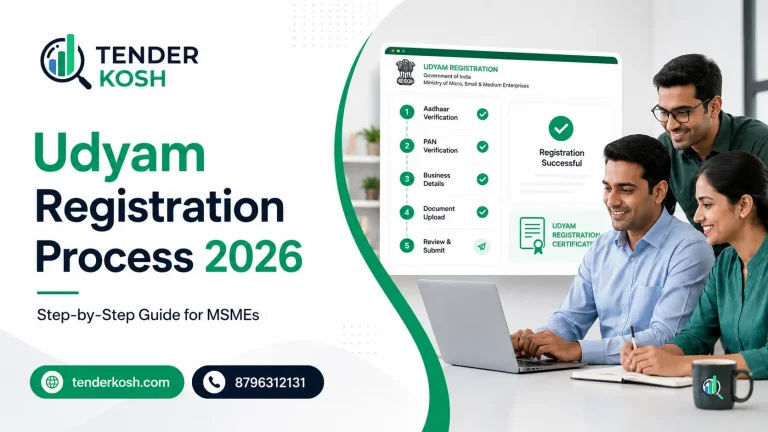
On the homepage, click Update Details or the annual update option. Enter your 19-digit Udyam Registration Number (URN) and the mobile number registered with your Udyam account. Verify via OTP. Your account opens automatically.
The portal automatically fetches your latest turnover from your GST returns (GSTR-1 and GSTR-3B) and investment data from your ITR. Review the pre-filled figures carefully. If your GST or ITR filings are not current, the auto-fetch will pull older data — file your returns first.
While in the update flow, review all other details — address, NIC activity codes, bank account, GSTIN, email, and mobile number. If any of these have changed since your last update, correct them now. NIC code errors are the most common cause of benefit eligibility mismatches.
Review all entries, confirm your declaration, and submit. The system processes the update and cross-verifies financial data against GST and Income Tax databases. This verification takes 24–48 hours for financial updates. Other changes process immediately.
Within 2–3 working days, your updated Udyam certificate is sent to your registered email and is available under Print Udyam Certificate on the portal. Your URN remains the same. The updated certificate reflects current financial year data and any category reclassification under the new April 2025 limits.
Before you start the update — file your returns. The Udyam portal fetches turnover from your most recently filed GST returns and investment from your most recent ITR. If either is pending, file the return first and allow 24–48 hours for the data to sync to government databases before attempting the Udyam update. Updating before returns are filed means the portal pulls the previous year’s data.
| Field | Can Be Updated? | How |
|---|---|---|
| Annual Turnover | Yes — auto-fetched from GST returns | Automatic via GST portal linkage. Ensure returns are filed before update |
| Investment in Plant and Machinery | Yes — auto-fetched from ITR | Automatic via Income Tax portal linkage. File ITR before update |
| Office or Plant Address | Yes | Self-update on portal — must match ITR-registered address for financial updates |
| NIC Activity Codes | Yes | Self-update. Select all activities the business actually performs — wrong or incomplete NIC codes affect scheme eligibility |
| Bank Account Details | Yes | Self-update — new account must be verified with OTP and bank confirmation |
| GSTIN | Yes — if GSTIN has changed or a new one added | Self-update. Multiple GSTINs for multiple states can be added |
| Email and Mobile Number | Yes | Self-update with OTP verification on new number |
| Business Name | Partially — minor corrections possible | Major name changes require administrative review via District Industries Centre |
| Aadhaar Number | No — permanently locked | Contact Udyam helpdesk or DIC for administrative correction — cannot be self-updated |
| PAN Number | No — permanently locked | Cannot be changed. If PAN was entered incorrectly, contact helpdesk — may require fresh registration in extreme cases |
If your business registered under the old Udyog Aadhaar Memorandum (UAM) system before July 2020, your certificate has been invalid for MSME benefit claims since June 30, 2022. If you have been using a UAM certificate to claim MSME benefits since then — EMD waivers, GeM preferences, CGTMSE loans — those claims have been technically improper.
The mandatory migration deadline to Udyam Registration is December 31, 2026. After this date, UAM certificates will no longer be recognised by any government system for any purpose.
If you have a UAM certificate — migrate immediately. You have already lost years of valid MSME benefit claims. Every day you remain on UAM is another day without proper coverage. Migration is free at udyamregistration.gov.in and your business history carries over. You will receive a fresh 19-digit URN that is valid across all government systems from the date of migration.
The most common error. Updating Udyam before your latest ITR or GST return is filed means the portal fetches previous year data. The certificate reflects old numbers. File your returns first — wait 24–48 hours — then update Udyam.
The Udyam update is 100% free on the official portal. Third-party websites charge ₹500–₹2,000 for a service you can do yourself in minutes. Many are scams that collect your Aadhaar and business details. Always go directly to udyamregistration.gov.in.
Export turnover is excluded from the MSME classification calculation — only domestic sales count. Many businesses inflate their classification category by including exports. Exclude export revenue when reviewing your classification under the new 2025 limits — you may qualify for a lower (more beneficial) category.
NIC codes determine which government schemes, tenders, and benefits apply to your business. A manufacturing enterprise using a service NIC code — or vice versa — will be excluded from schemes relevant to its actual activity. Review and update your NIC codes during every annual update cycle.
When businesses cannot find their Udyam certificate or have trouble logging in, they sometimes create a second registration. This creates duplicates — which can trigger cancellation of both certificates. Always contact the helpdesk at NIC (udyam@gov.in) or call 18001800163 before creating any new registration.
After completing the update, download the revised certificate immediately and share it with your bank relationship manager, procurement team, and GeM profile manager. Many benefit failures happen because the buyer or lender is looking at an old certificate you shared previously. Always circulate the current version.
An updated Udyam certificate unlocks EMD exemptions, purchase preferences, and priority procurement access across every government tender platform. TenderKosh tracks live tenders from 1,000+ portals — CPPP, GeM, IREPS, NTPC, SECI, DFCCIL, and more — so you find the right opportunities to apply your MSME advantages the moment they open.
Browse Live Government Tenders View Plans Why TenderKoshThe Udyam annual update is the mandatory yearly process where MSME-registered enterprises verify and update their financial data — investment in plant and machinery and annual turnover — based on the latest ITR and GST filings. The Ministry of MSME requires this to ensure your classification as Micro, Small, or Medium remains accurate. Failing to update results in stale data that causes benefit suspension, loan rejection, and disqualification from government schemes, tenders, and GeM preferences.
If you do not complete the Udyam annual update, your certificate reflects outdated financial data. This suspends access to CGTMSE collateral-free loans, Section 43B(h) payment protection, GeM MSME purchase preference, EMD exemption on government tenders, TReDS invoice discounting onboarding, and all subsidy schemes linked to Udyam status. Banks use real-time Udyam data for lending decisions — stale data causes loan rejections or delays.
Under Notification S.O. 1364(E) dated March 21, 2025, revised MSME limits took effect on April 1, 2025. Micro enterprises: investment up to ₹2.5 crore and turnover up to ₹10 crore. Small enterprises: investment up to ₹25 crore and turnover up to ₹100 crore. Medium enterprises: investment up to ₹125 crore and turnover up to ₹500 crore. These represent a 2.5 times increase in investment limits and double the turnover limits from the 2020 thresholds. Existing registrations benefit automatically — but you need to complete the annual update to have the correct category reflected on your certificate.
The Udyam certificate has lifetime validity and does not expire or require renewal. Your 19-digit URN stays permanently the same. However, the financial data — turnover and investment — must be updated annually after filing ITR and GST returns to reflect the correct classification. Failing to update does not cancel the certificate but causes outdated data that blocks MSME benefits in practice. Anyone charging you for “Udyam renewal” is operating a scam — the annual update is free on the official portal.
Visit udyamregistration.gov.in. Click Update Details and log in with your URN and registered mobile OTP. The portal auto-fetches turnover from your GST returns and investment from your ITR. Verify the pre-filled data, update address, NIC codes, bank details, or contact information if needed, and submit. Updated certificate arrives in 2–3 working days by email and is available under Print Udyam Certificate. The process is free, fully online, and takes under 10 minutes when your returns are already filed.
Upward reclassification happens automatically if your enterprise exceeds the ceiling in either investment OR turnover for your current category — just one measure crossing the limit is enough to move you up. Downward reclassification is harder — your enterprise moves to a lower category only when BOTH investment AND turnover fall below the lower category ceiling simultaneously. This asymmetry protects growing businesses from being moved up prematurely and businesses that temporarily contract from losing category stability.
No. Export turnover is explicitly excluded from the annual turnover used for MSME classification under the composite criterion. Only domestic revenue — sales within India — counts toward the turnover threshold. If your business has significant export revenue, your effective classification turnover may be considerably lower than your total revenue, potentially keeping you in a lower and more beneficial MSME category. This is one of the most commonly missed aspects of Udyam registration that causes unnecessary upward reclassification.
Enterprises still on the old Udyog Aadhaar Memorandum (UAM) system must migrate to Udyam Registration by December 31, 2026. UAM certificates have been invalid for MSME benefit claims since June 30, 2022. If you are still using a UAM certificate, you have been missing legitimate MSME benefits for years and your benefit claims have been technically unsupported. Migrate immediately at udyamregistration.gov.in — the process is free and your existing business information carries over.
Section 43B(h) of the Income Tax Act requires buyers to pay Micro and Small Enterprise suppliers within 45 days to claim a tax deduction on the payment. If they pay late, the unpaid amount is added back to their taxable income for that year. The provision is triggered by the supplier being a valid Udyam-registered Micro or Small Enterprise. If your Udyam certificate has stale data or incorrect classification, buyers can dispute your MSME status and resist the 45-day obligation — which weakens your legal position and your ability to use MSME Samadhaan for recovery.
Updatable fields include: turnover and investment (auto-fetched from GST/ITR), office and plant address, NIC activity codes, bank account details, GSTIN, email, and mobile number. Permanently locked fields that cannot be self-updated include: Aadhaar number and PAN number. For locked field corrections, contact the Udyam helpdesk at udyam@gov.in, call 18001800163, or approach your District Industries Centre. Never attempt to create a new registration to change locked fields — duplicates are flagged and can cause both certificates to be cancelled.
Discover relevant tenders, monitor corrigenda, compare opportunities, and move from document reading to structured action.