TenderKosh for EPC teams
Turn tender reading into faster bidding decisions.
Discover relevant tenders, monitor corrigenda, compare opportunities, and move from document reading to structured action.
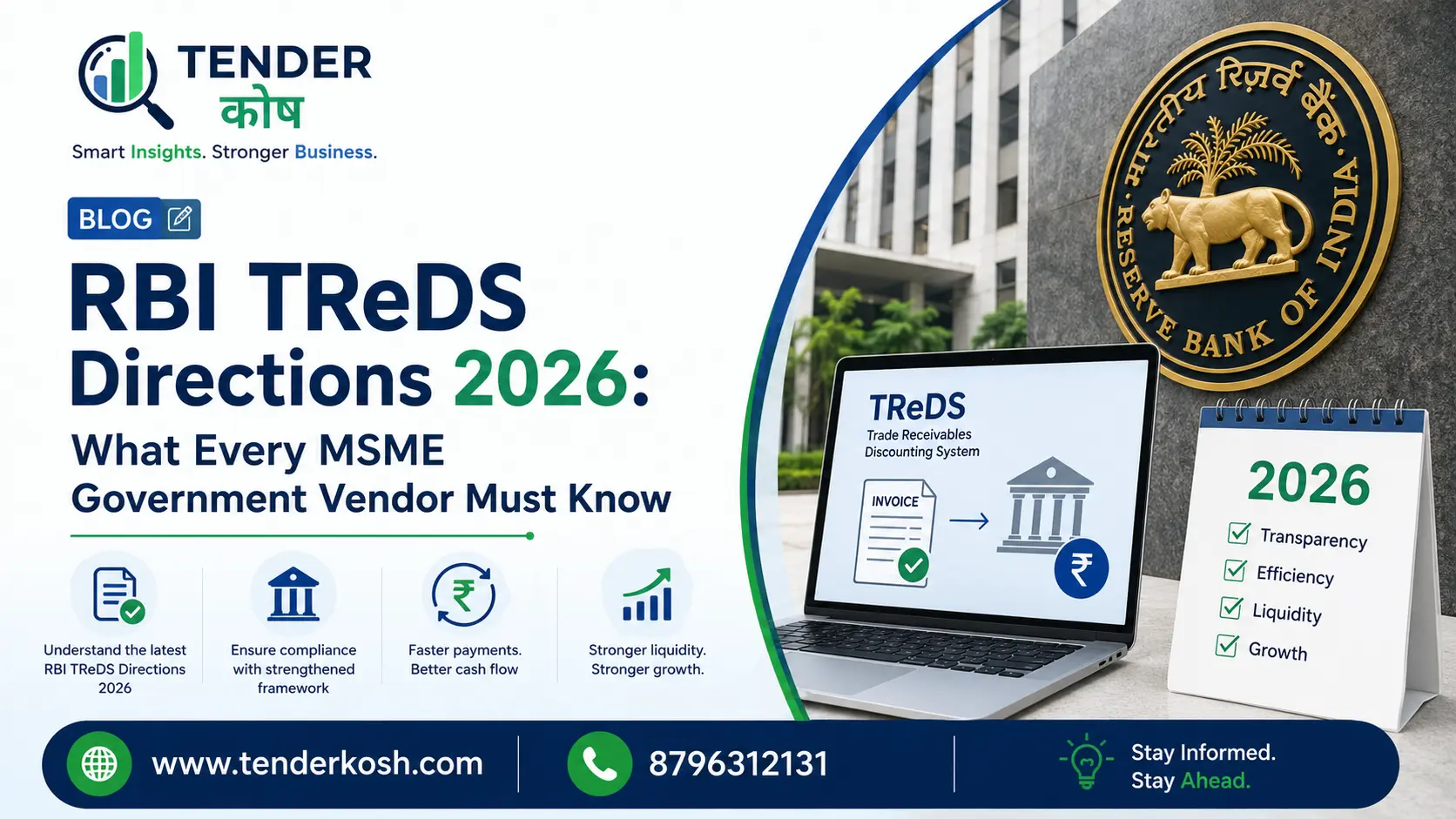
On April 8, 2026, the Reserve Bank of India released its most significant overhaul of invoice financing rules for MSMEs since TReDS was launched in 2014. The draft RBI (Trade Receivables Discounting System) Directions 2026 replaces eight years of scattered circulars and guidelines with a single Master Direction — and introduces reforms that directly affect how quickly MSME government vendors can get paid, how cheaply they can access working capital, and how much protection they have when a buyer defaults.
If you supply goods or services to government departments, PSUs, or large companies and are waiting 45 to 90 days for payment — these directions are the most important regulatory development of 2026 for your business. This guide explains every key change, what it means in practice for MSME vendors, and exactly what you need to do to start using TReDS effectively.
Key Takeaways
Your government buyer is already legally required to be on TReDS. All CPSEs and companies with turnover above ₹250 crore must register on a TReDS platform under the MSME Ministry’s November 2024 gazette notification. If your PSU or large company buyer is not yet active on TReDS, they are in non-compliance — and you have every right to demand they activate it for your invoices.
TReDS is an RBI-regulated digital marketplace where MSME sellers upload their government or corporate invoices and receive early payment from competing banks and NBFCs — without waiting for the buyer’s credit period to end.
Here is how a single transaction works:
After delivering goods or completing a service, the MSME seller uploads the invoice to a TReDS platform. This creates a Factoring Unit — a digital record of the receivable. Alternatively, the buyer can initiate the process by uploading the invoice themselves (called reverse factoring).
The government department, PSU, or corporate buyer logs into the same platform and accepts the invoice. Once accepted, the buyer has an unconditional, irrevocable obligation to pay the financier on the due date. No set-offs for quality disputes are permitted after acceptance.
Multiple banks and NBFCs registered on the platform submit bids to finance the accepted invoice, each offering a discounting rate. The MSME seller selects the best bid — typically the lowest discount rate — and accepts it. Competition among financiers drives rates down.
The winning financier credits the MSME seller’s bank account within T+2 days — meaning within 2 working days of bid acceptance. The MSME receives the invoice value minus the discounting fee. For a ₹10 lakh invoice at 8% annual discount, the MSME receives approximately ₹9.93 lakh for a 30-day early payment.
On the original invoice due date, the buyer settles the full invoice amount directly with the financier. The MSME seller has no further obligation. This is the without recourse protection — if the buyer defaults on this payment, the MSME is not liable. The risk belongs to the buyer and the financier.
Under the new RBI TReDS Directions 2026, the TReDS platform must file the assignment of receivables with CERSAI. This prevents double-financing of the same invoice on another platform or by another lender — protecting both the financier and the integrity of the transaction.
The RBI TReDS Directions 2026 were announced on April 8, 2026 as part of the Statement on Developmental and Regulatory Policies. The draft was open for stakeholder feedback until May 1, 2026. Here is what changes under the new framework and what each change means for MSME government vendors.
| Change | What Was the Old Rule | What the 2026 Directions Propose | Impact on MSME Vendors |
|---|---|---|---|
| MSME Onboarding Changed | TReDS platforms required to conduct due diligence of MSME sellers before approving their access — causing friction and delays in registration | Due diligence requirement for MSME sellers during onboarding is removed. Simpler, faster access to the platform for MSME vendors | MSMEs can register and start uploading invoices faster — reducing the time from decision-to-join to first payment |
| Regulatory Framework Changed | TReDS rules were spread across multiple RBI circulars issued between 2014 and 2023 — inconsistent, hard to track, prone to interpretation gaps | Single unified Master Direction replacing all prior circulars. One authoritative document covering all operational, governance, and participation norms | Clearer, more predictable rules for all participants. Fewer disputes arising from circular conflicts or outdated guidance |
| Capital Requirements for Platforms Changed | High paid-up capital requirement of ₹100 crore for new TReDS platform operators — restricting entry of new platforms | Minimum net worth requirement reduced to ₹25 crore, aligned with other non-bank payment system operators | More TReDS platforms may enter the market → more competition → potentially better rates and features for MSME sellers |
| Credit Guarantee Support New | Financiers on TReDS had no formal credit guarantee mechanism — limiting their willingness to lend at competitive rates, especially for smaller or newer MSMEs | Financiers can now avail credit guarantee cover via NCGTC (National Credit Guarantee Trustee Company) for their TReDS lending exposures | Reduces financier risk → more financiers join platforms → more competition → lower discounting rates for MSME sellers |
| Insurance Facility New | No formal insurance mechanism on TReDS. Financiers bore full buyer default risk without coverage tools | Financiers can use insurance cover for TReDS transactions. Insurance premiums cannot be charged to MSME sellers — cost must be borne by the financier | MSMEs get the benefit of insured transactions (better financier participation) at no additional cost to themselves |
| Re-discounting New | Once a financier discounted an MSME invoice, it was held to maturity — limiting how much capital a single financier could deploy on the platform | Financiers can now re-discount (sell) their TReDS exposures to other financiers, subject to RBI’s credit-risk transfer rules | More capital available on the platform overall → MSME invoices get financed more reliably, especially during credit-tight periods |
| CERSAI Registration New | No mandatory registry for invoice assignments on TReDS — creating risk of the same invoice being financed on multiple platforms simultaneously | TReDS platforms must file assignment of receivables with CERSAI for each discounted factoring unit | Prevents double-financing fraud. Strengthens legal certainty of each transaction. Protects MSME sellers from being entangled in lender disputes |
| Buyer Payment Obligation Changed | Buyer payment terms were covered under platform agreements but the unconditional nature of the obligation was not uniformly specified or enforced | Buyer’s obligation to pay on due date is now explicitly unconditional and without recourse — no set-offs for quality disputes once the invoice is accepted. Buyers cannot withhold payment citing delivery issues after acceptance | Stronger protection for MSME sellers. Once your invoice is accepted, the money is effectively secured regardless of any post-acceptance dispute the buyer raises |
| Settlement Mechanism Changed | Settlement was largely platform-specific with varying timelines and processes | Platforms must ensure seamless T+2 settlement across all transaction types including insurance premium collection, claim settlement, and fee transactions | Faster, more predictable payment to MSME sellers across all three authorized platforms |
Of all the changes in the RBI TReDS Directions 2026, the removal of the due diligence requirement for MSME sellers during onboarding is the most practically significant for government vendors who are not yet on TReDS.
Previously, getting onto a TReDS platform required a formal due diligence process — document verification, business validation, and approval that could take days or weeks. For small MSME vendors with limited administrative bandwidth, this friction was a real deterrent. Many eligible vendors simply never registered.
Under the proposed directions, this requirement is removed entirely. MSME sellers can register on a TReDS platform and start uploading invoices with standard KYC documentation — PAN, GST, bank account, and Udyam Registration — without waiting for a separate due diligence clearance. The process becomes comparable to signing up for a business banking service, not applying for a loan.
Practical implication for government vendors: If you supply to a CPSE or company with turnover above ₹250 crore and your invoices are regularly paid late, there is no longer any procedural barrier to getting on TReDS. The removal of due diligence means registration is now a matter of hours, not weeks. Your next unpaid invoice can be your first TReDS transaction.
One of the structural barriers to MSME-friendly TReDS rates has always been the financier side of the equation. Banks and NBFCs participating on TReDS carry buyer default risk — and that risk is priced into the discounting rate offered to the MSME seller. Higher perceived risk means higher discount, which means less money reaching the MSME.
The RBI TReDS Directions 2026 address this directly through two mechanisms.
Financiers on TReDS can now access credit guarantee cover through the National Credit Guarantee Trustee Company Limited (NCGTC) for their TReDS lending exposures. NCGTC is the same government-backed entity that manages credit guarantee schemes for MSME loans. When a financier’s exposure is guaranteed by NCGTC, the risk of buyer default is partially absorbed by the government guarantee — reducing the effective cost of the financier’s risk and allowing them to offer better rates.
Financiers can now use insurance products to cover their TReDS exposures. The critical protection for MSME sellers: insurance premiums cannot be passed to them. The entire cost of insurance is borne by the financier. MSMEs get the benefit of insured transactions — more confident financier participation — at zero additional cost.
What this means in rupees: If credit guarantee and insurance reduce a financier’s effective risk from 2% to 0.5%, the discount rate offered to an MSME seller on a 30-day invoice could fall from approximately 9–10% per annum to 7–8% per annum. On a ₹10 lakh invoice with a 30-day early payment, that is a saving of approximately ₹800–1,600 per transaction — directly into your working capital.
Understanding who your buyer is on TReDS matters. The government has expanded mandatory TReDS registration requirements significantly through the MSME Ministry’s Gazette Notification S.O. 4845(E) dated November 7, 2024.
| Buyer Category | TReDS Registration Status | Deadline | Governing Notification |
|---|---|---|---|
| All CPSEs (NTPC, BHEL, RVNL, IRCON, Oil PSUs, Defence PSUs, etc.) | Mandatory | March 31, 2025 | S.O. 4845(E), November 7, 2024 and S.O. 5621(E), November 2, 2018 |
| Companies with turnover above ₹250 crore (large private sector, listed companies) | Mandatory | March 31, 2025 | S.O. 4845(E), November 7, 2024 (revised from earlier ₹500 crore threshold) |
| Companies with turnover ₹500 crore–₹250 crore | Previously mandatory under 2018 notification, now covered under 2024 revision | Already past | S.O. 5621(E), November 2, 2018 |
| State Government Departments and State PSUs | Not mandated at central level — participation varies by state | No fixed deadline | State-specific policies |
| Small and mid-size private companies (below ₹250 crore) | Voluntary — not mandated | No deadline | Not covered under current mandate |
If your CPSE or large-company buyer is not on TReDS, they are in non-compliance. The Registrar of Companies (RoC) in each state is the competent authority to monitor and enforce TReDS registration compliance. If your buyer is non-compliant, you can report the non-compliance to the RoC of your buyer’s state. You can simultaneously file a delayed payment complaint on MSME Samadhaan — the two mechanisms work in parallel and reinforce each other.
RBI has authorised three TReDS platforms. MSME sellers can register on any or all three — and registering on multiple platforms is recommended because it increases competition among financiers bidding for your invoices.
| Platform | Full Name / Operator | Promoters | Best Known For |
|---|---|---|---|
| RXIL | Receivables Exchange of India Ltd | NSE and SIDBI joint venture | Strong government and PSU buyer base; SIDBI backing provides MSME credibility. Best for MSME vendors supplying CPSEs and government departments. |
| M1xchange | M1xchange (Mynd Solutions) | Mynd Solutions — private fintech | Highest transaction volumes; strong large-corporate buyer network; active in manufacturing and supply chain sectors. Good for vendors with large private sector buyers. |
| Invoicemart | A.TREDS Ltd | Axis Bank and mjunction services (SAIL/TATA Steel JV) | Strong in metals, steel, and heavy industry supply chains; Axis Bank’s financier network provides good rates. Good for infrastructure and construction vendors. |
Registering on all three platforms takes a few hours per platform and involves standard KYC documentation. Once registered, your invoices are visible to all financiers on that platform — and you accept only the best bid. There is no commitment to any single financier.
Visit RXIL (rxil.in), M1xchange (m1xchange.com), and Invoicemart (invoicemart.in). Registration requires PAN, Udyam Registration Number, GST certificate, cancelled cheque, and latest ITR. With due diligence removed under the new directions, onboarding is now significantly faster.
Log into each TReDS platform and search for your buyer. If your CPSE or large company buyer is not registered, they are in non-compliance with the MSME Ministry’s November 2024 notification. Escalate to their procurement head and, if needed, report to the RoC of their state.
Udyam Registration is required for TReDS access. Verify your 19-digit Udyam number is active and the annual update is complete at udyamregistration.gov.in. Lapsed or outdated Udyam details prevent platform verification and delay your first transaction.
A TReDS transaction requires the buyer to accept the invoice on the platform. That acceptance is easier to get when delivery is acknowledged in writing — signed challan, email confirmation, or inspection report. Build this into every supply or service completion before raising the invoice.
TReDS solves the cash flow problem prospectively — by converting future invoices into immediate cash. MSME Samadhaan recovers dues on invoices that have already been delayed. Use both: activate TReDS for new invoices and file on Samadhaan for existing overdue amounts. They operate independently and do not conflict.
When bidding on new government tenders, prefer departments and PSUs that are active on TReDS. An active TReDS buyer means your invoice can be financed within days of delivery — removing working capital uncertainty from your bid planning entirely.
Many MSME vendors confuse TReDS and Samadhaan or assume they serve the same purpose. They do not. They address the same underlying problem — delayed payment — but at different stages and through entirely different mechanisms.
| Parameter | TReDS | MSME Samadhaan |
|---|---|---|
| What it does | Converts future receivables into immediate cash — you get paid before the buyer’s credit period ends | Recovers payment after the buyer has already defaulted — legal enforcement via MSEFC |
| When to use | Before the invoice is overdue — proactively, on every invoice with a TReDS-registered buyer | After the 45-day MSMED Act deadline has passed without payment |
| Who is involved | MSME seller, buyer, financier (bank/NBFC), TReDS platform | MSME seller, buyer, MSEFC (state facilitation council), potentially civil court |
| Cost to MSME | Discounting fee (typically 7–10% p.a. on the early payment period) — a cost of speed | Free — no filing cost, no lawyer required |
| Time to get money | T+2 days after invoice acceptance and financier bid | 3–9 months through MSEFC conciliation and arbitration |
| Requires buyer cooperation | Yes — buyer must be registered and must accept the invoice on the platform | No — MSEFC proceeds even if buyer does not cooperate (ex parte arbitration) |
| Best used for | Ongoing, repeat invoices with regular large government buyers or CPSEs | One-off disputes, buyers who refuse to engage, or when the buyer relationship has broken down |
TReDS solves the working capital problem after you win. TenderKosh helps you find the right tenders to win — from 1,000+ government procurement portals including CPPP, GeM, IREPS, NTPC, SECI, DFCCIL, and Metro Rail. Track live tenders, get corrigendum alerts, and bid on tenders from buyers with strong payment records.
Browse Live Tenders View Plans Why TenderKoshThe RBI TReDS Directions 2026 is a draft Master Direction released by the Reserve Bank of India on April 8, 2026 as part of its Statement on Developmental and Regulatory Policies. It replaces all earlier scattered circulars governing TReDS platforms with a single unified regulatory document. Key reforms include removing due diligence requirements for MSME seller onboarding, streamlined capital requirements for platform operators, credit guarantee support via NCGTC, insurance facilities for financiers at no cost to MSME sellers, re-discounting permissions, and mandatory CERSAI registration of invoice assignments.
TReDS is an RBI-regulated digital platform where MSME sellers upload invoices raised on government departments, PSUs, and large corporate buyers and receive early payment from competing banks and NBFCs before the buyer’s credit period ends. Instead of waiting 45 to 90 days for payment, the MSME sells the invoice to a financier at a small discount and receives cash within T+2 days. All TReDS transactions are without recourse to the MSME seller — if the buyer defaults, the financial liability rests with the buyer, not the MSME.
The RBI has proposed removing the requirement for TReDS platforms to conduct due diligence on MSME sellers during onboarding. Previously this process caused delays and friction in accessing the platform. Removing it simplifies and speeds up registration significantly — meaning MSME vendors can get onto TReDS and start uploading invoices faster, with less documentation. Standard KYC documents — PAN, GST, bank details, Udyam Registration — are sufficient.
Under the MSME Ministry’s November 7, 2024 gazette notification, all companies registered under the Companies Act 2013 with annual turnover exceeding ₹250 crore — reduced from the earlier ₹500 crore threshold — along with all Central Public Sector Enterprises (CPSEs) engaged in procurement from MSMEs, are mandatorily required to register on a TReDS platform. If your government department or PSU buyer falls in this category, they are legally obligated to be on TReDS — and you can demand they activate it for your invoices.
Without recourse means that once your invoice is accepted and discounted on TReDS, the repayment risk belongs entirely to the buyer — not to you, the MSME seller. If the government department or company that owes you money fails to pay the financier on the due date, the financier cannot come after you for recovery. Your invoice has been paid and your obligation is discharged the moment the financier credits your account. This is the most critical financial protection TReDS provides to MSME sellers.
The RBI TReDS Directions 2026 permit financiers — banks and NBFCs on TReDS platforms — to access credit guarantee cover for their TReDS lending exposures through the National Credit Guarantee Trustee Company Limited (NCGTC). This reduces the risk for financiers, which is expected to attract more banks and NBFCs to participate on TReDS, increase competition among financiers, and lower the discounting rates offered to MSME sellers. For MSME government vendors, this means cheaper access to early payment on invoices.
No. The RBI TReDS Directions 2026 explicitly permit financiers to use insurance facilities for TReDS transactions but prohibit them from charging the insurance premium to MSME sellers. The insurance cost must be borne entirely by the financier. MSME sellers benefit from the additional security that insurance provides — more confident financier participation and potentially lower rates — without paying for it.
CERSAI — Central Registry of Securitisation Asset Reconstruction and Security Interest of India — is a central registry where security interests in assets are recorded. Under the RBI TReDS Directions 2026, TReDS platforms must register the assignment of receivables with CERSAI when an invoice is discounted. This prevents the same invoice from being double-financed on different platforms or by different lenders simultaneously. For MSME sellers, CERSAI registration provides legal certainty that their invoice financing is properly recorded and protected.
The three RBI-authorized TReDS platforms are RXIL — Receivables Exchange of India Ltd, a joint venture of NSE and SIDBI; M1xchange, operated by Mynd Solutions; and Invoicemart, operated by A.TREDS Ltd, a joint venture of Axis Bank and mjunction services. MSME sellers can register on any or all three platforms. Registering on multiple platforms increases competition among financiers and typically results in better discounting rates on your invoices.
Re-discounting means a financier who has already discounted an MSME invoice can sell that exposure to another financier in the secondary market, subject to RBI’s credit-risk transfer rules. For MSME vendors, re-discounting improves overall platform liquidity — more financiers participate because they can manage their exposure by selling down positions — which increases the pool of available capital and can improve the rates at which MSME invoices are financed, particularly during periods of tight credit.
Discover relevant tenders, monitor corrigenda, compare opportunities, and move from document reading to structured action.