
TenderKosh for EPC teams
Turn tender reading into faster bidding decisions.
Discover relevant tenders, monitor corrigenda, compare opportunities, and move from document reading to structured action.
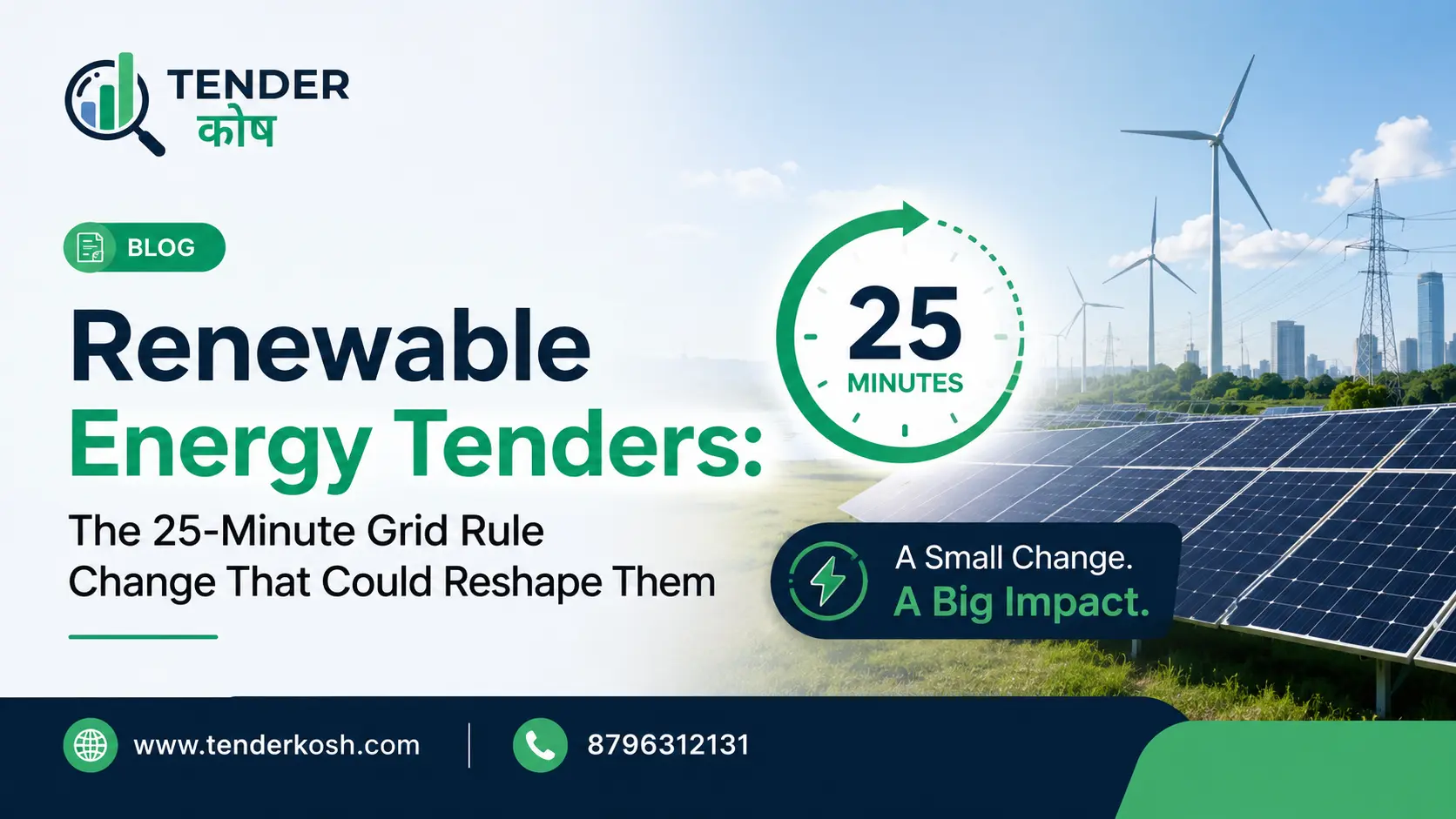
Most tender professionals watch new solar tenders, wind auctions, BESS projects, and green-hydrogen opportunities. Very few pay attention to electricity scheduling regulations — and that’s understandable, because scheduling windows sound like something only grid operators and power traders would care about. But a recent regulatory proposal is proving otherwise, and it could quietly reshape how renewable energy tenders are designed, evaluated, and executed across India.
A proposal to reduce electricity scheduling timelines from roughly 75 minutes to 50 minutes is creating debate between grid operators, thermal power stakeholders, and renewable-heavy states. On the surface it looks like a minor operational adjustment. In reality it could influence renewable forecasting requirements, battery storage demand, grid-balancing contracts, hybrid project design, and the technical specifications of future EPC tenders. That is exactly why smart renewable contractors are paying close attention.
A note on figures and status: The specific 75-minute to 50-minute figures and the proposal’s current stage are based on the source discussion and may change as the regulatory process unfolds. Scheduling reforms are subject to consultation, stakeholder feedback, and final orders from the relevant electricity regulator. Treat the exact numbers as indicative and verify the current proposal and timeline against the official regulator’s notifications before relying on specifics.
Key Takeaways
Without getting overly technical: electricity generators are required to tell grid operators in advance how much power they expect to supply. This process is called scheduling. Today, generators get a larger scheduling window that gives them more time to predict generation and manage dispatch decisions. The proposed reform would shorten that window from approximately 75 minutes to about 50 minutes.
A 25-minute difference sounds insignificant. But in power systems, 25 minutes can be the difference between accurate forecasting and grid instability, between power surpluses and shortages. And that gap matters most for renewable energy — which is why it feeds directly into the future of renewable energy tenders.
Coal and gas plants can generally control their output. Solar and wind projects cannot — their production depends on cloud cover, wind speed, weather patterns, and seasonal variation. The shorter the scheduling window becomes, the more critical forecasting accuracy becomes. That creates both a challenge and an opportunity.
| The Challenge | The Opportunity |
|---|---|
| Renewable developers may need better forecasting systems, advanced weather analytics, and improved operational controls to comply with tighter windows. | Projects that manage variability effectively gain a real competitive advantage in bids — and that is where the tender market begins to change. |
This is where the story becomes interesting for EPC contractors. Battery Energy Storage Systems (BESS) can smooth renewable fluctuations. If solar output falls unexpectedly, storage can bridge the gap. If renewable generation exceeds expectations, energy can be stored rather than curtailed. As scheduling requirements tighten, storage becomes more valuable — which is why many observers believe future renewable energy tenders may increasingly require integrated storage.
Renewable Market Insight: The most valuable renewable project of the future may not be the one generating the cheapest electricity. It may be the one capable of delivering the most predictable electricity. And storage is becoming the tool that enables that predictability.
Most renewable discussion focuses on generation. But electricity systems need something equally important: balance. Supply and demand must stay aligned at all times, and as renewable penetration rises, balancing becomes more complex. That creates growing demand for a category of procurement many EPC contractors are not yet watching.
Services that keep the grid stable — increasingly procured as renewable share grows and the grid needs faster, more flexible support.
Fast-responding assets that hold grid frequency steady — a natural fit for battery storage and flexible generation.
Energy storage, flexible generation assets, and grid-support infrastructure that together absorb the variability of renewables.
The proposal is generating substantial debate because different parts of the power sector see it very differently. Understanding both sides helps you read where the rule — and the tenders that follow — may land.
| Renewable-Heavy States (Support) | Thermal & Some Grid Stakeholders (Concern) |
|---|---|
| Modern forecasting technologies have improved substantially, so shorter windows are manageable. | Shorter windows increase forecasting pressure and compliance requirements. |
| Faster scheduling could improve grid responsiveness and market efficiency. | Tighter timelines may create operational uncertainty. |
| It better reflects real-time generation conditions and supports advanced renewable integration. | Generators could face higher exposure to imbalance penalties. |
| They view it as a step toward a more modern electricity market. | They see real operational risk that needs careful transition. |
Many procurement trends begin as regulatory changes. Then they become qualification requirements. Then they become mandatory tender conditions. We have already seen this pattern with domestic content requirements, forecasting obligations, energy storage mandates, and grid-compliance standards. The same pattern could emerge here — meaning what looks today like a scheduling discussion may shape tomorrow’s renewable energy tenders.
The pattern that matters: Today’s regulatory discussion → tomorrow’s qualification criterion → next year’s technical specification → a future eligibility requirement. By the time that journey completes, early movers are already prepared and everyone else is scrambling to catch up.
This is the area many experts are watching most closely. If grid flexibility becomes increasingly important, procurement agencies may begin favouring projects that build in reliability rather than relying on generation capacity alone.
| Project Model | Why It Gains an Edge Under Tighter Scheduling |
|---|---|
| Battery Energy Storage (BESS) | Directly smooths fluctuations and provides fast, dispatchable response |
| Solar-plus-Storage | Shifts solar output to when it’s needed, improving delivery predictability |
| Wind-plus-Storage | Buffers wind variability, reducing imbalance risk |
| Dispatchable Renewable Models | Deliver firm, schedulable power — increasingly what grids and buyers want |
Instead of evaluating projects solely on generation capacity, authorities may place greater emphasis on delivery reliability — which changes how renewable projects are designed, financed, and tendered.
Monitor utility-scale BESS, grid-scale storage, and standalone battery projects. Build capability or partnerships before storage becomes a tender prerequisite.
Renewable forecasting systems, weather-analytics platforms, and AI-based generation prediction tools will increasingly separate qualifying bids from rejected ones.
Solar-plus-BESS, wind-plus-BESS, and renewable hybrid parks are likely to feature more heavily in future renewable energy tenders.
The implications extend across the broader renewable ecosystem. A scheduling reform that starts as a grid-operator concern could ultimately create entirely new procurement categories — benefiting a wide set of players.
Potential beneficiaries include:
The next big renewable opportunity may not come from a new policy announcement — it may emerge from a change in how electricity is scheduled. TenderKosh tracks live solar, wind, BESS, and hybrid tenders, plus corrigenda, across 1,000+ government procurement portals, so you catch shifting requirements early and bid prepared.
Browse Live Tenders View Plans Why TenderKoshAt first glance, reducing a scheduling window from 75 minutes to 50 minutes sounds like a technical adjustment only power-system operators would notice. But beneath the surface it touches some of the most important themes shaping India’s renewable future: forecasting accuracy, grid stability, battery-storage adoption, renewable integration, and future procurement design.
For tender professionals, the lesson is simple: major procurement shifts often begin with small regulatory changes. If this proposal moves forward, the 25-minute rule change could influence how renewable energy tenders are bid, evaluated, and executed for years to come. The most successful participants don’t just respond to tenders after release — they track the factors that shape tomorrow’s tender design. This is one of those factors.
The proposal would reduce the advance scheduling window for electricity generation — the period in which generators must inform grid operators how much power they expect to supply. Shortening it from roughly 75 minutes to about 50 minutes would require generators to provide more accurate forecasts within a tighter timeframe. Although it sounds like a minor operational adjustment, it has significant implications for renewable forecasting, grid balancing, and how future renewable energy tenders may be designed.
Renewable generation from solar and wind depends on weather conditions and cannot be controlled the way coal or gas plants can. A shorter scheduling window makes forecasting accuracy far more important, because there is less time to predict generation and manage dispatch. This raises the value of advanced forecasting systems, grid flexibility, and battery storage — all of which could increasingly feature in the design and qualification criteria of future renewable energy tenders.
Battery Energy Storage Systems (BESS) help smooth renewable fluctuations: storage can bridge the gap when solar output falls unexpectedly, and absorb surplus energy that would otherwise be curtailed. As scheduling requirements tighten and delivery reliability becomes more important, storage becomes more valuable. Many industry observers expect this to accelerate the inclusion of BESS, solar-plus-storage, and hybrid models in future renewable tenders, shifting evaluation from pure generation capacity toward dependable, dispatchable power.
Quite possibly. Many procurement trends begin as regulatory changes, then become qualification requirements, and eventually mandatory tender conditions — as seen with domestic content rules, forecasting obligations, and earlier storage mandates. If tighter grid management raises the importance of flexibility, procurement agencies may increasingly favour projects that include battery storage or hybrid solutions, meaning future renewable energy tenders could place greater weight on delivery reliability rather than generation capacity alone.
Forward-looking EPC contractors should begin monitoring developments in battery energy storage (utility-scale and standalone BESS), forecasting technologies (weather analytics and AI-based generation prediction), and hybrid renewable projects such as solar-plus-storage and wind-plus-storage. Building capability and partnerships in these areas now positions a contractor ahead of competitors when grid regulations evolve into tender qualification criteria and technical specifications.
Discover relevant tenders, monitor corrigenda, compare opportunities, and move from document reading to structured action.