TenderKosh for EPC teams
Turn tender reading into faster bidding decisions.
Discover relevant tenders, monitor corrigenda, compare opportunities, and move from document reading to structured action.
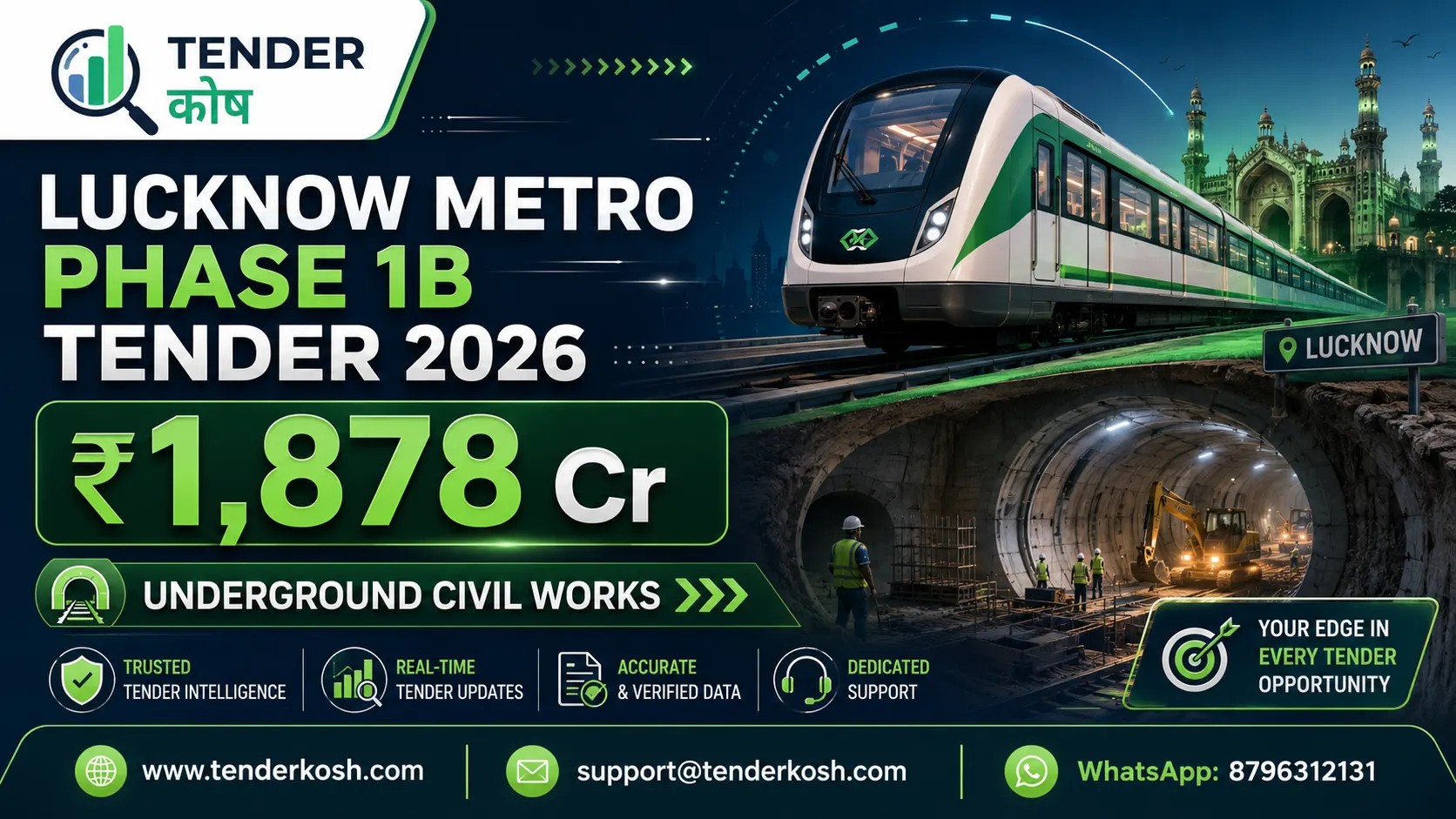
The Lucknow Metro Phase 1B Tender 2026 — floated by the Uttar Pradesh Metro Rail Corporation (UPMRC) — covers the design and construction of a 6.70 km underground metro section between Charbagh and Chowk, including 7 underground stations. With an estimated value of ₹1,877.89 crore and a bid closing date of 27 July 2026, this package is drawing attention from EPC contractors, civil engineering firms, and metro specialists across the country.
This is not a peripheral support contract. It is a full civil works package for one of the most technically demanding components of an urban metro expansion — 6.70 km of underground infrastructure through central Lucknow, including 7 underground stations. If you are an infrastructure firm tracking large civil tenders in India, this package deserves close attention.
Key Takeaways
Tender timelines move fast: Bid deadlines, corrigenda, and submission requirements for UPMRC packages can change with short notice. The information in this post reflects details available at time of publication — always verify current status, revised deadlines, and updated documents directly on the UPMRC portal or CPPP before proceeding.
| Parameter | Details |
|---|---|
| Issuing Authority | Uttar Pradesh Metro Rail Corporation (UPMRC) |
| Project | Lucknow Metro Phase 1B — East-West Corridor |
| Package Scope | Underground section: Charbagh Metro Station to Chowk Metro Station Civil Works |
| Underground Length | Approximately 6.70 km |
| Stations | 7 underground metro stations |
| Estimated Tender Value | ₹1,877.89 crore (approx. INR 18.78 billion) High Value |
| Bid Closing Date | 27 July 2026 |
| Contract Type | Design and Construction (EPC / Civil Works) |
The tender covers complete civil works for the underground stretch of the East-West Corridor between Charbagh and Chowk — two of Lucknow’s most prominent and densely trafficked locations. The full corridor is approximately 11.16 km with a mix of elevated and underground sections; this package specifically addresses the underground portion through central Lucknow where land constraints and urban density make construction particularly challenging.
Design and civil construction of 7 underground metro stations, including station box excavation, structural works, and platform infrastructure.
Civil works for the 6.70 km underground running section, coordinating tunneling, lining, and structural requirements across the alignment.
Utility relocation, traffic diversions, groundwater management, and safety planning in a dense central-city environment — the most complex element of any underground metro package.
Why underground metro scopes are different: Underground metro construction is among the most technically demanding civil work in India’s infrastructure sector. Station box excavation, tunneling coordination, groundwater control, and simultaneous traffic management in a busy urban corridor all require specialist expertise, robust equipment, and experienced project management. That complexity raises execution risk — but also substantially raises the entry bar for competitors.
The Lucknow Metro Phase 1B Tender 2026, at nearly ₹1,878 crore, is one of the larger single civil packages visible in Uttar Pradesh’s current infrastructure pipeline. The value alone signals that this package is intended for serious infrastructure players — not small subcontractors or consultancy firms. But beyond the number, there are three specific reasons this tender stands out.
Lucknow Metro Phase 1B has been progressing through planning, approvals, and budget support — including a ₹550 crore central allocation to the East-West Corridor. This is not a speculative announcement; it is a funded, priority project.
Underground metro projects of this scale typically run for several years. For the winning contractor, that means sustained revenue, substantial equipment mobilisation, and a landmark reference project in the national metro space.
Large packages like this generate significant downstream demand — in concrete works, waterproofing, reinforcement steel, precast systems, MEP interfaces, excavation support, and tunneling services — for suppliers and subcontractors across the value chain.
Given the scale, technical complexity, and underground scope of the Lucknow Metro Phase 1B Tender 2026, this package is best suited to a specific profile of contractor or consortium. Here is how to assess fit.
| Bidder Type | Relevance |
|---|---|
| National EPC Contractors | Firms with large civil works portfolios and prior metro or tunneling experience are the primary target profile for a package of this value and complexity |
| Metro Specialists | Companies that have executed underground metro contracts in Indian cities — particularly station box construction and cut-and-cover work — are strongly positioned to qualify |
| Joint Ventures | Packages of this scale frequently permit JV bidding, allowing firms to combine financial and technical qualifications to meet eligibility thresholds |
| International Contractors | Large foreign EPC firms with Indian partnerships may find this package attractive given its scale and technical depth — particularly if UPMRC opens to international bids |
| Subcontractors & Suppliers | Not direct bidders, but firms in concrete, waterproofing, reinforcement steel, MEP, and tunneling services should track this package to position for subcontracting opportunities once the main contract is awarded |
UPMRC follows a structured bid process typical of major metro corporations. Here is how to approach the Lucknow Metro Phase 1B Tender 2026 effectively.
The tender document contains the full scope, technical specifications, eligibility criteria, and submission requirements. Read it completely before committing resources to bid preparation.
Underground metro packages carry strict technical qualification requirements — prior contract size, experience thresholds, and equipment credentials. Confirm eligibility before investing in bid preparation.
If your firm does not independently meet all thresholds, identify potential JV partners early. Forming and structuring a consortium takes time, and the 27 July deadline does not leave a large window.
UPMRC typically holds pre-bid meetings for complex packages. Attending lets you clarify scope ambiguities, understand evaluation criteria, and signal credible interest to the client.
Bid security (EMD) for a package of this value will be substantial. Ensure your bank guarantee or instrument is prepared in the correct format and submitted within the specified timeline.
UPMRC, like all metro corporations, issues corrigenda that can change scope, eligibility, or deadlines. Missing a corrigendum means submitting an outdated bid. Use a tender tracking platform to catch every update.
Common reasons bids fail on large metro civil packages:
Even firms that are not positioned to bid directly for the Lucknow Metro Phase 1B Tender 2026 should be tracking it. A civil works package of this scale creates substantial follow-on demand across the construction supply chain once the main contractor is appointed.
Station box and tunnel lining structures demand large volumes of high-specification concrete and reinforcement steel — typically subcontracted to specialist suppliers.
Underground metro stations require comprehensive waterproofing systems and geotechnical monitoring — specialist subcontract categories with limited competition.
Civil packages interface with mechanical, electrical, and plumbing systems — creating subcontracting opportunities for MEP firms once the primary contractor is mobilised.
For subcontractors and suppliers: Track the award of this package once bids close. Once the main contractor is announced, reach out early to position for subcontract opportunities — these relationships are built before mobilisation, not after it starts.
UPMRC and other metro corporations issue large civil works packages throughout the year — often with short bid windows and frequent corrigenda. TenderKosh tracks UPMRC, DMRC, and 1,000+ other portals in real time, so you get alerts the moment a new civil works, infrastructure, or metro tender is published — and again when it changes.
Browse Live Tenders View Plans Why TenderKoshThe Lucknow Metro Phase 1B Tender 2026 is one of the more significant infrastructure procurement opportunities currently open in Uttar Pradesh — and in India’s metro rail market more broadly. At ₹1,877.89 crore, with a 6.70 km underground alignment, 7 stations, and a central-city corridor through one of India’s major state capitals, this is the kind of project that reshapes order books and builds long-term credibility in the national infrastructure sector.
For contractors with the right technical pedigree, the fundamentals are clear: download the document, verify eligibility, assess JV options, attend pre-bid meetings, and track corrigenda diligently through to the 27 July 2026 deadline. For suppliers and subcontractors, track the award and position early. Either way, this is a project worth watching closely.
The Lucknow Metro Phase 1B Tender 2026 is a civil works package floated by the Uttar Pradesh Metro Rail Corporation (UPMRC) for the design and construction of a 6.70 km underground metro section between Charbagh and Chowk, covering 7 underground stations. The estimated tender value is ₹1,877.89 crore.
The bid closing date for the Lucknow Metro Phase 1B Tender 2026 underground civil works package is 27 July 2026. Bidders should monitor the UPMRC portal for corrigenda and any deadline revisions before submission.
This is a large-value, technically complex civil works package intended for experienced EPC contractors and infrastructure firms with a proven track record in underground metro construction, tunneling, station box excavation, or comparable heavy civil works. Joint ventures between eligible firms are also commonly permitted for packages of this scale.
The package covers 7 underground metro stations between Charbagh and Chowk as part of Lucknow’s East-West Corridor. The underground section spans approximately 6.70 km through central Lucknow.
The Lucknow Metro Phase 1B Tender 2026 is issued by the Uttar Pradesh Metro Rail Corporation (UPMRC) and published on their official portal. It may also appear on CPPP. Tender aggregator platforms such as TenderKosh track UPMRC notices across portals and send alerts when new packages or corrigenda are published.
Given the underground scope and contract value, bidders are expected to demonstrate prior experience in metro or heavy urban infrastructure — particularly underground station construction, cut-and-cover methods, tunneling, or large-package civil works. The tender document will specify exact experience and turnover thresholds.
This article is general information, not advice. It has been compiled from publicly available sources — government releases and notifications, official portals, published tender documents and trade reporting — and reflects our understanding at the time of writing. It is not legal, financial, tax or professional advice, and it does not create any advisory relationship.
Public procurement changes constantly. Tender terms, eligibility criteria, thresholds, fees, deadlines, scheme conditions and government policy are revised frequently, often through corrigenda issued mid-window and sometimes without wide notice. Figures and rules that were accurate when published may already have changed by the time you read this.
Always verify against the primary source before you act or bid. The tender document, the issuing authority's official portal and the relevant government notification are the authoritative sources. Where anything in this article differs from them, the official source prevails. Do not rely on this page — or on any third-party summary — as the basis for a bid, an investment or a compliance decision.
TenderKosh is a private tender-intelligence platform. We are not a government body, and we are not affiliated with, endorsed by or acting on behalf of any government department, ministry, PSU or procurement portal. Names, marks and portals referenced belong to their respective owners and are used for identification only. External links are provided for convenience; we do not control and are not responsible for third-party content.
While we take reasonable care, we make no warranty as to the accuracy, completeness or currency of this content, and accept no liability for any loss or damage arising from reliance on it.Spotted something wrong or out of date? Please tell us at support@tenderkosh.com — we correct errors promptly.See our full Disclaimer.
Discover relevant tenders, monitor corrigenda, compare opportunities, and move from document reading to structured action.