

TenderKosh for EPC teams
Turn tender reading into faster bidding decisions.
Discover relevant tenders, monitor corrigenda, compare opportunities, and move from document reading to structured action.
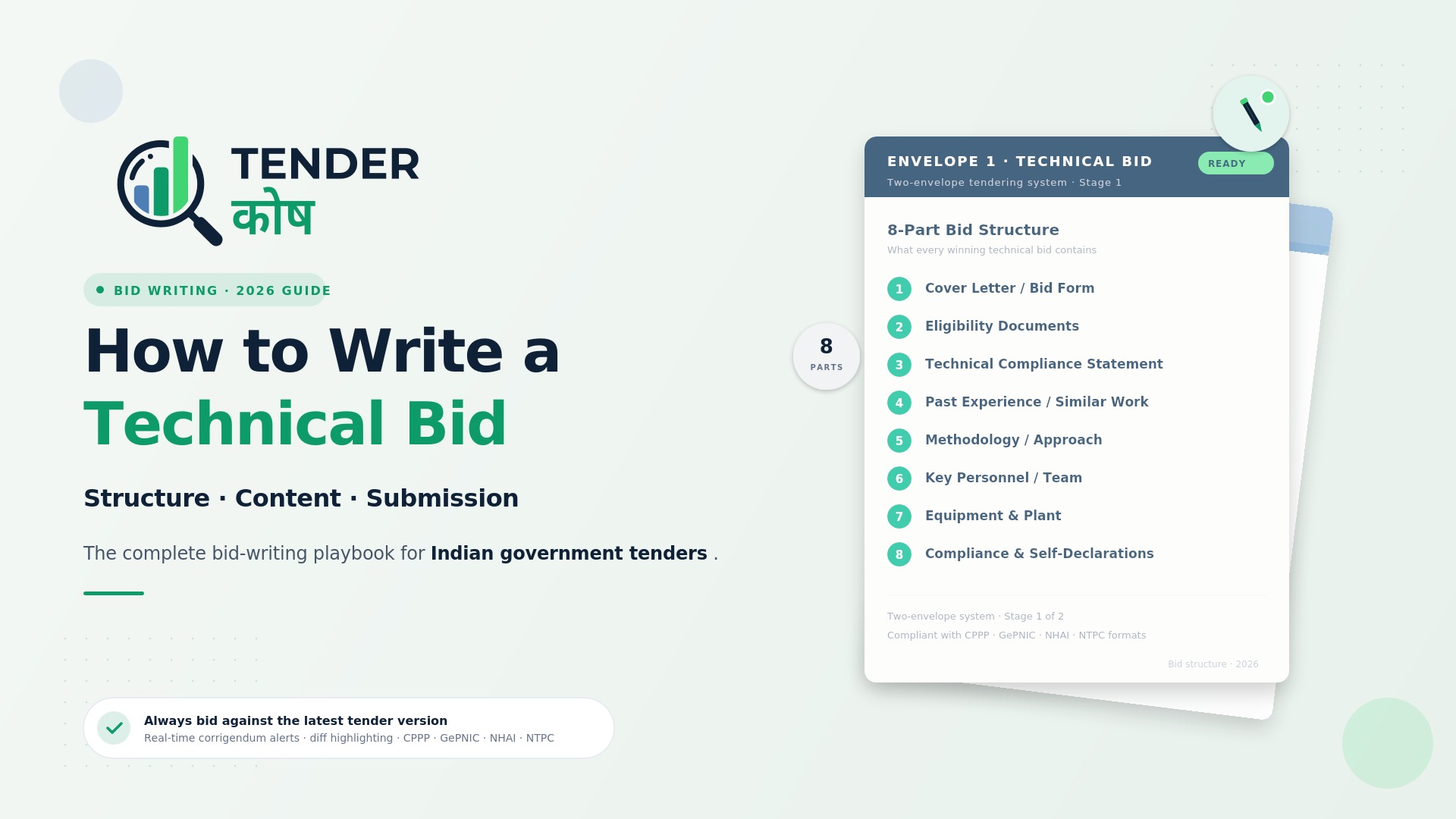
A winning technical bid clears every mandatory eligibility and document requirement without a single gap, then demonstrates your capability in a way that maps directly to the tender’s evaluation criteria.
Because a large share of bids are rejected at technical evaluation before price is even opened, exact compliance and completeness matter as much as genuine capability. Win the technical bid and you earn the right to compete on price; fail it and your quote is never even seen.
Here’s the uncomfortable truth about government tenders: industry estimates suggest roughly 20–30% of bids are rejected at the technical evaluation stage, before the financial bid is ever opened. Nearly one in three bidders never gets their price considered — not because they were too expensive, but because of a missing document, an expired certificate, a “similar work” mismatch, or a methodology that read like a company brochure instead of a project plan.
The good news is that almost all of these failures are preventable. Writing a winning technical bid is far less about eloquence than about discipline: reading the tender precisely, mapping every requirement, evidencing each one, and submitting a complete, corrigendum-checked package on time. This guide walks through exactly how to do that, step by step.
Key Takeaways
On this page
A technical evaluator is not reading your bid to be impressed — they’re reading it to tick boxes against a pre-defined set of criteria published in the tender. Understanding that mindset changes how you write.
Evaluation is either pass/fail against mandatory qualifying criteria, or a scored assessment against a published matrix, or a combination — the tender tells you which. In every case, the evaluator’s job is to confirm, requirement by requirement, that your bid meets what the document asks. If a criterion is mandatory and your bid doesn’t clearly evidence it, the bid is set aside, however capable your firm actually is. A bid that makes the evaluator hunt for information is a bid that loses points or gets rejected.
So the winning move is to make evaluation effortless: present each required element clearly, in the order the tender asks for it, with the proof attached and labelled. You’re writing for a checklist, not for applause. The difference between the technical and financial stages is covered in our guide on technical bid vs financial bid — this article is about winning the first stage.
A winning technical bid follows a repeatable, seven-step process every time — the discipline is what wins, not last-minute effort. Here is the sequence at a glance, expanded in the sections that follow.
Read the NIT, RFP/RFQ, eligibility, and evaluation criteria fully before deciding to bid.
List every requirement and map it to the exact document or page that satisfies it.
Gather every document, check validity dates, formats, and signatures.
Respond to the actual scope and evaluation criteria, not a generic profile.
Match “similar work” and turnover exactly to the tender’s definitions.
Provide CVs and evidence that meet the stated minimum conditions.
Run a second-person review, confirm the latest corrigendum, upload ahead of the deadline.
The single highest-value habit in bidding is reading the entire tender document before you commit a rupee of effort — then honestly deciding whether you qualify. Bidding on a tender you can’t clear is worse than not bidding at all.
Read the NIT, the detailed RFP/RFQ, the eligibility criteria, the technical specifications, and the evaluation methodology in full. Pull out every mandatory condition — turnover, similar-work experience, certifications, key personnel, statutory documents — and check each against your company honestly. If you fail a mandatory criterion you can’t remedy, walk away and spend the effort on a tender you can win. If you’re weighing why one tender’s bar differs from a similar one, our guide on why similar tenders carry different eligibility criteria explains the factors at play.
A compliance matrix is the tool that separates bids that win from bids that get rejected on a technicality. It’s a simple table that turns the tender’s requirements into a checklist you can prove against.
For every requirement in the tender, create a row: the requirement, the tender clause or page it comes from, the document or section of your bid that satisfies it, and a status. Working through this matrix forces you to notice a missing solvency certificate or an unaddressed specification before the evaluator does. It also becomes your submission index, so nothing is left out.
| Tender Requirement | Clause / Page | Your Evidence | Status |
|---|---|---|---|
| Average annual turnover threshold | Eligibility, Cl. X | CA-certified turnover certificate + audited accounts | Met |
| One similar completed work | Eligibility, Cl. Y | Work order + client completion certificate | Met |
| Key personnel — project manager | Technical, Cl. Z | CV with qualifications and experience | Met |
| ISO / sector certification | Technical annexure | Valid certificate copy | Check expiry |
| EMD / bid security | ITB clause | BG / DD / declaration as specified | Met |
The largest category of technical rejections is document failures — missing, expired, wrongly formatted, or unsigned — so this step deserves obsessive attention. Capability doesn’t matter if a mandatory annexure is absent.
Gather every document your compliance matrix calls for, then verify each one against three tests: is it present, is it valid (not expired), and is it in the exact format the tender requires. Pay special attention to items that quietly lapse — ISO or BIS certificates, registrations, and EMD instruments — and to easily-forgotten mandatory items like affidavits, no-blacklisting declarations, integrity pacts, and authorised-signatory proof. A completion certificate must be issued by the actual client; a turnover figure must be evidenced by audited statements, not unaudited records.
Do a second-person document check. The person who prepared the bid is the worst person to check it — they read what they meant to include, not what’s actually there. A structured review by a second person catches a large share of document-related rejections before submission.
Track live tenders with eligibility, technical criteria, document lists, corrigenda, and deadlines across GeM, CPPP, PSUs, and state portals — all in one dashboard.
Where a technical bid is scored rather than just pass/fail, the methodology is where you win or lose points — and a generic, copy-pasted methodology is one of the most common reasons capable firms score low. Evaluators can spot a template instantly.
Write your methodology as a direct response to this specific project. Address the actual scope, site or operating conditions, the sequence and phasing of work, your quality-control and safety approach, resource deployment, and risk mitigation — and structure it so that each scored parameter in the evaluation matrix has a clearly labelled section answering it. If the tender scores “understanding of project”, “work plan”, and “quality assurance” separately, give the evaluator three headed sections they can score directly. The goal is that an evaluator can move down their matrix and tick each criterion from your text without searching.
Map your methodology to the scoring matrix, heading for heading. Before you write, list the scored parameters from the tender. Then write one clearly-titled section per parameter, in the same order. This single habit tends to lift technical scores more than any amount of polished prose, because it makes the evaluator’s job effortless.
“Similar work” is defined by each tender, and experience that looks relevant to you may not satisfy the exact definition — this mismatch rejects more capable bidders than almost anything else. Present your experience in the tender’s terms, not your own.
Read the tender’s exact definition of similar work — the type, value, components, and look-back period — and then select and present the completed projects that map to it precisely. Pair every work order with its client-issued completion certificate, and make sure each certificate states the project value, completion date, and nature of work in a way that matches the qualifying parameters. Equally, calculate turnover on the exact basis the tender specifies: some tenders count only relevant turnover rather than total, and some require specific financial years — using the wrong basis is a frequent, avoidable disqualifier.
For technically demanding tenders, named key personnel and evidenced equipment are mandatory conditions, and shortfalls here are as fatal as a missing certificate. Match your team and resources to the exact stated minimums.
Provide CVs for each named role the tender requires — project manager, engineers, quality and safety leads — ensuring every CV demonstrates the minimum qualification and years of experience the tender specifies. Where equipment ownership or assured availability is required, attach the proof the tender asks for. Don’t assume an evaluator will infer capability; state it explicitly and evidence it, role by role and item by item, so each maps to a requirement in your compliance matrix.
The last step is where otherwise-winning bids are lost — to a missed corrigendum or a last-minute upload that fails at the deadline. Build in time for a proper review and an early submission.
Run your completed bid against the compliance matrix one final time, ideally with a second reviewer. Then — critically — check the portal for the latest corrigendum: an amendment issued after you downloaded the tender can change eligibility, specifications, required documents, or the deadline, and a bid that doesn’t reflect it can be rejected even if it’s otherwise perfect. Finally, upload well before the deadline. E-procurement portals lock at the exact closing time, and a slow connection, a large file, or a portal query you miss can cost you the bid in the final minutes.
Nearly every technical rejection traces back to a short list of recurring, avoidable mistakes. Guarding against these is most of what winning requires.
Run this checklist before every submission — it turns the whole process above into a repeatable final gate.
A winning technical bid clears every mandatory eligibility and document requirement without a single gap, then demonstrates capability in a way that maps directly to the tender’s evaluation criteria. Because a large share of bids are rejected at technical evaluation before price is even opened, completeness and exact compliance matter as much as capability.
Most technical rejections are procedural, not capability gaps: a missing or expired document, similar-work experience that doesn’t match the tender’s definition, turnover calculated on the wrong basis, a generic methodology, or a missed corrigendum. A capable company can lose purely on a documentation slip.
Common examples include company registration, GST and PAN, audited financials and turnover proof, similar-work experience (work orders paired with completion certificates), key-personnel CVs, equipment details, quality certifications, EMD or bid security, and any mandatory affidavits or declarations. The exact checklist must be taken from the specific tender’s NIT, RFP/RFQ, and submission instructions.
Write a project-specific methodology that responds point by point to the tender’s scope, technical specifications, and evaluation criteria, rather than a generic company profile. Address the actual site or project conditions, sequence of work, quality and safety approach, and how you meet each scored parameter, so an evaluator can tick their matrix directly from your text.
Yes. A corrigendum can change eligibility, specifications, required documents, or the deadline after you download the tender. A bid that does not reflect an applicable corrigendum can be rejected at technical evaluation even if it is otherwise perfect, so always check for the latest corrigendum before submitting.
Winning a technical bid is a discipline, not a talent. The firms that consistently clear technical evaluation aren’t necessarily the most capable — they’re the ones who read the tender fully, map every requirement to evidence, write to the evaluator’s scoring matrix, verify every document twice, and submit early with the latest corrigendum incorporated.
Build that process once and run it every time, and you stop losing bids you were fully qualified to win — and start reaching the financial stage, where your price finally gets its chance.
Note: Technical bid requirements, evaluation methods, and mandatory documents vary by tender and are set out in each tender’s NIT, RFP/RFQ, and evaluation criteria, in line with the General Financial Rules (GFR) 2017 and the procuring authority’s own manual. Always treat the specific tender document as the authoritative source. Central tenders are published on the Central Public Procurement Portal, eprocure.gov.in.
This article is general information, not advice. It has been compiled from publicly available sources — government releases and notifications, official portals, published tender documents and trade reporting — and reflects our understanding at the time of writing. It is not legal, financial, tax or professional advice, and it does not create any advisory relationship.
Public procurement changes constantly. Tender terms, eligibility criteria, thresholds, fees, deadlines, scheme conditions and government policy are revised frequently, often through corrigenda issued mid-window and sometimes without wide notice. Figures and rules that were accurate when published may already have changed by the time you read this.
Always verify against the primary source before you act or bid. The tender document, the issuing authority's official portal and the relevant government notification are the authoritative sources. Where anything in this article differs from them, the official source prevails. Do not rely on this page — or on any third-party summary — as the basis for a bid, an investment or a compliance decision.
TenderKosh is a private tender-intelligence platform. We are not a government body, and we are not affiliated with, endorsed by or acting on behalf of any government department, ministry, PSU or procurement portal. Names, marks and portals referenced belong to their respective owners and are used for identification only. External links are provided for convenience; we do not control and are not responsible for third-party content.
While we take reasonable care, we make no warranty as to the accuracy, completeness or currency of this content, and accept no liability for any loss or damage arising from reliance on it.Spotted something wrong or out of date? Please tell us at support@tenderkosh.com — we correct errors promptly.See our full Disclaimer.
Discover relevant tenders, monitor corrigenda, compare opportunities, and move from document reading to structured action.