TenderKosh for EPC teams
Turn tender reading into faster bidding decisions.
Discover relevant tenders, monitor corrigenda, compare opportunities, and move from document reading to structured action.
If you’ve ever tried to chase government tenders in India, you already know the problem.
You log into GeM in the morning. Switch to the CPP Portal at lunch. Open SECI’s tender page in the evening because someone on a WhatsApp group mentioned a 700 MW solar bid. By the time you’ve finished refreshing tabs, half the day is gone — and you still don’t know whether you missed something on a state PSU portal nobody told you about.
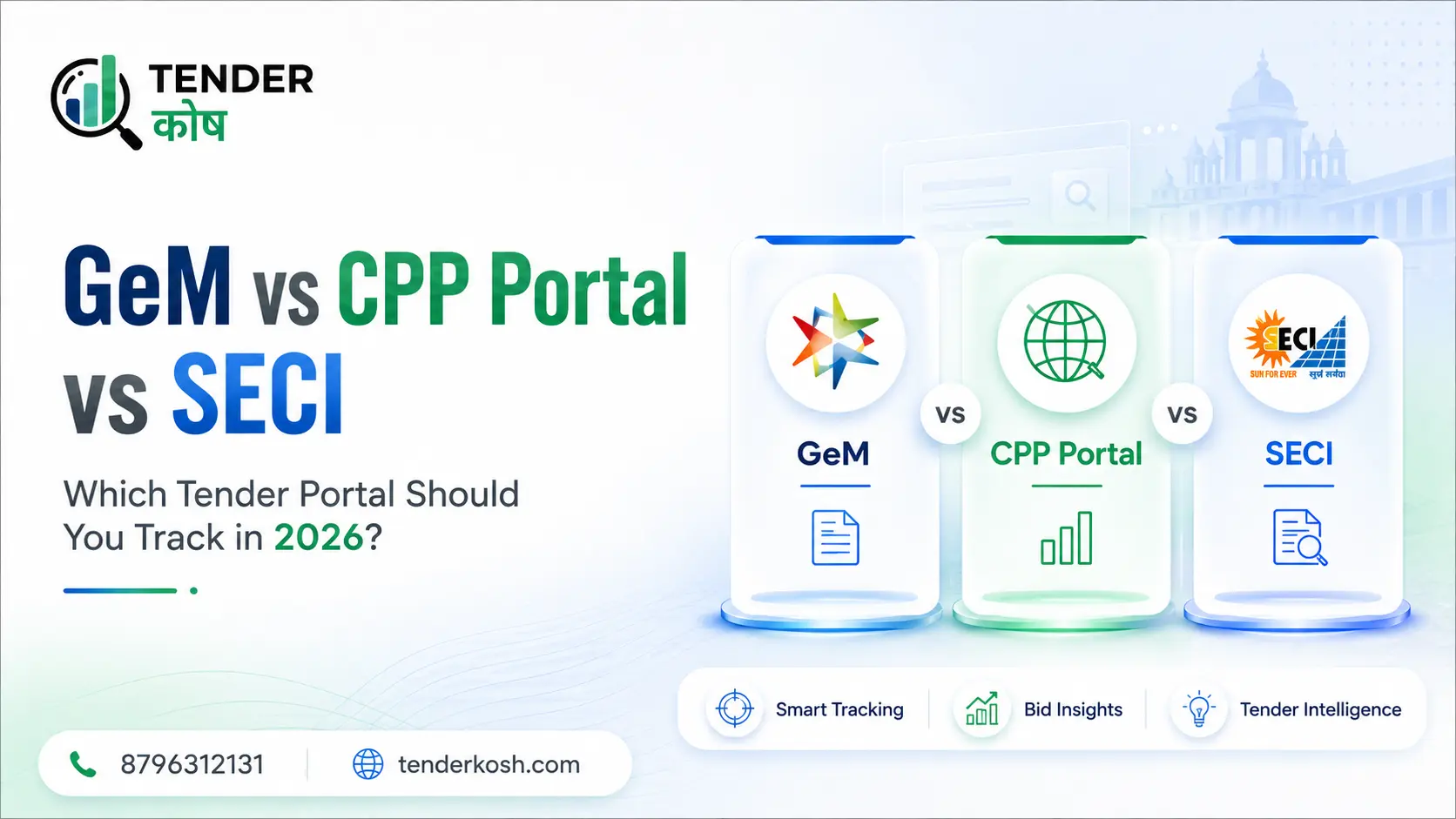
So which tender portal should you actually track? This GeM vs CPP Portal vs SECI guide explains which platform matters most for your business category.
The honest answer: it depends on what you sell, and “just one” is almost always the wrong answer. Let’s break down what each portal really is, who it’s built for, and where the smart money is going for tender intelligence in 2026.
To explore active and upcoming opportunities, you can visit:
| Feature | GeM | CPP Portal | SECI |
|---|---|---|---|
| Full name | Government e-Marketplace | Central Public Procurement Portal | Solar Energy Corporation of India |
| URL | gem.gov.in | eprocure.gov.in | seci.co.in |
| Owned by | Govt. of India (100%) | NIC, Dept. of Expenditure | Navratna CPSU under MNRE |
| Primary purpose | End-to-end marketplace for goods & services | Single-window publishing of central govt. tenders | Renewable energy tendering & implementation |
| Who can buy | Central, State, PSUs, autonomous bodies | All Central Govt. bodies (mandatory) | DISCOMs, govt. agencies via SECI |
| Who can sell | Any registered seller (including MSMEs) | Any eligible bidder | RE developers, EPC contractors, OEMs |
| Tender types | Direct purchase, L1, bidding, reverse auction | e-publishing + e-procurement | RFS, NIT, RfP for solar, wind, hybrid, BESS |
| Best for | Standard goods, services, MSME products | Tracking PAN-India central govt. bids | Renewable energy developers & suppliers |
| Mandatory since | 2017 (for many categories) | 2012 | — (sector-specific) |
Now let’s look at each one properly.
The Government e-Marketplace (GeM) is India’s national online marketplace for government procurement. It launched in 2016 and was made mandatory for many procurement categories in 2017.
Think of GeM as the “Amazon for government buyers.” Central ministries, state governments, PSUs, and autonomous bodies can directly purchase goods and services from registered sellers, with built-in tools for e-bidding, reverse auctions, and demand aggregation.
What you’ll find on GeM:
Best suited for: MSMEs, manufacturers, service providers, and traders who supply commonly procured goods or services. If you sell a product or service that any government office could need, GeM is non-negotiable.
Limitations to know:
The Central Public Procurement Portal (CPPP or CPP Portal) at eprocure.gov.in is the older sibling. Built and run by the National Informatics Centre (NIC) under the Department of Expenditure, it’s been mandatory since 2012 for all Central Government Ministries, Departments, Central Public Sector Enterprises (CPSEs), and Autonomous & Statutory Bodies to publish their tender enquiries here.
CPPP has two distinct modules:
What you’ll find on CPP Portal:
Best suited for: Contractors and bidders who work with central government departments, CPSEs, and large public sector clients infrastructure, defence (non-classified), railways, PSUs in oil & gas, power, telecom, etc.
Limitations to know:
Solar Energy Corporation of India (SECI) is a Navratna CPSU under the Ministry of New and Renewable Energy. It’s the single largest renewable energy implementing agency in India and has run roughly a quarter of the country’s utility-scale RE tendering capacity in recent years.
SECI tenders are not your everyday goods-and-services bids. They are large, structured, sector-specific instruments — typically tariff-based competitive bidding for solar PV, wind, hybrid, Battery Energy Storage Systems (BESS), Firm and Dispatchable RE (FDRE), and pumped storage.
What you’ll find on SECI:
Best suited for: RE developers (IPPs), EPC contractors, OEMs of solar modules/inverters / BESS, transmission consultants, and specialised service providers in the clean-energy space.
Limitations to know:
Here’s the uncomfortable truth most contractors learn the hard way:
You rarely get to track just one.
A solar EPC company has to monitor SECI and CPPP (because state DISCOM tenders sit there) and GeM (because government buyers procure inverters, cables, and O&M services there). A stationery supplier living on GeM will still want CPPP visibility for large CPSE bulk orders. A defence-adjacent contractor will track CPPP, defproc.gov.in, and the relevant PSU portals.
Here’s a rough rule of thumb:
Now multiply that by the number of state portals (Maharashtra, Tamil Nadu, Karnataka, Gujarat, UP each have their own e-procurement systems), PSU-specific portals (Defence, Indian Railways, NTPC, ONGC, Coal India), and you’re looking at 15–50+ websites to monitor for a single business.
That’s where the real problem starts.
Most businesses run tender tracking with one of two methods:
Here’s what that costs you:
A serious bidder doesn’t need more portals. They need one place that pulls from all of them, filtered to what their business can actually win.
TenderKosh is built around a simple idea: stop treating GeM, CPP Portal, SECI, and every state and PSU portal as separate problems. Treat them as one stream of opportunity, filtered to your business.
What that looks like in practice:
Instead of asking “which portal should I track?”, you ask the better question: “Which tenders, across every portal, can my business win this month?“
That’s the shift TenderKosh is built for.
No. GeM is a transactional marketplace where government buyers can directly purchase goods and services. The CPP Portal is primarily a publishing and e-procurement platform for tender notices and bid submissions across central government bodies. They are integrated bids on CPPP get a GeM-generated GeMARPTS ID but they serve different functions.
No. While SECI’s flagship RFS tenders for utility-scale solar and wind are dominated by large IPPs, SECI also issues smaller rooftop solar tenders under RESCO mode, EPC packages, and service contracts that MSME-scale developers and contractors can bid on.
Yes. Each portal has its own registration and authentication requirements. GeM requires seller onboarding with a catalogue listing. CPPP needs bidder enrolment with a Digital Signature Certificate (DSC). SECI tenders are often published on third-party bidding portals (like TCIL or ISN-ETS) which need their own registration.
Yes, viewing and downloading tender documents on both GeM and the CPP Portal is generally free. Some specific tenders may have a tender fee or processing fee at the time of submission, mentioned in the NIT.
TenderKosh aggregates publicly published tender notices from official government sources and structures them into a single, searchable, alert-driven platform. The data is from official portals; the value is in unification, filtering, and intelligence on top of it.
GeM, CPP Portal, and SECI aren’t competing portals — they’re three different windows into how the Indian government procures. Each one matters for different business categories, and each one is impossible to ignore if you’re serious about government tenders.
But asking “which one should I track?” is the wrong frame. The businesses winning consistently in 2026 are the ones tracking all the portals their business touches — without spending three hours a day doing it.
That’s the problem TenderKosh exists to solve. One platform, every relevant tender, filtered to what you can actually win.
Have a question about a specific portal or sector? Drop it in the comments — we read every one and turn the best ones into future guides.
For more details or support, feel free to contact our team.
Contact Tender Kosh
This article is general information, not advice. It has been compiled from publicly available sources — government releases and notifications, official portals, published tender documents and trade reporting — and reflects our understanding at the time of writing. It is not legal, financial, tax or professional advice, and it does not create any advisory relationship.
Public procurement changes constantly. Tender terms, eligibility criteria, thresholds, fees, deadlines, scheme conditions and government policy are revised frequently, often through corrigenda issued mid-window and sometimes without wide notice. Figures and rules that were accurate when published may already have changed by the time you read this.
Always verify against the primary source before you act or bid. The tender document, the issuing authority's official portal and the relevant government notification are the authoritative sources. Where anything in this article differs from them, the official source prevails. Do not rely on this page — or on any third-party summary — as the basis for a bid, an investment or a compliance decision.
TenderKosh is a private tender-intelligence platform. We are not a government body, and we are not affiliated with, endorsed by or acting on behalf of any government department, ministry, PSU or procurement portal. Names, marks and portals referenced belong to their respective owners and are used for identification only. External links are provided for convenience; we do not control and are not responsible for third-party content.
While we take reasonable care, we make no warranty as to the accuracy, completeness or currency of this content, and accept no liability for any loss or damage arising from reliance on it.Spotted something wrong or out of date? Please tell us at support@tenderkosh.com — we correct errors promptly.See our full Disclaimer.
Discover relevant tenders, monitor corrigenda, compare opportunities, and move from document reading to structured action.