TenderKosh for EPC teams
Turn tender reading into faster bidding decisions.
Discover relevant tenders, monitor corrigenda, compare opportunities, and move from document reading to structured action.
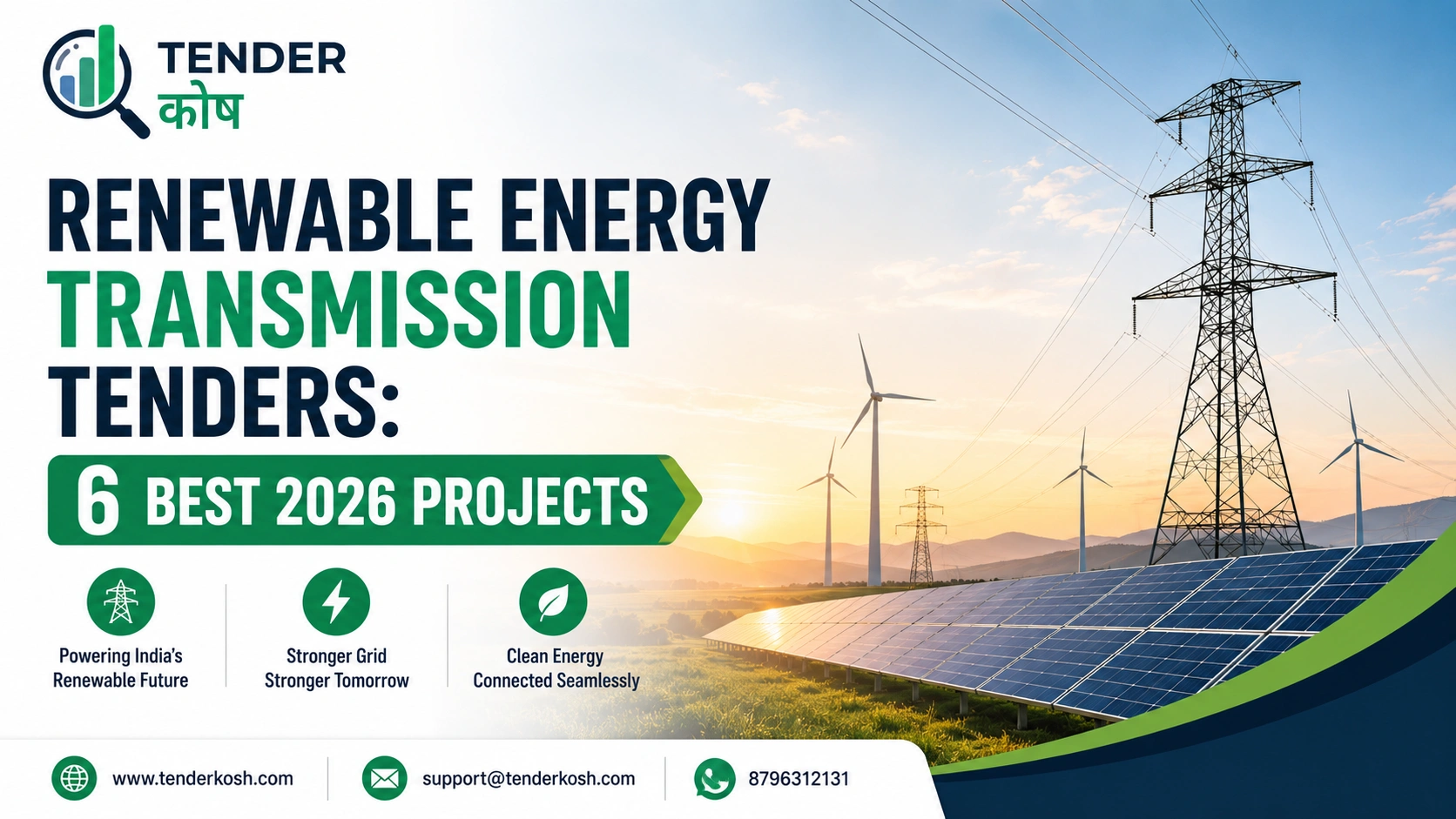
Renewable energy transmission tenders build the lines and substations that carry power out of renewable energy zones. Inter-state projects are awarded through Tariff-Based Competitive Bidding, run mainly by PFC Consulting and RECPDCL, on a build-own-operate-transfer basis.
Renewable energy transmission tenders run at enormous scale — single tenders in 2026 have covered evacuation of 14 GW. So are the qualification bars: one Gujarat tender sought minimum net worth in the region of ₹15 billion. For most firms the opportunity is not the transmission licence itself but the supply chain underneath it.
India’s renewable target is usually discussed in terms of generation capacity. The harder problem is moving the electricity. A solar park in Kutch or a wind cluster in Anantapur is worthless without a 765 kV corridor carrying the power to demand centres a thousand kilometres away — and that corridor has to be tendered, financed, built and energised on roughly the same timeline as the generation it serves.
The scale behind renewable energy transmission tenders is difficult to overstate. National planning has anticipated something in the order of 190,000 circuit kilometres of transmission lines and 1,270 GVA of transformation capacity to support the renewable capacity envisaged by 2032. That programme is being delivered through a steady stream of competitively bid projects, and 2026 has been a heavy year for renewable energy transmission tenders.
This guide covers how renewable energy transmission tenders work, who issues them, the projects worth watching, what it actually takes to qualify — and, for the great majority of readers who cannot bid as a transmission developer, where the accessible work sits.
Key Takeaways
Generation can be built in eighteen months. A 1,200 km high-voltage corridor cannot — which is the whole reason renewable energy transmission tenders exist. That mismatch is the central scheduling problem in India’s energy transition, and it is why renewable energy transmission tenders are issued in advance of, and sized against, the generation they will serve.
Geography compounds the demand for renewable energy transmission tenders. India’s best solar and wind resources sit in Gujarat, Rajasthan, Karnataka, Andhra Pradesh and Tamil Nadu, while much of the demand sits elsewhere. The result is a programme of renewable energy zones, each with a pooling station and an evacuation scheme tendered separately — Khavda, Lakadia, Jam Khambhaliya, Ananthapuram and Tumkur recur through the 2026 pipeline.
What that means commercially. Because these schemes are planned around specific generation clusters, the transmission pipeline is a reliable leading indicator of where generation build-out will follow. A firm watching where evacuation schemes are tendered has advance sight of where solar, wind and storage work will appear eighteen to thirty-six months later.
Renewable energy transmission tenders are decided by Tariff-Based Competitive Bidding, which selects a transmission service provider on price alone, once technical qualification is settled. The mechanism differs from ordinary tendering in ways worth understanding.
| Stage | What Happens |
|---|---|
| Scheme planning | The transmission scheme is planned centrally against a renewable energy zone and its expected capacity |
| RFP issue | A bid process coordinator issues the request for proposal, with scope, timelines and qualification criteria |
| Qualification | Bidders are assessed on financial and technical criteria — net worth, completed infrastructure payments, experience |
| E-reverse auction | Qualified bidders compete downward on the levelised annual transmission tariff |
| Award | Lowest levelised tariff wins; letter of intent issued; performance guarantee furnished |
| Build | Commonly a 36-month scheduled commercial operation period from award |
| Operate | Long-term transmission service agreement, with O&M periods commonly set at 35 years from commercial operation |
The commercial consequence of BOOT. You are not paid a contract price to build an asset; you fund it, own it, and earn a tariff over decades. That converts a construction tender into an infrastructure investment with a thirty-five-year horizon — which is precisely why the qualification bars look the way they do, and why the bidder list is short.
Renewable energy transmission tenders come from bid process coordinators, not a single portal.
| Body | Role | What to Watch |
|---|---|---|
| PFC Consulting (PFCCL) | Bid process coordinator; subsidiary of Power Finance Corporation | The majority of recent inter-state RFPs for renewable evacuation |
| RECPDCL | Bid process coordinator; subsidiary of REC Limited | Large ISTS packages awarded through TBCB |
| CTUIL | Central Transmission Utility — planning, plus its own tenders | Independent engineer appointments; note some tenders get annulled and re-issued |
| Ministry of Power | Publishes TBCB notifications and RFP documents | The consolidated view of what is out for bid |
| State transmission utilities | Intra-state schemes, some also via TBCB | Smaller packages with lower entry bars |
These renewable energy transmission tenders illustrate the shape and scale of the 2026 pipeline. Several bid windows have closed or been awarded — they are included because the pattern repeats and the next tranche will look similar. Verify any live tender with the issuing coordinator before acting.
PFC Consulting tendered an inter-state system to evacuate up to 14 GW, covering Lakadia Phase-II (7.5 GW), Jam Khambhaliya Phase-II (5.5 GW) and Jamnagar Phase-I Part C (1 GW). Scope ran from survey and detailed project report through financing, design, construction and O&M on a BOOT basis, with completion required within 36 months of award.
Why it matters: a single tender covering 14 GW of evacuation signals where the largest generation build-out is expected to land.
A separate PFC Consulting scheme requiring a 765/400 kV substation with four 1,500 MVA transformers and a 400/220 kV substation with ten 500 MVA transformers, plus 765 kV double-circuit lines from Kalyanpur to Jamnagar and toward the Saurashtra region near Rajkot. Bid bond was set around ₹760 million with performance guarantee near ₹1.9 billion.
Why it matters: the transformer and line quantities here are the clearest signal of downstream equipment demand in the pipeline.
Integration of 3 GW from the Ananthapuram-III renewable energy zone, with 3×1,500 MVA 765/400 kV and 7×500 MVA 400/220 kV substations at the pooling station, a ±300 MVAR STATCOM, and the Ananthapuram-III–Krishnagiri 765 kV double-circuit line. EMD was set around ₹319 million with performance guarantee near ₹797.5 million, and O&M at 35 years from commercial operation.
Why it matters: the most completely specified example in this list — a useful template for what a REZ evacuation package contains.
Augmentation of the Tumkur-II pooling station with additional 400/220 kV, 500 MVA interconnecting transformers, the Tumkur-II–Madhugiri 400 kV quad double-circuit line, and a ±300 MVAr static synchronous compensator with switching arrangements for bus reactors under implementation.
Why it matters: augmentation packages are smaller than greenfield corridors, which makes them the more realistic tier for mid-sized transmission developers.
The Khavda renewable energy zone in Gujarat has been tendered in successive phases, including a Phase-IV package of around 7 GW and a Phase-V package of around 8 GW. The Phase-V Part A award to Power Grid comprised 6,000 MW ±800 kV HVDC terminals at Khavda and Nagpur with a bipole line of roughly 1,200 km, plus associated interconnections.
Why it matters: HVDC at this scale is a specialist market with very few capable suppliers globally — and long equipment lead times.
A Rajasthan renewable energy zone programme of around 20 GW under Phase-III, tendered in parts, alongside other schemes including a Madhya Pradesh solar energy zone package and dynamic reactive compensation at Khavda pooling stations.
Why it matters: programmes tendered in parts create repeated, similar packages — learn the format once and you can bid the series.
Transmission schemes surface across PFC Consulting, RECPDCL, CTUIL, the Ministry of Power, GeM, CPPP and state utilities — and the EPC and supply packages appear months later. Track them all in one dashboard, filtered by category, value and state, with corrigendum alerts.
Being direct about this saves readers weeks: almost nobody qualifies to bid these as a transmission service provider. The financial bars restrict the field to a handful of large developers and utilities.
The 6.5 GW Gujarat scheme illustrates the scale of qualification in renewable energy transmission tenders. Bidders needed a minimum net worth in the region of ₹15 billion across the last three financial years, with no negative year, alongside a qualifying track record of payments received for completed infrastructure projects over five years — in the region of ₹38 billion in aggregate, with individual projects above a substantial minimum. Smaller schemes carry proportionally smaller bars, but they remain in the billions rather than the crores.
Consortiums are permitted, within limits. Transmission RFPs typically allow consortium participation with conditions — for instance a minimum equity share for the lead member, and a requirement that the selected bidder retain a majority holding for a defined period after commercial operation. That lock-in matters: it prevents a qualifying partner from exiting immediately after award. If you are considering this route, our guide to joint venture bidding covers how pooling works and what each member must still meet individually.
For how financial thresholds are constructed generally — turnover, net worth, solvency and experience — see our guide to tender pre-qualification criteria.
Every one of these renewable energy transmission tenders creates a procurement programme underneath it, and that is where most firms will find work. The developer who wins the licence does not manufacture transformers or string conductors itself.
| Opportunity | What It Involves | Timing |
|---|---|---|
| EPC and erection subcontracts | Tower erection, foundations, stringing, substation civil and electrical works | Awarded by the winning developer after financial close |
| Equipment supply | Transformers, reactors, STATCOM and reactive compensation, switchgear, protection systems | Long-lead items ordered early in the 36-month window |
| Towers and conductors | Fabrication and galvanising, conductor supply | Sustained demand across the whole programme |
| Survey, DPR and engineering | Route survey, geotechnical work, detailed project reports, design consultancy | Earliest stage — often before the main award |
| Right-of-way and land services | Land acquisition support, compensation, forest and wildlife clearances | Runs alongside construction; frequently on the critical path |
| Independent engineer appointments | Third-party monitoring and certification of scheme execution | Tendered separately by the transmission utility |
The independent engineer route is worth knowing about. The central transmission utility separately tenders appointments of independent engineers for named schemes — Khavda phases, Rajasthan REZ packages, substation augmentations. These are consultancy engagements with qualification bars set for engineering firms rather than infrastructure developers, and they are publicly tendered. If you are an engineering consultancy in the power sector, that is a live and accessible channel.
There is no single feed for renewable energy transmission tenders, which is the practical difficulty. A complete view means watching several channels at once.
That last point deserves emphasis. Across renewable energy transmission tenders, the award is the signal that matters most for suppliers. For most readers the useful signal is not the RFP but the award, because the supply-chain procurement follows it. Tracking who wins a corridor gives you a several-month head start on the EPC and equipment packages that follow.
They are tenders to build the lines and substations that carry power from renewable energy zones to where it is consumed. Most inter-state projects are awarded through Tariff-Based Competitive Bidding, where a bidder is selected on the lowest levelised annual transmission tariff and then builds, owns, operates and eventually transfers the asset, typically with a 35-year service period from commercial operation.
Schemes are planned centrally and then run by bid process coordinators. PFC Consulting, a subsidiary of Power Finance Corporation, and REC Power Development and Consultancy, a subsidiary of REC Limited, are the two principal coordinators for inter-state projects. The Central Transmission Utility of India handles planning and separately tenders supporting appointments, and the Ministry of Power publishes TBCB notifications.
Tariff-Based Competitive Bidding is the process used to select a transmission service provider. Qualified bidders compete in an electronic reverse auction and the project is awarded to whoever quotes the lowest levelised annual transmission tariff. The winner develops the project on a build, own, operate and transfer basis under a long-term transmission service agreement.
The bars are very high and scale with project size. One 2026 tender for a 6.5 GW evacuation scheme in Gujarat required a minimum net worth in the region of ₹15 billion across the last three financial years with no negative year, alongside substantial payments received for completed infrastructure projects over five years. Consortium participation is generally permitted, with minimum equity conditions on the lead member and on the selected bidder for a period after commercial operation.
Recent inter-state tenders have specified a scheduled commercial operation period of around 36 months from award, followed by an operation and maintenance period commonly set at 35 years from the commercial operation date. That construction window is what creates the supply-chain demand for towers, conductors, transformers, reactive compensation equipment and specialist erection contractors.
Not usually as the transmission service provider, because the net worth and track record requirements exclude all but the largest developers. The realistic route is the supply chain underneath: EPC and erection subcontracts awarded by the winning developer, equipment supply, survey and detailed project report work, right-of-way and land services, and separately tendered appointments such as independent engineers.
A renewable energy zone is an area identified as having concentrated solar or wind resource, around which a pooling station and evacuation scheme are planned. Power from multiple generation projects in the zone is collected at the pooling station and carried out on high-voltage corridors. Khavda, Lakadia, Jam Khambhaliya, Ananthapuram and Tumkur are examples that recur across the current tender pipeline.
Renewable energy transmission tenders are among the largest infrastructure procurements running in India, and among the least accessible. A minimum net worth in the billions and a thirty-five-year ownership horizon put the transmission licence itself beyond nearly everyone.
That is not a reason to ignore renewable energy transmission tenders. Every awarded corridor generates years of subcontract, supply, survey and consultancy work, and separately tendered appointments like independent engineers sit at bars an engineering firm can actually clear. Watch the awards as closely as the RFPs — because for most firms the winning developer is not a competitor, but the customer.
Note on figures: project capacities, bid security amounts, net worth thresholds, scope details and timelines above are drawn from public trade reporting and tender announcements — including Mercom India, Renewable Watch, Enerdata and SolarQuarter — current at the time of writing. Several bid windows referenced have closed or been awarded, and tenders are sometimes annulled and re-issued. Figures are indicative of the shape and scale of the pipeline, not a live tender list. Confirm any specific tender’s status, scope, qualification criteria and deadline with the issuing bid process coordinator or transmission utility before acting.
This article is general information, not advice. It has been compiled from publicly available sources — government releases and notifications, official portals, published tender documents and trade reporting — and reflects our understanding at the time of writing. It is not legal, financial, tax or professional advice, and it does not create any advisory relationship.
Public procurement changes constantly. Tender terms, eligibility criteria, thresholds, fees, deadlines, scheme conditions and government policy are revised frequently, often through corrigenda issued mid-window and sometimes without wide notice. Figures and rules that were accurate when published may already have changed by the time you read this.
Always verify against the primary source before you act or bid. The tender document, the issuing authority's official portal and the relevant government notification are the authoritative sources. Where anything in this article differs from them, the official source prevails. Do not rely on this page — or on any third-party summary — as the basis for a bid, an investment or a compliance decision.
TenderKosh is a private tender-intelligence platform. We are not a government body, and we are not affiliated with, endorsed by or acting on behalf of any government department, ministry, PSU or procurement portal. Names, marks and portals referenced belong to their respective owners and are used for identification only. External links are provided for convenience; we do not control and are not responsible for third-party content.
While we take reasonable care, we make no warranty as to the accuracy, completeness or currency of this content, and accept no liability for any loss or damage arising from reliance on it.Spotted something wrong or out of date? Please tell us at support@tenderkosh.com — we correct errors promptly.See our full Disclaimer.
Discover relevant tenders, monitor corrigenda, compare opportunities, and move from document reading to structured action.