TenderKosh for EPC teams
Turn tender reading into faster bidding decisions.
Discover relevant tenders, monitor corrigenda, compare opportunities, and move from document reading to structured action.
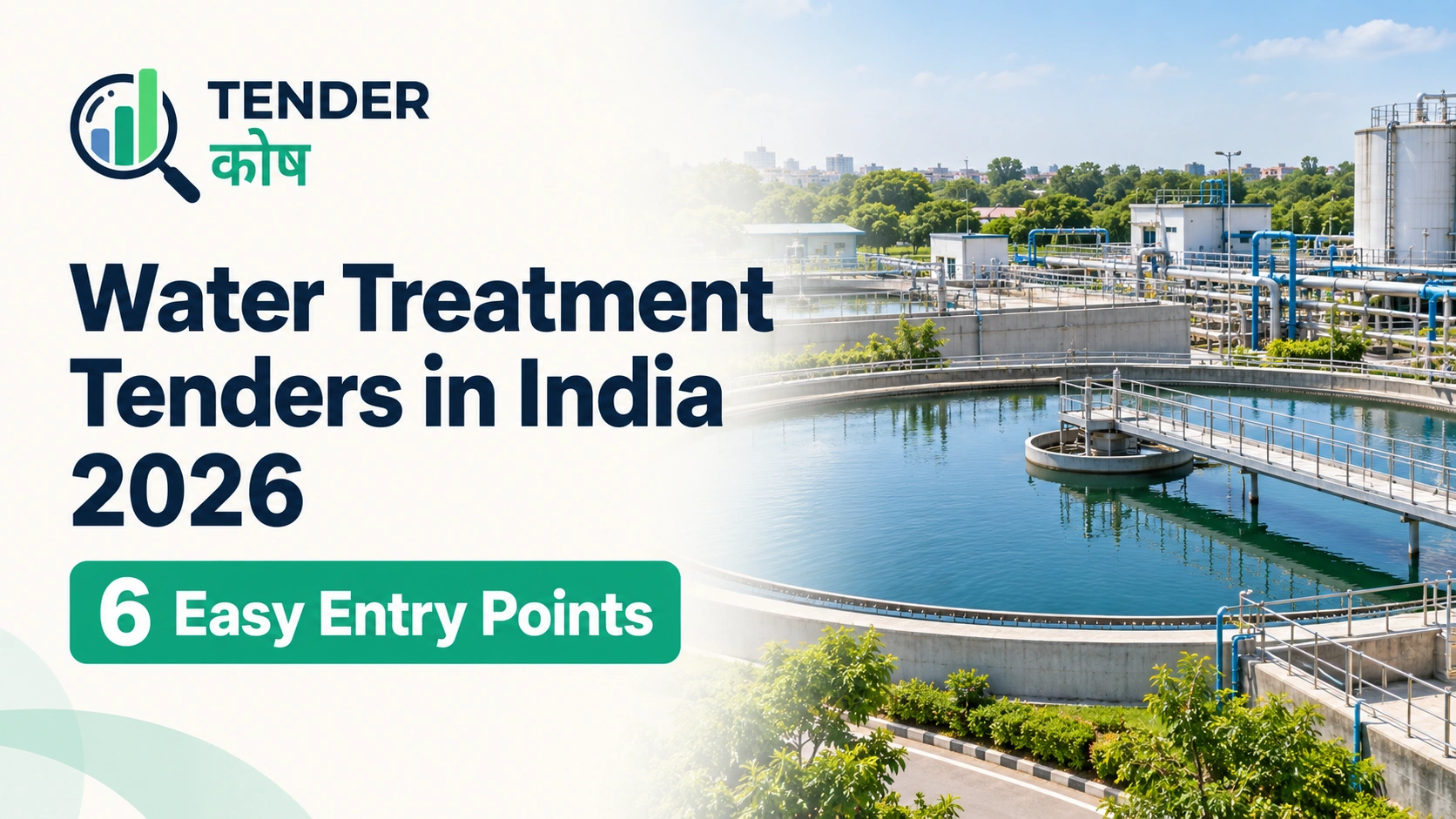
Water treatment tenders in India 2026 are driven mainly by two programmes — Jal Jeevan Mission, whose restructured JJM 2.0 phase was approved in March 2026 with a rural coverage target of 2028, and AMRUT 2.0 for urban water and sewerage.
Unusually for infrastructure, this market is accessible at almost every scale. The same pipeline carries packages worth over ₹1,600 crore and maintenance contracts worth a few lakh. The catch is the O&M tail: five and ten-year obligations are routinely attached to construction, and that is where contracts are won or lost financially.
Water is the least glamorous and most consistently funded corner of Indian public procurement. It does not attract the coverage that solar auctions or highway packages do, and that is precisely why it rewards attention: demand is structural rather than cyclical, every state is buying, and the tender sizes range so widely that a two-person firm and a listed EPC major can both find work in the same programme.
The scale is substantial. Aggregator listings of water treatment tenders for 2026 indicate several hundred live water treatment plant tenders and several thousand water supply tenders under Jal Jeevan Mission alone — figures worth treating as an indication of volume rather than an official count, but the direction is unambiguous.
This guide covers what is funding the water treatment tenders pipeline, the types of water treatment tenders you will actually meet, real packages from the 2026 market, the O&M structure that decides profitability, and where firms of each size can realistically enter.
Key Takeaways
Water treatment tenders are programme-driven, which makes the pipeline unusually predictable. Understanding which scheme funds a tender tells you a good deal about its scope, its O&M structure and how long the flow of similar packages will continue.
| Programme | What It Funds | What It Means for Bidders |
|---|---|---|
| Jal Jeevan Mission / JJM 2.0 | Rural drinking water supply — sources, WTPs, pumping, distribution to households | JJM 2.0 was approved in March 2026 targeting rural coverage by 2028, so packages continue to flow. Long O&M obligations are common. |
| AMRUT 2.0 | Urban water supply, sewerage and septage management in towns and cities | Drives municipal WTP construction and sewer networks, often with five-year O&M attached. |
| Namami Gange and river programmes | Sewage treatment and interception in river basins | STP-heavy, with discharge-standard compliance obligations. |
| State schemes and disaster restoration | State water supply schemes; restoration of rain and flood damage to existing works | Smaller, faster-moving packages — often the most accessible tier. |
| Industrial and institutional | ETPs, zero liquid discharge, campus and facility WTP/STP maintenance | Driven by compliance rather than scheme funding, so demand is steady and less seasonal. |
Why programme funding matters practically. When central funds are released to states under a scheme, tendering follows within months. In April 2026, for instance, central funds were released under JJM 2.0 across several states including Uttar Pradesh, Chhattisgarh, Madhya Pradesh, Odisha and Maharashtra. Fund release announcements are a usable leading indicator of where packages will appear next.
Five structures cover most water treatment tenders, and each demands different credentials.
| Type | Scope | Typical Bidder |
|---|---|---|
| WTP construction / EPC | Survey, DPR, design, build and commission a drinking water treatment plant, often with intake works and pumping stations | Water EPC firms and large civil contractors |
| STP and sewerage | Sewer network laying, jointing, testing plus a sewage treatment plant, sometimes bundled across several towns | Contractors combining trenching, pipe-laying and plant construction |
| Operation & maintenance | Running an existing plant to performance standards for a defined term — often one to three years, sometimes longer | Specialist O&M and facility service firms |
| Equipment supply and installation | Chlorinators and dosing systems, filter media, RO units, pumps, instrumentation | Manufacturers, distributors, small installers |
| Comprehensive AMC | Bundled maintenance of WTP, STP, ETP and allied systems at a campus or facility | Multi-discipline maintenance contractors |
WTP and STP are not interchangeable. A water treatment plant makes raw water fit for supply; a sewage treatment plant treats used water before discharge or reuse. Different process technology, different compliance regime, and frequently a different department issuing the tender. Credentials in one do not automatically qualify you for the other — check how the tender defines similar work before assuming your experience certificates count.
These illustrate the range rather than serving as a live list. Several have closed. Verify any current tender on the issuing authority’s portal before acting.
A drinking water supply project drawing from Jakham Dam for over a thousand villages across Chittorgarh, Pratapgarh, Rajsamand and Udaipur districts, tendered in packages covering the WTP, intake pumping stations and a long series of clear-water pumping stations. The lead package was valued at over ₹1,600 crore.
Why watch: multi-district JJM packages of this size are consortium territory — see our guide to joint venture bidding.
A JJM package covering villages across several blocks of Dholpur and Bayana, valued at roughly ₹600 crore, with ten years of operation and maintenance and a one-year defect liability period included in scope.
Why watch: the clearest example of the structure that defines this market — build, then run it for a decade.
A works tender from the Directorate of Local Bodies covering sewerage and septage management across four urban local bodies — sewer laying, jointing, testing and commissioning plus a sewage treatment plant, with one year defect liability and ten years O&M. Estimated value around ₹205 crore, with EMD of roughly ₹4.10 crore against a tender fee of ₹5,000.
Why watch: a genuinely mid-sized package. The EMD is modest next to large EPC work, but you need credentials in both sewer networks and plant construction.
Canal water based supply projects for construction of small municipal WTPs — around 4 MLD at Bhai Rupa in Bathinda and 4.3 MLD at Talwandi Bhai in Ferozepur — each with five years of operation and maintenance, in the ₹18 crore range.
Why watch: a repeating town-by-town format. Win one and the next is materially easier to price and qualify for.
Packages such as a 17 MLD WTP with sump, pump house and a well-cum-pump house serving several panchayaths, at values in the ₹15–20 crore range, alongside larger pumping main and production component packages.
Why watch: plant construction at a scale a competent regional civil contractor can realistically deliver.
A continuous stream of smaller work: operating a 9 MLD WTP for a year, three-year O&M of a 75 MLD AMRUT plant, six-month operation of a small treatment plant, chlorinator unit supply at a 40 MLD WTP, filter media replacement, and comprehensive AMCs bundling WTP, STP, ETP and allied systems at institutional campuses.
Why watch: values from a few lakh upward, recurring annually, and the fastest route to building water-sector credentials.
Water treatment tenders are published mostly at state level, across dozens of separate portals, plus CPPP and GeM. Track them all in one place — filtered by category, value and state — with corrigendum alerts so a revised EMD or scope change never costs you a bid.
This is the single most important commercial feature of water treatment tenders, and the one most often under-priced. Construction contracts in this sector routinely carry five or ten years of operation and maintenance after a one-year defect liability period, priced in the same bid.
You are quoting today for costs you will incur in 2036. A ten-year O&M obligation means power at future tariffs, chemicals at future prices, staff at future wages, and consumables and membrane or media replacement across a full asset cycle. A construction margin that looks healthy can be entirely consumed by an O&M period costed at today’s rates.
What to model before you price:
Getting the arithmetic right matters as much as getting the assumptions right — see our guide on BOQ in tenders for how pricing errors compound across long schedules.
Few infrastructure markets are as open at the lower tiers as water treatment tenders. The realistic route in depends on what you already are.
| If You Are… | Start With | Then Progress To |
|---|---|---|
| An equipment supplier | Chlorinators, dosing systems, pumps, RO units, instrumentation — including via GeM | Supply-and-install packages, then plant electro-mechanical scope |
| A small services firm | Plant operation contracts, filter media replacement, annual maintenance | Multi-year O&M of larger plants |
| A regional civil contractor | Pipeline, sump, pump house and restoration work | Small municipal WTP construction packages |
| An established civil / EPC firm | Town-level WTP or STP packages with bundled O&M | Multi-town clusters and district packages |
| A large EPC company | District-scale JJM packages | Multi-district packages, usually in consortium |
Water treatment tenders apply the usual financial gates plus sector-specific technical ones. Turnover and net worth thresholds work as they do elsewhere — our guide to tender pre-qualification criteria covers how those are constructed. What is distinctive here is what counts as similar work.
Two risks specific to this sector. First, payment cycles — urban local bodies and state departments vary considerably in how promptly they settle, and a ten-year O&M contract is a ten-year receivables relationship. Second, raw water variability — if source quality deteriorates beyond the design basis, you may be contractually obliged to meet output standards anyway. Read the design-basis and change-in-condition clauses before you price.
Water treatment tenders are the most fragmented category in Indian procurement, because the buyers are overwhelmingly state and municipal bodies.
Because the same scheme generates near-identical water treatment tenders town by town, the practical advantage goes to whoever sees them early and consistently. For the wider list of what causes bids to fail once you find them, see our guide to tender bid rejection reasons.
They are public procurements to design, build, operate or maintain facilities that treat water or wastewater — drinking water treatment plants, sewage and effluent treatment plants, and the intake works, pumping stations and pipelines around them. They are issued by state public health engineering departments, water supply and sanitation boards, urban local bodies, municipal corporations and industrial bodies, and range from small maintenance contracts to packages worth over a thousand crore.
Two dominate. Jal Jeevan Mission covers rural drinking water supply, and its restructured phase JJM 2.0 was approved in March 2026 with the aim of extending tap water coverage to rural households by 2028. AMRUT 2.0 drives urban water supply and sewerage infrastructure. Alongside them sit Namami Gange for river-basin sewage treatment, state-funded schemes, and industrial effluent and zero liquid discharge requirements.
Very often, and the O&M period is frequently long. Recent packages have attached five-year and ten-year operation and maintenance obligations to construction contracts, typically after a one-year defect liability period. That means the contract is not a build job with a handover but a decade-long service commitment, and the O&M pricing frequently decides whether the whole contract is profitable.
Yes, more realistically than in most infrastructure sectors, because the tender sizes span an unusually wide range. The same market that carries packages worth hundreds of crores also carries plant operation contracts, chlorination and dosing equipment supply, filter media replacement, pipeline repair and annual maintenance contracts worth a few lakh. Those smaller contracts build the credentials needed for larger EPC work later.
Mostly on state e-procurement portals, since public health engineering departments, water boards and urban local bodies are state bodies. Central and centrally funded procurement can also appear on CPPP, standard equipment and services are increasingly bought through GeM, and some institutional and railway facility contracts appear on their own portals. Monitoring only one channel misses a large share of the market.
A water treatment plant treats raw water from a river, canal, reservoir or groundwater source to make it fit for supply. A sewage treatment plant treats used water and wastewater before discharge or reuse. They involve different process technologies, different compliance regimes and often different departments, so a firm credentialed in one is not automatically qualified for the other.
It varies with scale. Small municipal plants of a few MLD are commonly scheduled over a year or so, while large multi-village or multi-district schemes involving intake works, transmission mains and several pumping stations run considerably longer — one large JJM EPC award was set at a construction and commissioning period of around 21 months from contract signing. The operation and maintenance period then begins after commissioning and the defect liability period.
Water treatment tenders are the most consistently accessible infrastructure market in India, and the easiest to lose money in. Accessible, because the pipeline runs from a few lakh to over a thousand crore and every state is buying. Easy to lose money in, because a decade of operation and maintenance is routinely bundled into a construction price quoted today.
Enter at the tier your credentials actually support, use O&M and supply contracts to build a water-sector record if you do not have one, and price the operating years with the same rigour as the construction. Then watch the fund releases — because in a programme-driven market, money moving to a state is the earliest signal that packages are coming.
Note on figures: project values, capacities, EMD amounts and O&M terms above are drawn from tender listings and public reporting current at the time of writing, and several tenders referenced have closed. Tender-count figures come from commercial aggregator listings rather than official statistics and indicate volume rather than a precise count. Scheme names, phases and targets are as publicly announced and may be revised. Always confirm a tender’s live status, scope, qualification criteria and deadline on the issuing authority’s official portal before acting.
This article is general information, not advice. It has been compiled from publicly available sources — government releases and notifications, official portals, published tender documents and trade reporting — and reflects our understanding at the time of writing. It is not legal, financial, tax or professional advice, and it does not create any advisory relationship.
Public procurement changes constantly. Tender terms, eligibility criteria, thresholds, fees, deadlines, scheme conditions and government policy are revised frequently, often through corrigenda issued mid-window and sometimes without wide notice. Figures and rules that were accurate when published may already have changed by the time you read this.
Always verify against the primary source before you act or bid. The tender document, the issuing authority's official portal and the relevant government notification are the authoritative sources. Where anything in this article differs from them, the official source prevails. Do not rely on this page — or on any third-party summary — as the basis for a bid, an investment or a compliance decision.
TenderKosh is a private tender-intelligence platform. We are not a government body, and we are not affiliated with, endorsed by or acting on behalf of any government department, ministry, PSU or procurement portal. Names, marks and portals referenced belong to their respective owners and are used for identification only. External links are provided for convenience; we do not control and are not responsible for third-party content.
While we take reasonable care, we make no warranty as to the accuracy, completeness or currency of this content, and accept no liability for any loss or damage arising from reliance on it.Spotted something wrong or out of date? Please tell us at support@tenderkosh.com — we correct errors promptly.See our full Disclaimer.
Discover relevant tenders, monitor corrigenda, compare opportunities, and move from document reading to structured action.