
TenderKosh for EPC teams
Turn tender reading into faster bidding decisions.
Discover relevant tenders, monitor corrigenda, compare opportunities, and move from document reading to structured action.
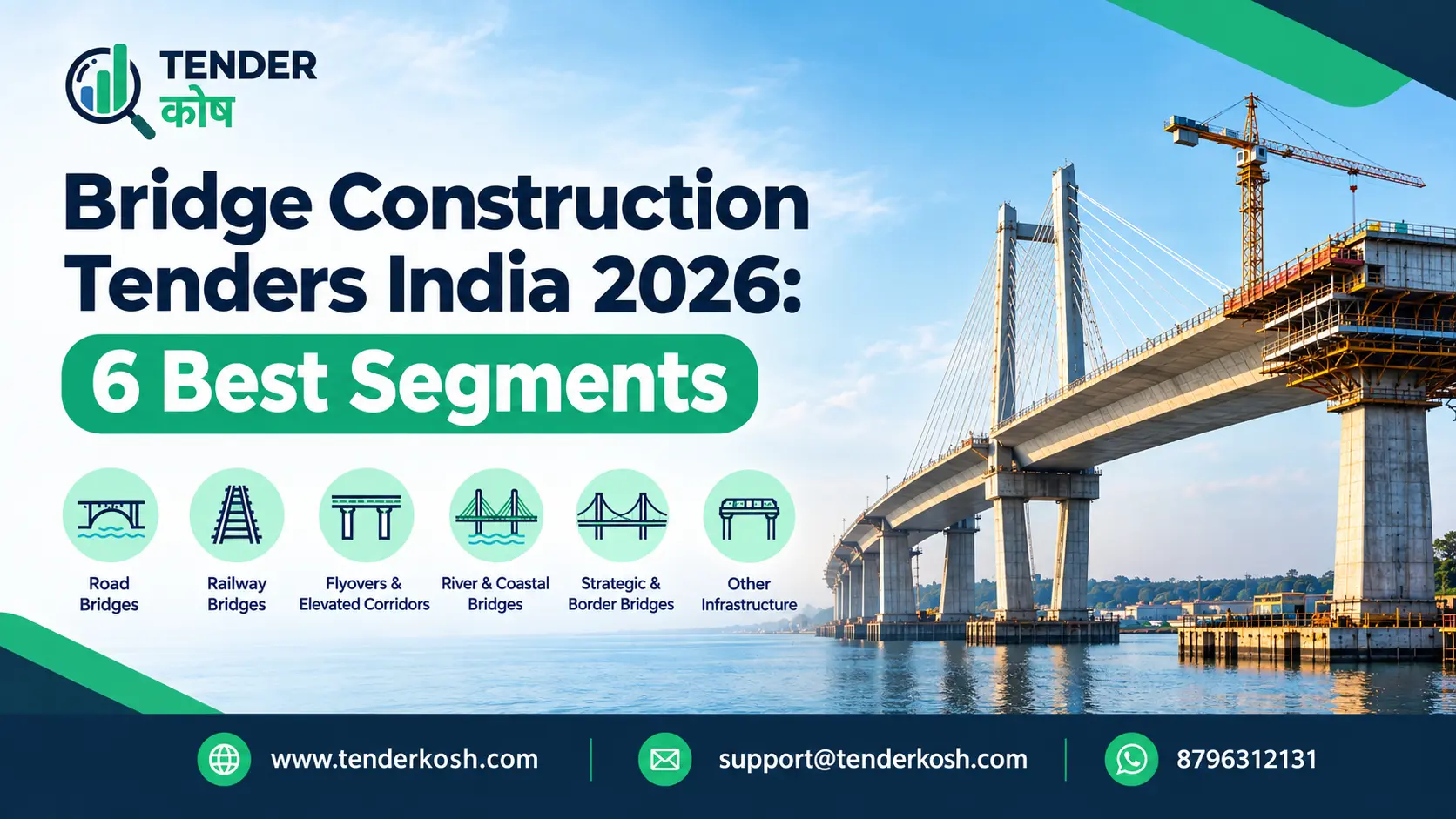
Bridge construction tenders in India come from an unusually wide set of issuers — NHAI and MoRTH, state PWDs and state bridge corporations, Indian Railways, municipal corporations, irrigation departments and defence engineering bodies.
The market splits into six segments with very different entry bars. The marquee river crossings go to large EPC firms, but the biggest and least contested stream is rehabilitation: programmes have provided for improving, replacing, widening and strengthening well over a thousand ageing bridges, and that work recurs continuously.
Bridge construction tenders occupy an odd position in Indian procurement. The big ones attract enormous attention — a new river crossing gets a foundation-stone ceremony and a fortnight of coverage — while the far larger volume of ordinary bridge work moves quietly through state PWD and municipal portals with almost no visibility at all.
For a contractor, that asymmetry is the opportunity in bridge construction tenders. Every firm chasing the marquee project is competing against the same dozen large EPC companies. Meanwhile a steady stream of culverts, minor bridges, approach works, repair and strengthening packages and annual maintenance contracts goes out with a fraction of the competition.
This guide covers who actually issues bridge construction tenders, the six segments and their realistic entry bars, the contract modes you will meet, what qualification looks like in this sector, and where to find the work.
Key Takeaways
Bridge construction tenders come from the most fragmented issuer landscape of any infrastructure category, and it is the main practical difficulty in the sector. The same structure type — a road over bridge, say — can be tendered by three entirely different authorities depending on whose road and whose railway it crosses.
| Issuer | What They Tender | Typical Scale |
|---|---|---|
| NHAI and MoRTH | Bridges, flyovers, vehicular underpasses and ROBs on national highways; major river crossings | Large — often within highway packages |
| State PWDs | Bridges and culverts on state highways and district roads; repair and strengthening | Small to mid-size, very high volume |
| State bridge corporations | Dedicated bridge agencies in several states handling major structures | Mid to large |
| Indian Railways | Rail bridges, ROBs and RUBs replacing level crossings, bridge maintenance zone contracts | Full range &mdash |
| Municipal corporations | Urban flyovers, canal and drain crossings, footbridges, small RCC bridges | Small to mid-size |
| Irrigation departments | Bridges over canals and drains, cross-drainage structures, gate and spillway works | Mostly small |
| Defence and PSU bodies | Bridges and underpasses within cantonments, plants and facilities | Small to mid-size |
ROB and RUB work has a shared-cost quirk. Because these structures sit at the meeting point of a road and a railway, responsibility and cost are typically shared between the road authority and the railway. That means the tender may be issued by either party depending on the arrangement, so watching only highway portals or only railway portals will miss half the pipeline.
Bridge construction tenders are not one market. Knowing which segment you are looking at tells you the likely competition, the contract mode and whether you can realistically qualify.
Long-span bridges over major rivers, frequently multi-lane and running to several kilometres. NHAI has taken forward projects such as an additional three-lane bridge over the Ganga of around 3.3 km for Buxar–Bharauli connectivity on NH-922, structured in hybrid annuity mode.
Realistic bidder: large EPC firms with long-span credentials, usually in consortium. See joint venture bidding.
Road over and under bridges replacing level crossings. A large national programme sanctioned over two hundred such structures across states, with the stated purpose of removing level crossings from national highways and the accidents associated with them. Railway divisions separately tender RUBs in lieu of specific level crossings.
Realistic bidder: established bridge contractors. Repeating format across states, so credentials transfer well.
Urban flyovers and grade separators, plus vehicular underpasses within highway packages — for instance a VUP on the Jhansi–Khajuraho section of NH-39 in Madhya Pradesh tendered on EPC mode, or a flyover on the Surat–Kamrej road tendered on design, engineering, procurement and construction basis.
Realistic bidder: mid to large contractors; municipal versions are often within reach of regional firms.
The high-volume base of the market: RCC bridges over branch channels within municipal wards, new bridges over drains, cross-drainage structures, and miscellaneous bridge works tendered as-and-when required under district divisions.
Realistic bidder: regional and local civil contractors. This is where bridge credentials are built.
Repair and strengthening of major bridges over rivers, reconstruction of damaged structures on national highways on EPC mode, replacement of bearings and expansion joints, and restoration of rain and flood damage to existing bridges.
Realistic bidder: specialist repair contractors and mid-size civil firms. Less contested than new build — covered in detail below.
Annual zone contracts for day-to-day maintenance and repair of track bridges and ROBs under a divisional engineer, rate contracts for bridge road marking and surface work, and condition survey and inventory consultancy under bridge management systems.
Realistic bidder: maintenance firms and engineering consultancies. Recurring annual revenue rather than one-off projects.
Bridge work is scattered across NHAI, state PWDs, bridge corporations, railways, municipal bodies, irrigation departments and defence engineers. Track them all in one place — filtered by value, category and state — with corrigendum alerts so a scope or EMD revision never costs you a bid.
A snapshot of bridge construction tenders from recent tendering and project announcements. These illustrate scale and spread rather than serving as a live list — verify anything current on the issuing authority’s portal.
This is the part of the market worth the most attention relative to how little it gets. Alongside new construction, national programmes have provided for improvement, replacement, widening and strengthening of well over a thousand old and worn bridges in a phased manner, with an indicative outlay running into tens of thousands of crores.
The logic is structural rather than political. India has an enormous inventory of ageing bridges — inventorisation under a national bridge management system has covered tens of thousands of structures on national highways alone — and every one of them eventually needs bearings replaced, expansion joints renewed, decks strengthened or the whole structure reconstructed. That demand does not depend on new capital programmes being announced.
Why it suits mid-size firms:
One caution on repair work. Quantities in rehabilitation contracts are frequently provisional, because the true condition of a structure is not fully known until work begins. Read the variation and extra-item clauses carefully, and price the risk that scope grows. Our guide on BOQ in tenders covers how provisional quantities should be handled.
| Mode | How It Works | Where It Appears |
|---|---|---|
| EPC | You design and build to a fixed price against the authority’s requirements | The default for standalone bridges, flyovers, VUPs and reconstruction |
| Hybrid annuity (HAM) | Authority funds part of project cost; the balance is recovered over an annuity period | Larger projects including major river crossings |
| BOT | You fund, build and recover through user fee revenue over a concession | Where toll revenue supports the investment; contract terms have been under revision |
| Item rate / percentage rate | Priced against a bill of quantities issued by the authority | Municipal bridges, culverts, repair and maintenance work |
| Annual rate contract | Standing rates drawn against repeatedly over a period | Maintenance, marking and minor repair across a division or zone |
Watch the model concession agreements. Highway contract documents have been under revision, with the build-operate-transfer framework reworked for the first time in well over a decade and hybrid annuity and EPC documents following. Terms that were standard on an older project may not be standard on the next one — read the agreement rather than assuming continuity.
Bridge construction tenders define similar work more narrowly than most civil categories, and that catches road contractors regularly. A firm with substantial highway experience but no completed bridge of the specified type and span may simply not qualify — our guides to pre-qualification criteria and the experience certificate cover how these tests are built and evidenced.
Three risks that bite specifically on bridges. Foundation uncertainty — river beds and soil conditions differ from the geotechnical assumptions, and deeper piling is expensive. Seasonal windows — substructure work in a river channel is often confined to the non-monsoon months, so a delay does not cost weeks, it costs a season. Utility and land interfaces — approaches frequently require utility shifting and land that is not fully in hand at award, and ROB work adds railway traffic-block dependencies you do not control.
Because the same bridge construction tenders recur district by district in near-identical form, the advantage goes to whoever sees packages early and consistently. For what causes bids to fail once you find them, see our guide to tender bid rejection reasons, and for how one major authority sets its bars, NHAI tender eligibility criteria.
No single authority. NHAI and the Ministry of Road Transport and Highways handle bridges on national highways, state public works departments and dedicated state bridge corporations handle state roads, Indian Railways handles rail bridges and shares responsibility for road over and under bridges at level crossings, and municipal corporations, irrigation departments and defence engineering bodies tender bridges within their own jurisdictions. That fragmentation is why single-portal monitoring misses most of the market.
A road over bridge carries road traffic above a railway line on an elevated structure. A road under bridge takes road traffic beneath the railway through an underpass. Both replace level crossings, and the choice between them depends on ground levels, drainage, land availability and cost. RUBs generally involve less structure but more drainage and dewatering risk, while ROBs involve larger spans and approach embankments.
Yes, if it targets the right segment. Mega river crossings and highway packages are dominated by large EPC firms, but the market also carries small municipal bridges and culverts, bridge repair and strengthening work, approach road and cross-drainage packages, and annual maintenance zone contracts. Those segments have achievable qualification bars and build the completed-bridge credentials needed for larger work later.
EPC is the most common mode for standalone bridges, where the contractor designs and builds to a fixed price. Hybrid annuity mode is used for larger projects, with the authority funding part of the cost and the balance recovered over an annuity period. Build-operate-transfer is used where user fee revenue supports the investment. Smaller municipal and repair works are usually item-rate or percentage-rate contracts against a bill of quantities.
It is one of the more overlooked opportunities in the sector. Alongside new construction, programmes have provided for improvement, replacement, widening and strengthening of large numbers of ageing bridges, and this work recurs continuously as structures age. Repair packages are typically smaller, more numerous and less contested than marquee new-build projects, which makes them a realistic route in for firms without a mega-project record.
Expect turnover and net worth thresholds proportionate to the estimated cost, plus completed similar works of comparable value and often comparable span or structure type. Bridge tenders frequently define similar work narrowly by structure category, so a contractor with road experience but no completed bridge of the specified type may not qualify. Plant and equipment availability and named technical personnel are commonly assessed as well.
Substructure work in river channels frequently is. Foundation and pier work in a live watercourse is often practical only outside the monsoon, which compresses the working window and makes early mobilisation critical. A delay in approvals, land handover or utility shifting can therefore cost an entire construction season rather than a few weeks, and that risk should be reflected in both your programme and your price.
Bridge construction tenders reward segment selection more than almost any other infrastructure category. The same search results contain a multi-kilometre river crossing that perhaps ten firms in the country can bid, and an RCC bridge over a municipal channel that a competent local contractor can deliver comfortably.
If you do not have completed bridges on your record, start where the bars are achievable — minor bridges, cross-drainage, repair and strengthening — and treat each completed structure as the credential that opens the next tier. And do not overlook rehabilitation. Ageing structures generate work whether or not anything new is announced, and far fewer firms are chasing it.
Note on figures and programmes: project details, values and scheme figures above are drawn from public reporting, government programme material and tender listings current at the time of writing; several tenders referenced have closed, and programme targets and outlays are as originally announced and may since have been revised. Contract frameworks including model concession agreements have been under revision. Figures indicate the shape and scale of the market rather than a live tender list. Always confirm a tender’s status, scope, qualification criteria and deadline on the issuing authority’s official portal before acting.
This article is general information, not advice. It has been compiled from publicly available sources — government releases and notifications, official portals, published tender documents and trade reporting — and reflects our understanding at the time of writing. It is not legal, financial, tax or professional advice, and it does not create any advisory relationship.
Public procurement changes constantly. Tender terms, eligibility criteria, thresholds, fees, deadlines, scheme conditions and government policy are revised frequently, often through corrigenda issued mid-window and sometimes without wide notice. Figures and rules that were accurate when published may already have changed by the time you read this.
Always verify against the primary source before you act or bid. The tender document, the issuing authority's official portal and the relevant government notification are the authoritative sources. Where anything in this article differs from them, the official source prevails. Do not rely on this page — or on any third-party summary — as the basis for a bid, an investment or a compliance decision.
TenderKosh is a private tender-intelligence platform. We are not a government body, and we are not affiliated with, endorsed by or acting on behalf of any government department, ministry, PSU or procurement portal. Names, marks and portals referenced belong to their respective owners and are used for identification only. External links are provided for convenience; we do not control and are not responsible for third-party content.
While we take reasonable care, we make no warranty as to the accuracy, completeness or currency of this content, and accept no liability for any loss or damage arising from reliance on it.Spotted something wrong or out of date? Please tell us at support@tenderkosh.com — we correct errors promptly.See our full Disclaimer.
Discover relevant tenders, monitor corrigenda, compare opportunities, and move from document reading to structured action.