TenderKosh for EPC teams
Turn tender reading into faster bidding decisions.
Discover relevant tenders, monitor corrigenda, compare opportunities, and move from document reading to structured action.
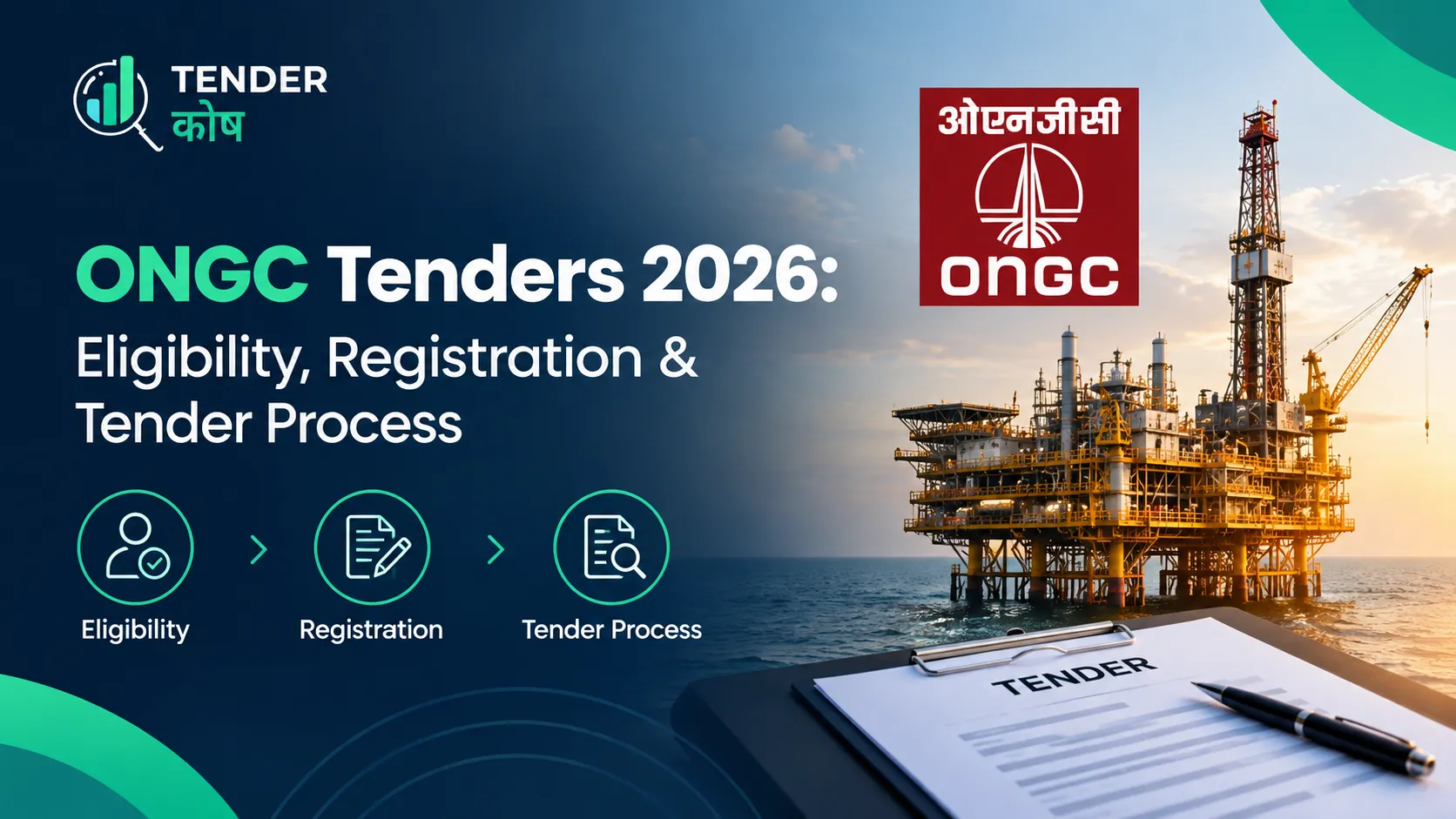
ONGC has directed bidders to the central government e-procurement portal for new tenders, rather than its legacy e-tender site. A great deal of published guidance still points at the old portal, which is the single most common reason newcomers cannot find current opportunities.
Separately, registration is not one process but three — a portal user ID to bid, enlistment to be considered in a category, and empanelment into a pre-approved pool. For some categories ONGC invites only limited tenders among enlisted or empanelled vendors, so without that status you may never see the opportunity.
ONGC tenders come from a Maharatna public sector enterprise under the Ministry of Petroleum and Natural Gas, and accounts for a large majority of India’s domestic crude oil and natural gas production. Running onshore fields, offshore platforms, deepwater blocks and processing facilities generates a continuous procurement requirement across drilling services, engineering and construction, equipment supply, logistics, inspection, manpower and IT.
That makes ONGC tenders one of the most valuable PSU revenue streams a supplier can have. It also makes it one of the more procedurally demanding, because the path from interested supplier to eligible bidder runs through registration steps that many firms discover only after missing a tender they could have won.
This guide covers where ONGC tenders are actually published in 2026, the three-layer registration structure, full eligibility and document requirements, the seven-step bid process, and the mistakes that cost bids.
Key Takeaways
Start here, because getting this wrong wastes every other hour you spend on ONGC tenders. ONGC’s own e-tender site now directs bidders to the central government e-procurement platform for new tenders, stating that ONGC will publish all new tenders there.
Most published guidance on ONGC tenders is out of date on this point. Articles and vendor blogs still instruct readers to register on the legacy ONGC e-procurement portal and search there for live opportunities. A supplier following that advice sees an increasingly stale list and concludes ONGC is not buying what they sell. Check the central portal for new tenders, keep access to the ONGC site for historical tenders and existing processes, and confirm the current position on ONGC’s own pages before you rely on either.
If you are new to the central portal where ONGC tenders now appear, our CPPP tender search guide covers registration, the search workflow and corrigendum tracking on that system.
A note on the legacy system. The older ONGC portal has historically required specific browser configuration — Internet Explorer or Edge in compatibility mode, with a signing component registered on the machine with administrator rights. If you still interact with it for an existing contract, budget IT time. Do not attempt this on a locked-down corporate laptop an hour before a deadline.
This is the structural thing most suppliers misunderstand about ONGC tenders, and it explains why some firms never see the ones they are best suited to. ONGC operates a dedicated vendor portal for enlistment and empanelment that is separate from the tendering system itself.
| What It Is | What It Gets You | |
|---|---|---|
| Portal user ID | An account on the e-procurement system, with a mapped Class 3 DSC | The ability to download documents and submit a bid on an open tender |
| Enlistment | A structured registration of suppliers and service providers with ONGC | Consideration for participation in tendering under the relevant categories of goods and services |
| Empanelment | Evaluation and onboarding of qualified vendors into a pre-approved pool for specific categories | Membership of the specialist pool ONGC draws on for defined requirements |
Why it matters commercially. For certain categories, ONGC invites only limited tenders among empanelled or enlisted vendors. A limited tender never appears as an open opportunity you can find and bid — it goes to a list you are either on or not on. If your product category works that way, no amount of portal searching substitutes for getting enlisted.
ONGC has indicated it needs in the region of 90 days to evaluate vendor proposals for empanelment or enlistment. Treat that as a business development investment made a quarter or more ahead of the tenders you want, not a task for the week a tender appears.
Baseline eligibility for ONGC tenders is straightforward; category-specific qualification is where it gets demanding.
Offshore experience is its own credential. A firm with strong onshore industrial experience is not automatically qualified for offshore work, where marine logistics, platform access, certification and safety regimes differ fundamentally. If offshore is your target, expect to build that record through subcontracting or supply before bidding as principal.
| Category | Typical Documents |
|---|---|
| Corporate | Certificate of incorporation or registration, PAN, GST registration, MSME or Udyam certificate where applicable |
| Authority | Power of attorney or board resolution authorising the bid signatory |
| Financial | Audited balance sheets and profit and loss statements for recent financial years, turnover and net worth certificates in the prescribed format |
| Experience | Completion and performance certificates for similar work, work orders and contract agreements |
| Technical | Specifications, datasheets, drawings, quality and safety certifications, equipment and personnel details |
| Commercial | Bid security instrument, tender fee or exemption confirmation, priced schedules |
| Declarations | Non-blacklisting, integrity pact where applicable, litigation disclosure |
ONGC publishes across the central e-procurement system and its own channels, and its offshore programme generates subcontract and supply work months later. Track it all in one dashboard — filtered by category, value and location — with corrigendum alerts so a spec or EMD revision never costs you a bid.
Obtain a Class 3 DSC from a licensed certifying authority and register on the e-procurement portal, ensuring certificate details match your account. Guidance suggests applying at least a week before any deadline you intend to meet.
Why it matters: registration is not instant, and a mismatched DSC fails at the submission screen.
Apply through the ONGC vendor portal for enlistment or empanelment in your categories. Evaluation takes around 90 days by ONGC’s own indication, so run it alongside your bidding rather than before it.
Why it matters: limited ONGC tenders in your category are invisible until you are on the list.
Search the central e-procurement platform for new ONGC tenders, filtering by organisation and category. Do not rely on the legacy portal for current opportunities.
Why it matters: this is the step where out-of-date advice on ONGC tenders costs suppliers entire quarters.
Download the full document set and read the qualification clause first — financial thresholds, similar work definition, HSE requirements and any enlistment condition.
Why it matters: ONGC tenders define similar work narrowly. Adjacent industrial experience often does not count.
Raise queries on scope interfaces, HSE obligations, site access and anything ambiguous in the specification. Clarifications and corrigenda usually follow.
Why it matters: a deviation raised pre-bid is a clarification; the same deviation in your submission can make the bid non-responsive.
Assemble credentials, compliance and technical documentation in the technical bid, and price in the financial bid, with the priced schedule completed exactly as issued.
Why it matters: price appearing anywhere in the technical envelope voids the bid. See our BOQ guide for pricing discipline.
Re-check the tender page for amendments immediately before upload, submit well ahead of closing, and retain the system acknowledgement.
Why it matters: technical glitches happen, and portals do not reopen for them.
The range of ONGC tenders is wider than the offshore headlines suggest, which is what makes ONGC accessible to firms outside the oilfield services majors.
| Category | Examples | Realistic Bidder |
|---|---|---|
| Drilling and well services | Rig hire, mud and cementing, wireline, logging, well testing | Oilfield services specialists |
| Offshore engineering | Platforms, subsea, marine construction, offshore logistics | Large EPC and marine contractors |
| Onshore engineering and works | Civil, mechanical, piping, electrical, facility construction | Mid to large civil and mechanical firms |
| Equipment and materials | Valves, pumps, tubulars, instrumentation, spares, consumables | Manufacturers and authorised suppliers |
| Inspection and testing | NDT, certification, third-party inspection, calibration | Specialist inspection firms |
| Support services | Manpower, transport, catering, housekeeping, security, IT | Service firms, including smaller entrants |
The exploration programme is a forward indicator. National offshore exploration funding channels support to explorers including ONGC, and each drilling or seismic campaign generates downstream procurement months later — vessels, services, equipment and logistics. Our guide to the Samudra Manthan scheme explains how scheme funding converts into operator tenders, and why watching the programme gives suppliers advance warning.
For the full picture of what causes bids to fail across Indian procurement, see our guide to tender bid rejection reasons. If a package is beyond your individual capacity covers the legitimate route.
ONGC has directed bidders to the central government e-procurement portal for new tenders, rather than its legacy e-tender site. The older ONGC portal continues to carry historical tenders and existing processes, which is why many third-party guides still point there. Check both, but treat the central portal as the destination for new opportunities and confirm the current position on ONGC’s own site before relying on it.
Enlistment is a structured registration process that allows suppliers and service providers to be considered for tendering in relevant categories of goods and services. Empanelment goes further: it evaluates and onboards qualified vendors into a pre-approved pool for specific categories under defined conditions. For some categories ONGC invites only limited tenders among empanelled or enlisted vendors, so without that status you may never see those opportunities at all.
Plan for months rather than days on the empanelment side. ONGC has indicated it needs around 90 days to evaluate vendor proposals for empanelment or enlistment. Separately, obtaining a user ID for the e-procurement portal is quicker, but guidance suggests applying at least a week before any bid deadline you intend to meet, since document verification takes time.
A valid Class 3 digital signature certificate from a licensed certifying authority is required to submit bids, alongside a valid user ID on the e-procurement portal. The certificate details must match your registered account. Obtain it well in advance, because an expired or mismatched DSC is discovered at the submission screen, when it is too late to fix.
Typically certificate of incorporation or registration, PAN, GST registration, MSME or Udyam certificate where applicable, power of attorney or board authorisation for the bid signatory, audited financial statements for recent financial years, experience certificates for similar completed work, technical documentation and quality certifications, and bid security in the form specified. The exact list is set by each tender.
Yes, though not for the large offshore drilling and platform packages, which demand specialist credentials and heavy financial capacity. ONGC procures across an enormous range including equipment supply, consumables, civil and mechanical works, inspection and testing, manpower and support services, logistics and IT. Smaller firms typically start in supply and services categories, and MSME benefits apply where the tender provides for them.
Yes. ONGC has moved vendor invoice submission onto a dedicated vendor portal feeding its enterprise system, replacing an earlier invoice management system. If you win work, understanding the post-award billing workflow matters commercially, because that is where payment timelines are decided. Check the current invoicing route with ONGC at contract stage rather than assuming the process you used previously still applies.
The hard part of ONGC tenders is not the bidding. It is being in a position to bid at all. A portal user ID, a valid Class 3 DSC, and enlistment or empanelment in your categories are three separate processes with three separate lead times, and the longest of them runs to roughly a quarter.
Start them now rather than when an ONGC tender appears, search the portal ONGC actually directs you to rather than the one most articles still name, and build your credentials in the supply and services categories if offshore engineering is out of reach today. The suppliers who win consistently here are simply the ones who did the registration work a quarter earlier than everyone else.
Note: ONGC’s procurement portals, vendor registration processes, evaluation timelines and category rules are set by ONGC and revised from time to time; publication arrangements in particular have changed and may change again. Details above reflect publicly available information at the time of writing, including ONGC’s own portal notices and industry guidance, and production share figures vary between sources. Always confirm the current publication portal, registration route and requirements on ONGC’s official sites and within the specific tender document before acting.
This article is general information, not advice. It has been compiled from publicly available sources — government releases and notifications, official portals, published tender documents and trade reporting — and reflects our understanding at the time of writing. It is not legal, financial, tax or professional advice, and it does not create any advisory relationship.
Public procurement changes constantly. Tender terms, eligibility criteria, thresholds, fees, deadlines, scheme conditions and government policy are revised frequently, often through corrigenda issued mid-window and sometimes without wide notice. Figures and rules that were accurate when published may already have changed by the time you read this.
Always verify against the primary source before you act or bid. The tender document, the issuing authority's official portal and the relevant government notification are the authoritative sources. Where anything in this article differs from them, the official source prevails. Do not rely on this page — or on any third-party summary — as the basis for a bid, an investment or a compliance decision.
TenderKosh is a private tender-intelligence platform. We are not a government body, and we are not affiliated with, endorsed by or acting on behalf of any government department, ministry, PSU or procurement portal. Names, marks and portals referenced belong to their respective owners and are used for identification only. External links are provided for convenience; we do not control and are not responsible for third-party content.
While we take reasonable care, we make no warranty as to the accuracy, completeness or currency of this content, and accept no liability for any loss or damage arising from reliance on it.Spotted something wrong or out of date? Please tell us at support@tenderkosh.com — we correct errors promptly.See our full Disclaimer.
Discover relevant tenders, monitor corrigenda, compare opportunities, and move from document reading to structured action.