TenderKosh for EPC teams
Turn tender reading into faster bidding decisions.
Discover relevant tenders, monitor corrigenda, compare opportunities, and move from document reading to structured action.
Before you assume something is broken: for a well-optimised catalogue in a high-volume category, a first direct purchase order commonly takes around 30 to 60 days. In niche categories or capital equipment it can take six months or more.
If you are inside that window, keep going. If you are well past it, the usual culprits are a thin or badly categorised catalogue, pricing above the direct purchase threshold, unfiled MSE documentation, and not bidding at all.
You completed registration, uploaded your products, and waited. Weeks later the dashboard still reads zero. It is a demoralising moment, and the natural conclusion is that GeM does not work for businesses like yours.
Usually that conclusion is wrong, for a reason nobody tells new sellers: on GeM, buyers come to you. There is no outbound selling, no calling procurement officers, no chasing. A government department develops a requirement, searches the catalogue, and buys. If no department in your category has needed what you sell in the last month, your listing was never going to convert — however good it is.
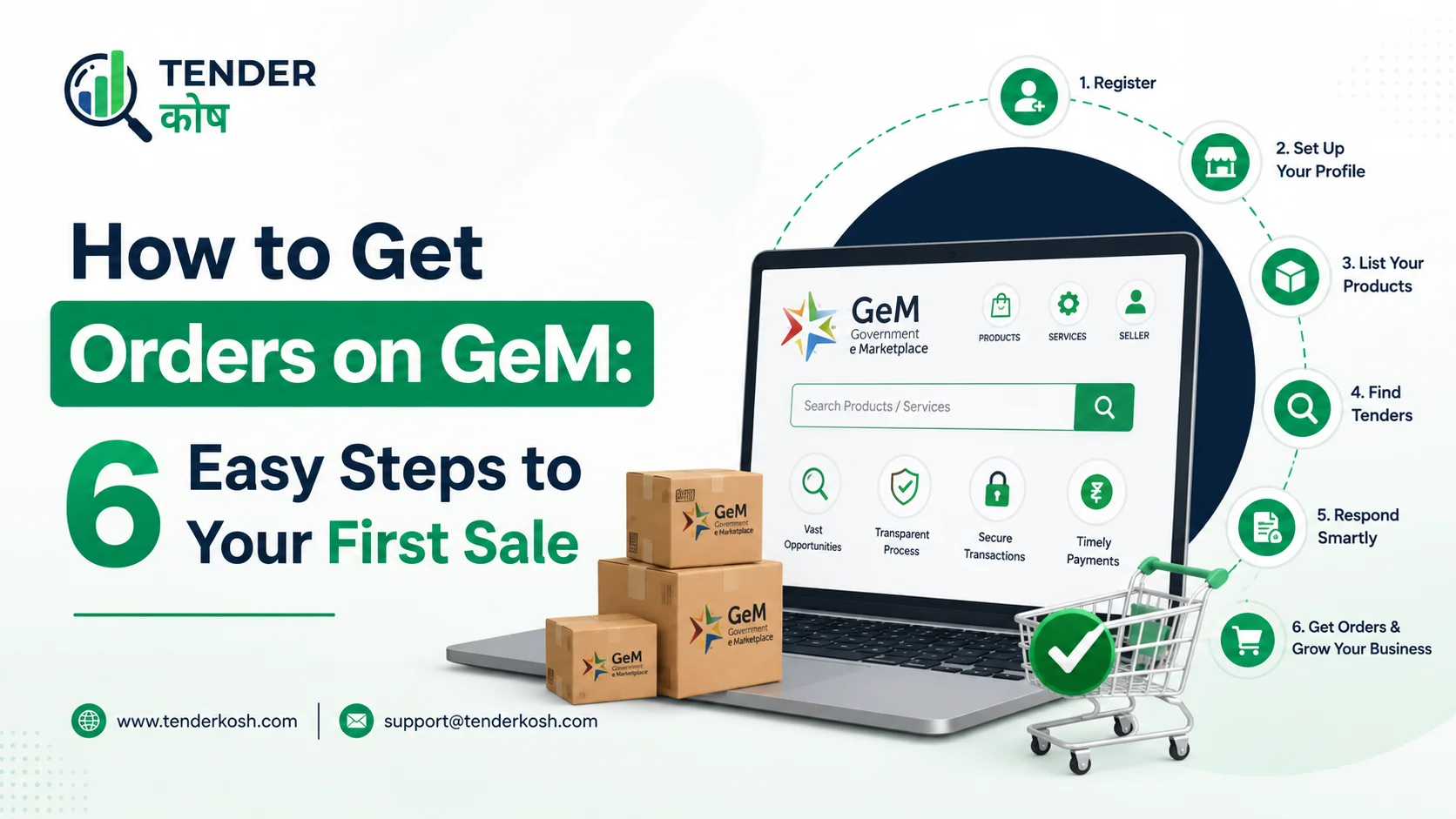
That does not mean sitting still. There is a great deal you can do to make sure that when a requirement does arise, you are the seller who gets found, shortlisted and ordered from. Here is how to get orders on GeM, starting with an honest diagnosis.
Key Takeaways
Work out why you are not getting orders on GeM before fixing anything. The remedies are completely different.
| Symptom | Likely Cause | Go To |
|---|---|---|
| Listed under a month, nothing yet | Nothing wrong — you are inside the normal window | Step 1 |
| Products live but almost no views | Wrong category, weak titles, missing specifications | Step 2 |
| Views but no orders | Price, delivery time or specification uncompetitive | Steps 2 and 3 |
| Losing on price repeatedly | Preferences not claimed, or genuinely uncompetitive costs | Step 4 |
| Only tiny orders, if any | Not participating in bids | Step 5 |
| Had orders, now dried up | Rating slipped below default-visibility thresholds | Step 6 |
| Six months, nothing, catalogue is fine | Category demand may genuinely be low | Reconsider category mix |
The single most useful thing a seller not getting orders on GeM can do is find out what normal looks like in their category. Industry guidance suggests that for a well-optimised catalogue in a high-volume category — stationery, IT peripherals, cleaning supplies and similar — a first direct purchase order commonly arrives within roughly 30 to 60 days. For niche categories and capital equipment, six months or more is unremarkable, because a relevant requirement simply has to arise first.
Why the difference is structural, not about you. A department buys printer cartridges continuously and a specialised laboratory instrument once every few years. In the first case your catalogue is competing for attention; in the second it is waiting for an event. Both are normal. Knowing which one you are in stops you from making panicked changes to a listing that was never the problem.
Use the waiting productively: complete your profile, widen your category coverage where you genuinely can supply, and start watching bids. Do not repeatedly rewrite a listing that has only been live for three weeks.
Buyers who place orders on GeM filter by category, scan a ranked list, and pick. Nobody reads your company profile first. If your product is in the wrong category, you are invisible no matter how good your price is — and wrong categorisation is the most common reason new sellers get no visibility at all.
Keep it current. Prices, stock or capacity, lead times, service geography and warranty terms all need to reflect reality. On catalogue-led purchases the buyer may transact with very little back-and-forth, so an out-of-date listing either loses the order or wins one you cannot profitably fulfil.
Most first orders on GeM come through direct purchase, and direct purchase has a ceiling. Reported guidance for 2026 puts that limit at ₹25,000 per transaction — a buyer can order straight from your catalogue at or below that value without running any competitive process.
| Buying Route | Reported Value Band | What Wins |
|---|---|---|
| Direct purchase | Up to around ₹25,000 | Being findable, correctly specified and sensibly priced. No bid needed. |
| L1 comparison | Roughly ₹25,000 to ₹5 lakh | Being the lowest compliant offer among multiple listed manufacturers. |
| Bid or reverse auction | Above roughly ₹5 lakh | Technical compliance first, then price. Active participation required. |
These thresholds are revised periodically. The figures above reflect guidance reported in 2026 and are included to show the shape of the system, not as current rules. Confirm live thresholds on gem.gov.in before building a pricing strategy on them.
The practical implication: if everything you sell is priced well above the direct purchase ceiling, you have closed off the easiest route to a first order. Consider whether a smaller pack size, a single-unit listing or an entry-level variant could sit under it. A small order that builds transaction history and rating is worth more early on than a large one you never win.
Catalogue orders are only part of the market. Track live GeM bids alongside CPPP, IREPS, SECI, NTPC and state portals in one dashboard, filtered by category, value and location, with alerts when a matching requirement appears or an existing one changes.
This is where sellers chasing orders on GeM leak the most value, because the advantages exist but are not applied automatically. GeM implements public procurement preference policies — but only for sellers who have correctly filed the supporting documentation on the portal.
Check your profile today. An expired or unverified Udyam entry, or a local-content declaration never filed, silently removes advantages you are legally entitled to. This is a thirty-minute job that can change your win rate more than a week of price cutting. See our GeM registration guide for what should be on your profile.
Waiting passively for catalogue orders on GeM caps you at the direct purchase ceiling. Anything substantial goes through a bid or reverse auction, and those require you to show up.
For the wider list of what causes bids to fail after submission, see our guide to tender bid rejection reasons.
Your rating determines whether you get orders on GeM at all, because it decides whether buyers ever see you. Industry guidance suggests around 4.0 out of 5.0 is the practical floor for appearing in default search results and buyer shortlists, with sellers below roughly 3.5 filtered out of many buyers’ default views.
The cruel arithmetic for new sellers is that with only one or two completed orders, a single poor experience moves your average enormously. One late delivery on your first order can suppress your visibility for months, which is exactly when you can least afford it.
It depends heavily on your category. For a well-optimised catalogue in a high-volume category such as stationery, IT peripherals or cleaning supplies, industry guidance suggests a first direct purchase order commonly arrives within roughly 30 to 60 days. Niche categories and capital equipment can take six months or longer, simply because a relevant requirement has to arise before anyone can buy. Silence in month one is usually normal rather than a sign something is broken.
Registration alone generates nothing. The most common causes are an empty or thin catalogue, products listed under the wrong category so buyers never see them, pricing above the direct purchase threshold where most first orders happen, missing documentation that would unlock MSE or local-content preferences, and simply not participating in bids. A category with genuinely low demand is also a real possibility worth checking honestly.
Reported guidance for 2026 puts the direct purchase limit at ₹25,000 per transaction, where a buyer can order straight from a seller catalogue without running a bid. Between roughly ₹25,000 and ₹5 lakh the buyer generally has to compare and buy from the lowest-priced compliant seller among multiple manufacturers, and above that a formal bid or reverse auction usually applies. Thresholds are revised periodically, so confirm the current limits on the portal.
Yes, but only if the supporting documents are correctly filed on the portal. Under the public procurement policy for micro and small enterprises, a defined share of annual procurement is reserved for MSEs, with sub-quotas for women-owned and SC/ST-owned enterprises. An MSE quoting within a defined margin of the lowest bid can also be given the opportunity to match that price and receive a share of the order. None of this applies automatically — your Udyam documentation has to be current and verifiable on your seller profile.
It affects whether buyers see you at all. Industry guidance suggests a rating around 4.0 out of 5.0 is the practical floor for appearing in default search results and buyer shortlists, with sellers below roughly 3.5 filtered out of many buyers’ default views. Since rating is built from delivery performance and order fulfilment, early orders matter disproportionately — one late delivery on your first order can suppress visibility for months.
No. The rule is one GSTIN, one seller account. Running parallel accounts for the same firm through different digital signatures or Aadhaar credentials is treated as a serious violation and can lead to deactivation of all linked accounts. If you want presence across more categories, add them to your existing account rather than creating another.
Fix visibility before you touch price. If your product is in the wrong category or has incomplete specifications, buyers never see your listing at all and no discount will help. Once you are genuinely findable and still losing, check whether you have claimed the MSE and local-content preferences you are entitled to — those can be worth more than a price cut. Cutting price to win an order you cannot fulfil profitably damages your rating and your business.
Most new sellers who are not getting orders on GeM have one of two problems: they are impatient, or they are invisible. The first fixes itself. The second does not fix itself at all, and no amount of waiting will change it.
Diagnose which you have. If you are three weeks in, keep building. If you are six months in with a thin catalogue, wrong categories, unfiled Udyam documentation and no bid participation, the platform is not the problem. Fix the catalogue, claim the preferences, start bidding, and protect the rating from your very first order — because on GeM, visibility compounds and so does its absence.
Note on figures: value thresholds, preference percentages, rating behaviour and category rules on GeM are set by the platform and revised periodically. Timelines to first order, rating floors and threshold values quoted above are drawn from industry guidance and public reporting current at the time of writing, not from official published statistics, and are included to indicate the shape of the system rather than as current rules. Confirm all live thresholds, policies and eligibility conditions on gem.gov.in and within your own seller dashboard.
This article is general information, not advice. It has been compiled from publicly available sources — government releases and notifications, official portals, published tender documents and trade reporting — and reflects our understanding at the time of writing. It is not legal, financial, tax or professional advice, and it does not create any advisory relationship.
Public procurement changes constantly. Tender terms, eligibility criteria, thresholds, fees, deadlines, scheme conditions and government policy are revised frequently, often through corrigenda issued mid-window and sometimes without wide notice. Figures and rules that were accurate when published may already have changed by the time you read this.
Always verify against the primary source before you act or bid. The tender document, the issuing authority's official portal and the relevant government notification are the authoritative sources. Where anything in this article differs from them, the official source prevails. Do not rely on this page — or on any third-party summary — as the basis for a bid, an investment or a compliance decision.
TenderKosh is a private tender-intelligence platform. We are not a government body, and we are not affiliated with, endorsed by or acting on behalf of any government department, ministry, PSU or procurement portal. Names, marks and portals referenced belong to their respective owners and are used for identification only. External links are provided for convenience; we do not control and are not responsible for third-party content.
While we take reasonable care, we make no warranty as to the accuracy, completeness or currency of this content, and accept no liability for any loss or damage arising from reliance on it.Spotted something wrong or out of date? Please tell us at support@tenderkosh.com — we correct errors promptly.See our full Disclaimer.
Discover relevant tenders, monitor corrigenda, compare opportunities, and move from document reading to structured action.